CHAPTER 4
JOB ANALYSIS & DESIGN
• CONCEPT OF JOB ANALYSIS
• PROCESS OF JOB ANALYSIS
• JOB ANALYSIS METHODS
• JOB DESCRIPTION
• JOB SPECIFICATION
• USES OF JOB ANALYSIS
• ISSUES IN JOB ANALYSIS
• CONCEPT OF JOB DESIGN
• MODERN MANAGEMENT TECHNIQUES
CONCEPT OF JOB
ANALYSIS
• Job Analysis is the process of determining and
recording all the pertinent information about a
specific job, including the tasks involved, the
knowledge and skill set required to perform the job,
the responsibilities attached to the job and the
abilities required to perform the job successfully.
• Job Analysis differentiates one job from another.
• It is also referred as JOB REVIEW or JOB
CLASSIFICATION.
• Two end products of Job Analysis are JOB
DESCRIPTION and JOB SPECIFICATION.
• Job Analysis provides inputs for:-
- Job Descriptions
– Employee Selection
– Training
– Performance Appraisals
– Job Classification
– Job Evaluation
– Job Design
PROCESS OF JOB
ANALYSIS
1. INFORMATION GATHERING
2. JOB-SPECIFIC COMPETENCY
DETERMINATION
3. DEVELOPING A JOB DESCRIPTION
4. DEVELOPING A JOB SPECIFICATION
JOB ANALYSIS
METHODS
• Observation Method
• Interviews
• Structured Questionnaire / Inventory
• Logbooks / Work Diaries
1. OBSERVATION METHOD:-
• The individuals performing the job are
observed and relevant points are noted.
• Eg: Motion and Time Studies
2. INDIVIDUAL INTERVIEW METHOD:-
• Applied when the job is complex
• Structured interviews are the most effective.
3. GROUP INTERVIEW METHOD:-
• Employees performing the same job are
interviewed together, in groups
4. QUESTIONNAIRE METHOD:-
• Long & structured questionnaire to be
filled in by job incumbent.
• Has both objective & open-ended
questions.
5. TECHNICAL CONFERENCE METHOD:-
• Gathering information from the EXPERTS,
usually supervisors & NOT the job
incumbents.
6. DIARY METHOD:-
• Job incumbents take immediate note of
the activities they perform.
7. FUNCTIONAL JOB ANALYSIS:-
• Developed by U.S. Department of Labor.
• Job analysts conducts background
research, interviews job incumbents &
supervisors, make site observations, &
then prepares a detailed document.
DATA PEOPLE THINGS
0 synthesizing 0 mentoring 0 setting up
1 coordinating 1 negotiating 1 precision working
2 analyzing 2 instructing 2 operating-controlling
3 compiling 3 supervising 3 driving- operating
4 computing 4 diversity 4 manipulating
5 copying 5 persuading 5 tending
6 comparing 6 speaking-signaling 6 feeding
7 serving 7 handling
8 helping
WORK FUNCTIONS &
THE LEVEL OF DIFFICULTY
8. POSITION ANALYSIS QUESTIONNAIRE (PAQ):-
• Describes job in term of worker activities.
• 194 elements to 5 dimensions:
i) Having decision making/ communication/ social
responsibilities
ii) Performing skilled activities
iii) Being physically active/ related environmental conditions.
iv) Operating vehicles/ equipment
v) Processing information
9. CRITICAL INCIDENT TECHNIQUE (CIT):-
• According to John Flanagan, behaviors in
specific situations contribute to the success or
failure of individuals
• Interviews & Questionnaire can be used to
collect the information on the critical incidents
• Most suitable for middle & top management
levels.
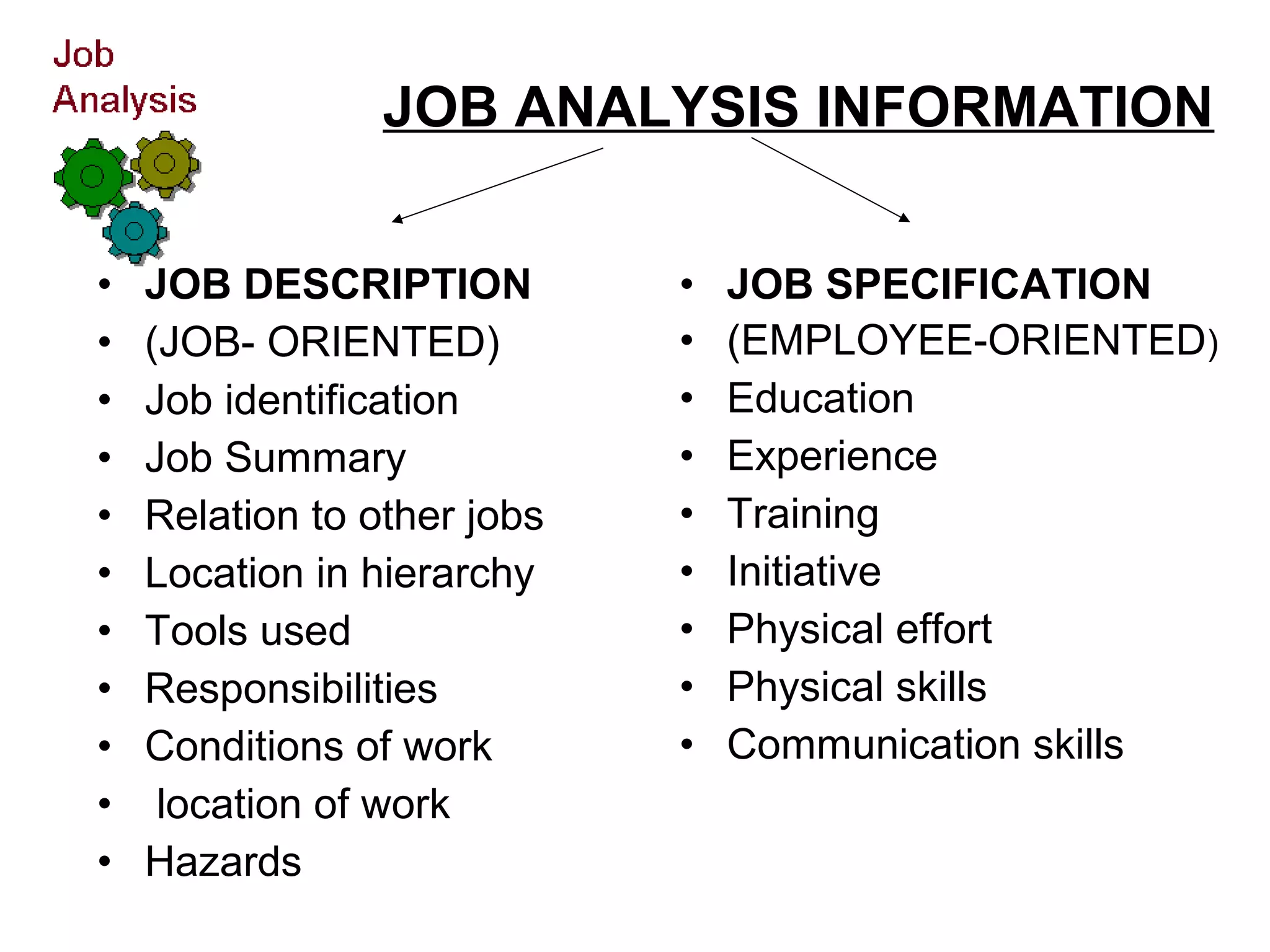
• JOB DESCRIPTION
• (JOB- ORIENTED)
• Job identification
• Job Summary
• Relation to other jobs
• Location in hierarchy
• Tools used
• Responsibilities
• Conditions of work
• location of work
• Hazards
• JOB SPECIFICATION
• (EMPLOYEE-ORIENTED)
• Education
• Experience
• Training
• Initiative
• Physical effort
• Physical skills
• Communication skills
JOB ANALYSIS INFORMATION
JOBS
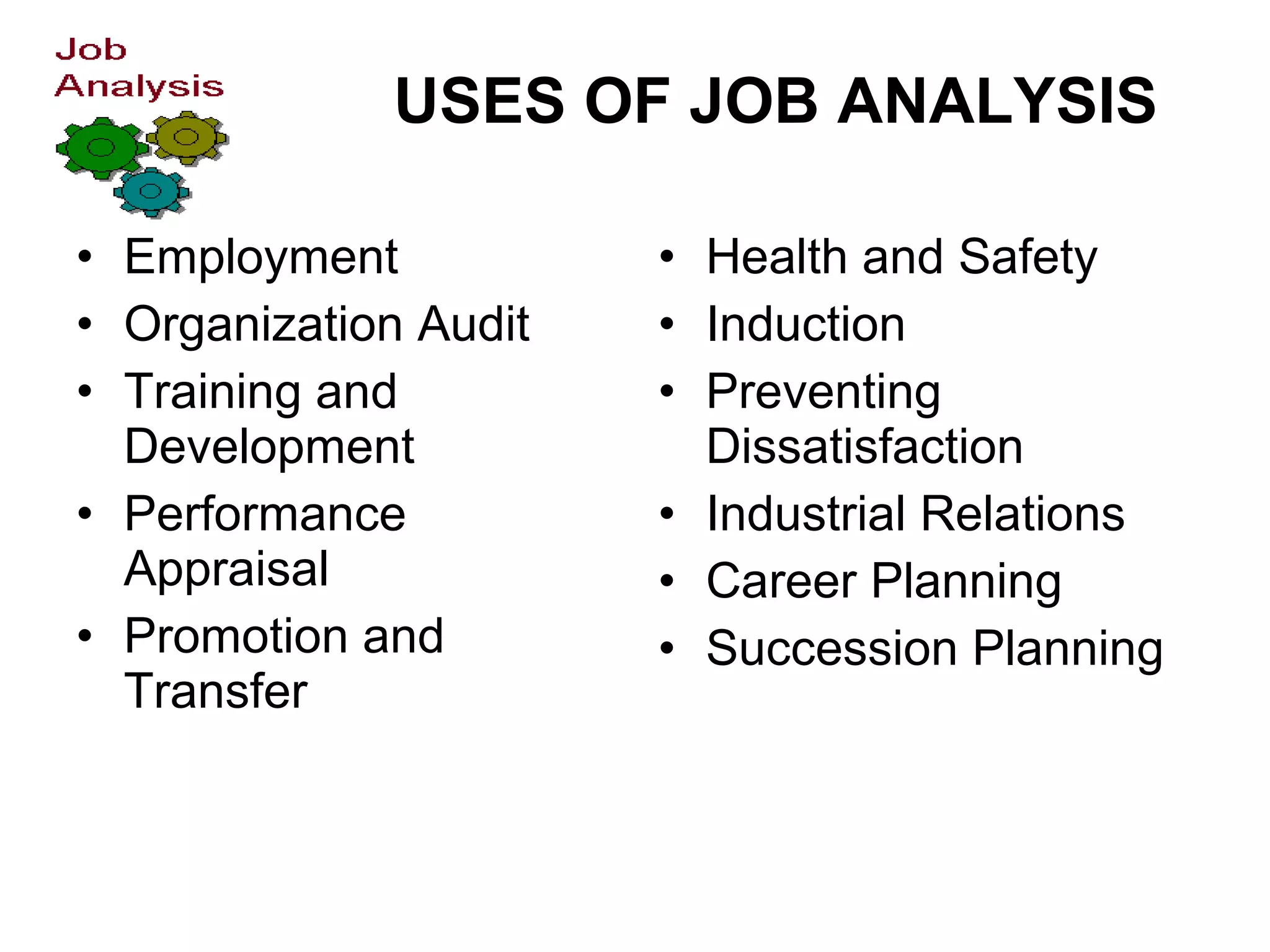
• Employment
• Organization Audit
• Training and
Development
• Performance
Appraisal
• Promotion and
Transfer
• Health and Safety
• Induction
• Preventing
Dissatisfaction
• Industrial Relations
• Career Planning
• Succession Planning
USES OF JOB ANALYSIS
CONCEPT OF JOB DESIGN
• Job design is the process of structuring work
and designating the specific activities at
individual or group levels.
• It determines,
– the responsibility of an employee
– the authority he enjoys over his work
– his scope of decision-making
– his level of satisfaction
– his productivity
• Major components of job design are:
– Job content / scope
• Includes various tasks to be performed by the job
holder, the responsibilities attached and the
relationship with other jobs.
– Job depth
• It is the autonomy or the authority that the job
holder enjoys in planning and organizing the work.
DIFFERENT APPROACHES
TO JOB DESIGN
• Engineering approach:
– The key element of the approach is “task idea”
– Use of overspecialization
– Demerits of overspecialization
• Repetition
• Mechanical pacing
• No end product
• Little social interaction
• No personal input
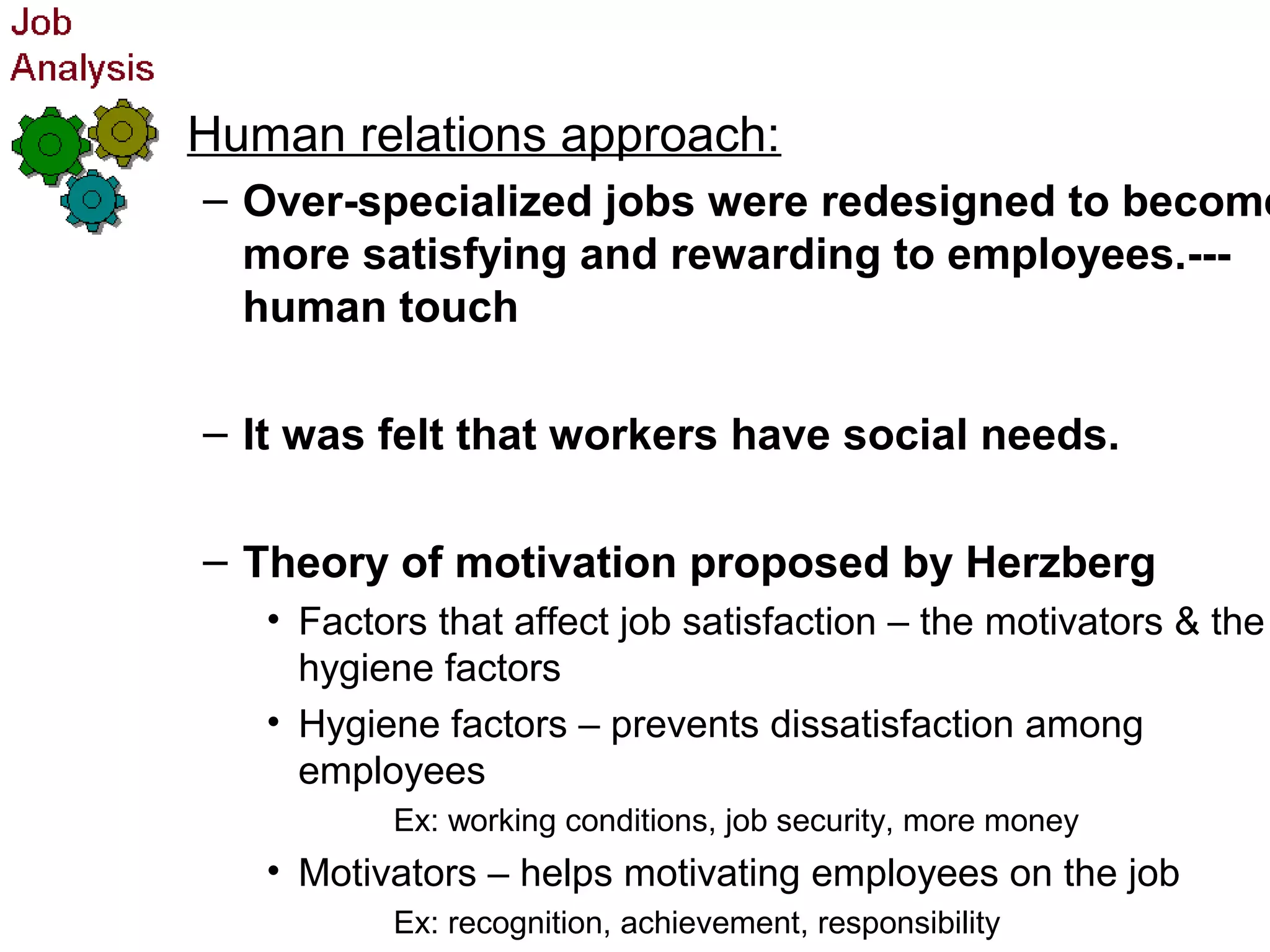
• Human relations approach:
– Over-specialized jobs were redesigned to become
more satisfying and rewarding to employees.---
human touch
– It was felt that workers have social needs.
– Theory of motivation proposed by Herzberg
• Factors that affect job satisfaction – the motivators & the
hygiene factors
• Hygiene factors – prevents dissatisfaction among
employees
Ex: working conditions, job security, more money
• Motivators – helps motivating employees on the job
Ex: recognition, achievement, responsibility
• Job characteristics approach
– Based on job characteristics theory of Hackman
and Oldham
• The theory states that employees work hard
when they are rewarded for their hard work.
– Identifies specific job characteristics that affect
productivity, motivation and satisfaction
– Core characteristic of a job are:
• Skill variety – the degree to which the job
necessitates the use of different skills
• Task identity – the degree to which the job requires
completion of task
• Task significance – the degree to which the job
makes an impact on the lives or the work of the
people
• Autonomy – the degree to which the job provides
freedom
• Feedback – the degree to which objective, direct
and timely information about performance is given
to the employees
• Skill variety, task identity & task significance
gives job satisfaction
• Autonomy gives sense of responsibility &
commitment
• Feedback enables to analyze performance
• Motivating Potential Score (MPS) of a job =
(skill variety + task identity + task significance)
3
X autonomy X feedback
• Sociotechnical approach
– both technical and social environment are
emphasized.
– Jobs according to this approach are:
• A little challenging and demanding
• Variety and novelty
• Social support and recognition
• Desirable future
• Decision-making authority
• Correlation with social lives
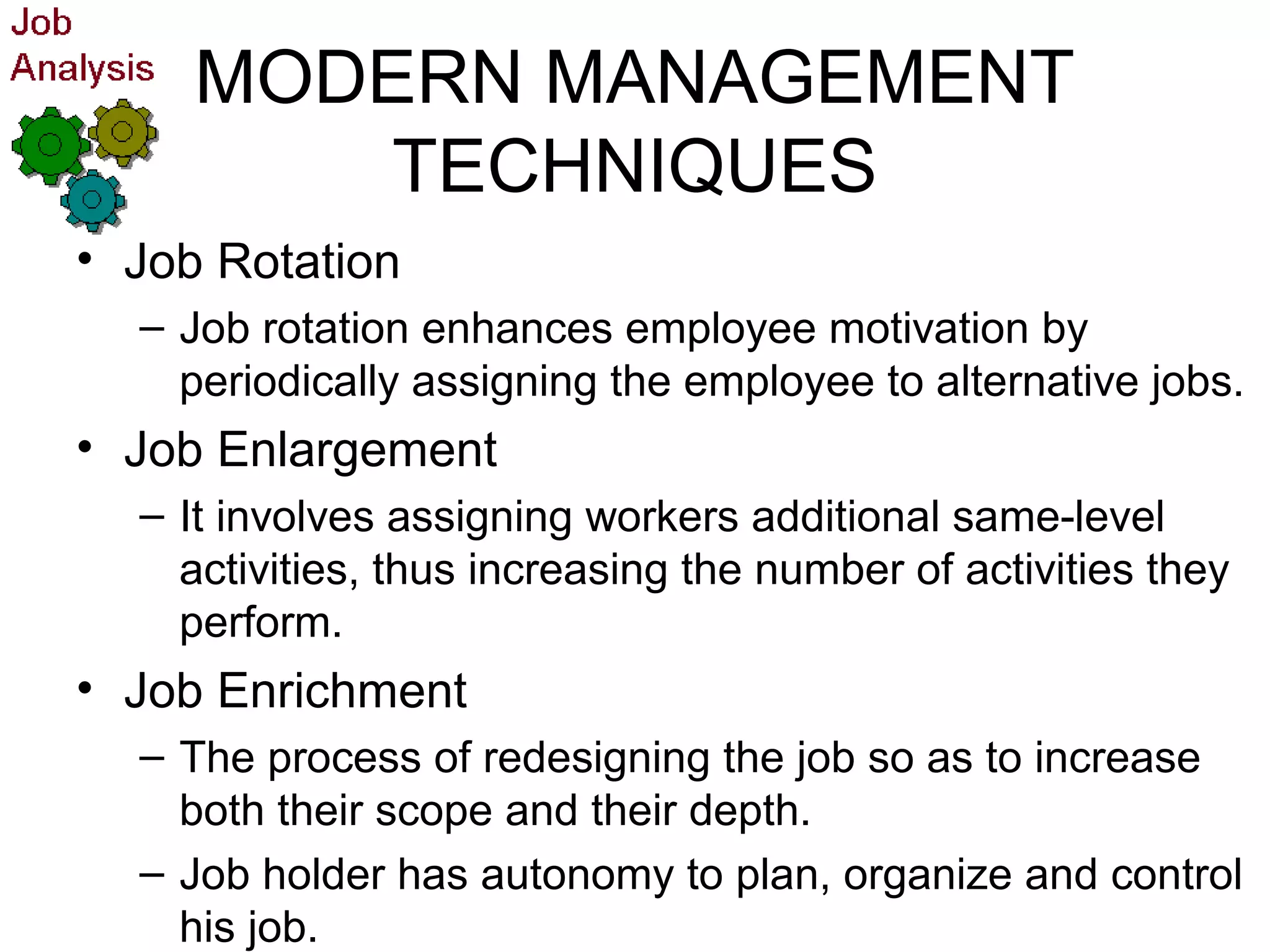
MODERN MANAGEMENT
TECHNIQUES
• Job Rotation
– Job rotation enhances employee motivation by
periodically assigning the employee to alternative jobs.
• Job Enlargement
– It involves assigning workers additional same-level
activities, thus increasing the number of activities they
perform.
• Job Enrichment
– The process of redesigning the job so as to increase
both their scope and their depth.
– Job holder has autonomy to plan, organize and control
his job.
• Flextime
– It allows the employees to choose their working
hours
• Telecommuting
– It is the practice of working at home or while
traveling, keeping in contact with the office.
• Job sharing
– Two or more part-time employees share the work of
a full-time employee.
• Condensed work week
– It involves compressing the work week by
increasing the number of working hours per day.
• Working from home
– Employees work from home and visit office once or
twice in a week.
Job Analysis & Design

Job Analysis & Design

  • 1.
    CHAPTER 4 JOB ANALYSIS& DESIGN • CONCEPT OF JOB ANALYSIS • PROCESS OF JOB ANALYSIS • JOB ANALYSIS METHODS • JOB DESCRIPTION • JOB SPECIFICATION • USES OF JOB ANALYSIS • ISSUES IN JOB ANALYSIS • CONCEPT OF JOB DESIGN • MODERN MANAGEMENT TECHNIQUES
  • 2.
    CONCEPT OF JOB ANALYSIS •Job Analysis is the process of determining and recording all the pertinent information about a specific job, including the tasks involved, the knowledge and skill set required to perform the job, the responsibilities attached to the job and the abilities required to perform the job successfully. • Job Analysis differentiates one job from another. • It is also referred as JOB REVIEW or JOB CLASSIFICATION.
  • 3.
    • Two endproducts of Job Analysis are JOB DESCRIPTION and JOB SPECIFICATION. • Job Analysis provides inputs for:- - Job Descriptions – Employee Selection – Training – Performance Appraisals – Job Classification – Job Evaluation – Job Design
  • 4.
    PROCESS OF JOB ANALYSIS 1.INFORMATION GATHERING 2. JOB-SPECIFIC COMPETENCY DETERMINATION 3. DEVELOPING A JOB DESCRIPTION 4. DEVELOPING A JOB SPECIFICATION
  • 5.
    JOB ANALYSIS METHODS • ObservationMethod • Interviews • Structured Questionnaire / Inventory • Logbooks / Work Diaries
  • 6.
    1. OBSERVATION METHOD:- •The individuals performing the job are observed and relevant points are noted. • Eg: Motion and Time Studies
  • 7.
    2. INDIVIDUAL INTERVIEWMETHOD:- • Applied when the job is complex • Structured interviews are the most effective. 3. GROUP INTERVIEW METHOD:- • Employees performing the same job are interviewed together, in groups
  • 8.
    4. QUESTIONNAIRE METHOD:- •Long & structured questionnaire to be filled in by job incumbent. • Has both objective & open-ended questions.
  • 9.
    5. TECHNICAL CONFERENCEMETHOD:- • Gathering information from the EXPERTS, usually supervisors & NOT the job incumbents. 6. DIARY METHOD:- • Job incumbents take immediate note of the activities they perform.
  • 10.
    7. FUNCTIONAL JOBANALYSIS:- • Developed by U.S. Department of Labor. • Job analysts conducts background research, interviews job incumbents & supervisors, make site observations, & then prepares a detailed document.
  • 11.
    DATA PEOPLE THINGS 0synthesizing 0 mentoring 0 setting up 1 coordinating 1 negotiating 1 precision working 2 analyzing 2 instructing 2 operating-controlling 3 compiling 3 supervising 3 driving- operating 4 computing 4 diversity 4 manipulating 5 copying 5 persuading 5 tending 6 comparing 6 speaking-signaling 6 feeding 7 serving 7 handling 8 helping WORK FUNCTIONS & THE LEVEL OF DIFFICULTY
  • 12.
    8. POSITION ANALYSISQUESTIONNAIRE (PAQ):- • Describes job in term of worker activities. • 194 elements to 5 dimensions: i) Having decision making/ communication/ social responsibilities ii) Performing skilled activities iii) Being physically active/ related environmental conditions. iv) Operating vehicles/ equipment v) Processing information
  • 13.
    9. CRITICAL INCIDENTTECHNIQUE (CIT):- • According to John Flanagan, behaviors in specific situations contribute to the success or failure of individuals • Interviews & Questionnaire can be used to collect the information on the critical incidents • Most suitable for middle & top management levels.
  • 14.
    • JOB DESCRIPTION •(JOB- ORIENTED) • Job identification • Job Summary • Relation to other jobs • Location in hierarchy • Tools used • Responsibilities • Conditions of work • location of work • Hazards • JOB SPECIFICATION • (EMPLOYEE-ORIENTED) • Education • Experience • Training • Initiative • Physical effort • Physical skills • Communication skills JOB ANALYSIS INFORMATION
  • 15.
  • 16.
    • Employment • OrganizationAudit • Training and Development • Performance Appraisal • Promotion and Transfer • Health and Safety • Induction • Preventing Dissatisfaction • Industrial Relations • Career Planning • Succession Planning USES OF JOB ANALYSIS
  • 17.
    CONCEPT OF JOBDESIGN • Job design is the process of structuring work and designating the specific activities at individual or group levels. • It determines, – the responsibility of an employee – the authority he enjoys over his work – his scope of decision-making – his level of satisfaction – his productivity
  • 18.
    • Major componentsof job design are: – Job content / scope • Includes various tasks to be performed by the job holder, the responsibilities attached and the relationship with other jobs. – Job depth • It is the autonomy or the authority that the job holder enjoys in planning and organizing the work.
  • 19.
    DIFFERENT APPROACHES TO JOBDESIGN • Engineering approach: – The key element of the approach is “task idea” – Use of overspecialization – Demerits of overspecialization • Repetition • Mechanical pacing • No end product • Little social interaction • No personal input
  • 20.
    • Human relationsapproach: – Over-specialized jobs were redesigned to become more satisfying and rewarding to employees.--- human touch – It was felt that workers have social needs. – Theory of motivation proposed by Herzberg • Factors that affect job satisfaction – the motivators & the hygiene factors • Hygiene factors – prevents dissatisfaction among employees Ex: working conditions, job security, more money • Motivators – helps motivating employees on the job Ex: recognition, achievement, responsibility
  • 21.
    • Job characteristicsapproach – Based on job characteristics theory of Hackman and Oldham • The theory states that employees work hard when they are rewarded for their hard work. – Identifies specific job characteristics that affect productivity, motivation and satisfaction – Core characteristic of a job are: • Skill variety – the degree to which the job necessitates the use of different skills • Task identity – the degree to which the job requires completion of task
  • 22.
    • Task significance– the degree to which the job makes an impact on the lives or the work of the people • Autonomy – the degree to which the job provides freedom • Feedback – the degree to which objective, direct and timely information about performance is given to the employees • Skill variety, task identity & task significance gives job satisfaction • Autonomy gives sense of responsibility & commitment • Feedback enables to analyze performance
  • 23.
    • Motivating PotentialScore (MPS) of a job = (skill variety + task identity + task significance) 3 X autonomy X feedback
  • 24.
    • Sociotechnical approach –both technical and social environment are emphasized. – Jobs according to this approach are: • A little challenging and demanding • Variety and novelty • Social support and recognition • Desirable future • Decision-making authority • Correlation with social lives
  • 25.
    MODERN MANAGEMENT TECHNIQUES • JobRotation – Job rotation enhances employee motivation by periodically assigning the employee to alternative jobs. • Job Enlargement – It involves assigning workers additional same-level activities, thus increasing the number of activities they perform. • Job Enrichment – The process of redesigning the job so as to increase both their scope and their depth. – Job holder has autonomy to plan, organize and control his job.
  • 26.
    • Flextime – Itallows the employees to choose their working hours • Telecommuting – It is the practice of working at home or while traveling, keeping in contact with the office. • Job sharing – Two or more part-time employees share the work of a full-time employee. • Condensed work week – It involves compressing the work week by increasing the number of working hours per day. • Working from home – Employees work from home and visit office once or twice in a week.