CHAPTER 5 Perception   By Aastha Tyagi
Perception:  is a process  by which an individual selects, organizes and interprets stimuli into a meaningful and coherent picture of the environment.
Differs from one person to another, depending on the needs, values and expectations. People respond to situations on the basis of their perception about the reality rather than reality itself.
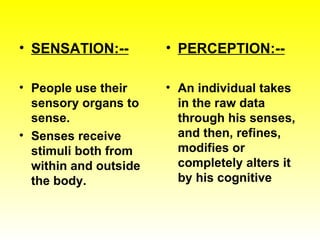
SENSATION:-- People use their sensory organs to sense. Senses receive stimuli both from within and outside the body. PERCEPTION:-- An individual takes in the raw data through his senses, and then, refines, modifies or completely alters it by his cognitive
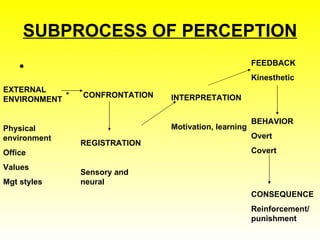
SUBPROCESS OF PERCEPTION EXTERNAL ENVIRONMENT Physical environment Office Values Mgt styles CONFRONTATION REGISTRATION Sensory and neural   INTERPRETATION Motivation, learning FEEDBACK Kinesthetic BEHAVIOR Overt Covert CONSEQUENCE Reinforcement/ punishment
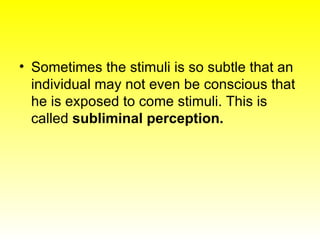
Sometimes the stimuli is so subtle that an individual may not even be conscious that he is exposed to come stimuli. This is called  subliminal perception.
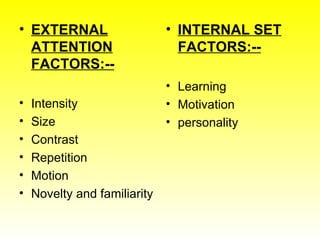
EXTERNAL ATTENTION FACTORS:-- Intensity Size Contrast Repetition Motion Novelty and familiarity INTERNAL SET FACTORS:-- Learning  Motivation personality
Factors Influencing Perception:   1.) Perceiver    2.) Target   3.) Situation
PERCEPTUAL ORGANISATION Emphasizes on the subsequent activities that take place in the perceptual process after a stimulus is received.
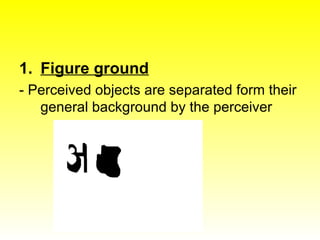
Figure ground - Perceived objects are separated form their general background by the perceiver
2.  Perceptual grouping Closure ( person may sometimes perceive a whole, where it doesn’t exist ) Continuity ( limited to continuous pattern ) Proximity similarity
3.  Perceptual Constancy The perception of elements like size, shape, color, brightness of an object remains constant and doesn’t change for one individual to another.
4.  Perceptual context - It provides meaning and value to objects, events, situation and other people in the environment - Different meaning in different situations.
5.  Perceptual defense A person may establish a defense against some stimuli or situation because they may be clashing with his personal values or culture or may be threatening. Denial Modification and distortion Change in perception Recognition but refusal to change
SOCIAL PERCEPTION (how an individual perceives others) Characteristics that influence the perception: Understanding of one’s own behavior Personal characteristics of a  person Self-esteem Not on one single skill
Shortcuts in Judging Others: 1.) attribution Way in which people explain cause for their own behavior 1. Dispositional attribution  ( behavior is affected by the characteristics of a person) 2. Situational attribution
2.) Stereotyping Tendency of generalizing the characteristics of all members of group 3) Halo Effect
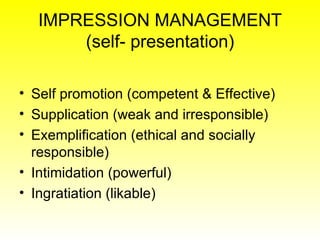
IMPRESSION MANAGEMENT (self- presentation) Self promotion (competent & Effective) Supplication (weak and irresponsible) Exemplification (ethical and socially responsible) Intimidation (powerful) Ingratiation (likable)
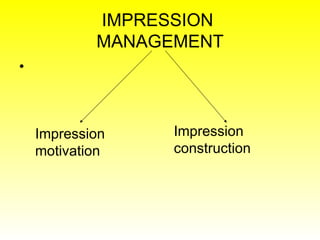
IMPRESSION  MANAGEMENT Impression motivation Impression construction
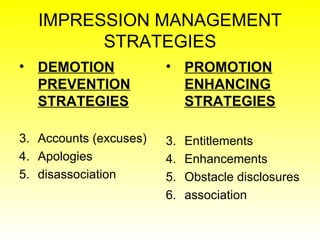
IMPRESSION MANAGEMENT STRATEGIES DEMOTION PREVENTION STRATEGIES Accounts (excuses) Apologies disassociation PROMOTION ENHANCING STRATEGIES Entitlements Enhancements Obstacle disclosures association

Perception

  • 1.
    CHAPTER 5 Perception By Aastha Tyagi
  • 2.
    Perception: isa process by which an individual selects, organizes and interprets stimuli into a meaningful and coherent picture of the environment.
  • 3.
    Differs from oneperson to another, depending on the needs, values and expectations. People respond to situations on the basis of their perception about the reality rather than reality itself.
  • 4.
    SENSATION:-- People usetheir sensory organs to sense. Senses receive stimuli both from within and outside the body. PERCEPTION:-- An individual takes in the raw data through his senses, and then, refines, modifies or completely alters it by his cognitive
  • 5.
    SUBPROCESS OF PERCEPTIONEXTERNAL ENVIRONMENT Physical environment Office Values Mgt styles CONFRONTATION REGISTRATION Sensory and neural INTERPRETATION Motivation, learning FEEDBACK Kinesthetic BEHAVIOR Overt Covert CONSEQUENCE Reinforcement/ punishment
  • 6.
    Sometimes the stimuliis so subtle that an individual may not even be conscious that he is exposed to come stimuli. This is called subliminal perception.
  • 7.
    EXTERNAL ATTENTION FACTORS:--Intensity Size Contrast Repetition Motion Novelty and familiarity INTERNAL SET FACTORS:-- Learning Motivation personality
  • 8.
    Factors Influencing Perception: 1.) Perceiver 2.) Target 3.) Situation
  • 9.
    PERCEPTUAL ORGANISATION Emphasizeson the subsequent activities that take place in the perceptual process after a stimulus is received.
  • 10.
    Figure ground -Perceived objects are separated form their general background by the perceiver
  • 11.
    2. Perceptualgrouping Closure ( person may sometimes perceive a whole, where it doesn’t exist ) Continuity ( limited to continuous pattern ) Proximity similarity
  • 12.
    3. PerceptualConstancy The perception of elements like size, shape, color, brightness of an object remains constant and doesn’t change for one individual to another.
  • 13.
    4. Perceptualcontext - It provides meaning and value to objects, events, situation and other people in the environment - Different meaning in different situations.
  • 14.
    5. Perceptualdefense A person may establish a defense against some stimuli or situation because they may be clashing with his personal values or culture or may be threatening. Denial Modification and distortion Change in perception Recognition but refusal to change
  • 15.
    SOCIAL PERCEPTION (howan individual perceives others) Characteristics that influence the perception: Understanding of one’s own behavior Personal characteristics of a person Self-esteem Not on one single skill
  • 16.
    Shortcuts in JudgingOthers: 1.) attribution Way in which people explain cause for their own behavior 1. Dispositional attribution ( behavior is affected by the characteristics of a person) 2. Situational attribution
  • 17.
    2.) Stereotyping Tendencyof generalizing the characteristics of all members of group 3) Halo Effect
  • 18.
    IMPRESSION MANAGEMENT (self-presentation) Self promotion (competent & Effective) Supplication (weak and irresponsible) Exemplification (ethical and socially responsible) Intimidation (powerful) Ingratiation (likable)
  • 19.
    IMPRESSION MANAGEMENTImpression motivation Impression construction
  • 20.
    IMPRESSION MANAGEMENT STRATEGIESDEMOTION PREVENTION STRATEGIES Accounts (excuses) Apologies disassociation PROMOTION ENHANCING STRATEGIES Entitlements Enhancements Obstacle disclosures association