MOTIVATION
Application of Motivation concept
Introduction
   Motivation can be defined as an internal
    condition initiated by drives, needs, or
    desires and producing a goal behaviour.
   According to Stephen P Robbins Motivation is
    “defined as the willingness to exert high
    levels of effort towards organizational goals.”
   According to Fred Luthans (1986) Motivation
    can be defined as “ a process that starts with
    psychological or psychological deficiency or
    need that activates behaviour or a drive that
    is aimed at a goal or incentive.”
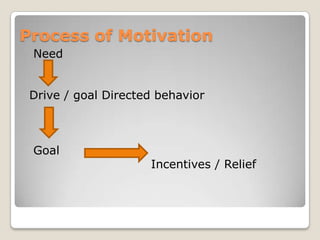
Process of Motivation
 Need


 Drive / goal Directed behavior


 Goal
                     Incentives / Relief
Nature and Importance of
Motivation
 Motivated employees are required
 It helps organization to survive
 Motivated employees are more productive
Motivating tools
 The best employee motivation efforts
  focus on what employees deem to be
  important.
 Many organizations find flexibility in job
  design.
 Helps in increasing productivity and better
  morale.
 Motivation includes issues of emotion,
  support, capability.
Employee Involvement
Programme
Forms of employee involvement programmes
 are:-
   1. Employee Involvement Teams
Group of employees who work on solving
problems.

   2. Participative Mangement
Degree of decision making power share with
their supervisors.
3.Representative participation
Represented by a small group who actually
participate.

   4. Quality Circles
Small groups of employees who work
voluntarily in the company time.
Theories of Motivation
 There are a number of different views as
  to what motivates workers
 The most commonly held views or
  theories will be discussed and have been
  developed over the last 100 years or so
 Unfortunately these theories do not all
  reach the same conclusions !!
Frederick Winslow Taylor                 (1856 – 1917)

 Workers    are motivated mainly by pay

 Theory of Scientific Management:-
• Workers do not naturally enjoy work    and so need
    close supervision and control
•   Therefore managers should break down
    production into a series of small tasks
•   Workers should then be given appropriate
    training and tools so they can work as efficiently
    as possible on one set task
•   Workers are then paid according to the number
    of items they produce in a set period of time-
    piece-rate pay
•   As a result workers are encouraged to work hard
    and maximise their productivity
   Taylor’s methods were widely adopted as
    businesses saw the benefits of increased
    productivity levels and lower unit costs
   The most notably advocate was Henry Ford
    who used them to design the first ever
    production line, making Ford cars
   This was the start of the era of mass
    production
   Taylor’s approach has close links with the
    concept of an autocratic management style
    (managers take all the decisions and simply
    give orders to those below them)
   Macgregor’s Theory X approach to workers
    (workers are viewed as lazy and wish to
    avoid responsibility)
 However workers soon came to dislike
  Taylor’s approach as they were only given
  boring, repetitive tasks to carry out and
  were being treated little better than
  human machines
 Firms could also afford to lay off workers
  as productivity levels increased
 This led to an increase in strikes and
  other forms of industrial action by dis-
  satisfied workers
Elton Mayo     (1880 – 1949)

 Workers are not just concerned with
  money but could be better motivated by
  having their social needs met whilst at
  work
 He focused on managers taking more of
  an interest in the workers, treating them
  as people who have worthwhile opinions
  and realising that workers enjoy
  interacting together
   Mayo conducted a series of experiments at
    the Hawthorne factory of the Western Electric
    Company in Chicago
   He isolated two groups of women workers
    and studied the effect on their productivity
    levels of changing factors such as lighting
    and working conditions.
   He expected to see productivity levels decline
    as lighting or other conditions became
    progressively worse
   What he actually discovered surprised him,
    whatever the change in lighting or working
    conditions, the productivity levels of the
    workers improved or remained the same
   From this Mayo concluded that workers are best motivated
    by:-
   Better communication between managers and
    workers (workers were consulted over the experiments
    and also had the opportunity to give feedback)
   Greater manager involvement in employees working
    lives (workers responded to the increased level of
    attention they were receiving)
   Working in groups or teams (workers did not previously
    regularly work in teams)

In practice therefore businesses should re-organise
production to encourage greater use of team
working and introduce personnel departments to
encourage greater manager involvement in looking
after employees’ interests
Abraham Maslow              (1908 – 1970)

 Abraham Maslow along with Frederick Herzberg
  introduced the Neo-Human Relations School in
  the 1950’s, which focused on the psychological
  needs of employees
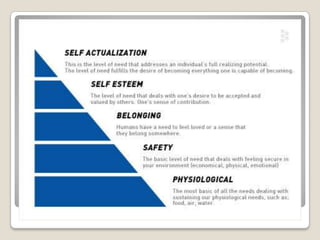
 Maslow put forward a theory that there are five
  levels of human needs which employees need to
  have fulfilled at work
 All of the needs are structured into a hierarchy
  and only once a lower level of need has been
  fully met
 Worker will be motivated by the opportunity of
  having the next need up in the hierarchy to be
  satisfied
Frederick Herzberg
 Motivators are more concerned with the
  actual job itself
 Interesting the work is and how much
  opportunity it gives for extra
  responsibility, recognition and promotion
 Herzberg believed that businesses should
  motivate employees by adopting a
  democratic approach to management
 Improving the nature and content of the
  actual job through certain methods
   Some of the methods managers could use to
    achieve this are:-
   Job enlargement – workers being given a
    greater variety of tasks to perform (not
    necessarily more challenging) which should
    make the work more interesting.
   Job enrichment - involves workers being
    given a wider range of more complex,
    interesting and challenging tasks surrounding
    a complete unit of work. This should give a
    greater sense of achievement.
   Empowerment means delegating more
    power to employees to make their own
    decisions over areas of their working life.

Motivation (final ppt)

  • 1.
  • 2.
    Introduction  Motivation can be defined as an internal condition initiated by drives, needs, or desires and producing a goal behaviour.  According to Stephen P Robbins Motivation is “defined as the willingness to exert high levels of effort towards organizational goals.”  According to Fred Luthans (1986) Motivation can be defined as “ a process that starts with psychological or psychological deficiency or need that activates behaviour or a drive that is aimed at a goal or incentive.”
  • 3.
    Process of Motivation Need Drive / goal Directed behavior Goal Incentives / Relief
  • 4.
    Nature and Importanceof Motivation  Motivated employees are required  It helps organization to survive  Motivated employees are more productive
  • 5.
    Motivating tools  Thebest employee motivation efforts focus on what employees deem to be important.  Many organizations find flexibility in job design.  Helps in increasing productivity and better morale.  Motivation includes issues of emotion, support, capability.
  • 6.
    Employee Involvement Programme Forms ofemployee involvement programmes are:- 1. Employee Involvement Teams Group of employees who work on solving problems. 2. Participative Mangement Degree of decision making power share with their supervisors.
  • 7.
    3.Representative participation Represented bya small group who actually participate. 4. Quality Circles Small groups of employees who work voluntarily in the company time.
  • 8.
    Theories of Motivation There are a number of different views as to what motivates workers  The most commonly held views or theories will be discussed and have been developed over the last 100 years or so  Unfortunately these theories do not all reach the same conclusions !!
  • 9.
    Frederick Winslow Taylor (1856 – 1917)  Workers are motivated mainly by pay  Theory of Scientific Management:- • Workers do not naturally enjoy work and so need close supervision and control • Therefore managers should break down production into a series of small tasks • Workers should then be given appropriate training and tools so they can work as efficiently as possible on one set task • Workers are then paid according to the number of items they produce in a set period of time- piece-rate pay • As a result workers are encouraged to work hard and maximise their productivity
  • 10.
    Taylor’s methods were widely adopted as businesses saw the benefits of increased productivity levels and lower unit costs  The most notably advocate was Henry Ford who used them to design the first ever production line, making Ford cars  This was the start of the era of mass production  Taylor’s approach has close links with the concept of an autocratic management style (managers take all the decisions and simply give orders to those below them)  Macgregor’s Theory X approach to workers (workers are viewed as lazy and wish to avoid responsibility)
  • 11.
     However workerssoon came to dislike Taylor’s approach as they were only given boring, repetitive tasks to carry out and were being treated little better than human machines  Firms could also afford to lay off workers as productivity levels increased  This led to an increase in strikes and other forms of industrial action by dis- satisfied workers
  • 12.
    Elton Mayo (1880 – 1949)  Workers are not just concerned with money but could be better motivated by having their social needs met whilst at work  He focused on managers taking more of an interest in the workers, treating them as people who have worthwhile opinions and realising that workers enjoy interacting together
  • 13.
    Mayo conducted a series of experiments at the Hawthorne factory of the Western Electric Company in Chicago  He isolated two groups of women workers and studied the effect on their productivity levels of changing factors such as lighting and working conditions.  He expected to see productivity levels decline as lighting or other conditions became progressively worse  What he actually discovered surprised him, whatever the change in lighting or working conditions, the productivity levels of the workers improved or remained the same
  • 14.
    From this Mayo concluded that workers are best motivated by:-  Better communication between managers and workers (workers were consulted over the experiments and also had the opportunity to give feedback)  Greater manager involvement in employees working lives (workers responded to the increased level of attention they were receiving)  Working in groups or teams (workers did not previously regularly work in teams) In practice therefore businesses should re-organise production to encourage greater use of team working and introduce personnel departments to encourage greater manager involvement in looking after employees’ interests
  • 15.
    Abraham Maslow (1908 – 1970)  Abraham Maslow along with Frederick Herzberg introduced the Neo-Human Relations School in the 1950’s, which focused on the psychological needs of employees  Maslow put forward a theory that there are five levels of human needs which employees need to have fulfilled at work  All of the needs are structured into a hierarchy and only once a lower level of need has been fully met  Worker will be motivated by the opportunity of having the next need up in the hierarchy to be satisfied
  • 17.
    Frederick Herzberg  Motivatorsare more concerned with the actual job itself  Interesting the work is and how much opportunity it gives for extra responsibility, recognition and promotion  Herzberg believed that businesses should motivate employees by adopting a democratic approach to management  Improving the nature and content of the actual job through certain methods
  • 18.
    Some of the methods managers could use to achieve this are:-  Job enlargement – workers being given a greater variety of tasks to perform (not necessarily more challenging) which should make the work more interesting.  Job enrichment - involves workers being given a wider range of more complex, interesting and challenging tasks surrounding a complete unit of work. This should give a greater sense of achievement.  Empowerment means delegating more power to employees to make their own decisions over areas of their working life.