CHAPTER 1 BASIC PRINCIPLES OF COMMUNICATION
Introduction Understanding Communication The Communication Process Barriers of Effective Communication The importance of Communication in Workplace
“ Communication” is a transfer of information between people, resulting in common understanding between them.
POPULAR DEFINITIONS: According to Newman and Summer: “ Communication is an exchange of facts, ideas, opinions or emotions by two or more persons.” According to Allen Louis, “It is the sum of all the things one person does when he wants to create an understanding  in the mind of another”
Bellows, Gilson and Odirone, “It’s a Communion by words, lettres, symbol or messages, and as a way that one organization members shares meaning with the other” Hoben says, “it’s the verbal interchange of thoughts or ideas.”
As per  Anderson, “ Communication is the process by which we understand others and in turn endeavor to be understood by them. It is dynamic, constantly changing and shifting in response to the total situation.” According to Berelson and Steiner, “Communication is the transmission of information, ideas, emotion, skills, etc., by the use of symbols, words, pictures, figures, graphs, etc.”
According to Fotheringham, “ Communication is a process involving the selection, production and transmission of signs in such a way as to help receiver perceive a meaning similar to that in the min d of the communicator.”
CHARACTERSTICS OF A COMMUNICATION
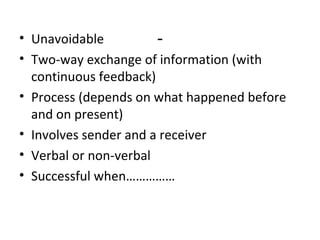
Unavoidable Two-way exchange of information (with continuous feedback) Process (depends on what happened before and on present) Involves sender and a receiver Verbal or non-verbal Successful when……………
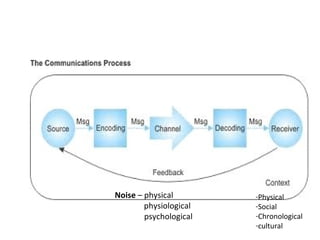
Noise  – physical   physiological   psychological Physical Social Chronological cultural
 
 
BARRIERS TO COMMUNICATION
Environmental barriers - noise Individual barriers – tendency to disapprove views of others. Organisational barriers – hierarchies (departmental barrier) Channel barrier Linguistic and cultural barrier Semantic barrier Non-verbal barrier
OVERCOMING THE BARRIERS TO COMMUNICATION
ORGANISATIONAL ACTION :- Encourage feedback Create climate of openness Use multiple channels of communication INDIVIDUAL ACTION :- Active listening Careful wording Selection of appropriate channels
IMPORTANCE OF COMMUNICATION  IN THE WORKPLACE
Greater awareness of organizational goals and teamwork Better employer-employee relationships Problem-solving Improved performance Stronger link between managers and the external environment

communication

  • 1.
    CHAPTER 1 BASICPRINCIPLES OF COMMUNICATION
  • 2.
    Introduction Understanding CommunicationThe Communication Process Barriers of Effective Communication The importance of Communication in Workplace
  • 3.
    “ Communication” isa transfer of information between people, resulting in common understanding between them.
  • 4.
    POPULAR DEFINITIONS: Accordingto Newman and Summer: “ Communication is an exchange of facts, ideas, opinions or emotions by two or more persons.” According to Allen Louis, “It is the sum of all the things one person does when he wants to create an understanding in the mind of another”
  • 5.
    Bellows, Gilson andOdirone, “It’s a Communion by words, lettres, symbol or messages, and as a way that one organization members shares meaning with the other” Hoben says, “it’s the verbal interchange of thoughts or ideas.”
  • 6.
    As per Anderson, “ Communication is the process by which we understand others and in turn endeavor to be understood by them. It is dynamic, constantly changing and shifting in response to the total situation.” According to Berelson and Steiner, “Communication is the transmission of information, ideas, emotion, skills, etc., by the use of symbols, words, pictures, figures, graphs, etc.”
  • 7.
    According to Fotheringham,“ Communication is a process involving the selection, production and transmission of signs in such a way as to help receiver perceive a meaning similar to that in the min d of the communicator.”
  • 8.
    CHARACTERSTICS OF ACOMMUNICATION
  • 9.
    Unavoidable Two-way exchangeof information (with continuous feedback) Process (depends on what happened before and on present) Involves sender and a receiver Verbal or non-verbal Successful when……………
  • 10.
    Noise –physical physiological psychological Physical Social Chronological cultural
  • 11.
  • 12.
  • 13.
  • 14.
    Environmental barriers -noise Individual barriers – tendency to disapprove views of others. Organisational barriers – hierarchies (departmental barrier) Channel barrier Linguistic and cultural barrier Semantic barrier Non-verbal barrier
  • 15.
    OVERCOMING THE BARRIERSTO COMMUNICATION
  • 16.
    ORGANISATIONAL ACTION :-Encourage feedback Create climate of openness Use multiple channels of communication INDIVIDUAL ACTION :- Active listening Careful wording Selection of appropriate channels
  • 17.
    IMPORTANCE OF COMMUNICATION IN THE WORKPLACE
  • 18.
    Greater awareness oforganizational goals and teamwork Better employer-employee relationships Problem-solving Improved performance Stronger link between managers and the external environment