Emotion
Mr.Visanth V S
Sherwood College of Nursing
Barabanki, UP
Emotion
Emotion is derived from a Latin word
“emovere” which means “stirred up” or “to
excite”.
So emotion is the excited state or stirred up
state of an individual and it is purely a
private experience.
An emotion is a full body/mind/behavior
response to a situation.
Definition
Emotion is defined as a subjective response that
is usually accompanied by physiological changes
and is associated with change in behavior.
Stirred up state of an organism. -Woodworth
Nature and Characteristics of Emotions
Emotions are universal
Emotions are personal/unique.
Emotions rise abruptly but subside slowly.
Emotions are the product of our perceptions.
Same emotions can be aroused by a number
of different stimuli, objects and situations.
Nature and Characteristics of Emotions
Whenever an organism is experiencing an
emotion a lot of energy is released.
Emotions bring about physical,
physiological and psychological changes in
the organism
Each emotion has certain definite muscular
and overt behavior
Types/Kinds of Emotions
Positive emotions: Are the pleasant emotions
which are beneficial/ helpful for the
individual.
Eg: happiness, joy, curiosity etc.
Negative emotions: Are unpleasant emotional
experiences, it doesn’t produce any beneficial
effects.
Eg: fear, angry, jealousy etc.
Contd….
Primary emotions: These are direct emotional
reactions to a situation, and they are called
primary because they come first.
Eg: Joy, happiness, fear, shame, sadness etc.
Secondary emotion: This is an emotional
response to a primary emotion, thus an emotion
about what we feel.
Eg: Worry, anxiety, anger, jealousy etc.
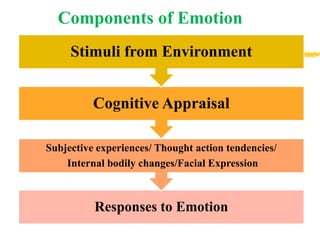
Components of Emotion
Responses to Emotion
Subjective experiences/ Thought action tendencies/
Internal bodily changes/Facial Expression
Cognitive Appraisal
Stimuli from Environment
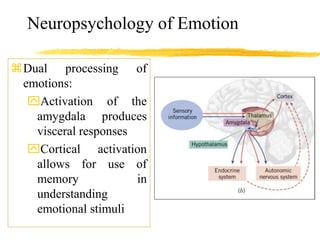
Neuropsychology of Emotion
Dual processing of
emotions:
Activation of the
amygdala produces
visceral responses
Cortical activation
allows for use of
memory in
understanding
emotional stimuli
Changes during Emotions
Physical Changes in Emotions
Facial expression: Each emotion has its definite
facial expressions. Various muscles of the face such
as the muscles of the eyes, nose, lips and forehead
undergo changes by twisting and twitching.
Muscular adjustments: Under certain emotional
expressions the muscles of the body make automatic
adjustments.
Contd…….
Voice changes: Voice also tells about the emotion of an
individual.
Releasing of energy: During emotions a lot of energy is
released to meet the emergency situation. Our liver
releases glycogen which gets converted into glucose and
it gets burnt releasing energy.
Respiration and circulation: In order to supply more
oxygen, lungs function faster and so breathing becomes
shallow and faster. Further there is an increased blood
pressure and heartbeats.
Contd….
Secretory Changes: There is a significant change in
various glands. The flow of these secretions in the form
of saliva, tears, sweats etc.
Changes in thermoregulation: There is a change in
temperature of the body. At the time of intense
excitement, it generally goes down.
Digestive changes: During emotions digestive system
gets affected. During emotional state our stomach and
intestines work quietly slow sometimes it increases the
function.
Contd…
 Other changes:
 Erection of hairs
 Stimulation of sweat glands
 Dryness of mouth
 Pupils become dilate
 Redness of the face
 Changes in body movements
 Blood clots more quickly in
case of wounds
Brain functioning
Emotion changes
our sensory and
perceptual
processes.
Psychological Changes in Emotions
During intense emotions our attention and
perceptual process get altered.
Our thinking and reasoning will be affected
adversely.
Learning will be slowed down during emotions.
Memory will be inhibited.
Disorientation of time, place and person may
experience during an intense emotion.
Contd…..
Person may be unable to concentrate in his tasks.
Decreased ability to analyze and solve problems.
Decrease in self-confidence and self-esteem.
Person may become dull, withdrawn and
pessimistic.
In certain emotions one may become aggressive,
become homicidal or suicidal ideas
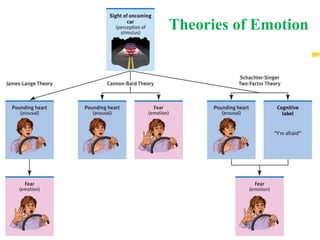
Theories of Emotion
Does your heart pound because you are
afraid... or are you afraid because you
feel your heart pounding?
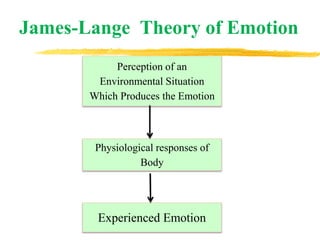
James-Lange Theory of Emotion
This theory is proposed by William James and
Carl Lange.
 This is one of the best examples of
physiological theory of emotions.
James-Lange theory suggests that emotions
occur as a result of physiological reactions to
events.
For example: I see a snake “I am trembling,
therefore I am feared.”
James-Lange Theory of Emotion
Perception of an
Environmental Situation
Which Produces the Emotion
Physiological responses of
Body
Experienced Emotion
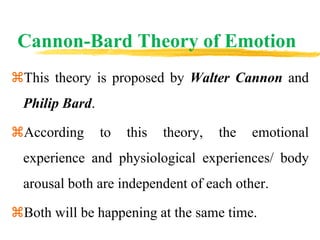
Cannon-Bard Theory of Emotion
This theory is proposed by Walter Cannon and
Philip Bard.
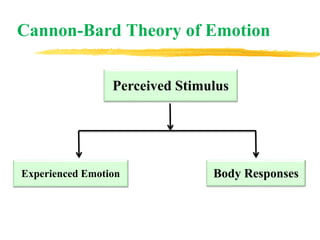
According to this theory, the emotional
experience and physiological experiences/ body
arousal both are independent of each other.
Both will be happening at the same time.
Cannon-Bard Theory of Emotion
Perceived Stimulus
Experienced Emotion Body Responses
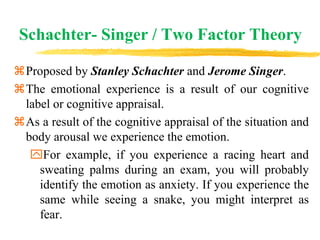
Schachter- Singer / Two Factor Theory
Proposed by Stanley Schachter and Jerome Singer.
The emotional experience is a result of our cognitive
label or cognitive appraisal.
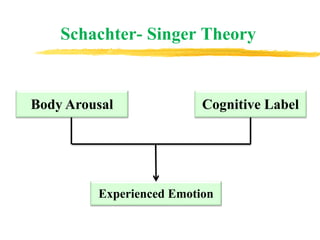
As a result of the cognitive appraisal of the situation and
body arousal we experience the emotion.
For example, if you experience a racing heart and
sweating palms during an exam, you will probably
identify the emotion as anxiety. If you experience the
same while seeing a snake, you might interpret as
fear.
Schachter- Singer Theory
Body Arousal Cognitive Label
Experienced Emotion
Theories of Emotion
Emotion-Psychology

Emotion-Psychology

  • 1.
    Emotion Mr.Visanth V S SherwoodCollege of Nursing Barabanki, UP
  • 2.
    Emotion Emotion is derivedfrom a Latin word “emovere” which means “stirred up” or “to excite”. So emotion is the excited state or stirred up state of an individual and it is purely a private experience. An emotion is a full body/mind/behavior response to a situation.
  • 3.
    Definition Emotion is definedas a subjective response that is usually accompanied by physiological changes and is associated with change in behavior. Stirred up state of an organism. -Woodworth
  • 4.
    Nature and Characteristicsof Emotions Emotions are universal Emotions are personal/unique. Emotions rise abruptly but subside slowly. Emotions are the product of our perceptions. Same emotions can be aroused by a number of different stimuli, objects and situations.
  • 5.
    Nature and Characteristicsof Emotions Whenever an organism is experiencing an emotion a lot of energy is released. Emotions bring about physical, physiological and psychological changes in the organism Each emotion has certain definite muscular and overt behavior
  • 6.
    Types/Kinds of Emotions Positiveemotions: Are the pleasant emotions which are beneficial/ helpful for the individual. Eg: happiness, joy, curiosity etc. Negative emotions: Are unpleasant emotional experiences, it doesn’t produce any beneficial effects. Eg: fear, angry, jealousy etc.
  • 7.
    Contd…. Primary emotions: Theseare direct emotional reactions to a situation, and they are called primary because they come first. Eg: Joy, happiness, fear, shame, sadness etc. Secondary emotion: This is an emotional response to a primary emotion, thus an emotion about what we feel. Eg: Worry, anxiety, anger, jealousy etc.
  • 8.
    Components of Emotion Responsesto Emotion Subjective experiences/ Thought action tendencies/ Internal bodily changes/Facial Expression Cognitive Appraisal Stimuli from Environment
  • 9.
    Neuropsychology of Emotion Dualprocessing of emotions: Activation of the amygdala produces visceral responses Cortical activation allows for use of memory in understanding emotional stimuli
  • 10.
  • 11.
    Physical Changes inEmotions Facial expression: Each emotion has its definite facial expressions. Various muscles of the face such as the muscles of the eyes, nose, lips and forehead undergo changes by twisting and twitching. Muscular adjustments: Under certain emotional expressions the muscles of the body make automatic adjustments.
  • 12.
    Contd……. Voice changes: Voicealso tells about the emotion of an individual. Releasing of energy: During emotions a lot of energy is released to meet the emergency situation. Our liver releases glycogen which gets converted into glucose and it gets burnt releasing energy. Respiration and circulation: In order to supply more oxygen, lungs function faster and so breathing becomes shallow and faster. Further there is an increased blood pressure and heartbeats.
  • 13.
    Contd…. Secretory Changes: Thereis a significant change in various glands. The flow of these secretions in the form of saliva, tears, sweats etc. Changes in thermoregulation: There is a change in temperature of the body. At the time of intense excitement, it generally goes down. Digestive changes: During emotions digestive system gets affected. During emotional state our stomach and intestines work quietly slow sometimes it increases the function.
  • 14.
    Contd…  Other changes: Erection of hairs  Stimulation of sweat glands  Dryness of mouth  Pupils become dilate  Redness of the face  Changes in body movements  Blood clots more quickly in case of wounds Brain functioning Emotion changes our sensory and perceptual processes.
  • 15.
    Psychological Changes inEmotions During intense emotions our attention and perceptual process get altered. Our thinking and reasoning will be affected adversely. Learning will be slowed down during emotions. Memory will be inhibited. Disorientation of time, place and person may experience during an intense emotion.
  • 16.
    Contd….. Person may beunable to concentrate in his tasks. Decreased ability to analyze and solve problems. Decrease in self-confidence and self-esteem. Person may become dull, withdrawn and pessimistic. In certain emotions one may become aggressive, become homicidal or suicidal ideas
  • 17.
    Theories of Emotion Doesyour heart pound because you are afraid... or are you afraid because you feel your heart pounding?
  • 18.
    James-Lange Theory ofEmotion This theory is proposed by William James and Carl Lange.  This is one of the best examples of physiological theory of emotions. James-Lange theory suggests that emotions occur as a result of physiological reactions to events. For example: I see a snake “I am trembling, therefore I am feared.”
  • 19.
    James-Lange Theory ofEmotion Perception of an Environmental Situation Which Produces the Emotion Physiological responses of Body Experienced Emotion
  • 20.
    Cannon-Bard Theory ofEmotion This theory is proposed by Walter Cannon and Philip Bard. According to this theory, the emotional experience and physiological experiences/ body arousal both are independent of each other. Both will be happening at the same time.
  • 21.
    Cannon-Bard Theory ofEmotion Perceived Stimulus Experienced Emotion Body Responses
  • 22.
    Schachter- Singer /Two Factor Theory Proposed by Stanley Schachter and Jerome Singer. The emotional experience is a result of our cognitive label or cognitive appraisal. As a result of the cognitive appraisal of the situation and body arousal we experience the emotion. For example, if you experience a racing heart and sweating palms during an exam, you will probably identify the emotion as anxiety. If you experience the same while seeing a snake, you might interpret as fear.
  • 23.
    Schachter- Singer Theory BodyArousal Cognitive Label Experienced Emotion
  • 24.

Editor's Notes