UNIT 5 GUIDELINES FOR WRITTEN  BUSINESS COMMUNICATION
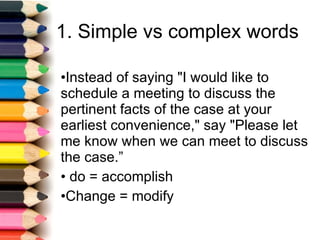
1. Simple vs complex words Instead of saying "I would like to schedule a meeting to discuss the pertinent facts of the case at your earliest convenience," say "Please let me know when we can meet to discuss the case.” do = accomplish Change = modify
2.  jargon, slangs, metaphors Jargon: technical terms that belong to particular subject area Slang: casual words that are not accepted and recognised in a standard english dictionary Metaphor: colorful comparison which evoke visual image
3. Parts of Speech Same as Use of big and complicated words may result in wrong message, use  of small words in the wrong way grammatically could have the same result
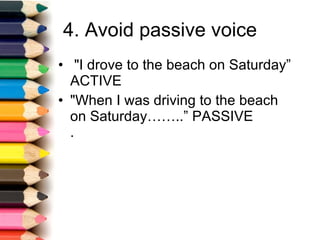
4. Avoid passive voice "I drove to the beach on Saturday” ACTIVE "When I was driving to the beach on Saturday……..” PASSIVE .
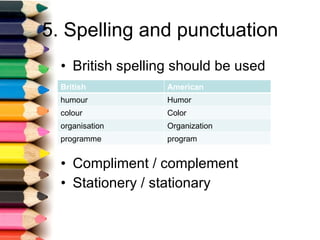
5. Spelling and punctuation British spelling should be used Compliment / complement Stationery / stationary British American humour Humor colour Color organisation Organization programme program
Punctuation:-  Apostrophe Parenthesis Colon Comma Dash full stop quotation marks semicolon
COMMON ERRORS IN ENGLISH redundancies:  Phrases which contain repetitive or unnecessary words to express same meaning. Eg, We need to know  Basic fundamentals  of english I’ll  return back  home at night
2. clichés: Phrases that are overused and should be avoided, since they make reading monotonous. “ Last but not the least, ………..” “ thanking in advance…….”
3. Frequently misused words: Certain words which sound similar or are spelt slightly differently tend to be used in wrong context. “ All together” “altogether” “ already” “all ready”
PRINCIPLES OF  BUSINESS WRITING Tone negative :  you failed to meet the sales target positive:  with a little extra effort, you could have achieved the target.
2. Emphasis Place idea in 1 st  or last paragraph, in order to get attention Use active voice Use words like “primary”, “major” and “significant” Number the ideas, to rank them in order of importance Use visual elements such as, bold type, capital letters, underline
3. Write appropriate level of readability (FOX INDEX) Select passage of 100 words Calculate average length of sentence (divide total no of words by total sentences) Find no of difficult words per 100 words Add above two Multiply by 0.4 = fog index

written business communication

  • 1.
    UNIT 5 GUIDELINESFOR WRITTEN BUSINESS COMMUNICATION
  • 2.
    1. Simple vscomplex words Instead of saying "I would like to schedule a meeting to discuss the pertinent facts of the case at your earliest convenience," say "Please let me know when we can meet to discuss the case.” do = accomplish Change = modify
  • 3.
    2. jargon,slangs, metaphors Jargon: technical terms that belong to particular subject area Slang: casual words that are not accepted and recognised in a standard english dictionary Metaphor: colorful comparison which evoke visual image
  • 4.
    3. Parts ofSpeech Same as Use of big and complicated words may result in wrong message, use of small words in the wrong way grammatically could have the same result
  • 5.
    4. Avoid passivevoice "I drove to the beach on Saturday” ACTIVE "When I was driving to the beach on Saturday……..” PASSIVE .
  • 6.
    5. Spelling andpunctuation British spelling should be used Compliment / complement Stationery / stationary British American humour Humor colour Color organisation Organization programme program
  • 7.
    Punctuation:- ApostropheParenthesis Colon Comma Dash full stop quotation marks semicolon
  • 8.
    COMMON ERRORS INENGLISH redundancies: Phrases which contain repetitive or unnecessary words to express same meaning. Eg, We need to know Basic fundamentals of english I’ll return back home at night
  • 9.
    2. clichés: Phrasesthat are overused and should be avoided, since they make reading monotonous. “ Last but not the least, ………..” “ thanking in advance…….”
  • 10.
    3. Frequently misusedwords: Certain words which sound similar or are spelt slightly differently tend to be used in wrong context. “ All together” “altogether” “ already” “all ready”
  • 11.
    PRINCIPLES OF BUSINESS WRITING Tone negative : you failed to meet the sales target positive: with a little extra effort, you could have achieved the target.
  • 12.
    2. Emphasis Placeidea in 1 st or last paragraph, in order to get attention Use active voice Use words like “primary”, “major” and “significant” Number the ideas, to rank them in order of importance Use visual elements such as, bold type, capital letters, underline
  • 13.
    3. Write appropriatelevel of readability (FOX INDEX) Select passage of 100 words Calculate average length of sentence (divide total no of words by total sentences) Find no of difficult words per 100 words Add above two Multiply by 0.4 = fog index