• Why dosome people perform better than others?
• Why does the same person act differently at different times?
5.
MOTIVES
• Motives arethe expressed needs and could be conscious or
subconscious.
• Sometimes motives define as reason to do something.
6.
MOTIVATING
• It isan act of stimulating emotion or desire and promoting
it to action.
• Research says there are two types of motivation:
• 1. positive motivation
• 2. negative motivation (fear/ based on force)
7.
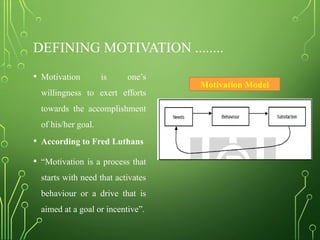
DEFINING MOTIVATION ........
•Motivation is one’s
willingness to exert efforts
towards the accomplishment
of his/her goal.
• According to Fred Luthans
• “Motivation is a process that
starts with need that activates
behaviour or a drive that is
aimed at a goal or incentive”.
Motivation Model
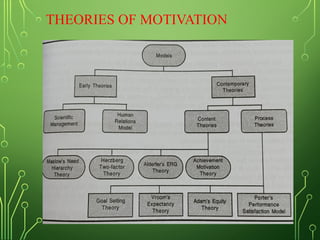
THE CONTENT THEORIES
•The content theories basically “what” of motivation.
• It means focus on the different things that people may
feel they need in their lives.
• In this content theories people’s motivations will be based
on acquiring the things that they think they need.
• So, manager first try to understand what employee need.
• Because performance of an employee always depends on
ability backed by motivation.
Performance = (ability * motivation)
10.
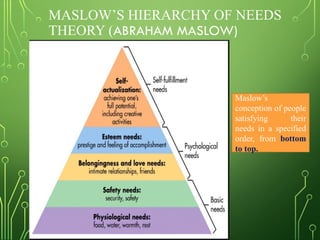
MASLOW’S HIERARCHY OFNEEDS
THEORY (ABRAHAM MASLOW)
Maslow’s
conception of people
satisfying their
needs in a specified
order, from bottom
to top.
11.
DISCUSSION ON FIVENEEDS
• Physiological Needs: (1st
order)
• 1. The Physiological needs are the basic needs for
sustaining the human life.
• 2. These needs include food, clothing, shelter, rest, water,
air, sleep.
• 3. lowest level in the hierarchy of needs.
The management attempts to meet such physiological needs
through payment of fair wages.
12.
SECURITY/SAFETY NEEDS: (2ND
ORDER)
•These are the needs connected with psychological fear of
loss of job, or hazard.
• An employee needs protection from such types of fear.
• The safety needs come after meeting the physiological
needs.
• Such physiological needs lose their motivational
potential when they are satisfied.
• As a result, safety needs replaces them.
The management attempts to meet such safety needs through
security of job , pension at old age, insurance coverage.
13.
SOCIAL NEEDS/LOVE BELONGING(3RD
ORDER)
• An employee is a human being who desires or likes to stay
(belong) in group.
• This is treated as basic social need of an individual.
Management provides break time more to satisfy this need.
14.
SELF -ESTEEM NEEDS
•need to be respected and appreciated by others.
• need to have the power and finally prestigious position.
• Esteem needs are two-fold in nature.
1. self-confidence, self-respect, competence
2. status, reputation, recognition and appreciation by others.
• Esteem needs do not assume the motivational properties unless the
previous needs are satisfied.
15.
SELF-ACTUALISATION NEEDS
• Highestamong the needs in the hierarchy of needs.
• Humans want to utilize their potentials to the maximum extent
and desires to become what they are capable of becoming.
• It is the ‘growth’ need.
• Though every one is capable of self-actualisation, many do not
reach this stage.
16.
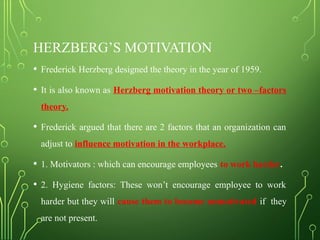
HERZBERG’S MOTIVATION
• FrederickHerzberg designed the theory in the year of 1959.
• It is also known as Herzberg motivation theory or two –factors
theory.
• Frederick argued that there are 2 factors that an organization can
adjust to influence motivation in the workplace.
• 1. Motivators : which can encourage employees to work harder.
• 2. Hygiene factors: These won’t encourage employee to work
harder but they will cause them to become unmotivated if they
are not present.
17.
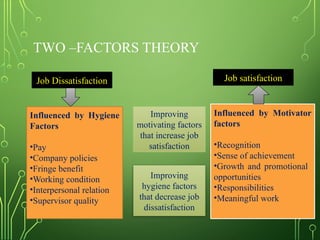
TWO –FACTORS THEORY
JobDissatisfaction
Influenced by Hygiene
Factors
•Pay
•Company policies
•Fringe benefit
•Working condition
•Interpersonal relation
•Supervisor quality
Improving
motivating factors
that increase job
satisfaction
Improving
hygiene factors
that decrease job
dissatisfaction
Job satisfaction
Influenced by Motivator
factors
•Recognition
•Sense of achievement
•Growth and promotional
opportunities
•Responsibilities
•Meaningful work
18.
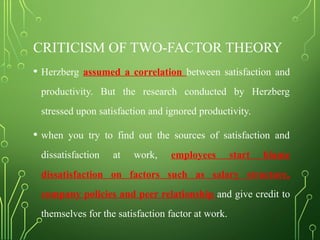
CRITICISM OF TWO-FACTORTHEORY
• Herzberg assumed a correlation between satisfaction and
productivity. But the research conducted by Herzberg
stressed upon satisfaction and ignored productivity.
• when you try to find out the sources of satisfaction and
dissatisfaction at work, employees start blame
dissatisfaction on factors such as salary structure,
company policies and peer relationship and give credit to
themselves for the satisfaction factor at work.
19.
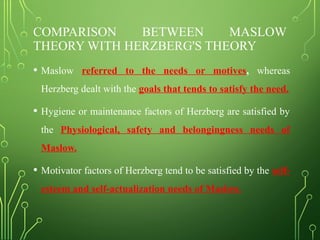
COMPARISON BETWEEN MASLOW
THEORYWITH HERZBERG'S THEORY
• Maslow referred to the needs or motives, whereas
Herzberg dealt with the goals that tends to satisfy the need.
• Hygiene or maintenance factors of Herzberg are satisfied by
the Physiological, safety and belongingness needs of
Maslow.
• Motivator factors of Herzberg tend to be satisfied by the self-
esteem and self-actualization needs of Maslow.
20.
PROCESS THEORY OFMOTIVATION
• In content theories of motivation emphasized the inner
needs in motivation
• The process theories of motivation do not explain how
needs emerge. Rather it explain the process through which
needs are translated into behaviour.
21.
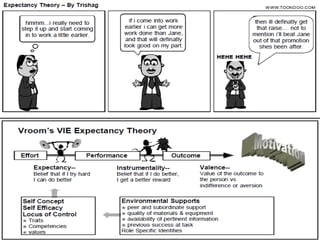
VROOM’S EXPECTANCY THEORY
•Expectancy Theory of Motivation was suggested by Victor H.
Vroom.
• It is based on the idea that work effort is directed towards
behaviour that people believe will lead to desired outcomes.
• In short we can understood that :
• People get motivated by how much they want something and
how surely they know that they will get that thing.
23.
VROOM’S EXPECTANCY THEORY
•Case 1:
• You can never be motivated by unrealistic whishes like you
will marry Brad Pitt.
• Do you remotely find any possibility of such wish getting
fulfilled ??
24.
VROOM’S EXPECTANCY THEORY
•Case 2:
• You strongly want to get a higher range luxury car and you
know that this wish is likely to be fulfilled or at least this is
a realistic wish that can be fulfilled.
25.
QUESTION TO YOU
•Why in case 2 motivation occurs?
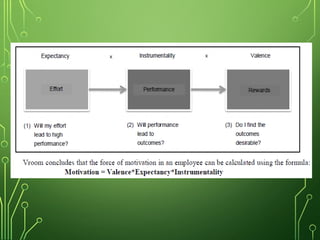
• The answer lies in three concept of Vroom’s expectancy theory.
• 1. Expectancy
• 2. Instrumentality
• 3. Valence
Let us understand each concept separately.
Then we will put them together to understand how it motivates
an individual.
26.
DISCUSSION ON THREECOMPONENTS
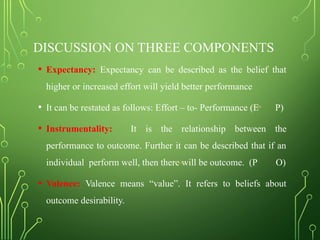
• Expectancy: Expectancy can be described as the belief that
higher or increased effort will yield better performance
• It can be restated as follows: Effort – to- Performance (E P)
• Instrumentality: It is the relationship between the
performance to outcome. Further it can be described that if an
individual perform well, then there will be outcome. (P O)
• Valence: Valence means “value”. It refers to beliefs about
outcome desirability.
27.
LET’S GO THROUGHA SMALL THEORY
• Marry joins a Company. As soon as she joins her boss tells her that if
she completes a given project properly, he will promote her and
increase her salary.
• Marry becomes happy and she is in hope of increasing her
performance does a lot of hard work, overtime etc.
• Further with increased performance she hopes to bag all the rewards
promised by the Boss.
• when she gets the rewards, she hopes to get something to which she
assigns a lot of value.
28.
SUMMARY OF THESTORY
• First hope of Marry is expectancy. This hope is further strengthened
if Marry gets sufficient resources and has enough skills at her hand.
• Second hope that with good performance she will achieve rewards is
called instrumentality.
• The third concept is valence. Suppose Marry achieves a decent level
of performance, completes the project and impresses to the Boss. The
boss in return will bestow reward upon her. Now Marry wanted a
fat paycheck but boss gave her a dry promotion. Marry definitely
doesn’t assign value to a dry promotion.
29.
• So nexttime when she gets any project, she will work on it half heartedly
as the reward she got did not fulfill her personal goal. Here she is
demotivated.
• But if marry gets a fat check along with promotion, she will be highly
motivated. This is valence. She will perform repeatedly to achieve her
desire outcome.
31.
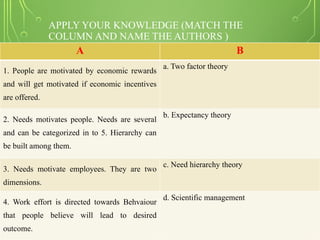
APPLY YOUR KNOWLEDGE(MATCH THE
COLUMN AND NAME THE AUTHORS )
A B
1. People are motivated by economic rewards
and will get motivated if economic incentives
are offered.
a. Two factor theory
2. Needs motivates people. Needs are several
and can be categorized in to 5. Hierarchy can
be built among them.
b. Expectancy theory
3. Needs motivate employees. They are two
dimensions.
c. Need hierarchy theory
4. Work effort is directed towards Behvaiour
that people believe will lead to desired
outcome.
d. Scientific management
32.
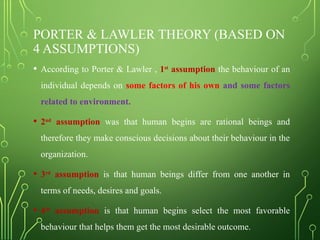
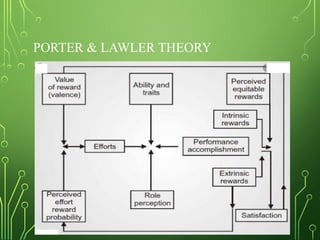
PORTER & LAWLERTHEORY (BASED ON
4 ASSUMPTIONS)
• According to Porter & Lawler , 1st
assumption the behaviour of an
individual depends on some factors of his own and some factors
related to environment.
• 2nd
assumption was that human begins are rational beings and
therefore they make conscious decisions about their behaviour in the
organization.
• 3rd
assumption is that human beings differ from one another in
terms of needs, desires and goals.
• 4th
assumption is that human begins select the most favorable
behaviour that helps them get the most desirable outcome.
33.
THE PROCESS ANDCONTEMPORARY
THEORIES (THE EQUITY THEORY)
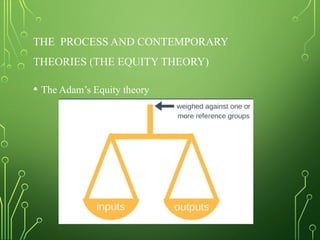
• The Adam’s Equity theory
34.
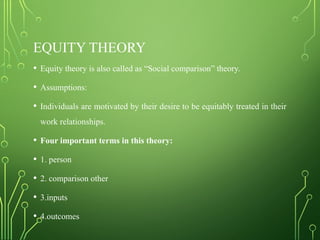
EQUITY THEORY
• Equitytheory is also called as “Social comparison” theory.
• Assumptions:
• Individuals are motivated by their desire to be equitably treated in their
work relationships.
• Four important terms in this theory:
• 1. person
• 2. comparison other
• 3.inputs
• 4.outcomes
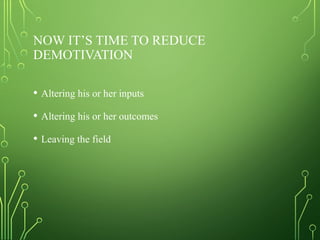
NOW IT’S TIMETO REDUCE
DEMOTIVATION
• Altering his or her inputs
• Altering his or her outcomes
• Leaving the field
37.
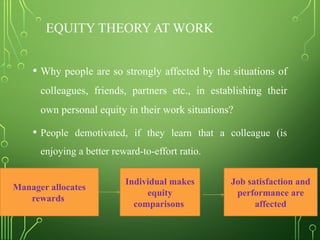
EQUITY THEORY ATWORK
• Why people are so strongly affected by the situations of
colleagues, friends, partners etc., in establishing their
own personal equity in their work situations?
• People demotivated, if they learn that a colleague (is
enjoying a better reward-to-effort ratio.
Manager allocates
rewards
Individual makes
equity
comparisons
Job satisfaction and
performance are
affected
38.
CONCLUSION
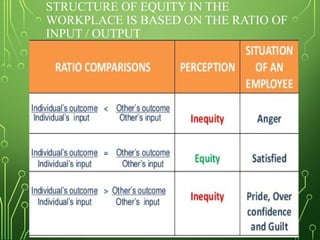
• Adams’ equitytheory of motivation says that to be motivated,
individuals need to perceive that the rewards they receive
for their contributions are fair, and these rewards are similar
to those received by their peers. If individuals perceive that
their rewards are not fair, they will feel distressed and try to
change things to create a sense of fairness.