Group No :-12
.
Presentation Psychology
Topic :-
MOTIVATION
Submitted To :
Ma’am Sajeela
Bilal Naeem 29552
Syed Uzair 29553
.
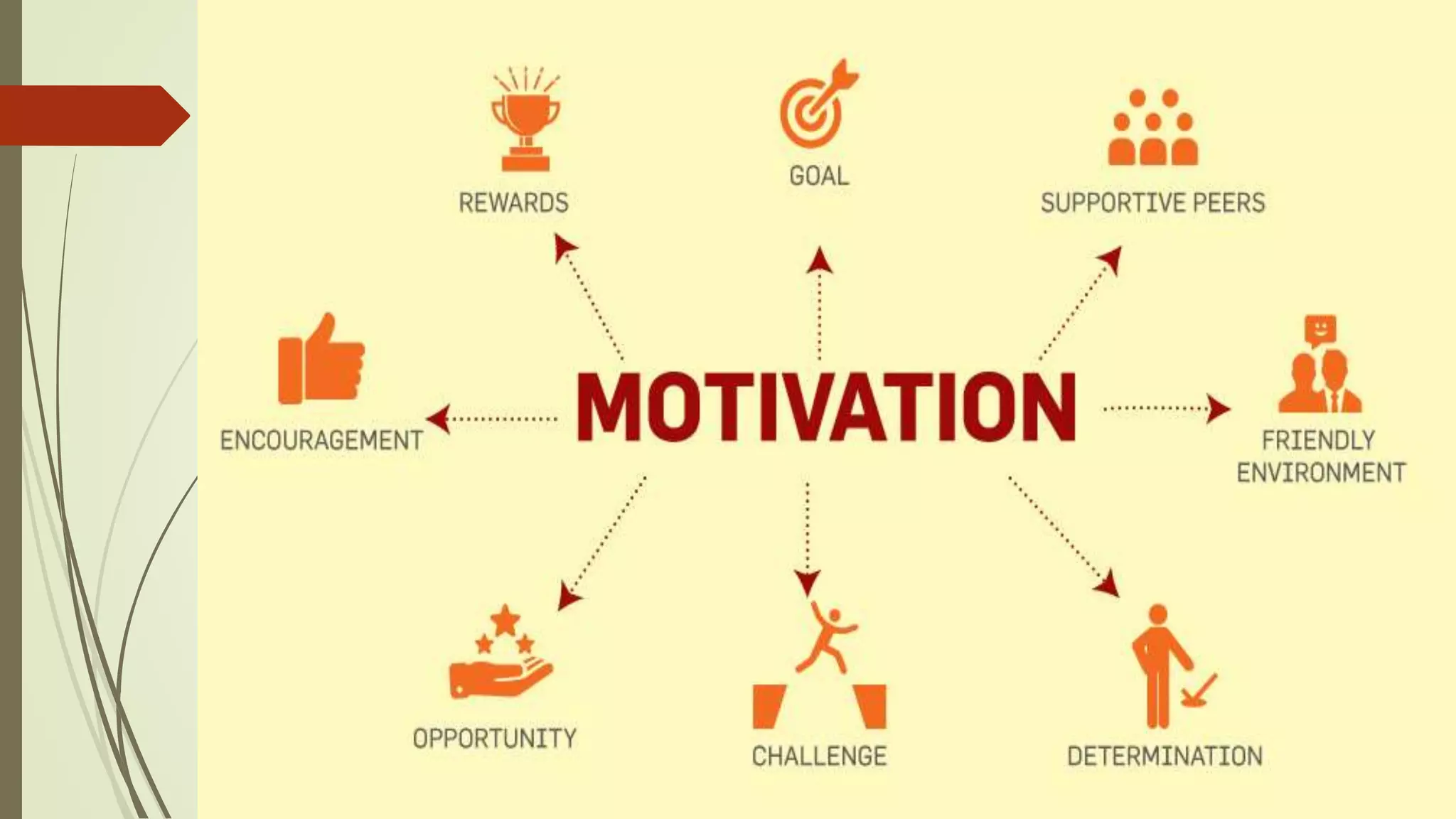
Motivation
The term 'MOTIVATION' has been derived from the latin word MOVERE'
which means 'TO MOVE'.
A Need or desire that motivate direct behavior towards goals
Motivation is the process of including and instigating the subordinates to put
in their best.
DEFINITION
• Motivation means a process of stimulating people to action to accomplish
desired goals. W.G.Scott
• Motivation is a general inspirational process which gets the members of the
team to pull their weight effectively to give their loyalty to the group to carry
out properly the tasks that they accepted and generally to play an effective
part in the job that the group has undertaken. E.F.L. Brech
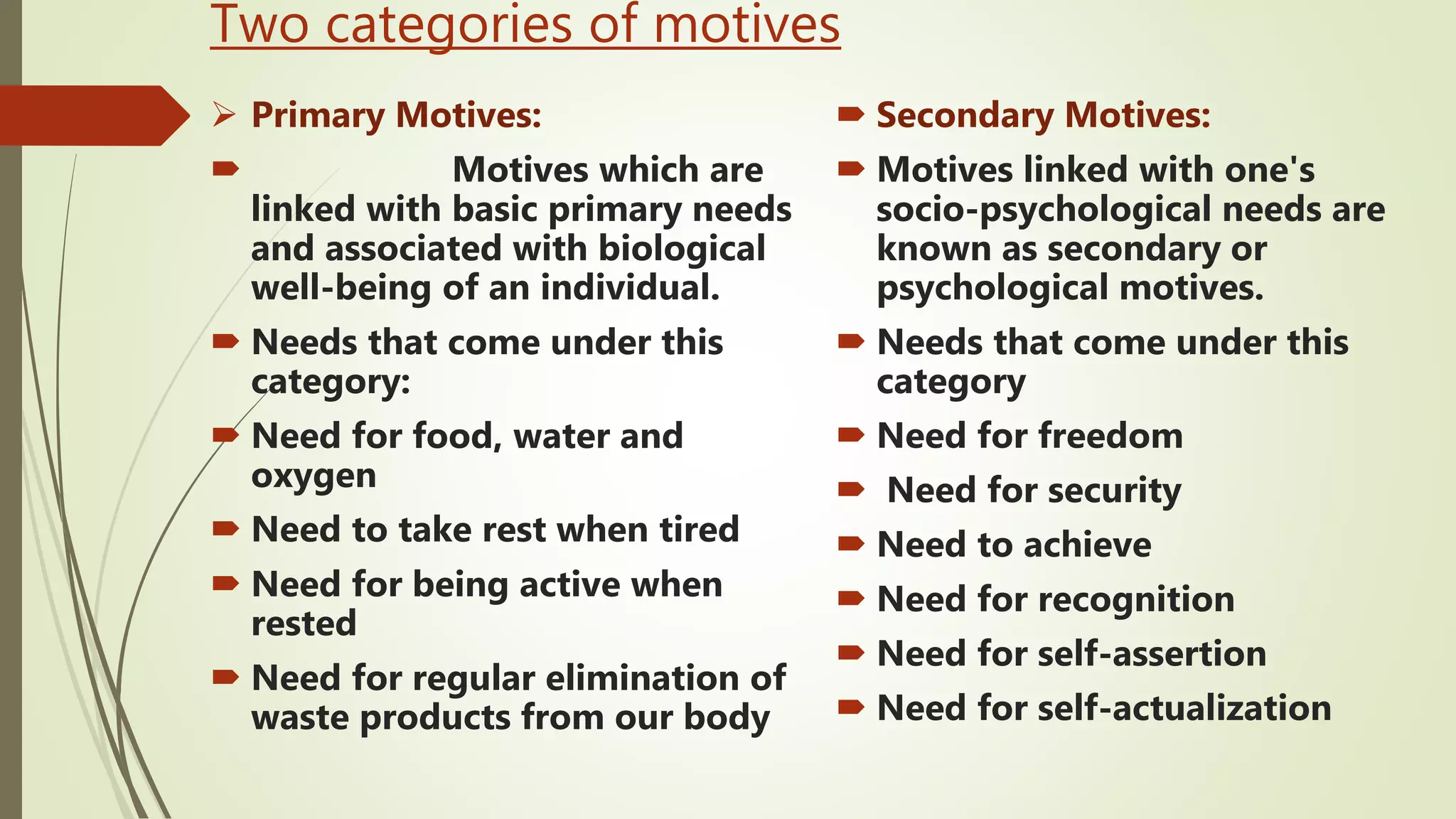
Two categories of motives
 Primary Motives:
 Motives which are
linked with basic primary needs
and associated with biological
well-being of an individual.
 Needs that come under this
category:
 Need for food, water and
oxygen
 Need to take rest when tired
 Need for being active when
rested
 Need for regular elimination of
waste products from our body
 Secondary Motives:
 Motives linked with one's
socio-psychological needs are
known as secondary or
psychological motives.
 Needs that come under this
category
 Need for freedom
 Need for security
 Need to achieve
 Need for recognition
 Need for self-assertion
 Need for self-actualization
NATURE AND CHARACTERISTICS OF MOTIVATION
Component of directing
Psychological aspect
Goals directed
Continuous process
Integrated
Positive or negative
 POSITIVE
 EXAMPLES:
 • Higher pay
 • Greater authority
 • Better designation
 • Providing rewards and incentives
 NEGATIVE
 EXAMPLES:
 • Issue of memo by showing negligence
 • Pay —cut
 • suspension
Type of Motivation
On the basis of source
 Extrinsic
 Intrinsic
 On the basis of approach
 Positive Motivation
 Negative Motivation
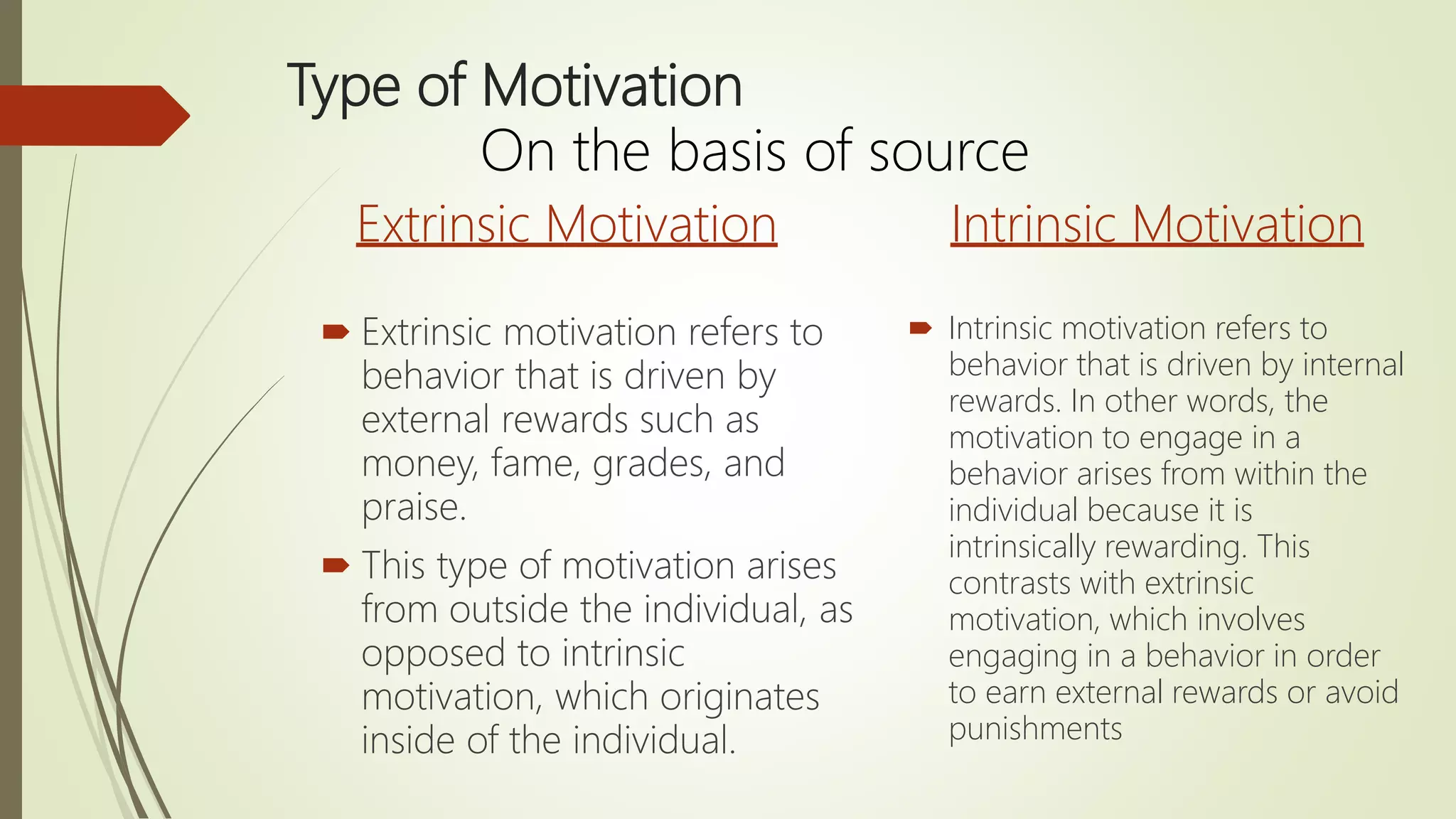
Type of Motivation
On the basis of source
Extrinsic Motivation
 Extrinsic motivation refers to
behavior that is driven by
external rewards such as
money, fame, grades, and
praise.
 This type of motivation arises
from outside the individual, as
opposed to intrinsic
motivation, which originates
inside of the individual.
Intrinsic Motivation
 Intrinsic motivation refers to
behavior that is driven by internal
rewards. In other words, the
motivation to engage in a
behavior arises from within the
individual because it is
intrinsically rewarding. This
contrasts with extrinsic
motivation, which involves
engaging in a behavior in order
to earn external rewards or avoid
punishments
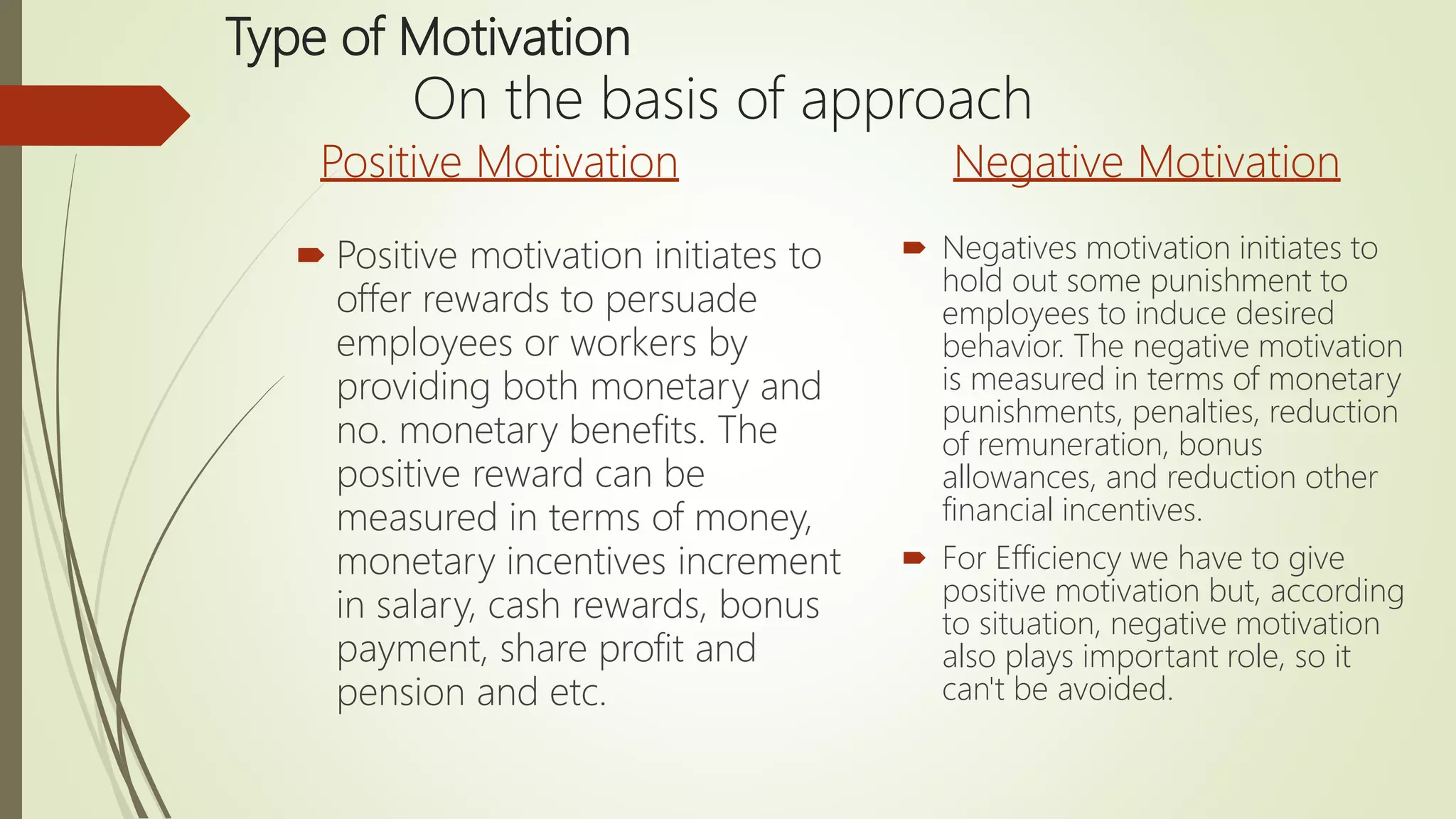
Type of Motivation
On the basis of approach
Positive Motivation
 Positive motivation initiates to
offer rewards to persuade
employees or workers by
providing both monetary and
no. monetary benefits. The
positive reward can be
measured in terms of money,
monetary incentives increment
in salary, cash rewards, bonus
payment, share profit and
pension and etc.
Negative Motivation
 Negatives motivation initiates to
hold out some punishment to
employees to induce desired
behavior. The negative motivation
is measured in terms of monetary
punishments, penalties, reduction
of remuneration, bonus
allowances, and reduction other
financial incentives.
 For Efficiency we have to give
positive motivation but, according
to situation, negative motivation
also plays important role, so it
can't be avoided.
Motivation Quotes
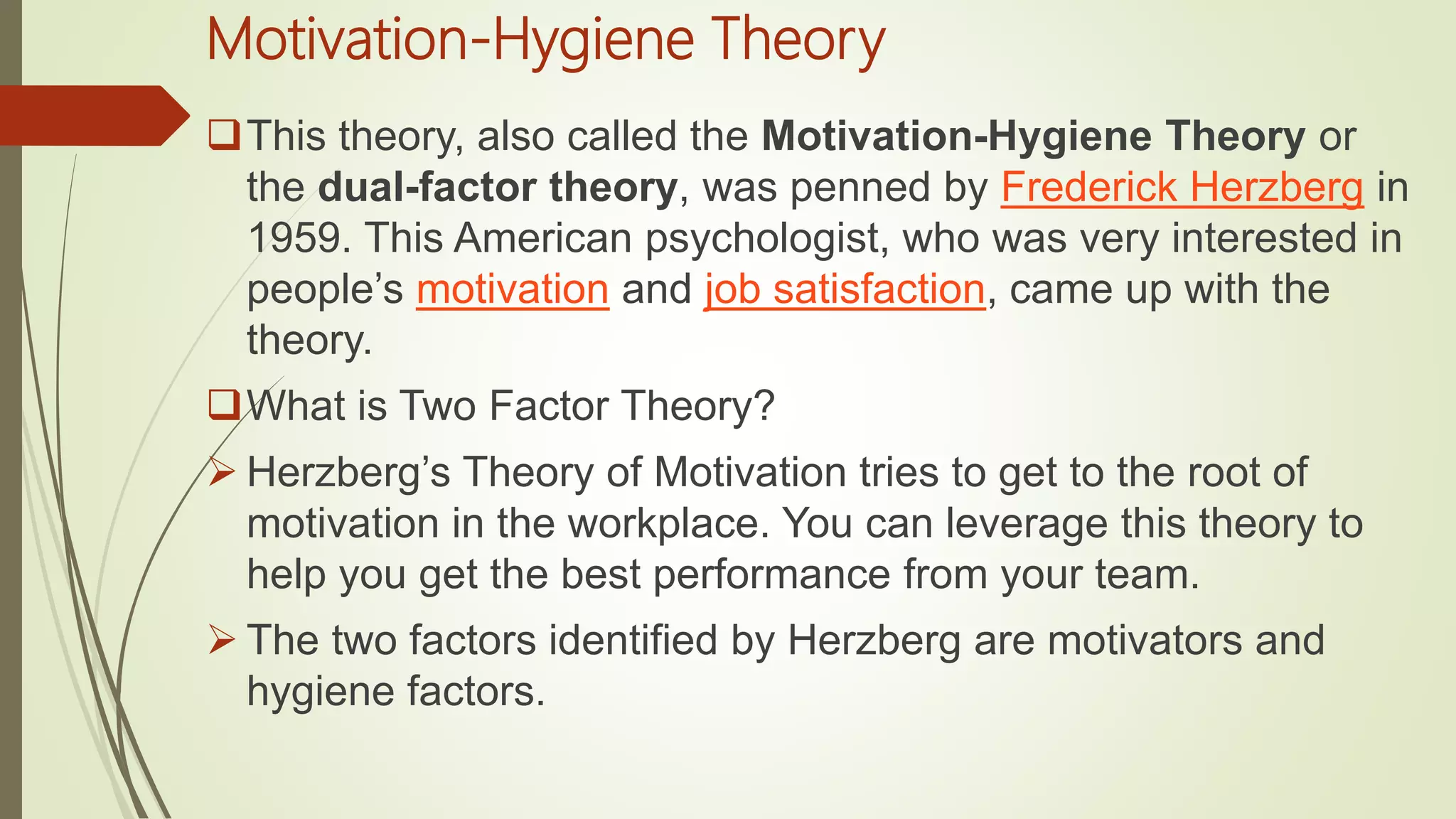
Motivation-Hygiene Theory
This theory, also called the Motivation-Hygiene Theory or
the dual-factor theory, was penned by Frederick Herzberg in
1959. This American psychologist, who was very interested in
people’s motivation and job satisfaction, came up with the
theory.
What is Two Factor Theory?
 Herzberg’s Theory of Motivation tries to get to the root of
motivation in the workplace. You can leverage this theory to
help you get the best performance from your team.
 The two factors identified by Herzberg are motivators and
hygiene factors.
1. Motivating Factors
 The presence of motivators causes employees to work harder. They are
found within the actual job itself.
2. Hygiene Factors
 The absence of hygiene factors will cause employees to work less hard.
Hygiene factors are not present in the actual job itself but surround the
job.
 The impact of motivating and hygiene factors is summarized in the
following diagram. Note that you will often see motivators referred to as
factors for satisfaction, and hygiene factors referred to as factors for
dissatisfaction.
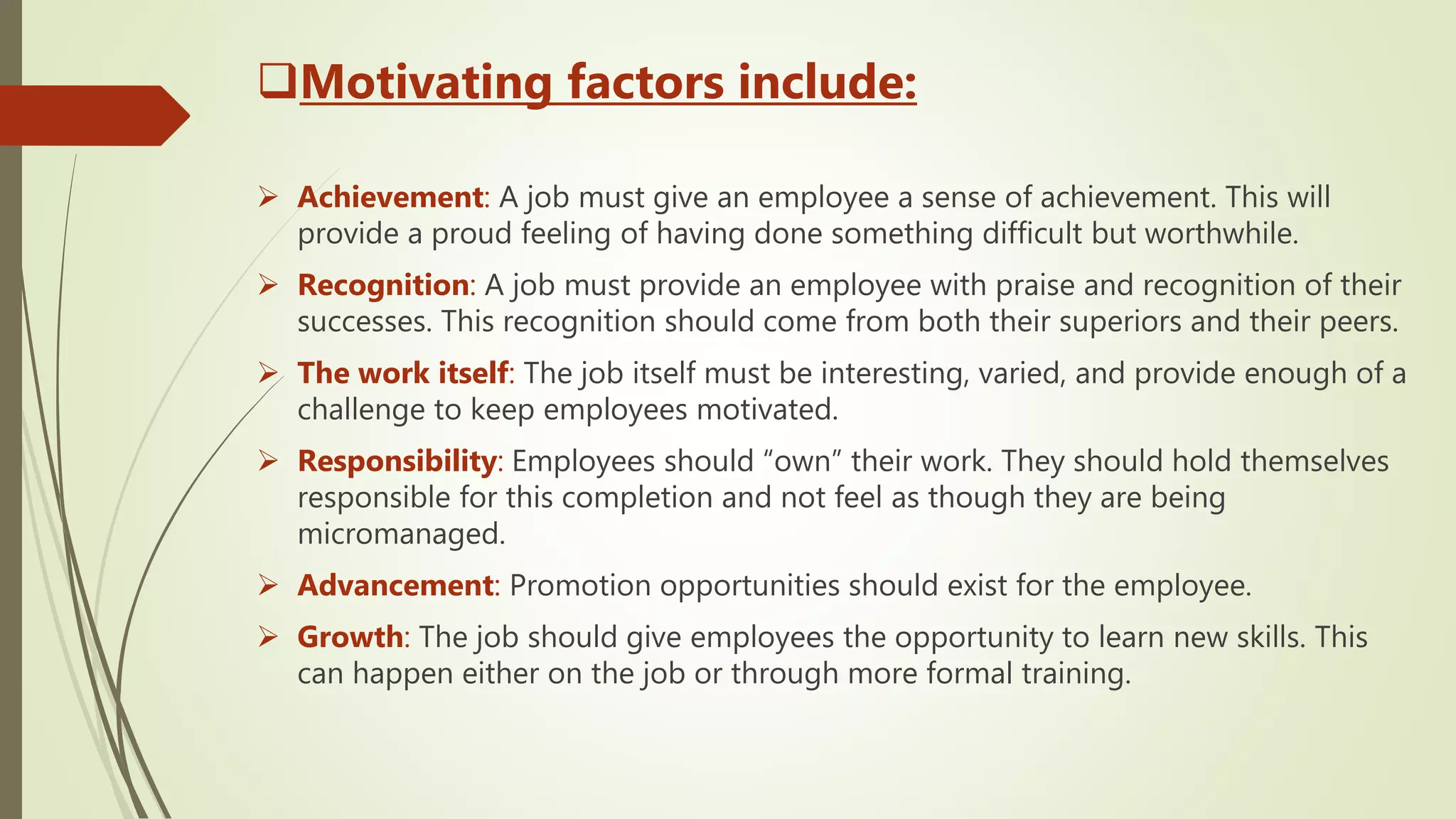
Motivating factors include:
 Achievement: A job must give an employee a sense of achievement. This will
provide a proud feeling of having done something difficult but worthwhile.
 Recognition: A job must provide an employee with praise and recognition of their
successes. This recognition should come from both their superiors and their peers.
 The work itself: The job itself must be interesting, varied, and provide enough of a
challenge to keep employees motivated.
 Responsibility: Employees should “own” their work. They should hold themselves
responsible for this completion and not feel as though they are being
micromanaged.
 Advancement: Promotion opportunities should exist for the employee.
 Growth: The job should give employees the opportunity to learn new skills. This
can happen either on the job or through more formal training.
Hygiene factors include:
 Company policies: These should be fair and clear to every employee. They must also be
equivalent to those of competitors.
 Supervision: Supervision must be fair and appropriate. The employee should be given as
much autonomy as is reasonable.
 Relationships: There should be no tolerance for bullying or cliques. A healthy, amiable,
and appropriate relationship should exist between peers, superiors, and subordinates.
 Work conditions: Equipment and the working environment should be safe, fit for
purpose, and hygienic.
 Salary: The pay structure should be fair and reasonable. It should also be competitive with
other organizations in the same industry.
 Status: The organization should maintain the status of all employees within the organization.
Performing meaningful work can provide a sense of status.
 Security: It is important that employees feel that their job is secure and they are not under
the constant threat of being laid-off.
The Four Stats
 In a general sense, there are four states an organization or team can find themselves in when it
comes to Two Factor Theory.
 1. High Hygiene and High Motivation
 This is the ideal situation and the one which every manager should strive for. Here, all employees
are motivated and have very few grievances.
 2. High Hygiene and Low Motivation
 In this situation, employees have few grievances but they are not highly motivated. An example of
this situation is where pay and working conditions are competitive but the work isn’t very
interesting. Employees are simply there to collect their salary.
 3. Low Hygiene and High Motivation
 In this situation, employees are highly motivated but they have a lot of grievances. A typical
example of this situation is where the work is exciting and really interesting but the pay and
conditions are behind competitors in the same industry.
 4. Low Hygiene and Low Motivation
 This is obviously a bad situation for an organization or team to find itself in. Here, employees aren’t
motivated and the hygiene factors are not up to scratch.
THE END

Motivation In Psychology

  • 1.
  • 2.
    Presentation Psychology Topic :- MOTIVATION SubmittedTo : Ma’am Sajeela Bilal Naeem 29552 Syed Uzair 29553
  • 3.
  • 5.
    Motivation The term 'MOTIVATION'has been derived from the latin word MOVERE' which means 'TO MOVE'. A Need or desire that motivate direct behavior towards goals Motivation is the process of including and instigating the subordinates to put in their best. DEFINITION • Motivation means a process of stimulating people to action to accomplish desired goals. W.G.Scott • Motivation is a general inspirational process which gets the members of the team to pull their weight effectively to give their loyalty to the group to carry out properly the tasks that they accepted and generally to play an effective part in the job that the group has undertaken. E.F.L. Brech
  • 6.
    Two categories ofmotives  Primary Motives:  Motives which are linked with basic primary needs and associated with biological well-being of an individual.  Needs that come under this category:  Need for food, water and oxygen  Need to take rest when tired  Need for being active when rested  Need for regular elimination of waste products from our body  Secondary Motives:  Motives linked with one's socio-psychological needs are known as secondary or psychological motives.  Needs that come under this category  Need for freedom  Need for security  Need to achieve  Need for recognition  Need for self-assertion  Need for self-actualization
  • 7.
    NATURE AND CHARACTERISTICSOF MOTIVATION Component of directing Psychological aspect Goals directed Continuous process Integrated
  • 8.
    Positive or negative POSITIVE  EXAMPLES:  • Higher pay  • Greater authority  • Better designation  • Providing rewards and incentives  NEGATIVE  EXAMPLES:  • Issue of memo by showing negligence  • Pay —cut  • suspension
  • 9.
    Type of Motivation Onthe basis of source  Extrinsic  Intrinsic  On the basis of approach  Positive Motivation  Negative Motivation
  • 10.
    Type of Motivation Onthe basis of source Extrinsic Motivation  Extrinsic motivation refers to behavior that is driven by external rewards such as money, fame, grades, and praise.  This type of motivation arises from outside the individual, as opposed to intrinsic motivation, which originates inside of the individual. Intrinsic Motivation  Intrinsic motivation refers to behavior that is driven by internal rewards. In other words, the motivation to engage in a behavior arises from within the individual because it is intrinsically rewarding. This contrasts with extrinsic motivation, which involves engaging in a behavior in order to earn external rewards or avoid punishments
  • 11.
    Type of Motivation Onthe basis of approach Positive Motivation  Positive motivation initiates to offer rewards to persuade employees or workers by providing both monetary and no. monetary benefits. The positive reward can be measured in terms of money, monetary incentives increment in salary, cash rewards, bonus payment, share profit and pension and etc. Negative Motivation  Negatives motivation initiates to hold out some punishment to employees to induce desired behavior. The negative motivation is measured in terms of monetary punishments, penalties, reduction of remuneration, bonus allowances, and reduction other financial incentives.  For Efficiency we have to give positive motivation but, according to situation, negative motivation also plays important role, so it can't be avoided.
  • 12.
  • 13.
    Motivation-Hygiene Theory This theory,also called the Motivation-Hygiene Theory or the dual-factor theory, was penned by Frederick Herzberg in 1959. This American psychologist, who was very interested in people’s motivation and job satisfaction, came up with the theory. What is Two Factor Theory?  Herzberg’s Theory of Motivation tries to get to the root of motivation in the workplace. You can leverage this theory to help you get the best performance from your team.  The two factors identified by Herzberg are motivators and hygiene factors.
  • 14.
    1. Motivating Factors The presence of motivators causes employees to work harder. They are found within the actual job itself. 2. Hygiene Factors  The absence of hygiene factors will cause employees to work less hard. Hygiene factors are not present in the actual job itself but surround the job.  The impact of motivating and hygiene factors is summarized in the following diagram. Note that you will often see motivators referred to as factors for satisfaction, and hygiene factors referred to as factors for dissatisfaction.
  • 17.
    Motivating factors include: Achievement: A job must give an employee a sense of achievement. This will provide a proud feeling of having done something difficult but worthwhile.  Recognition: A job must provide an employee with praise and recognition of their successes. This recognition should come from both their superiors and their peers.  The work itself: The job itself must be interesting, varied, and provide enough of a challenge to keep employees motivated.  Responsibility: Employees should “own” their work. They should hold themselves responsible for this completion and not feel as though they are being micromanaged.  Advancement: Promotion opportunities should exist for the employee.  Growth: The job should give employees the opportunity to learn new skills. This can happen either on the job or through more formal training.
  • 18.
    Hygiene factors include: Company policies: These should be fair and clear to every employee. They must also be equivalent to those of competitors.  Supervision: Supervision must be fair and appropriate. The employee should be given as much autonomy as is reasonable.  Relationships: There should be no tolerance for bullying or cliques. A healthy, amiable, and appropriate relationship should exist between peers, superiors, and subordinates.  Work conditions: Equipment and the working environment should be safe, fit for purpose, and hygienic.  Salary: The pay structure should be fair and reasonable. It should also be competitive with other organizations in the same industry.  Status: The organization should maintain the status of all employees within the organization. Performing meaningful work can provide a sense of status.  Security: It is important that employees feel that their job is secure and they are not under the constant threat of being laid-off.
  • 19.
    The Four Stats In a general sense, there are four states an organization or team can find themselves in when it comes to Two Factor Theory.  1. High Hygiene and High Motivation  This is the ideal situation and the one which every manager should strive for. Here, all employees are motivated and have very few grievances.  2. High Hygiene and Low Motivation  In this situation, employees have few grievances but they are not highly motivated. An example of this situation is where pay and working conditions are competitive but the work isn’t very interesting. Employees are simply there to collect their salary.  3. Low Hygiene and High Motivation  In this situation, employees are highly motivated but they have a lot of grievances. A typical example of this situation is where the work is exciting and really interesting but the pay and conditions are behind competitors in the same industry.  4. Low Hygiene and Low Motivation  This is obviously a bad situation for an organization or team to find itself in. Here, employees aren’t motivated and the hygiene factors are not up to scratch.
  • 20.