Motivation and Reward
What does it mean to be motivated?
Questions:
What motivates you? What demotivates you?
How is one motivated?
Why is one motivated to do x or y?
Performance problems…
Signs and symptoms:-
• Organization
• Group/Team
• Individual
role of ‘motivation’?
Performance Regulation
• External regulation (Scientific Mgt)
• Subjective regulation (Human Relations)
Regulation through understanding and
managing the employee mind-set
(cooperative systems approach)
Topic of satisfaction and motivation entered the
agenda
Motivation and Reward
….for love…isn’t that the reason why we do
anything….?
Do you love to work? Do you work for love? Do you
work to enable you to love? Would you work if you
didn’t have to?
‘Pay might be the reason why millions of people get out
of bed in the morning and go to work but what they
do when they get there is an entirely different
manner’….(the lottery question…)
Herzberg (1968)
• The simplest method of getting someone to
move is to kick him in the pants
• However, if you kick your dog it moves, but
was it motivated to move?
…..it would certainly be motivated to move
away!
• True motivation comes from within the
person who wants to move
=> goal directed
When we go out to play…
• How might the concept of play inform our
understanding of motivation?
• What is play? What is work?
• Can we play in work? Can we work in play?
What motivates?
Content Theories = taxonomic ‘lists’ of need (e.g. Maslow’s
Hierarchy), motives (e.g. sensation seeking, need for
achievement, need for power)
- e.g. Maslow’s Hierarchy: theory of motivation in general versus
work in particular => attractive ‘holistic’ idea
survival, security/safety, social/belonging, esteem, cognitive,
aesthetic, self-actualising
Hierarchical proposition => movement into a higher order
domain presupposes to fulfilment of lower order needs
Evaluation..
Popularity versus scientific integrity- intuitive plausibility
Difficult to test – needs can operate simultaneously, depends on
relative salience
Arbitrary categorisation – one may seek to fulfil a higher order
need to satisfy lower order needs - e.g. for employability
Does need fulfilment motivate? (complete satisfaction or
continuous striving)
So what? How do ‘needs’ they work? How might we use the
theory?
Two Factor Theory
Herzberg (1968) –
intrinsic (from within)
extrinsic (from outside)
Hygiene needs = ‘disatisfiers’, must be fulfilled to
prevent disatisfaction but won’t increase satisfaction
Motivators = ‘satisfiers’, but won’t prevent
disatisfaction
Evaluation..
No direct evidence, but again, plausible
- e.g. ‘tip of the iceberg’ effect in absence of satisfiers,
dissatisfiers become more salient
Also maybe a threshold of hygiene needs after which more pay
adds nothing to satisfaction (Law of Diminishing Returns)
But, distinction intrinsic and extrinsic dubious e.g. payment
(hygiene/extrinsic) makes possible the fulfilment of intrinsic
(satisfiers) needs, also depends what ‘pay’ means (could be
intrinsic motivator for some)
Again, so what?
How does motivation come about?
Process theories - e.g. equity theory (distributive justice,
procedural justice) instrumentality-expectancy theory, social
exchange theory, goal setting theory…
Social comparisons = reference point
Presuppose a superordinate need for equity/justice/balance of
exchange
Presuppose rational calculation of inputs/outputs
Highly cognitive … where is the sentiment?
So what? What do they tell us about motivation?
What, Why and How?
Content = what? Arbitrary lists of needs
Process = how? Cognitive mechanisms
How useful is either without an answer to ‘why
is one motivated to do x rather than y?’
Importance of theory -> source of explanation
and ‘intervention leverage’
Absence of coherent theory
Piecemeal/fragmented, mini-models, laboratory based,
decontextualised
A theory of motivation must be able to deal with:-
• Individual differences
• Motivated behaviour can occur in adverse
circumstances - e.g. demoralised but continue to
work hard
• Why there might be opposite reactions of some
people to the same objective circumstances
Motivation and Satisfaction
All theories incorporate satisfaction, but, one
can be motivated even if dissatisfied
Why?
Scenario -> professional person in the caring
professions, there is low morale and high
turnover, but not necessarily poor
performance..
Work => self-expressive (directly or indirectly)
Motivation as an expression of identity
What higher order needs does work fulfil?
Competence/efficacy, achievement, meaning,
esteem /worth / validation…
Why are we motivated to do what we do?
Can one be motivated in a ‘have to’ situation? - i.e. is
pure ‘want to’ or intrinsic motivation possible
without constraint?
Implications…
An identity theory of motivation…
Does the term ‘motivation’ signify something
unitary (uni-dimensional) or multi-
dimensional?
Is it more useful as an analytic framework than a
concept?
Still doesn’t answer the question of how?
How?
Theories of goal directed and self-regulated behaviour
Psychological Contract Theory = schema theory
(Rousseau) and/or relationship psychology (Herriot)
Critical importance of understanding processes, not
just inside the head, but between people and the
artefacts in their environment
Universal and Particular
• How can universal theories be used in
particular instances?
• Importance of context…
universal theories are acontextual
particularistic situations – apply only in
a particular context
Contingency theory….
The context of motivation…
Adequacy of individual level of analysis
Groups as a critical link pin and source of
psychological leverage
Understand group processes – formal and
informal – e.g. how do people maintain
motivation in boring jobs? Informal
compensatory mechanisms where there is
some creative licence afforded by mgt
(informal job redesign)
The context of reward
Payment systems => rarely truly contingent on
performance (PRP)
Complex relationship between payment and intrinsic
motivation – e.g. can change the meaning of work
Individual PRP in a team context can undermine
teamwork by creating interpersonal competition
Control or Facilitation
• Balance between management control and
personal/team autonomy
• Critical importance of informal as well as
formal processes
• Imposition of new formal processes (e.g. job
redesign, new technology) can undermine
informal processes with big performance
costs…
Doing more harm than good…
• Sweeping ‘potted’ job design solutions, out-of-
context, potentially disruptive of informal processes
naturally evolved to increase/maintain motivation in
otherwise boring (formal) jobs..
• Context, history, meaning
– What is the context? Context is created in part by informal
processes
– History? Of the current situation, of the individual/group
situation..
– Meaning? What does work mean to an individual or
group…
Work flow…
• What is the task and task objective?
• What are the task conditions and constraints?
• How will the task be completed (processes)
-optimise process by taking into consideration the
task and its requirements and the people involved
-select process that is win-win for task and people;
involve people in deciding on process
Control versus Autonomy – Formal versus Informal
Processes
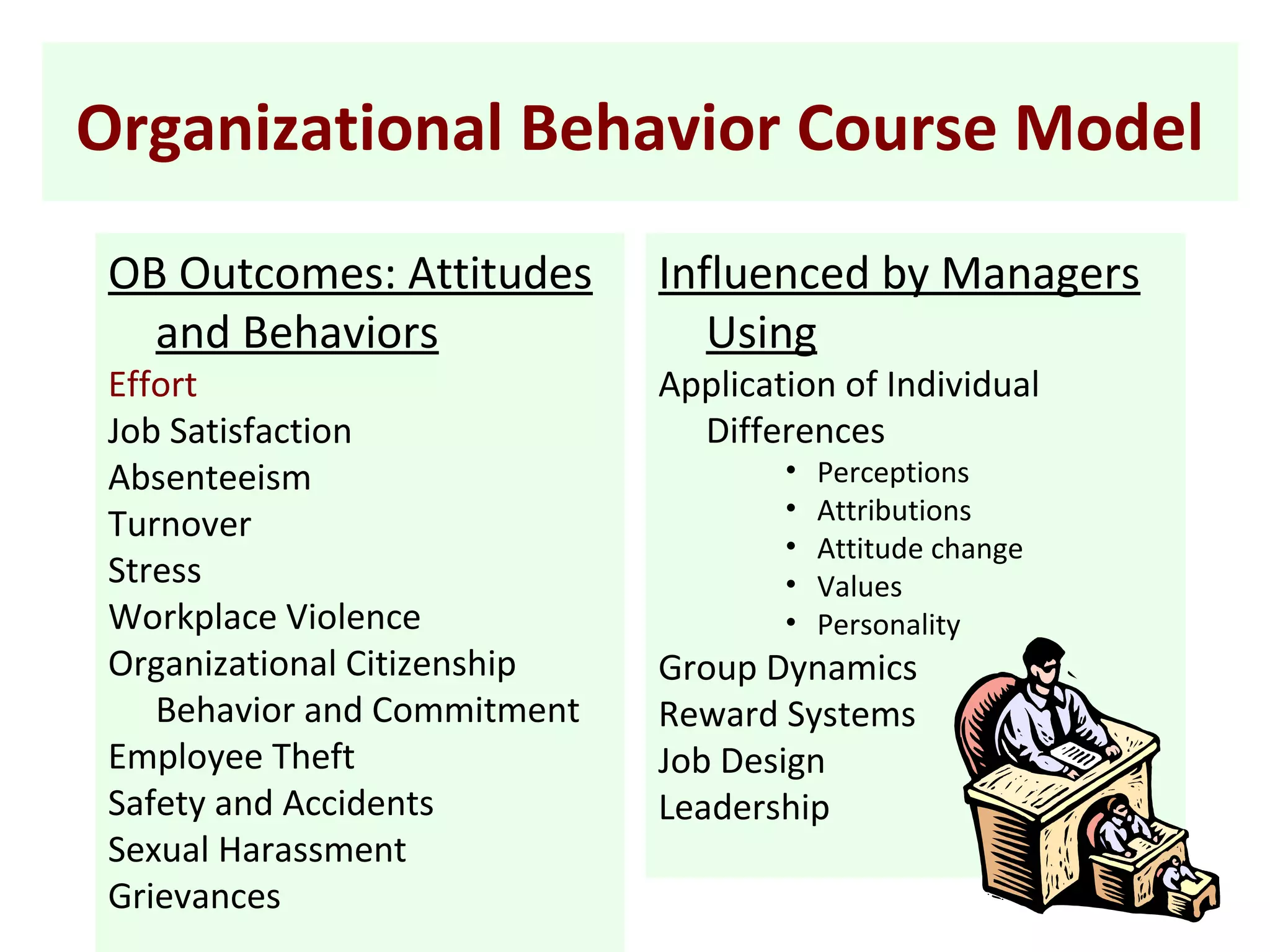
Organizational Behavior Course Model
OB Outcomes: Attitudes
and Behaviors
Effort
Job Satisfaction
Absenteeism
Turnover
Stress
Workplace Violence
Organizational Citizenship
Behavior and Commitment
Employee Theft
Safety and Accidents
Sexual Harassment
Grievances
Influenced by Managers
Using
Application of Individual
Differences
• Perceptions
• Attributions
• Attitude change
• Values
• Personality
Group Dynamics
Reward Systems
Job Design
Leadership
• Motivation Illustration
• Misconceptions about Motivation
*Current generation has no work ethic
* Some people are born “lazy”
* Most people are motivated by the same thing
Why is Motivation Important?
• Under optimal conditions,
effort can often be
increased and sustained
• Delegation without
constant supervision is
always necessary
• Employees can become
self-motivated
• Motivated employees can
provide competitive
advantage by offering
suggestions & working to
satisfy customers
Bottom Line
Motivation is accomplishing
things through the efforts of
others. If you cannot do this,
you will fail as a manager.
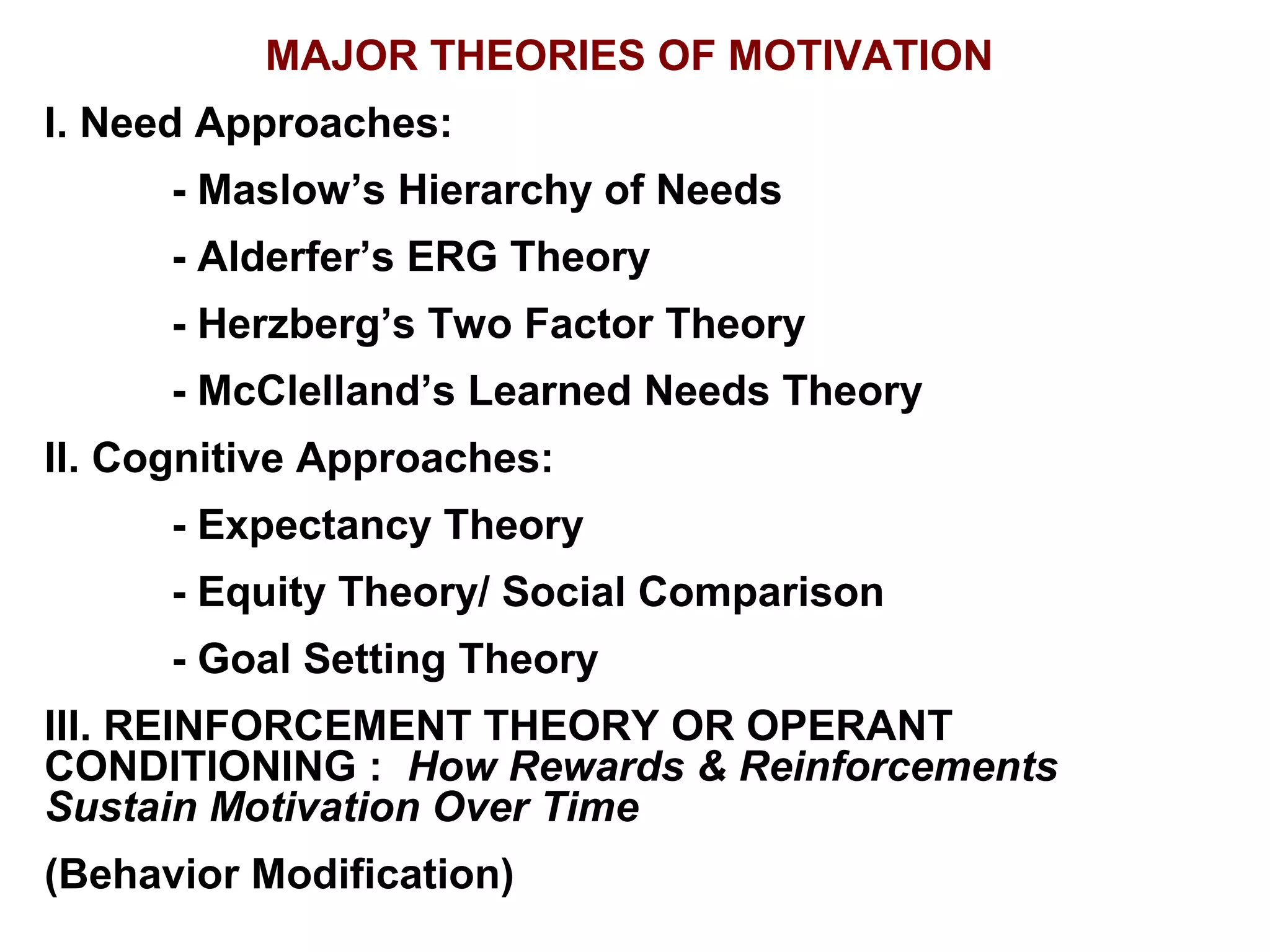
MAJOR THEORIES OF MOTIVATION
I. Need Approaches:
- Maslow’s Hierarchy of Needs
- Alderfer’s ERG Theory
- Herzberg’s Two Factor Theory
- McClelland’s Learned Needs Theory
II. Cognitive Approaches:
- Expectancy Theory
- Equity Theory/ Social Comparison
- Goal Setting Theory
III. REINFORCEMENT THEORY OR OPERANT
CONDITIONING : How Rewards & Reinforcements
Sustain Motivation Over Time
(Behavior Modification)
Job performance = f (ability X
motivation X organizational
support)
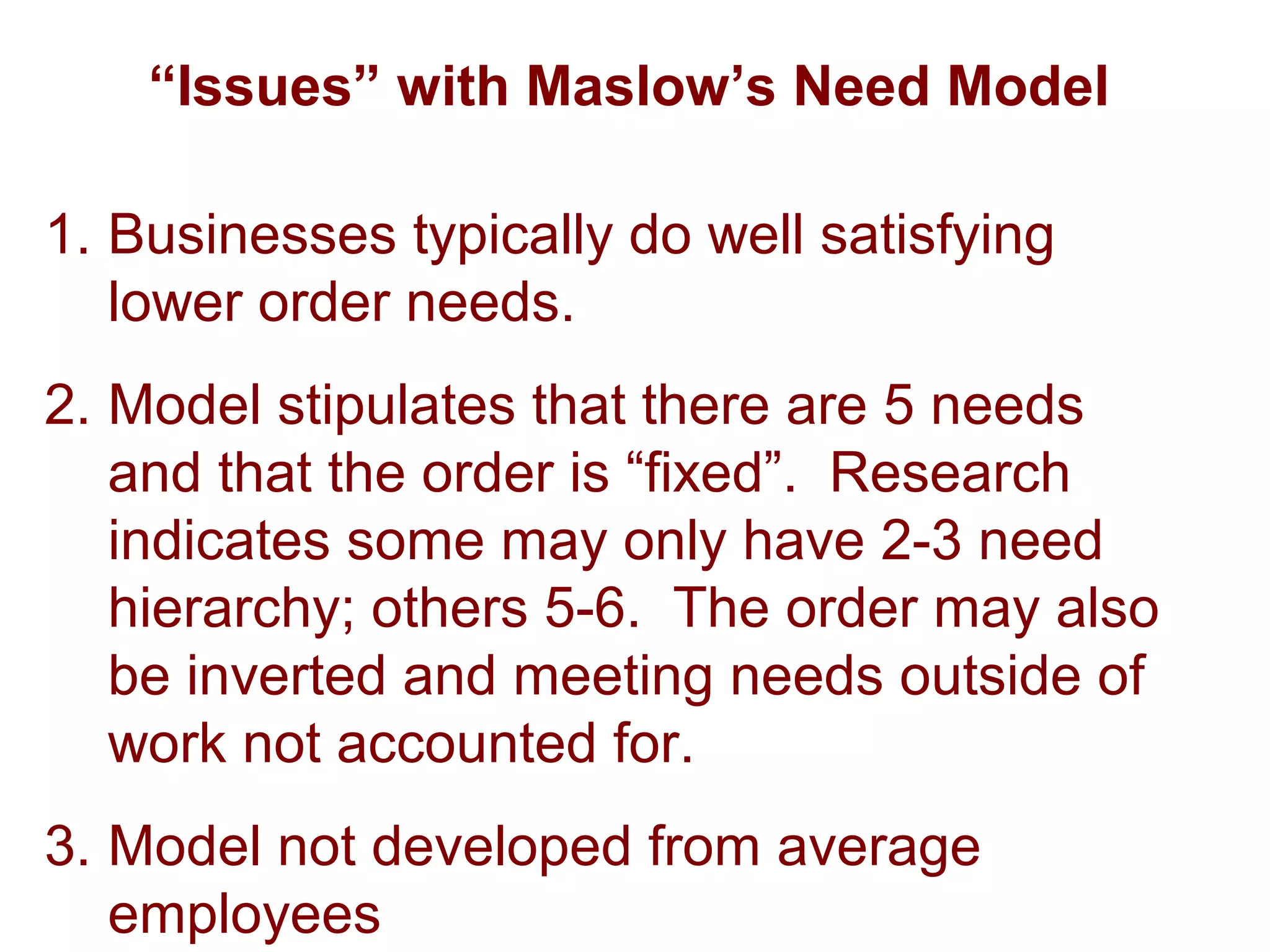
“Issues” with Maslow’s Need Model
1. Businesses typically do well satisfying
lower order needs.
2. Model stipulates that there are 5 needs
and that the order is “fixed”. Research
indicates some may only have 2-3 need
hierarchy; others 5-6. The order may also
be inverted and meeting needs outside of
work not accounted for.
3. Model not developed from average
employees
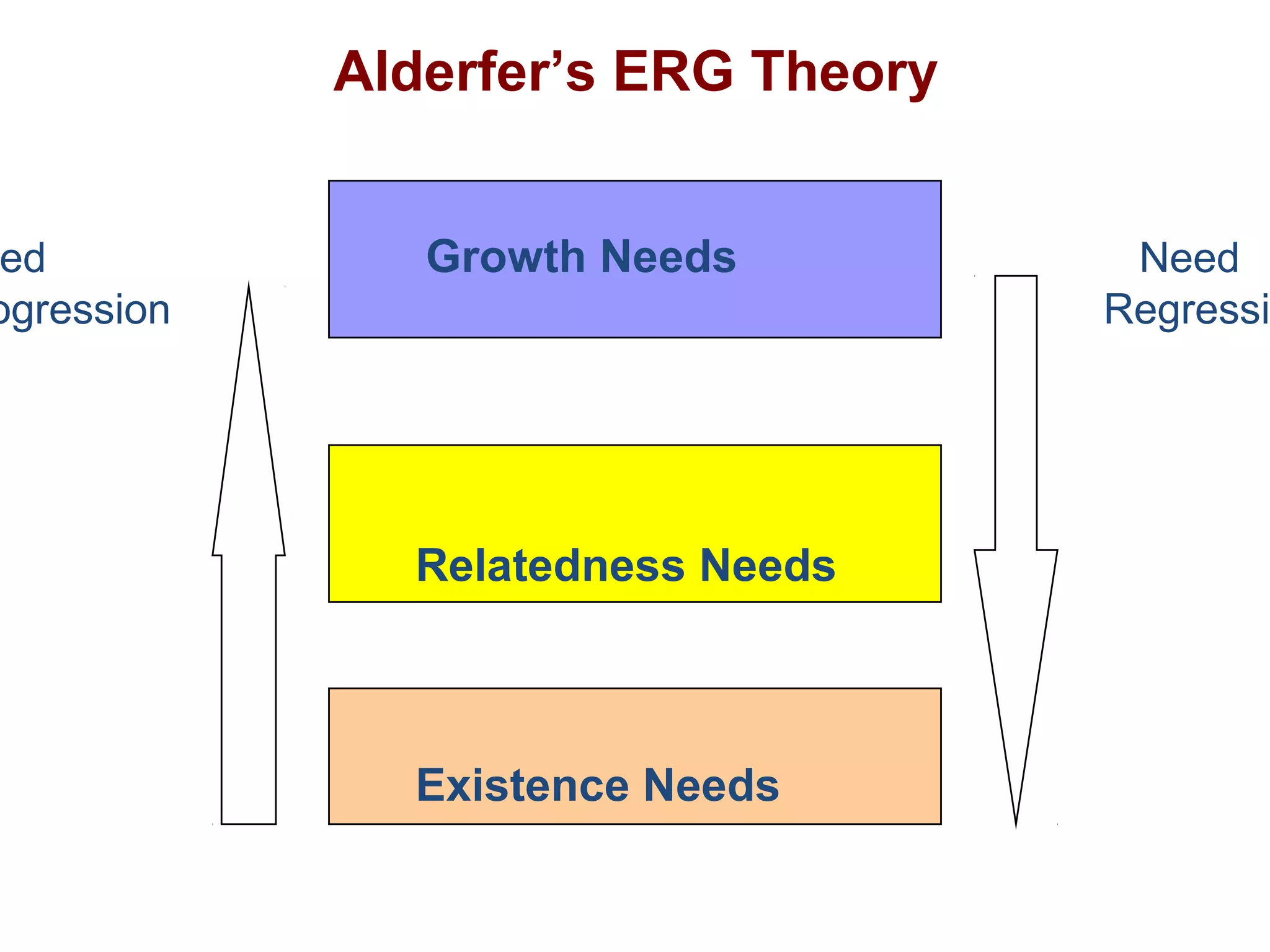
Alderfer’s ERG Theory
ed Growth Needs Need
ogression Regressi
Relatedness Needs
Existence Needs
Herzberg’s Theory Rests on 2 Assumptions
1.) Being satisfied with one’s job is equivalent
to being motivated; “a satisfied worker is a
motivated worker”
2.) Job satisfaction and dissatisfaction are
separate concepts with unique determinants
based on work with accountants and engineers
Herzberg’s 2-Factor Theory
Determinants of Job
Dissatisfaction are
Hygiene* Factors:
• Pay, fringe benefits
• Working conditions
• Quality of supervision
• Interpersonal
relations
Job Environment
Factors
* Poor hygiene can make you,
sick, but good hygiene won’t
Determinants of Job
Satisfaction are
Motivator Factors:
• Work itself,
responsibility
• Advancement
• Recognition
Job Content
Factors
Assessment of Herzberg
Contributions
• 1st to argue that job
content/job design was
important
• Job enrichment (the work
itself) as a job satisfaction
strategy
• Model appealing and easy to
understand
Criticisms
• May be “method-bound” by
self-serving bias
• Some individual
differences, like desire for
pay, rejected as a motivator.
• Also, not everyone wants an
enriched job
• Assumes satisfaction
(presence of motivators) =
motivation
WORK PREFERENCES OF PERSONS HIGH IN NEED
FOR ACHIEVEMENT, AFFILIATION, AND POWER
INDIVIDUAL NEED WORK PREFERENCES JOB EXAMPLE
High need for
achievement
High need for
affiliation
High need for
power
- Individual responsibility
- Challenging but
achievable goals
- Feedback on
performance
- Interpersonal
relationships
- Opportunities to
communicate
- Control over other
persons
- Attention
- Recognition
Field sales person
with challenging
quota and opportunity
to earn individual
bonus
Customer service
representative;
member of work unit
subject to group
wage bonus plan
Formal position of
supervisory
responsibility;
appointment as
head of special task
force or committee
A Comparison of Internal Need Theories of Motivation
aslow’s Alderfer’s Herzberg’s McClelland’s
erarchy ERG Two Factor Acquired
Needs Theory Theory Needs Theory
elf- Achievement
ctualization Growth
Motivator
steem Power
Relatedness
elonging Affiliation
Hygiene
ecurity
Existence
hysiological
THE GOALS OF COGNITIVE
THEORIES ARE
TO EXPLAIN THOUGHTS ABOUT
EFFORT:
1.) the decision to expend effort
2.) the level of effort to exert
3.) how effort can be made to
persist over time
Expectancy Theory
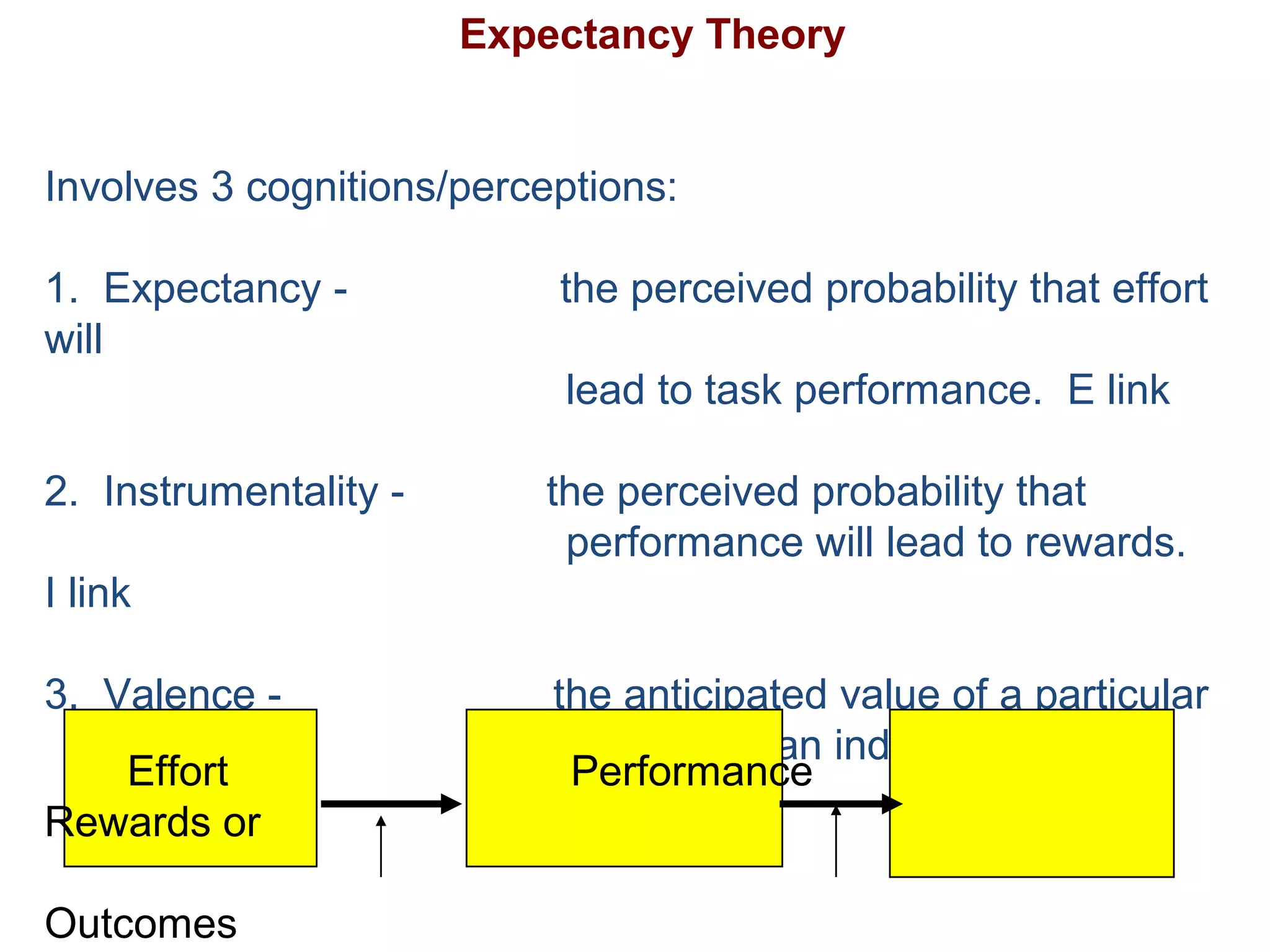
Involves 3 cognitions/perceptions:
1. Expectancy - the perceived probability that effort
will
lead to task performance. E link
2. Instrumentality - the perceived probability that
performance will lead to rewards.
I link
3. Valence - the anticipated value of a particular
outcome to an individual.
Effort Performance
Rewards or
Outcomes
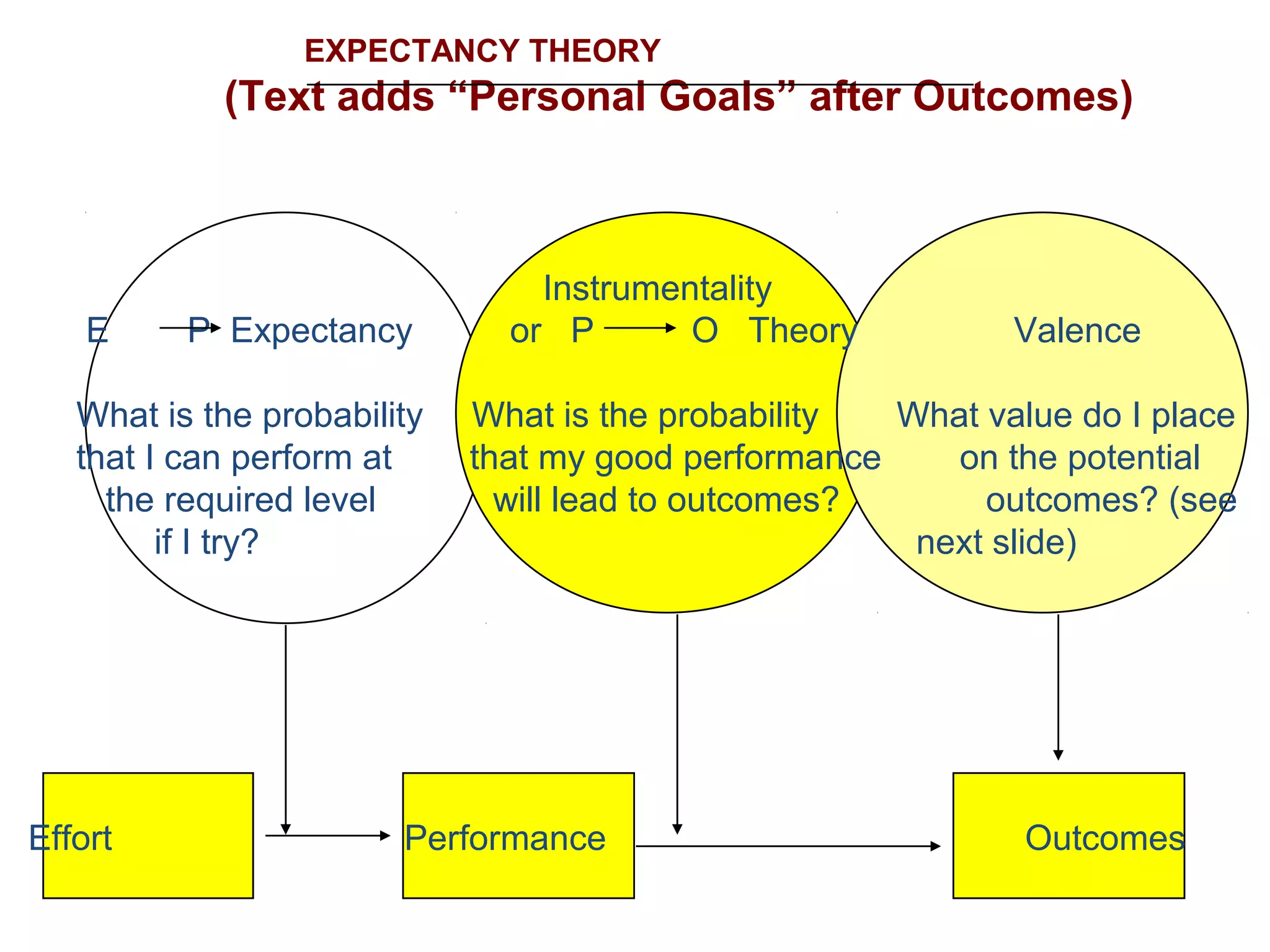
EXPECTANCY THEORY
(Text adds “Personal Goals” after Outcomes)
E P Expectancy or P O Theory Valence
What is the probability What is the probability What value do I place
that I can perform at that my good performance on the potential
the required level will lead to outcomes? outcomes? (see
if I try? next slide)
Instrumentality
Effort Performance Outcomes
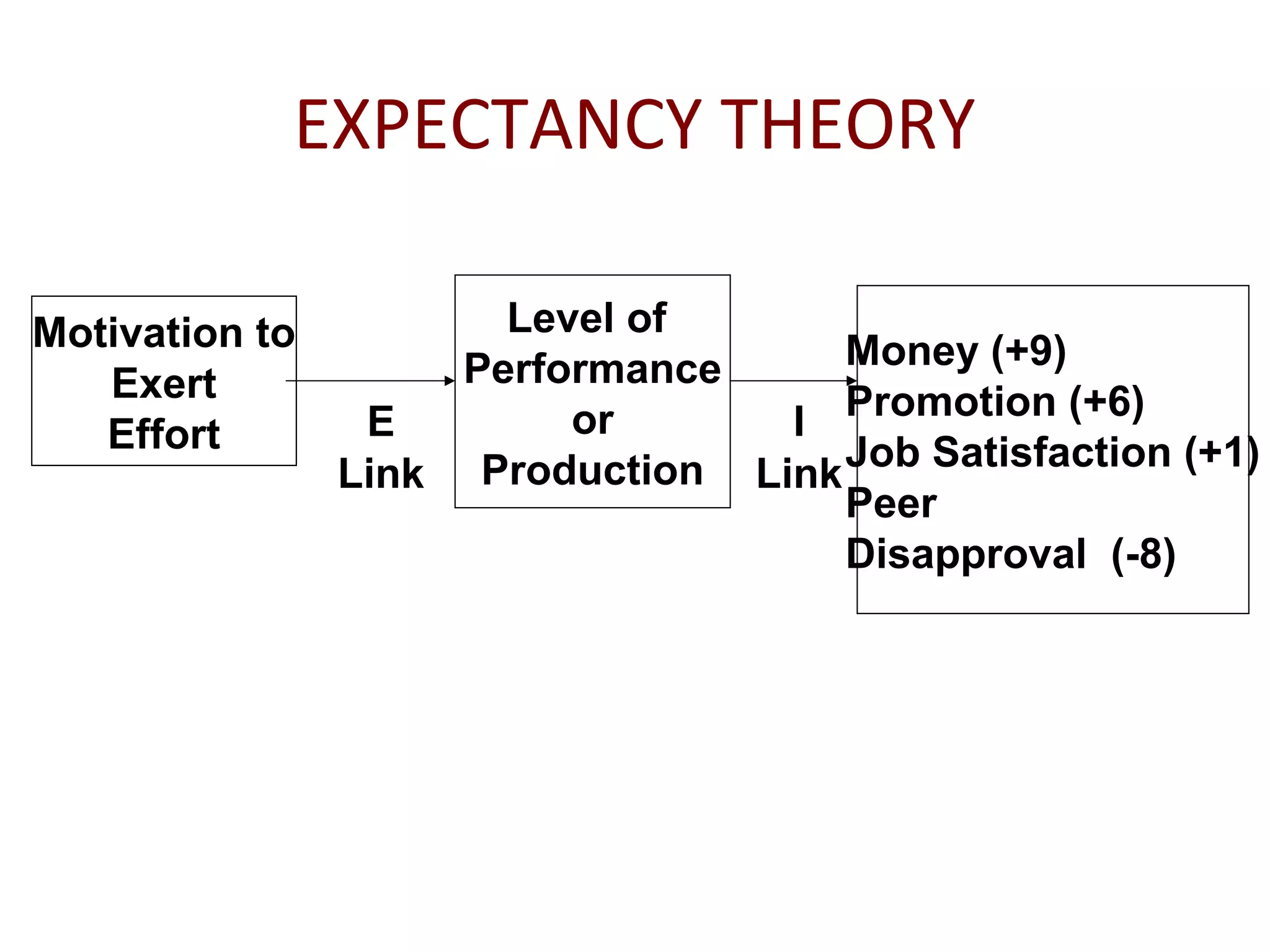
Motivation to
Exert
Effort
Level of
Performance
or
Production
Money (+9)
Promotion (+6)
Job Satisfaction (+1)
Peer
Disapproval (-8)
E
Link
I
Link
EXPECTANCY THEORY
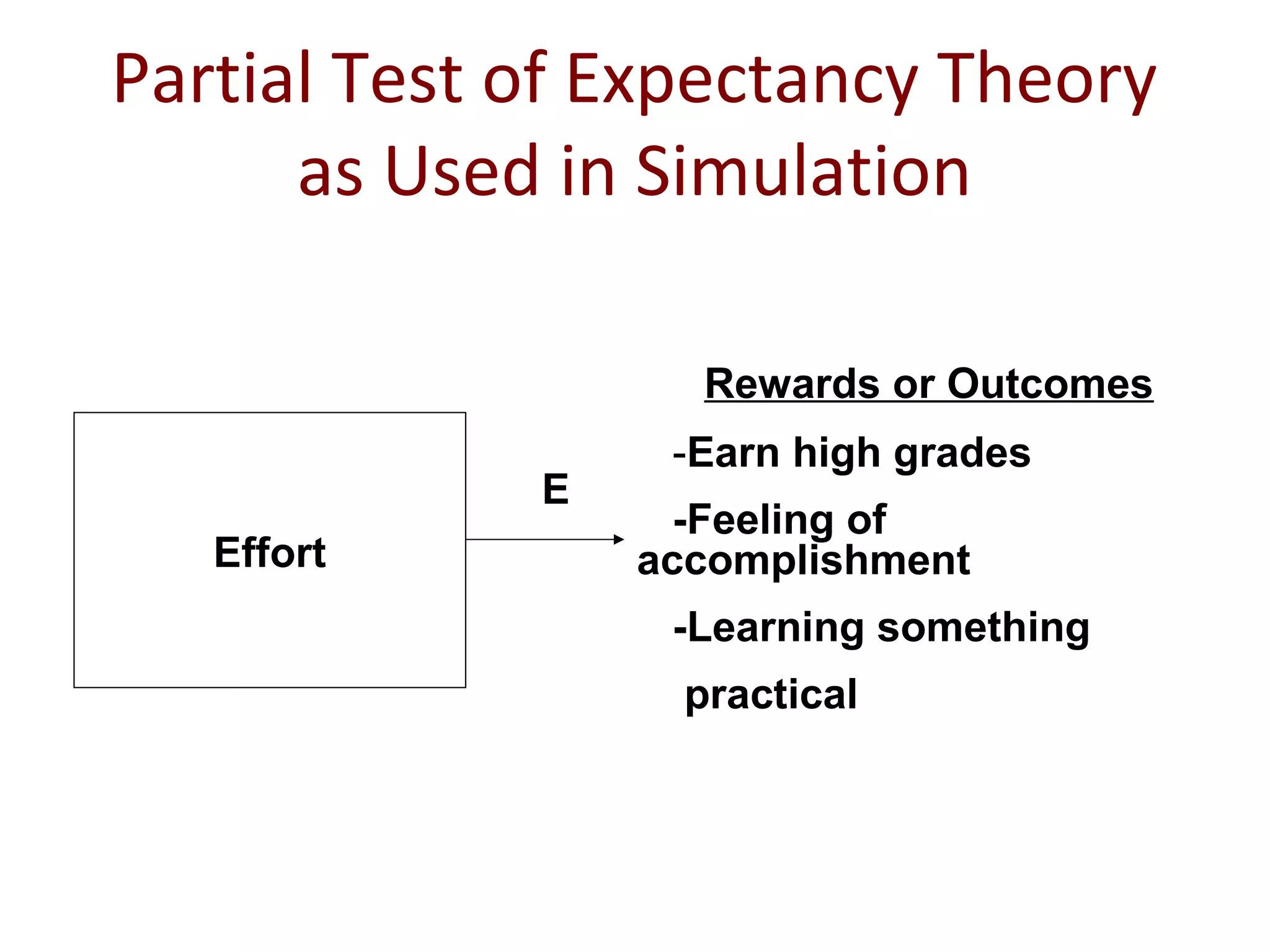
Effort
-Earn high grades
-Feeling of
accomplishment
-Learning something
practical
Partial Test of Expectancy Theory
as Used in Simulation
E
Rewards or Outcomes
Implications for Managers
• Need to offer employees valued rewards (high
valences)
• Need to insure that if people are willing to put forth
effort that you help them succeed. Maintain the E
link (Provide tools, info, support)
• Need to make sure that you follow through with
reward system that is tied to performance. Maintain
the I link (Differential rewards for performance)
What is the basis of equity theory?
• …the thinking process by which one makes
a decision to exert effort is a function of
social comparison
• Based on individual perceptions of
outcomes (what your receive from
expending effort to complete a task), job
inputs (what you bring or contribute to
the task) and perceptions of a referent
person.
Equity Theory: The decision to exert effort is a function
of social comparison
Involves 3 relevant perceptions:
1. Perceptions of outcomes received from performing a task.
(e.g., pay)
2. Perceptions of inputs required to perform a task.
3. Perceptions of the outcomes and inputs of a REFERENCE
PERSON.
If: Outcomes Self Outcomes Reference Person
=
Inputs Self Inputs Reference Person
Then equity exists.
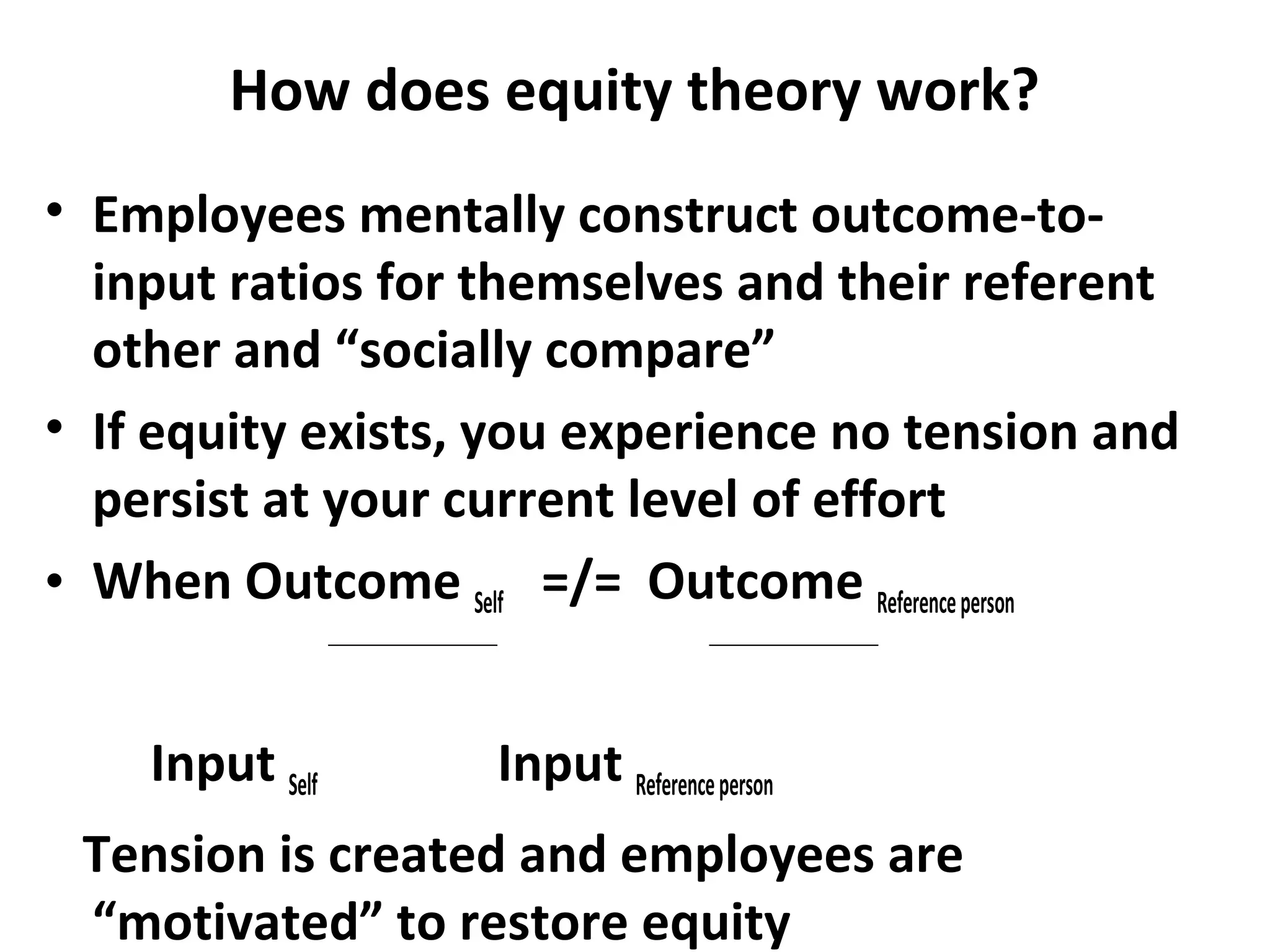
How does equity theory work?
• Employees mentally construct outcome-to-
input ratios for themselves and their referent
other and “socially compare”
• If equity exists, you experience no tension and
persist at your current level of effort
• When Outcome Self =/= Outcome Referenceperson
Input Self Input Referenceperson
Tension is created and employees are
“motivated” to restore equity
Equity Theory
Equitable Situation:
Outcomes Self = Outcomes Reference Person
Job Inputs Self Job Inputs Reference Person
Inequitable Situations:
A. Under-reward or “Cheated” (from Self’s point of view)
Outcomes/Inputs Self 4/5 < Outcomes/Inputs Reference Person 5/5
B. Over-reward or “Guilty” (from Self’s point of view)
Outcomes/Inputs Self 5/4 > Outcomes/Inputs Reference Person 5/5
C. Either way, a person is “motivated” to restore equity with R.P.
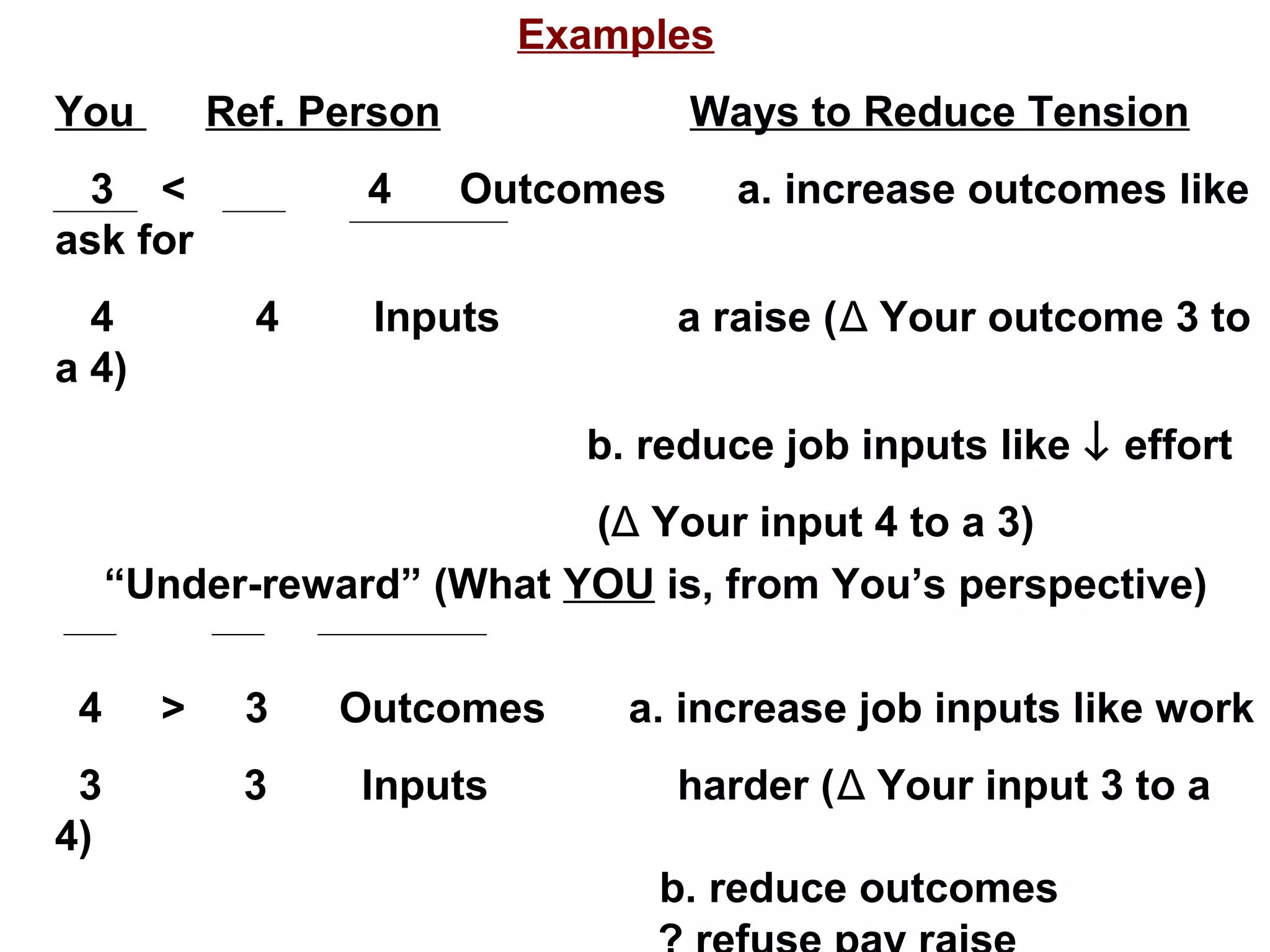
Examples
You Ref. Person Ways to Reduce Tension
3 < 4 Outcomes a. increase outcomes like
ask for
4 4 Inputs a raise (Δ Your outcome 3 to
a 4)
b. reduce job inputs like ↓ effort
(Δ Your input 4 to a 3)
“Under-reward” (What YOU is, from You’s perspective)
4 > 3 Outcomes a. increase job inputs like work
3 3 Inputs harder (Δ Your input 3 to a
4)
b. reduce outcomes
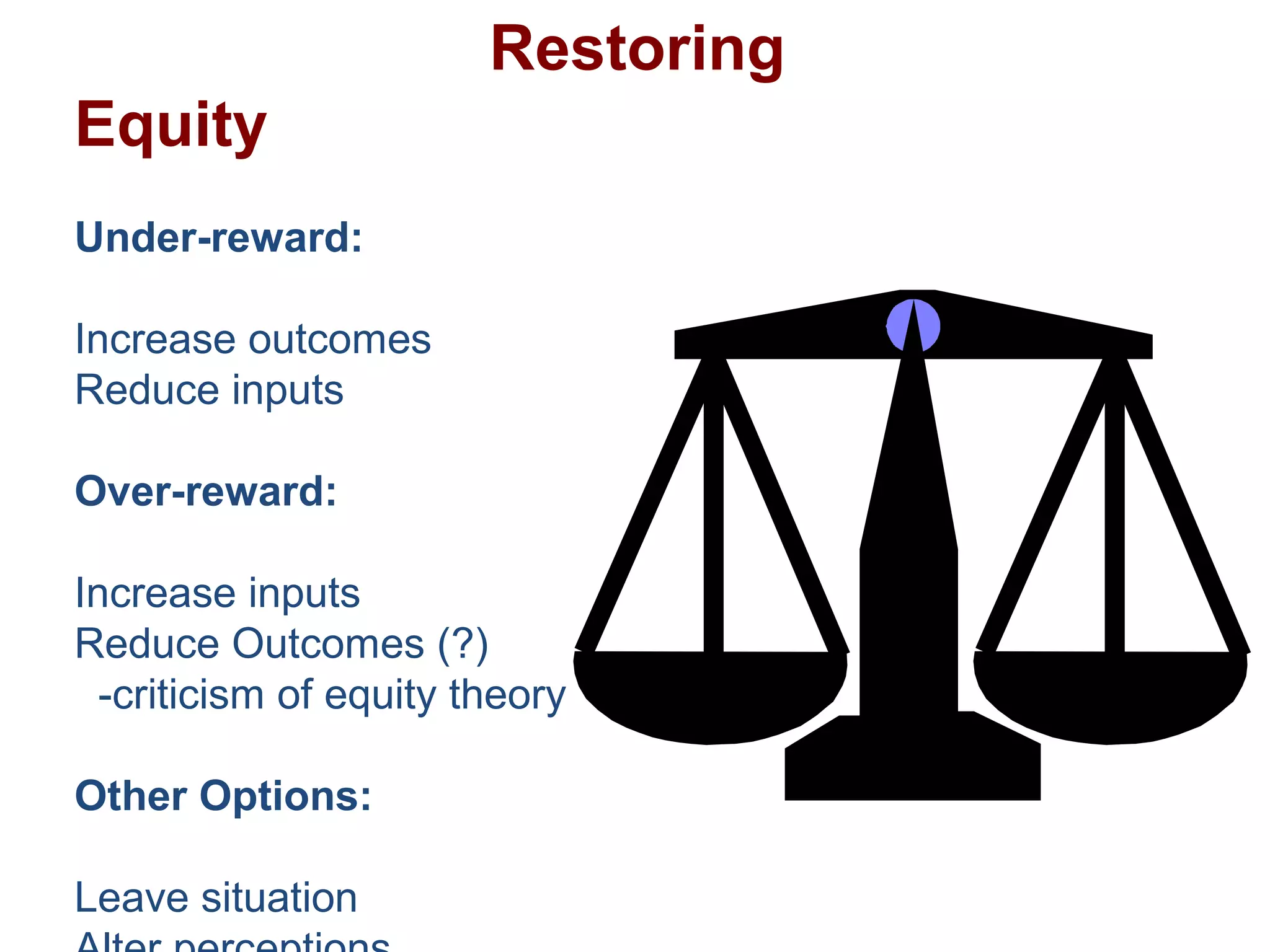
Restoring
Equity
Under-reward:
Increase outcomes
Reduce inputs
Over-reward:
Increase inputs
Reduce Outcomes (?)
-criticism of equity theory
Other Options:
Leave situation
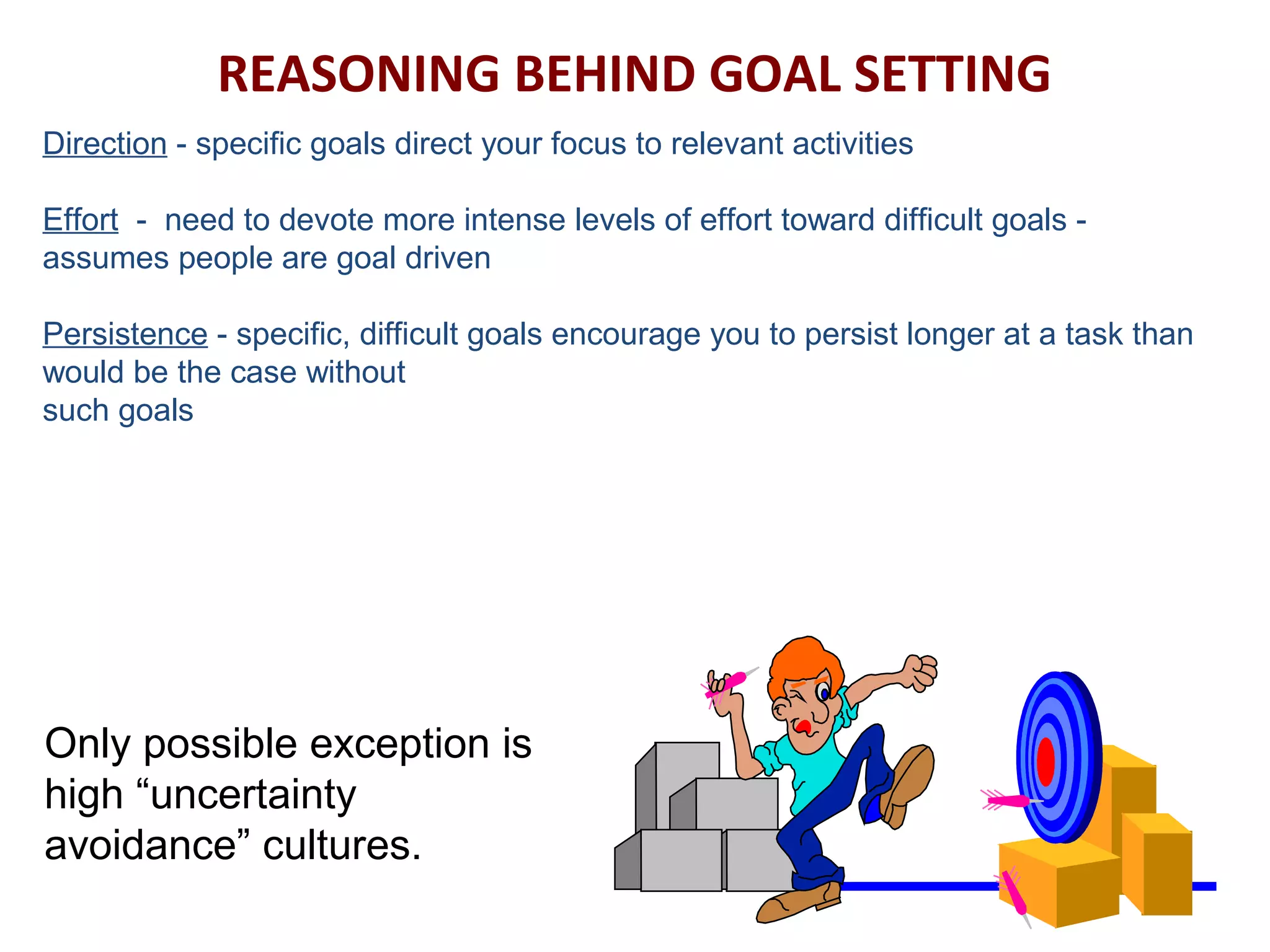
REASONING BEHIND GOAL SETTING
Direction - specific goals direct your focus to relevant activities
Effort - need to devote more intense levels of effort toward difficult goals -
assumes people are goal driven
Persistence - specific, difficult goals encourage you to persist longer at a task than
would be the case without
such goals
Only possible exception is
high “uncertainty
avoidance” cultures.
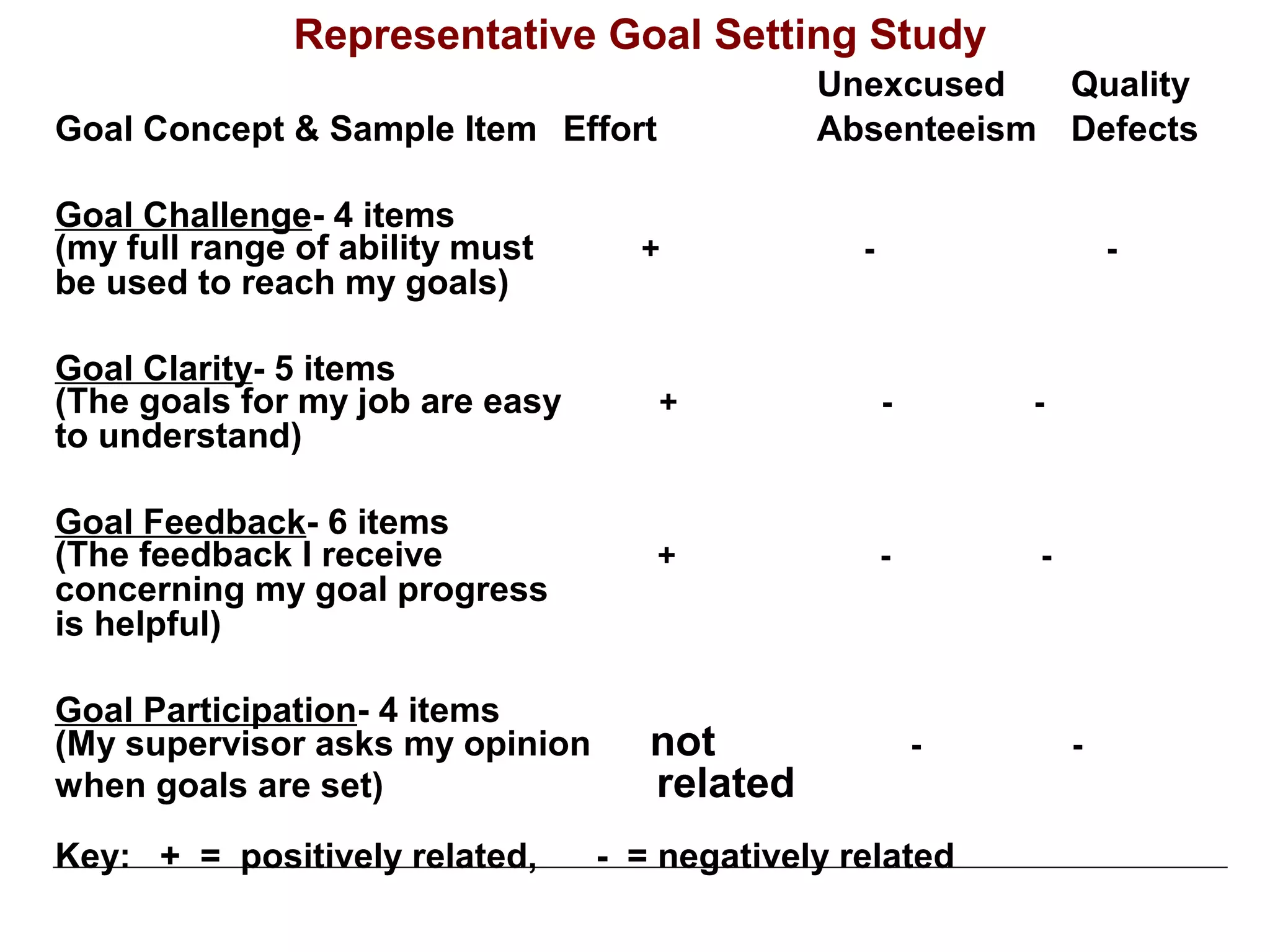
Representative Goal Setting Study
Unexcused Quality
Goal Concept & Sample Item Effort Absenteeism Defects
Goal Challenge- 4 items
(my full range of ability must + - -
be used to reach my goals)
Goal Clarity- 5 items
(The goals for my job are easy + - -
to understand)
Goal Feedback- 6 items
(The feedback I receive + - -
concerning my goal progress
is helpful)
Goal Participation- 4 items
(My supervisor asks my opinion not - -
when goals are set) related
Key: + = positively related, - = negatively related
MAJOR THEORIES OF MOTIVATION
II. Cognitive Approaches:
- Expectancy Theory
- Equity Theory/ Social Comparison
- Goal Setting Theory
III. REINFORCEMENT THEORY OR OPERANT CONDITIONING : How Rewards &
Reinforcements Sustain Motivation Over Time (Behavior Modification)
●May best address how motivation can be made to persist over time
● Behaviors like effort can be sustained or changed by experiencing or
observing reinforcements
Reinforcement Theory of Motivation
• Some view as an explanation of motivation; others
limit it to how motivation is sustained over time.
• Does not have to rely on needs, perceptions or
cognitions. Managers can design work environment
to provide “reinforcers” that strengthen desired
behaviors & weaken undesired behaviors.
“Motivation is a function of the environment”.
• Others allow for cognitions in that people can
observe rewards and punishments applied to others.
Called social learning or vicarious learning.
Motivation as a Form of Learning:
The Law of Effect
• Behavior that leads
toward rewards tends to
be repeated
• Behavior that tends to
lead toward no rewards
or toward punishment
tends to be avoided
• The type of reinforcer &
the timing (schedule) of
reinforcement are key
Reinforcers Which Strengthen Behavior: What managers can
do to increase the probability of behavior in the future
a. Positive reinforcement--rewards contingent on exhibiting the correct behavior.
b. Avoidance Learning—withholding something unpleasant when a desired
behavior is engaged in (e.g., an annoying alarm is avoided when a machine is used
properly, not operating in reverse). Or, using social learning, noticing how engaging
in some behavior avoids an unpleasant outcome (e.g., arrive on time and the boss
does not yell). Text: Negative reinforcement
Reinforcers Which Weaken Behavior: What
managers can do to decrease the probability of behavior in the future
a. Punishment--administering unpleasant
consequences
following an undesirable behavior.
b. Extinction--when there are no rewards for a
behavior which was previously rewarded.
Timing of Reinforcement
a. How quickly reinforcers work depends on their
timing
b. Continuous. Used to “shape” new behaviors
c. But continuous reinforcement is impractical
1. Costly
2. Not as effective in sustaining behavior
over time
Partial Reinforcement Schedules
1. Based on passage of time
Fixed Interval- Reinforcer given after set period of time.
Ex.: Weekly pay.
Variable Interval- Reinforcer given randomly with passage of time.
Ex.: Surprise bonus based on time.
2. Based on behavior exhibited by the employee (team)
Fixed Ratio- Reinforcers based on behaviors.
Ex.: Piece rate pay.
Variable Ratio- Reinforcers applied randomly after exhibition of
behaviors.
Ex.: A company vacation to Hawaii for all employees after a new
contract landed; spot bonuses.
Schedules of Reinforcement
Spacing or Timing of Reinforcer
Fixed Variable
Based on
# of behaviors
exhibited Fixed Ratio Variable Ratio
(ratio) -piece rate -door to door
sales
Basis for
determining Based on Fixed Interval Variable Interval
frequency of passage -weekly
-Occasional
reinforcer of time paycheck praise
by boss
(interval)Which schedule sustains behavior the longest?
Summary of Motivation Theories
A. View all these approaches as a “bag of tricks.”
Alternatives to choose from, remembering that all are not
compatible.
B. Judge whether you believe each “works.” Rely on the
scientific data presented, your experiences, and your
common sense.
C. Evaluate your prospects for successfully implementing
each one--we all vary in our interpersonal skills and ability
to render social rewards sincerely.

Motivation

  • 1.
    Motivation and Reward Whatdoes it mean to be motivated? Questions: What motivates you? What demotivates you? How is one motivated? Why is one motivated to do x or y?
  • 2.
    Performance problems… Signs andsymptoms:- • Organization • Group/Team • Individual role of ‘motivation’?
  • 3.
    Performance Regulation • Externalregulation (Scientific Mgt) • Subjective regulation (Human Relations) Regulation through understanding and managing the employee mind-set (cooperative systems approach) Topic of satisfaction and motivation entered the agenda
  • 4.
    Motivation and Reward ….forlove…isn’t that the reason why we do anything….? Do you love to work? Do you work for love? Do you work to enable you to love? Would you work if you didn’t have to? ‘Pay might be the reason why millions of people get out of bed in the morning and go to work but what they do when they get there is an entirely different manner’….(the lottery question…)
  • 5.
    Herzberg (1968) • Thesimplest method of getting someone to move is to kick him in the pants • However, if you kick your dog it moves, but was it motivated to move? …..it would certainly be motivated to move away! • True motivation comes from within the person who wants to move => goal directed
  • 6.
    When we goout to play… • How might the concept of play inform our understanding of motivation? • What is play? What is work? • Can we play in work? Can we work in play?
  • 7.
    What motivates? Content Theories= taxonomic ‘lists’ of need (e.g. Maslow’s Hierarchy), motives (e.g. sensation seeking, need for achievement, need for power) - e.g. Maslow’s Hierarchy: theory of motivation in general versus work in particular => attractive ‘holistic’ idea survival, security/safety, social/belonging, esteem, cognitive, aesthetic, self-actualising Hierarchical proposition => movement into a higher order domain presupposes to fulfilment of lower order needs
  • 8.
    Evaluation.. Popularity versus scientificintegrity- intuitive plausibility Difficult to test – needs can operate simultaneously, depends on relative salience Arbitrary categorisation – one may seek to fulfil a higher order need to satisfy lower order needs - e.g. for employability Does need fulfilment motivate? (complete satisfaction or continuous striving) So what? How do ‘needs’ they work? How might we use the theory?
  • 9.
    Two Factor Theory Herzberg(1968) – intrinsic (from within) extrinsic (from outside) Hygiene needs = ‘disatisfiers’, must be fulfilled to prevent disatisfaction but won’t increase satisfaction Motivators = ‘satisfiers’, but won’t prevent disatisfaction
  • 10.
    Evaluation.. No direct evidence,but again, plausible - e.g. ‘tip of the iceberg’ effect in absence of satisfiers, dissatisfiers become more salient Also maybe a threshold of hygiene needs after which more pay adds nothing to satisfaction (Law of Diminishing Returns) But, distinction intrinsic and extrinsic dubious e.g. payment (hygiene/extrinsic) makes possible the fulfilment of intrinsic (satisfiers) needs, also depends what ‘pay’ means (could be intrinsic motivator for some) Again, so what?
  • 11.
    How does motivationcome about? Process theories - e.g. equity theory (distributive justice, procedural justice) instrumentality-expectancy theory, social exchange theory, goal setting theory… Social comparisons = reference point Presuppose a superordinate need for equity/justice/balance of exchange Presuppose rational calculation of inputs/outputs Highly cognitive … where is the sentiment? So what? What do they tell us about motivation?
  • 12.
    What, Why andHow? Content = what? Arbitrary lists of needs Process = how? Cognitive mechanisms How useful is either without an answer to ‘why is one motivated to do x rather than y?’ Importance of theory -> source of explanation and ‘intervention leverage’
  • 13.
    Absence of coherenttheory Piecemeal/fragmented, mini-models, laboratory based, decontextualised A theory of motivation must be able to deal with:- • Individual differences • Motivated behaviour can occur in adverse circumstances - e.g. demoralised but continue to work hard • Why there might be opposite reactions of some people to the same objective circumstances
  • 14.
    Motivation and Satisfaction Alltheories incorporate satisfaction, but, one can be motivated even if dissatisfied Why? Scenario -> professional person in the caring professions, there is low morale and high turnover, but not necessarily poor performance.. Work => self-expressive (directly or indirectly)
  • 15.
    Motivation as anexpression of identity What higher order needs does work fulfil? Competence/efficacy, achievement, meaning, esteem /worth / validation… Why are we motivated to do what we do? Can one be motivated in a ‘have to’ situation? - i.e. is pure ‘want to’ or intrinsic motivation possible without constraint?
  • 16.
    Implications… An identity theoryof motivation… Does the term ‘motivation’ signify something unitary (uni-dimensional) or multi- dimensional? Is it more useful as an analytic framework than a concept? Still doesn’t answer the question of how?
  • 17.
    How? Theories of goaldirected and self-regulated behaviour Psychological Contract Theory = schema theory (Rousseau) and/or relationship psychology (Herriot) Critical importance of understanding processes, not just inside the head, but between people and the artefacts in their environment
  • 18.
    Universal and Particular •How can universal theories be used in particular instances? • Importance of context… universal theories are acontextual particularistic situations – apply only in a particular context Contingency theory….
  • 19.
    The context ofmotivation… Adequacy of individual level of analysis Groups as a critical link pin and source of psychological leverage Understand group processes – formal and informal – e.g. how do people maintain motivation in boring jobs? Informal compensatory mechanisms where there is some creative licence afforded by mgt (informal job redesign)
  • 20.
    The context ofreward Payment systems => rarely truly contingent on performance (PRP) Complex relationship between payment and intrinsic motivation – e.g. can change the meaning of work Individual PRP in a team context can undermine teamwork by creating interpersonal competition
  • 21.
    Control or Facilitation •Balance between management control and personal/team autonomy • Critical importance of informal as well as formal processes • Imposition of new formal processes (e.g. job redesign, new technology) can undermine informal processes with big performance costs…
  • 22.
    Doing more harmthan good… • Sweeping ‘potted’ job design solutions, out-of- context, potentially disruptive of informal processes naturally evolved to increase/maintain motivation in otherwise boring (formal) jobs.. • Context, history, meaning – What is the context? Context is created in part by informal processes – History? Of the current situation, of the individual/group situation.. – Meaning? What does work mean to an individual or group…
  • 23.
    Work flow… • Whatis the task and task objective? • What are the task conditions and constraints? • How will the task be completed (processes) -optimise process by taking into consideration the task and its requirements and the people involved -select process that is win-win for task and people; involve people in deciding on process Control versus Autonomy – Formal versus Informal Processes
  • 24.
    Organizational Behavior CourseModel OB Outcomes: Attitudes and Behaviors Effort Job Satisfaction Absenteeism Turnover Stress Workplace Violence Organizational Citizenship Behavior and Commitment Employee Theft Safety and Accidents Sexual Harassment Grievances Influenced by Managers Using Application of Individual Differences • Perceptions • Attributions • Attitude change • Values • Personality Group Dynamics Reward Systems Job Design Leadership
  • 25.
    • Motivation Illustration •Misconceptions about Motivation *Current generation has no work ethic * Some people are born “lazy” * Most people are motivated by the same thing
  • 26.
    Why is MotivationImportant? • Under optimal conditions, effort can often be increased and sustained • Delegation without constant supervision is always necessary • Employees can become self-motivated • Motivated employees can provide competitive advantage by offering suggestions & working to satisfy customers
  • 27.
    Bottom Line Motivation isaccomplishing things through the efforts of others. If you cannot do this, you will fail as a manager.
  • 28.
    MAJOR THEORIES OFMOTIVATION I. Need Approaches: - Maslow’s Hierarchy of Needs - Alderfer’s ERG Theory - Herzberg’s Two Factor Theory - McClelland’s Learned Needs Theory II. Cognitive Approaches: - Expectancy Theory - Equity Theory/ Social Comparison - Goal Setting Theory III. REINFORCEMENT THEORY OR OPERANT CONDITIONING : How Rewards & Reinforcements Sustain Motivation Over Time (Behavior Modification)
  • 29.
    Job performance =f (ability X motivation X organizational support)
  • 30.
    “Issues” with Maslow’sNeed Model 1. Businesses typically do well satisfying lower order needs. 2. Model stipulates that there are 5 needs and that the order is “fixed”. Research indicates some may only have 2-3 need hierarchy; others 5-6. The order may also be inverted and meeting needs outside of work not accounted for. 3. Model not developed from average employees
  • 31.
    Alderfer’s ERG Theory edGrowth Needs Need ogression Regressi Relatedness Needs Existence Needs
  • 32.
    Herzberg’s Theory Restson 2 Assumptions 1.) Being satisfied with one’s job is equivalent to being motivated; “a satisfied worker is a motivated worker” 2.) Job satisfaction and dissatisfaction are separate concepts with unique determinants based on work with accountants and engineers
  • 33.
    Herzberg’s 2-Factor Theory Determinantsof Job Dissatisfaction are Hygiene* Factors: • Pay, fringe benefits • Working conditions • Quality of supervision • Interpersonal relations Job Environment Factors * Poor hygiene can make you, sick, but good hygiene won’t Determinants of Job Satisfaction are Motivator Factors: • Work itself, responsibility • Advancement • Recognition Job Content Factors
  • 34.
    Assessment of Herzberg Contributions •1st to argue that job content/job design was important • Job enrichment (the work itself) as a job satisfaction strategy • Model appealing and easy to understand Criticisms • May be “method-bound” by self-serving bias • Some individual differences, like desire for pay, rejected as a motivator. • Also, not everyone wants an enriched job • Assumes satisfaction (presence of motivators) = motivation
  • 35.
    WORK PREFERENCES OFPERSONS HIGH IN NEED FOR ACHIEVEMENT, AFFILIATION, AND POWER INDIVIDUAL NEED WORK PREFERENCES JOB EXAMPLE High need for achievement High need for affiliation High need for power - Individual responsibility - Challenging but achievable goals - Feedback on performance - Interpersonal relationships - Opportunities to communicate - Control over other persons - Attention - Recognition Field sales person with challenging quota and opportunity to earn individual bonus Customer service representative; member of work unit subject to group wage bonus plan Formal position of supervisory responsibility; appointment as head of special task force or committee
  • 36.
    A Comparison ofInternal Need Theories of Motivation aslow’s Alderfer’s Herzberg’s McClelland’s erarchy ERG Two Factor Acquired Needs Theory Theory Needs Theory elf- Achievement ctualization Growth Motivator steem Power Relatedness elonging Affiliation Hygiene ecurity Existence hysiological
  • 37.
    THE GOALS OFCOGNITIVE THEORIES ARE TO EXPLAIN THOUGHTS ABOUT EFFORT: 1.) the decision to expend effort 2.) the level of effort to exert 3.) how effort can be made to persist over time
  • 38.
    Expectancy Theory Involves 3cognitions/perceptions: 1. Expectancy - the perceived probability that effort will lead to task performance. E link 2. Instrumentality - the perceived probability that performance will lead to rewards. I link 3. Valence - the anticipated value of a particular outcome to an individual. Effort Performance Rewards or Outcomes
  • 39.
    EXPECTANCY THEORY (Text adds“Personal Goals” after Outcomes) E P Expectancy or P O Theory Valence What is the probability What is the probability What value do I place that I can perform at that my good performance on the potential the required level will lead to outcomes? outcomes? (see if I try? next slide) Instrumentality Effort Performance Outcomes
  • 40.
    Motivation to Exert Effort Level of Performance or Production Money(+9) Promotion (+6) Job Satisfaction (+1) Peer Disapproval (-8) E Link I Link EXPECTANCY THEORY
  • 41.
    Effort -Earn high grades -Feelingof accomplishment -Learning something practical Partial Test of Expectancy Theory as Used in Simulation E Rewards or Outcomes
  • 42.
    Implications for Managers •Need to offer employees valued rewards (high valences) • Need to insure that if people are willing to put forth effort that you help them succeed. Maintain the E link (Provide tools, info, support) • Need to make sure that you follow through with reward system that is tied to performance. Maintain the I link (Differential rewards for performance)
  • 43.
    What is thebasis of equity theory? • …the thinking process by which one makes a decision to exert effort is a function of social comparison • Based on individual perceptions of outcomes (what your receive from expending effort to complete a task), job inputs (what you bring or contribute to the task) and perceptions of a referent person.
  • 44.
    Equity Theory: Thedecision to exert effort is a function of social comparison Involves 3 relevant perceptions: 1. Perceptions of outcomes received from performing a task. (e.g., pay) 2. Perceptions of inputs required to perform a task. 3. Perceptions of the outcomes and inputs of a REFERENCE PERSON. If: Outcomes Self Outcomes Reference Person = Inputs Self Inputs Reference Person Then equity exists.
  • 45.
    How does equitytheory work? • Employees mentally construct outcome-to- input ratios for themselves and their referent other and “socially compare” • If equity exists, you experience no tension and persist at your current level of effort • When Outcome Self =/= Outcome Referenceperson Input Self Input Referenceperson Tension is created and employees are “motivated” to restore equity
  • 46.
    Equity Theory Equitable Situation: OutcomesSelf = Outcomes Reference Person Job Inputs Self Job Inputs Reference Person Inequitable Situations: A. Under-reward or “Cheated” (from Self’s point of view) Outcomes/Inputs Self 4/5 < Outcomes/Inputs Reference Person 5/5 B. Over-reward or “Guilty” (from Self’s point of view) Outcomes/Inputs Self 5/4 > Outcomes/Inputs Reference Person 5/5 C. Either way, a person is “motivated” to restore equity with R.P.
  • 47.
    Examples You Ref. PersonWays to Reduce Tension 3 < 4 Outcomes a. increase outcomes like ask for 4 4 Inputs a raise (Δ Your outcome 3 to a 4) b. reduce job inputs like ↓ effort (Δ Your input 4 to a 3) “Under-reward” (What YOU is, from You’s perspective) 4 > 3 Outcomes a. increase job inputs like work 3 3 Inputs harder (Δ Your input 3 to a 4) b. reduce outcomes
  • 48.
    Restoring Equity Under-reward: Increase outcomes Reduce inputs Over-reward: Increaseinputs Reduce Outcomes (?) -criticism of equity theory Other Options: Leave situation
  • 49.
    REASONING BEHIND GOALSETTING Direction - specific goals direct your focus to relevant activities Effort - need to devote more intense levels of effort toward difficult goals - assumes people are goal driven Persistence - specific, difficult goals encourage you to persist longer at a task than would be the case without such goals Only possible exception is high “uncertainty avoidance” cultures.
  • 50.
    Representative Goal SettingStudy Unexcused Quality Goal Concept & Sample Item Effort Absenteeism Defects Goal Challenge- 4 items (my full range of ability must + - - be used to reach my goals) Goal Clarity- 5 items (The goals for my job are easy + - - to understand) Goal Feedback- 6 items (The feedback I receive + - - concerning my goal progress is helpful) Goal Participation- 4 items (My supervisor asks my opinion not - - when goals are set) related Key: + = positively related, - = negatively related
  • 51.
    MAJOR THEORIES OFMOTIVATION II. Cognitive Approaches: - Expectancy Theory - Equity Theory/ Social Comparison - Goal Setting Theory III. REINFORCEMENT THEORY OR OPERANT CONDITIONING : How Rewards & Reinforcements Sustain Motivation Over Time (Behavior Modification) ●May best address how motivation can be made to persist over time ● Behaviors like effort can be sustained or changed by experiencing or observing reinforcements
  • 52.
    Reinforcement Theory ofMotivation • Some view as an explanation of motivation; others limit it to how motivation is sustained over time. • Does not have to rely on needs, perceptions or cognitions. Managers can design work environment to provide “reinforcers” that strengthen desired behaviors & weaken undesired behaviors. “Motivation is a function of the environment”. • Others allow for cognitions in that people can observe rewards and punishments applied to others. Called social learning or vicarious learning.
  • 53.
    Motivation as aForm of Learning: The Law of Effect • Behavior that leads toward rewards tends to be repeated • Behavior that tends to lead toward no rewards or toward punishment tends to be avoided • The type of reinforcer & the timing (schedule) of reinforcement are key
  • 54.
    Reinforcers Which StrengthenBehavior: What managers can do to increase the probability of behavior in the future a. Positive reinforcement--rewards contingent on exhibiting the correct behavior. b. Avoidance Learning—withholding something unpleasant when a desired behavior is engaged in (e.g., an annoying alarm is avoided when a machine is used properly, not operating in reverse). Or, using social learning, noticing how engaging in some behavior avoids an unpleasant outcome (e.g., arrive on time and the boss does not yell). Text: Negative reinforcement
  • 55.
    Reinforcers Which WeakenBehavior: What managers can do to decrease the probability of behavior in the future a. Punishment--administering unpleasant consequences following an undesirable behavior. b. Extinction--when there are no rewards for a behavior which was previously rewarded.
  • 56.
    Timing of Reinforcement a.How quickly reinforcers work depends on their timing b. Continuous. Used to “shape” new behaviors c. But continuous reinforcement is impractical 1. Costly 2. Not as effective in sustaining behavior over time
  • 57.
    Partial Reinforcement Schedules 1.Based on passage of time Fixed Interval- Reinforcer given after set period of time. Ex.: Weekly pay. Variable Interval- Reinforcer given randomly with passage of time. Ex.: Surprise bonus based on time. 2. Based on behavior exhibited by the employee (team) Fixed Ratio- Reinforcers based on behaviors. Ex.: Piece rate pay. Variable Ratio- Reinforcers applied randomly after exhibition of behaviors. Ex.: A company vacation to Hawaii for all employees after a new contract landed; spot bonuses.
  • 58.
    Schedules of Reinforcement Spacingor Timing of Reinforcer Fixed Variable Based on # of behaviors exhibited Fixed Ratio Variable Ratio (ratio) -piece rate -door to door sales Basis for determining Based on Fixed Interval Variable Interval frequency of passage -weekly -Occasional reinforcer of time paycheck praise by boss (interval)Which schedule sustains behavior the longest?
  • 59.
    Summary of MotivationTheories A. View all these approaches as a “bag of tricks.” Alternatives to choose from, remembering that all are not compatible. B. Judge whether you believe each “works.” Rely on the scientific data presented, your experiences, and your common sense. C. Evaluate your prospects for successfully implementing each one--we all vary in our interpersonal skills and ability to render social rewards sincerely.

Editor's Notes