MotivationOrganizational Behaviour
MotivationOverviewThe study of motivation is complex. It is a significant study for managers because employees when motivated are stimulated to achieve organizational goals. Employees who are motivated remain focus in a systematic way. Without a knowledge of motivation managers are in danger of guiding the behaviour of subordinates and make mistakes towards the desired outcomes of the organization.
MotivationWhat makes motivation a complex study is the fact that it takes different approaches to motivate an employee. In addressing what it takes to motivate an employee, we need to examine the following:Meeting the basic needs.Designing jobs that motivate employees.Creating the belief that desired goals can be achieved.Treating people equitably.
ObjectiveStudents should be able to:Define motivation.Understand the process of motivation.Explain the content theories and process theories of motivation.Grasp the implications for managers.
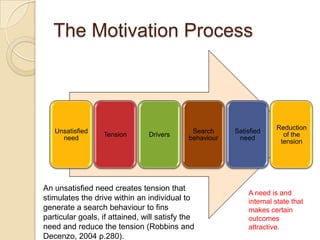
The Motivation ProcessAn unsatisfied need creates tension that stimulates the drive within an individual to generate a search behaviour to fins particular goals, if attained, will satisfy the need and reduce the tension (Robbins and Decenzo, 2004 p.280).A need is and internal state that makes certain outcomes attractive.
Definition of motivationMotivation represents forces acting within a person the causes a person to behave in a specific, goal-directed manner (Slocum and Hellriegel, 2007 p.392).The arousal, direction, and persistence of behaviour (Daft 2005 p.588).The willingness to exert high levels of effort to reach organizational goals, conditioned by the effort’s ability to satisfy some individual need (Robbins and Decenzo, 2004 p. 279).
Categories of motivation theoriesA group of theories that places emphasis on needs that motivate peopleA category of theories that explain how employees select behaviours to meet their needs
Content Theories MotivationMaslow’s hierarchy of needs
Herzberg’s Two-factor theory
McClelland’s Acquire needs theory
Alderfer’s ERG theoryMaslow’s Motivation Theory
Maslow theory – the explanationLower-end needs are the priority needs, which must be satisfied before higher-order need are activated.Needs are satisfied in sequence.When a need is satisfied, it declines in importance and the next need becomes dominant.To motivate an individual one must know where that person is in the hierarchy and focus on satisfying at or above that level.
Implications of Maslow’s theory in the workplaceNot everyone is motivated in the same way.Motivation and need satisfaction are anticipatory in nature.Managers must seek to guide and direct employee behaviour to meet the organizational needs and individual needs simultaneously.
Herzberg’s Two-factor TheoryHygiene FactorsWorking conditionsPay and securityCompany policiesSupervisorsInterpersonal relationshipsMotivatorsAchievementRecognitionResponsibilityWork itselfPersonal growthSatisfactionNo satisfactionMotivation factorsHygiene factorsNo dissatisfaction dissatisfaction
Herzberg’s theory - explanationHygiene factors involve the presence or absence of job dissatisfiers. When the hygiene factors are present, the individual is not dissatisfied; however when they are absent the individual is dissatisfied. In any case hygiene factors to not motivate.Motivators are factors that influence satisfaction and consequently motivate the person from within as he or she achieve the higher-level needs of achievement, recognition, and personal growth.
Implication of Herzberg’s theoryProviding the hygiene factors will eliminate employee dissatisfaction bur will not motivate workers to high levels of achievement. Recognition, responsibility, and the opportunity to achieve personal growth will promote satisfaction and employee performance. The benefit of this theory has implication for the effect of company systems and job design (how work is arranged and how much employees control their work) on employee satisfaction and performance.
Maslow and Herzberg compared
Process theoriesExpectancy theory
Equity theory
Goal setting theoryEquity Theory A process theory that focuses on individuals’ perception of how fairly they are treated relative to others.A situation that exists when the ratio of one person’s outcome to input equals that of another person.Input – an individual’s contribution or effortOutput – what an individual receives from his or her contribution or effort
Equity theory explainedAccording to the theory individuals assign a degree of importance to their input and outcomes. Individuals feel that they are treated fairly when they perceive that their outcomes to inputs are equal to that of others.Any deviation from this perception leads to a feeling of inequity and demotivation. Such inequity feeling results in various actions the individuals are likely to take.
Equity theory explainedConsequences of inequity:Change in inputs – a person may choose to increase or decrease his or her inputs to the organizationChange outcomes – a person may change his or her outcomes to restore equity.  An unpaid person may request a salary increase or better working conditions.Distort perceptions – a person may mentally distort the situation to achieve a balance.Leave the job – a person may tenders his or her resignation of request a transfer to another department.

Motivation

  • 1.
  • 2.
    MotivationOverviewThe study ofmotivation is complex. It is a significant study for managers because employees when motivated are stimulated to achieve organizational goals. Employees who are motivated remain focus in a systematic way. Without a knowledge of motivation managers are in danger of guiding the behaviour of subordinates and make mistakes towards the desired outcomes of the organization.
  • 3.
    MotivationWhat makes motivationa complex study is the fact that it takes different approaches to motivate an employee. In addressing what it takes to motivate an employee, we need to examine the following:Meeting the basic needs.Designing jobs that motivate employees.Creating the belief that desired goals can be achieved.Treating people equitably.
  • 4.
    ObjectiveStudents should beable to:Define motivation.Understand the process of motivation.Explain the content theories and process theories of motivation.Grasp the implications for managers.
  • 5.
    The Motivation ProcessAnunsatisfied need creates tension that stimulates the drive within an individual to generate a search behaviour to fins particular goals, if attained, will satisfy the need and reduce the tension (Robbins and Decenzo, 2004 p.280).A need is and internal state that makes certain outcomes attractive.
  • 6.
    Definition of motivationMotivationrepresents forces acting within a person the causes a person to behave in a specific, goal-directed manner (Slocum and Hellriegel, 2007 p.392).The arousal, direction, and persistence of behaviour (Daft 2005 p.588).The willingness to exert high levels of effort to reach organizational goals, conditioned by the effort’s ability to satisfy some individual need (Robbins and Decenzo, 2004 p. 279).
  • 7.
    Categories of motivationtheoriesA group of theories that places emphasis on needs that motivate peopleA category of theories that explain how employees select behaviours to meet their needs
  • 8.
  • 9.
  • 10.
  • 11.
  • 12.
    Maslow theory –the explanationLower-end needs are the priority needs, which must be satisfied before higher-order need are activated.Needs are satisfied in sequence.When a need is satisfied, it declines in importance and the next need becomes dominant.To motivate an individual one must know where that person is in the hierarchy and focus on satisfying at or above that level.
  • 13.
    Implications of Maslow’stheory in the workplaceNot everyone is motivated in the same way.Motivation and need satisfaction are anticipatory in nature.Managers must seek to guide and direct employee behaviour to meet the organizational needs and individual needs simultaneously.
  • 14.
    Herzberg’s Two-factor TheoryHygieneFactorsWorking conditionsPay and securityCompany policiesSupervisorsInterpersonal relationshipsMotivatorsAchievementRecognitionResponsibilityWork itselfPersonal growthSatisfactionNo satisfactionMotivation factorsHygiene factorsNo dissatisfaction dissatisfaction
  • 15.
    Herzberg’s theory -explanationHygiene factors involve the presence or absence of job dissatisfiers. When the hygiene factors are present, the individual is not dissatisfied; however when they are absent the individual is dissatisfied. In any case hygiene factors to not motivate.Motivators are factors that influence satisfaction and consequently motivate the person from within as he or she achieve the higher-level needs of achievement, recognition, and personal growth.
  • 16.
    Implication of Herzberg’stheoryProviding the hygiene factors will eliminate employee dissatisfaction bur will not motivate workers to high levels of achievement. Recognition, responsibility, and the opportunity to achieve personal growth will promote satisfaction and employee performance. The benefit of this theory has implication for the effect of company systems and job design (how work is arranged and how much employees control their work) on employee satisfaction and performance.
  • 17.
  • 18.
  • 19.
  • 20.
    Goal setting theoryEquityTheory A process theory that focuses on individuals’ perception of how fairly they are treated relative to others.A situation that exists when the ratio of one person’s outcome to input equals that of another person.Input – an individual’s contribution or effortOutput – what an individual receives from his or her contribution or effort
  • 21.
    Equity theory explainedAccordingto the theory individuals assign a degree of importance to their input and outcomes. Individuals feel that they are treated fairly when they perceive that their outcomes to inputs are equal to that of others.Any deviation from this perception leads to a feeling of inequity and demotivation. Such inequity feeling results in various actions the individuals are likely to take.
  • 22.
    Equity theory explainedConsequencesof inequity:Change in inputs – a person may choose to increase or decrease his or her inputs to the organizationChange outcomes – a person may change his or her outcomes to restore equity. An unpaid person may request a salary increase or better working conditions.Distort perceptions – a person may mentally distort the situation to achieve a balance.Leave the job – a person may tenders his or her resignation of request a transfer to another department.