UNIT-II
MOSFETs
Ref: Adel S.Sedra, Kenneth C.Smith Microelectronic circuits, Oxford University press, USA, sixth edition, 2009
Anil Neerukonda Institute of Technology & Sciences (Autonomous)
(Affiliated to AU, Approved by AICTE & Accredited by NBA (ECE, EEE, CSE, IT & Mech.) & NAAC)
Sangivalasa-531 162, Bheemunipatnam Mandal, Visakhapatnam District
Phone: 08933-225083/84/87 Fax: 226395
Website: www.anits.edu.in email: principal@anits.edu.in
Objectives of Module
• The physical structure of the MOS transistor and how it works.
• Current–Voltage characteristics.
• To analyze and design circuits that contain MOS transistors, resistors, and DC sources.
• How the transistor can be used as amplifier and switch
• Basic MOSFET amplifier configurations
ANIL PRASAD DADI/Dept. of ECE 2
Introduction
• Three-terminal devices are used in a multitude of applications, ranging from signal amplification
to digital logic and memory.
• The basic principle is voltage between two terminals controls the current flowing in the third
terminal.
• The three-terminal device can be used to realize a controlled source which is the basis for
amplifier design and act as a switch which is the basis for the realization of the logic inverter, the
basic element of digital circuits.
• e.g MOSFET , BJT
ANIL PRASAD DADI/Dept. of ECE 3
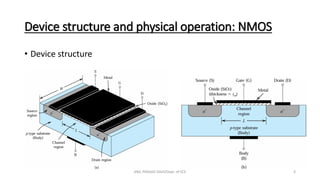
Device structure and physical operation: NMOS
• Device structure
ANIL PRASAD DADI/Dept. of ECE 4
Device structure and physical operation
• Source: Source is the terminal throughwhich majority charge
carriers enter into the semiconductor bar.
ANIL PRASAD DADI/Dept. of ECE 5
Device structure and physical operation
• Source: Source is the terminal throughwhich majority charge
carriers enter into the semiconductor bar.
• Drain: Drain is the terminal throughwhich majority charge carriers leave the
semiconductor bar
ANIL PRASAD DADI/Dept. of ECE 6
Device structure and physical operation
• Source: Source is the terminal throughwhich majority charge
carriers enter into the semiconductor bar.
• Drain: Drain is the terminal throughwhich majority charge carriers leave the
semiconductor bar
• Channel: Channel is the path between source(S) and drain(D) through which majority
charge carriers travel from S to D
ANIL PRASAD DADI/Dept. of ECE 7
Device structure and physical operation
• Source: Source is the terminal throughwhich majority charge
carriers enter into the semiconductor bar.
• Drain: Drain is the terminal throughwhich majority charge carriers leave the
semiconductor bar
• Channel: Channel is the path between source(S) and drain(D) through which majority
charge carriers travel from S to D
• Gate: Gate is the terminal to control the flow of charge carriers from S to D.
ANIL PRASAD DADI/Dept. of ECE 8
Test your understanding
• Why the name MOSFET/insulated-gate FET or IGFET?
• How many terminals does MOSFET have?
• Why do MOSFET is considered as three terminal device?
• Is MOSFET is a symmetrical device?
ANIL PRASAD DADI/Dept. of ECE 9
Operation with Zero Gate Voltage
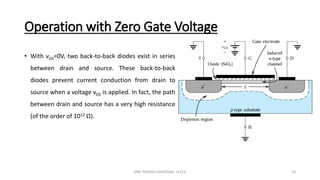
• With vGS=0V, two back-to-back diodes exist in series
between drain and source. These back-to-back
diodes prevent current conduction from drain to
source when a voltage vDS is applied. In fact, the path
between drain and source has a very high resistance
(of the order of 1012 Ω).
ANIL PRASAD DADI/Dept. of ECE 10
Creating a Channel for Current Flow
ANIL PRASAD DADI/Dept. of ECE 11
Creating a Channel for Current Flow
ANIL PRASAD DADI/Dept. of ECE 12
Creating a Channel for Current Flow
ANIL PRASAD DADI/Dept. of ECE 13
Creating a Channel for Current Flow
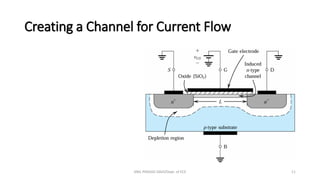
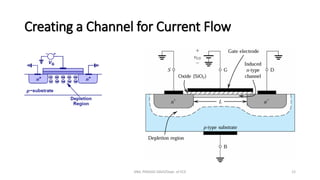
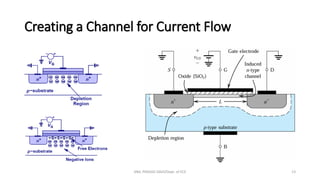
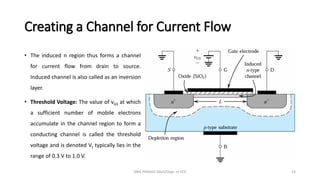
• The induced n region thus forms a channel
for current flow from drain to source.
Induced channel is also called as an inversion
layer.
• Threshold Voltage: The value of vGS at which
a sufficient number of mobile electrons
accumulate in the channel region to form a
conducting channel is called the threshold
voltage and is denoted Vt typically lies in the
range of 0.3 V to 1.0 V.
ANIL PRASAD DADI/Dept. of ECE 14
MOS capacitor
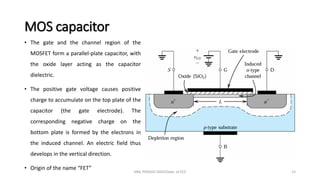
• The gate and the channel region of the
MOSFET form a parallel-plate capacitor, with
the oxide layer acting as the capacitor
dielectric.
• The positive gate voltage causes positive
charge to accumulate on the top plate of the
capacitor (the gate electrode). The
corresponding negative charge on the
bottom plate is formed by the electrons in
the induced channel. An electric field thus
develops in the vertical direction.
• Origin of the name “FET”
ANIL PRASAD DADI/Dept. of ECE 15
MOS capacitor
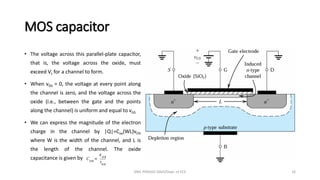
• The voltage across this parallel-plate capacitor,
that is, the voltage across the oxide, must
exceed Vt for a channel to form.
• When vDS = 0, the voltage at every point along
the channel is zero, and the voltage across the
oxide (i.e., between the gate and the points
along the channel) is uniform and equal to vGS
• We can express the magnitude of the electron
charge in the channel by |Q|=Cox(WL)vOV
where W is the width of the channel, and L is
the length of the channel. The oxide
capacitance is given by
ANIL PRASAD DADI/Dept. of ECE 16
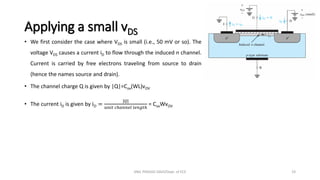
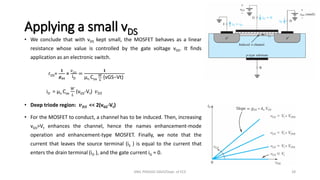
Applying a small vDS
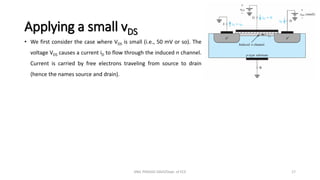
• We first consider the case where VDS is small (i.e., 50 mV or so). The
voltage VDS causes a current iD to flow through the induced n channel.
Current is carried by free electrons traveling from source to drain
(hence the names source and drain).
ANIL PRASAD DADI/Dept. of ECE 17
Applying a small vDS
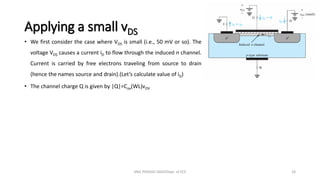
• We first consider the case where VDS is small (i.e., 50 mV or so). The
voltage VDS causes a current iD to flow through the induced n channel.
Current is carried by free electrons traveling from source to drain
(hence the names source and drain).(Let’s calculate value of iD)
• The channel charge Q is given by |Q|=Cox(WL)vOV
ANIL PRASAD DADI/Dept. of ECE 18
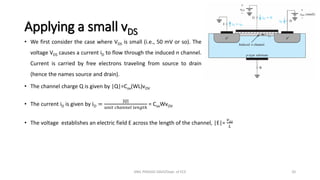
Applying a small vDS
• We first consider the case where VDS is small (i.e., 50 mV or so). The
voltage VDS causes a current iD to flow through the induced n channel.
Current is carried by free electrons traveling from source to drain
(hence the names source and drain).
• The channel charge Q is given by |Q|=Cox(WL)vOV
• The current iD is given by iD =
|𝑄|
𝑢𝑛𝑖𝑡 𝑐ℎ𝑎𝑛𝑛𝑒𝑙 𝑙𝑒𝑛𝑔𝑡ℎ
= CoxWvOV
ANIL PRASAD DADI/Dept. of ECE 19
Applying a small vDS
• We first consider the case where VDS is small (i.e., 50 mV or so). The
voltage VDS causes a current iD to flow through the induced n channel.
Current is carried by free electrons traveling from source to drain
(hence the names source and drain).
• The channel charge Q is given by |Q|=Cox(WL)vOV
• The current iD is given by iD =
|𝑄|
𝑢𝑛𝑖𝑡 𝑐ℎ𝑎𝑛𝑛𝑒𝑙 𝑙𝑒𝑛𝑔𝑡ℎ
= CoxWvOV
• The voltage establishes an electric field E across the length of the channel, |E|=
𝑣𝐷𝑆
𝐿
ANIL PRASAD DADI/Dept. of ECE 20
Applying a small vDS
• We first consider the case where VDS is small (i.e., 50 mV or so). The
voltage VDS causes a current iD to flow through the induced n channel.
Current is carried by free electrons traveling from source to drain
(hence the names source and drain).
• The channel charge Q is given by |Q|=Cox(WL)vOV
•
|𝑄|
𝑢𝑛𝑖𝑡 𝑐ℎ𝑎𝑛𝑛𝑒𝑙 𝑙𝑒𝑛𝑔𝑡ℎ
= CoxWvOV
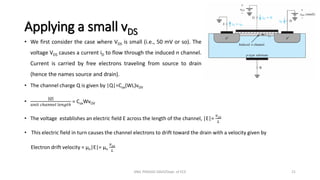
• The voltage establishes an electric field E across the length of the channel, |E|=
𝑣𝐷𝑆
𝐿
• This electric field in turn causes the channel electrons to drift toward the drain with a velocity given by
Electron drift velocity = µn|E|= µn
𝑣𝐷𝑆
𝐿
ANIL PRASAD DADI/Dept. of ECE 21
Applying a small vDS
• The value of iD can now be found by multiplying the charge per unit
channel length by the electron drift velocity
iD = |Q|× vd = Cox(W)vOV × µn
𝑣𝐷𝑆
𝐿
iD = [µn Cox
𝑊
𝐿
vOV ] 𝑣𝐷𝑆
• Thus, for small vDS, the channel behaves as a linear resistance whose
value is controlled by the overdrive voltage , which in turn is
determined by vGS : iD = [µn Cox
𝑊
𝐿
(vGS-Vt) ] 𝑣𝐷𝑆
• The conductance of the channel is given by
gDS = [µn Cox
𝑊
𝐿
(vGS-Vt) ]
ANIL PRASAD DADI/Dept. of ECE 22
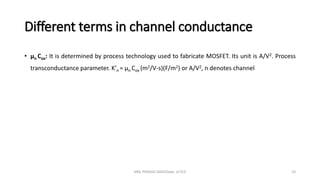
Different terms in channel conductance
• µn Cox: It is determined by process technology used to fabricate MOSFET. Its unit is A/V2. Process
transconductance parameter. K’n = µn Cox (m2/V-s)(F/m2) or A/V2, n denotes channel
ANIL PRASAD DADI/Dept. of ECE 23
Different terms in channel conductance
• µn Cox: It is determined by process technology used to fabricate MOSFET. Its unit is A/V2. Process
transconductance parameter. K’n = µn Cox (m2/V-s)(F/m2) or A/V2, n denotes channel
•
𝑾
𝑳
: It is dimensionless quantity determined by device designer to give I-V characteristics as
desired. It is transistor aspect ratio
ANIL PRASAD DADI/Dept. of ECE 24
Different terms in channel conductance
• µn Cox: It is determined by process technology used to fabricate MOSFET. Its unit is A/V2. Process
transconductance parameter. K’n = µn Cox (m2/V-s)(F/m2) or A/V2, n denotes channel
•
𝑾
𝑳
: It is dimensionless quantity determined by device designer to give I-V characteristics as
desired. It is transistor aspect ratio
• µn Cox
𝑾
𝑳
: MOSFET transconductance parameter Kn= K’n
𝑾
𝑳
= µn Cox
𝑾
𝑳
ANIL PRASAD DADI/Dept. of ECE 25
Different terms in channel conductance
• µn Cox: It is determined by process technology used to fabricate MOSFET. Its unit is A/V2. Process
transconductance parameter. K’n = µn Cox (m2/V-s)(F/m2) or A/V2, n denotes channel
•
𝑾
𝑳
: It is dimensionless quantity determined by device designer to give I-V characteristics as
desired. It is transistor aspect ratio
• µn Cox
𝑾
𝑳
: MOSFET transconductance parameter Kn= K’n
𝑾
𝑳
= µn Cox
𝑾
𝑳
• vOV=vGS-Vt : It is very important circuit design parameter
ANIL PRASAD DADI/Dept. of ECE 26
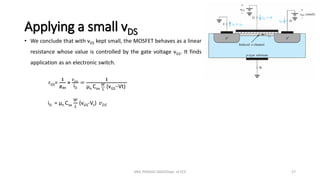
Applying a small vDS
• We conclude that with vDS kept small, the MOSFET behaves as a linear
resistance whose value is controlled by the gate voltage vGS. It finds
application as an electronic switch.
rDS=
𝟏
𝒈𝑫𝑺
=
𝑣𝐷𝑆
iD
=
𝟏
µn Cox
𝑊
𝐿
(vGS−Vt)
iD = µn Cox
𝑊
𝐿
(vGS-Vt) 𝑣𝐷𝑆
ANIL PRASAD DADI/Dept. of ECE 27
Applying a small vDS
• We conclude that with vDS kept small, the MOSFET behaves as a linear
resistance whose value is controlled by the gate voltage vGS. It finds
application as an electronic switch.
rDS=
𝟏
𝒈𝑫𝑺
=
𝑣𝐷𝑆
iD
=
𝟏
µn Cox
𝑊
𝐿
(vGS−Vt)
iD = µn Cox
𝑊
𝐿
(vGS-Vt) 𝑣𝐷𝑆
• Deep triode region: 𝒗𝑫𝑺 << 2(vGS-Vt)
• For the MOSFET to conduct, a channel has to be induced. Then, increasing
vGS>Vt enhances the channel, hence the names enhancement-mode
operation and enhancement-type MOSFET. Finally, we note that the
current that leaves the source terminal (iS ) is equal to the current that
enters the drain terminal (iD ), and the gate current iG = 0.
ANIL PRASAD DADI/Dept. of ECE 28
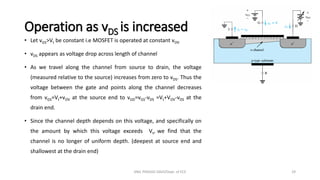
Operation as vDS is increased
• Let vGS>Vt be constant i.e MOSFET is operated at constant vOV
• vDS appears as voltage drop across length of channel
• As we travel along the channel from source to drain, the voltage
(measured relative to the source) increases from zero to vDS. Thus the
voltage between the gate and points along the channel decreases
from vGS=Vt+vOV at the source end to vGD=vGS-vDS =Vt+VOV-vDS at the
drain end.
• Since the channel depth depends on this voltage, and specifically on
the amount by which this voltage exceeds Vt, we find that the
channel is no longer of uniform depth. (deepest at source end and
shallowest at the drain end)
ANIL PRASAD DADI/Dept. of ECE 29
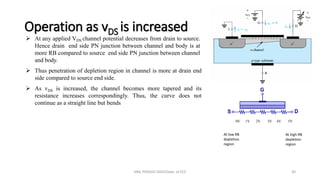
Operation as vDS is increased
➢ At any applied VDS channel potential decreases from drain to source.
Hence drain end side PN junction between channel and body is at
more RB compared to source end side PN junction between channel
and body.
➢ Thus penetration of depletion region in channel is more at drain end
side compared to source end side.
➢ As vDS is increased, the channel becomes more tapered and its
resistance increases correspondingly. Thus, the curve does not
continue as a straight line but bends
ANIL PRASAD DADI/Dept. of ECE 30
0V 1V 2V 3V 4V 5V
At low RB
depletion
region
At high RB
depletion
region
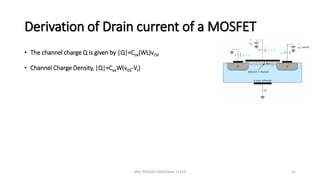
Derivation of Drain current of a MOSFET
• The channel charge Q is given by |Q|=Cox(WL)vOV
• Channel Charge Density, |Q|=CoxW(vGS-Vt)
ANIL PRASAD DADI/Dept. of ECE 31
Derivation of Drain current of a MOSFET
• The channel charge Q is given by |Q|=Cox(WL)vOV
• Channel Charge Density, |Q|=CoxW(vGS-Vt)
• Let x be a point along the channel from source to drain, and v(x)
its potential, |Q|=CoxW[vGS-v(x)-Vt]
ANIL PRASAD DADI/Dept. of ECE 32
Derivation of Drain current of a MOSFET
• The channel charge Q is given by |Q|=Cox(WL)vOV
• Channel Charge Density, |Q|=CoxW(vGS-Vt)
• Let x be a point along the channel from source to drain, and v(x)
its potential, |Q|=CoxW[vGS-v(x)-Vt]
• iD = |Q|× vd = CoxW[vGS-v(x)-Vt] × µn
𝑑𝑣
𝑑𝑥
iD = µn Cox w [vGS-v(x)-Vt]
𝑑𝑣
𝑑𝑥
ANIL PRASAD DADI/Dept. of ECE 33
Derivation of Drain current of a MOSFET
• iD = µn Cox w [vGS-v(x)-Vt]
𝑑𝑣
𝑑𝑥
ANIL PRASAD DADI/Dept. of ECE 34
Derivation of Drain current of a MOSFET
• iD = µn Cox w [vGS-v(x)-Vt]
𝑑𝑣
𝑑𝑥
• ‫׬‬
0
𝐿
𝑖𝐷 𝑑𝑥= µn Cox w ‫׬‬
0
𝑣𝐷𝑆
[vGS−v(x)−Vt] dv
ANIL PRASAD DADI/Dept. of ECE 35
Derivation of Drain current of a MOSFET
• iD = µn Cox w [vGS-v(x)-Vt]
𝑑𝑣
𝑑𝑥
• ‫׬‬
0
𝐿
𝑖𝐷 𝑑𝑥= µn Cox w ‫׬‬
0
𝑣𝐷𝑆
[vGS−v(x)−Vt] dv
• iDL= µn Cox w ‫׬‬
0
𝑣𝐷𝑆
[vGS−Vt]dv − ‫׬‬
0
𝑣𝐷𝑆
v(x)dv
ANIL PRASAD DADI/Dept. of ECE 36
Derivation of Drain current of a MOSFET
• iD = µn Cox w [vGS-v(x)-Vt]
𝑑𝑣
𝑑𝑥
• ‫׬‬
0
𝐿
𝑖𝐷 𝑑𝑥= µn Cox w ‫׬‬
0
𝑣𝐷𝑆
[vGS−v(x)−Vt] dv
• iDL= µn Cox w ‫׬‬
0
𝑣𝐷𝑆
[vGS−Vt]dv − ‫׬‬
0
𝑣𝐷𝑆
v(x)dv
• iDL= µn Cox w| (vGS−Vt)𝑣−
𝑣2
2
|𝑣𝐷𝑆
0
ANIL PRASAD DADI/Dept. of ECE 37
Derivation of Drain current of a MOSFET
• iD = µn Cox w [vGS-v(x)-Vt]
𝑑𝑣
𝑑𝑥
• ‫׬‬
0
𝐿
𝑖𝐷 𝑑𝑥= µn Cox w ‫׬‬
0
𝑣𝐷𝑆
[vGS−v(x)−Vt] dv
• iDL= µn Cox w ‫׬‬
0
𝑣𝐷𝑆
[vGS−Vt]dv − ‫׬‬
0
𝑣𝐷𝑆
v(x)dv
• iDL= µn Cox w| (vGS−Vt)𝑣−
𝑣2
2
|𝑣𝐷𝑆
0
• iDL= µn Cox w[(vGS−Vt)𝑣𝐷𝑆−
𝑣𝐷𝑆
2
2
]
ANIL PRASAD DADI/Dept. of ECE 38
Derivation of Drain current of a MOSFET
• iD = µn Cox w [vGS-v(x)-Vt]
𝑑𝑣
𝑑𝑥
• ‫׬‬
0
𝐿
𝑖𝐷 𝑑𝑥= µn Cox w ‫׬‬
0
𝑣𝐷𝑆
[vGS−v(x)−Vt] dv
• iDL= µn Cox w ‫׬‬
0
𝑣𝐷𝑆
[vGS−Vt]dv − ‫׬‬
0
𝑣𝐷𝑆
v(x)dv
• iDL= µn Cox w| (vGS−Vt)𝑣−
𝑣2
2
|𝑣𝐷𝑆
0
• iDL= µn Cox w[(vGS−Vt)𝑣𝐷𝑆−
𝑣𝐷𝑆
2
2
]
• iD= µn Cox
𝑊
𝐿
[(vGS−Vt)𝑣𝐷𝑆−
𝑣𝐷𝑆
2
2
]
ANIL PRASAD DADI/Dept. of ECE 39
Operation for vDS ≥vOV
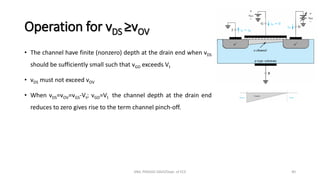
• The channel have finite (nonzero) depth at the drain end when vDS
should be sufficiently small such that vGD exceeds Vt
• vDS must not exceed vOV
• When vDS=vOV=vGS-Vt; vGD=Vt the channel depth at the drain end
reduces to zero gives rise to the term channel pinch-off.
ANIL PRASAD DADI/Dept. of ECE 40
Operation for vDS ≥vOV
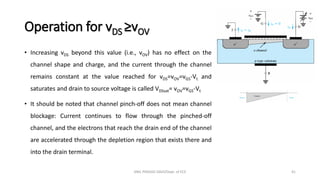
• Increasing vDS beyond this value (i.e., vOV) has no effect on the
channel shape and charge, and the current through the channel
remains constant at the value reached for vDS=vOV=vGS-Vt and
saturates and drain to source voltage is called VDSsat= vOV=vGS-Vt
• It should be noted that channel pinch-off does not mean channel
blockage: Current continues to flow through the pinched-off
channel, and the electrons that reach the drain end of the channel
are accelerated through the depletion region that exists there and
into the drain terminal.
ANIL PRASAD DADI/Dept. of ECE 41
Operation for vDS ≥vOV
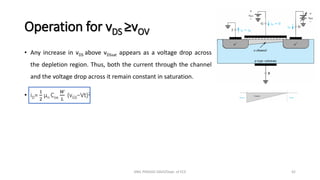
• Any increase in vDS above vDSsat appears as a voltage drop across
the depletion region. Thus, both the current through the channel
and the voltage drop across it remain constant in saturation.
• iD=
1
2
µn Cox
𝑊
𝐿
(vGS−Vt)2
ANIL PRASAD DADI/Dept. of ECE 42
Current Voltage Characteristics
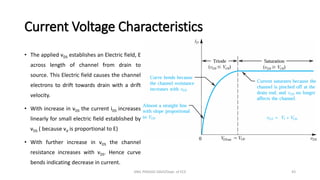
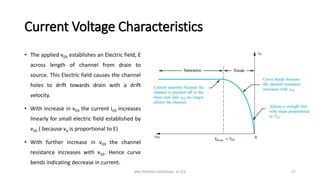
• The applied vDS establishes an Electric field, E
across length of channel from drain to
source. This Electric field causes the channel
electrons to drift towards drain with a drift
velocity.
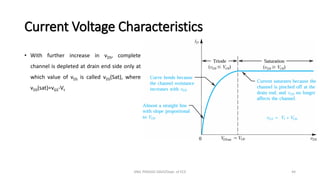
• With increase in vDS the current iDS increases
linearly for small electric field established by
vDS ( because vd is proportional to E)
• With further increase in vDS the channel
resistance increases with vDS. Hence curve
bends indicating decrease in current.
ANIL PRASAD DADI/Dept. of ECE 43
Current Voltage Characteristics
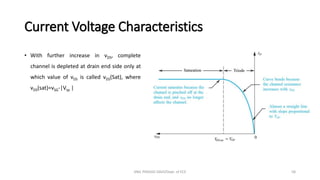
• With further increase in vDS, complete
channel is depleted at drain end side only at
which value of vDS is called vDS(Sat), where
vDS(sat)=vGS-Vt
ANIL PRASAD DADI/Dept. of ECE 44
Current Voltage Characteristics
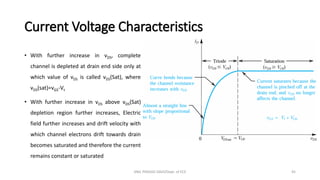
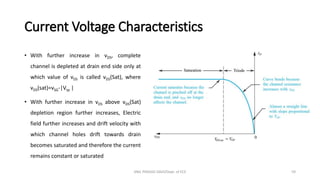
• With further increase in vDS, complete
channel is depleted at drain end side only at
which value of vDS is called vDS(Sat), where
vDS(sat)=vGS-Vt
• With further increase in vDS above vDS(Sat)
depletion region further increases, Electric
field further increases and drift velocity with
which channel electrons drift towards drain
becomes saturated and therefore the current
remains constant or saturated
ANIL PRASAD DADI/Dept. of ECE 45
Regions of Operation
• Linear region: vDS< vGS-Vt
iD= µn Cox
𝑾
𝑳
[(vGS−Vt)𝒗𝑫𝑺−
𝒗𝑫𝑺
𝟐
𝟐
]
• Deep triode region: vDS<<2( vGS-Vt)
iD = µn Cox
𝑾
𝑳
(vGS-Vt) 𝒗𝑫𝑺
• Saturation region: vDS≥( vGS-Vt)
iD=
𝟏
𝟐
µn Cox
𝑾
𝑳
(vGS−Vt)𝟐
ANIL PRASAD DADI/Dept. of ECE 46
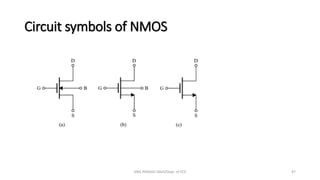
Circuit symbols of NMOS
ANIL PRASAD DADI/Dept. of ECE 47
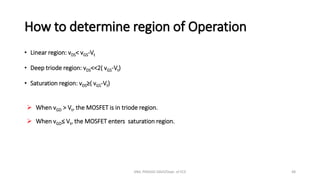
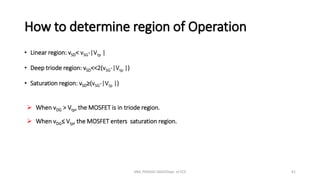
How to determine region of Operation
• Linear region: vDS< vGS-Vt
• Deep triode region: vDS<<2( vGS-Vt)
• Saturation region: vDS≥( vGS-Vt)
➢ When vGD > Vt, the MOSFET is in triode region.
➢ When vGD≤ Vt, the MOSFET enters saturation region.
ANIL PRASAD DADI/Dept. of ECE 48
The iD–vGS Characteristic
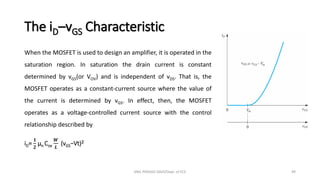
When the MOSFET is used to design an amplifier, it is operated in the
saturation region. In saturation the drain current is constant
determined by vGS(or VOV) and is independent of vDS. That is, the
MOSFET operates as a constant-current source where the value of
the current is determined by vGS. In effect, then, the MOSFET
operates as a voltage-controlled current source with the control
relationship described by
iD=
𝟏
𝟐
µn Cox
𝑾
𝑳
(vGS−Vt)𝟐
ANIL PRASAD DADI/Dept. of ECE 49
Finite output resistance in Saturation
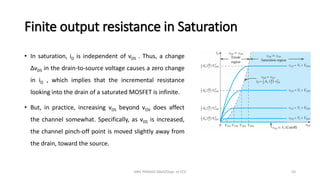
• In saturation, iD is independent of vDS . Thus, a change
ΔvDS in the drain-to-source voltage causes a zero change
in iD , which implies that the incremental resistance
looking into the drain of a saturated MOSFET is infinite.
• But, in practice, increasing vDS beyond vOV does affect
the channel somewhat. Specifically, as vDS is increased,
the channel pinch-off point is moved slightly away from
the drain, toward the source.
ANIL PRASAD DADI/Dept. of ECE 50
Finite output resistance in Saturation
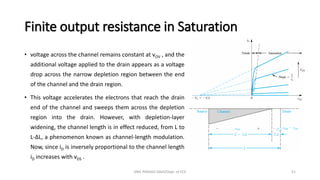
• voltage across the channel remains constant at vOV , and the
additional voltage applied to the drain appears as a voltage
drop across the narrow depletion region between the end
of the channel and the drain region.
• This voltage accelerates the electrons that reach the drain
end of the channel and sweeps them across the depletion
region into the drain. However, with depletion-layer
widening, the channel length is in effect reduced, from L to
L-∆L, a phenomenon known as channel-length modulation.
Now, since iD is inversely proportional to the channel length
iD increases with vDS .
ANIL PRASAD DADI/Dept. of ECE 51
Finite output resistance in Saturation
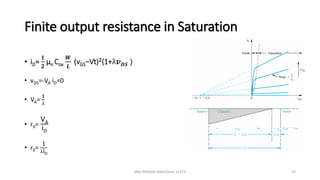
• iD=
𝟏
𝟐
µn Cox
𝑾
𝑳
(vGS−Vt)𝟐(1+λ𝒗𝑫𝑺 )
• vDS=-VA iD=0
• VA=
𝟏
λ
• r0=
VA
iD
• r0=
1
λiD
ANIL PRASAD DADI/Dept. of ECE 52
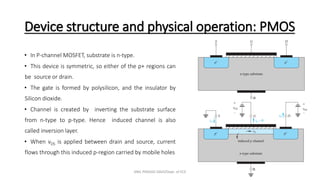
Device structure and physical operation: PMOS
• In P-channel MOSFET, substrate is n-type.
• This device is symmetric, so either of the p+ regions can
be source or drain.
• The gate is formed by polysilicon, and the insulator by
Silicon dioxide.
• Channel is created by inverting the substrate surface
from n-type to p-type. Hence induced channel is also
called inversion layer.
• When vDS is applied between drain and source, current
flows through this induced p-region carried by mobile holes
ANIL PRASAD DADI/Dept. of ECE 53
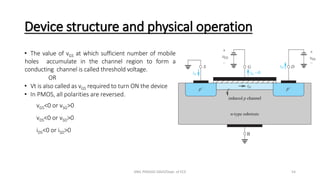
Device structure and physical operation
• The value of vGS at which sufficient number of mobile
holes accumulate in the channel region to form a
conducting channel is called threshold voltage.
OR
• Vt is also called as vGS required to turn ON the device
• In PMOS, all polarities are reversed.
vGS<0 or vSG>0
vDS<0 or vSD>0
iDS<0 or iSD>0
ANIL PRASAD DADI/Dept. of ECE 54
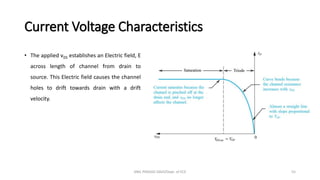
Current Voltage Characteristics
• The applied vDS establishes an Electric field, E
across length of channel from drain to
source. This Electric field causes the channel
holes to drift towards drain with a drift
velocity.
ANIL PRASAD DADI/Dept. of ECE 55
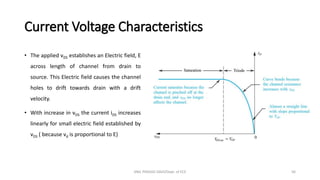
Current Voltage Characteristics
• The applied vDS establishes an Electric field, E
across length of channel from drain to
source. This Electric field causes the channel
holes to drift towards drain with a drift
velocity.
• With increase in vDS the current iDS increases
linearly for small electric field established by
vDS ( because vd is proportional to E)
ANIL PRASAD DADI/Dept. of ECE 56
Current Voltage Characteristics
• The applied vDS establishes an Electric field, E
across length of channel from drain to
source. This Electric field causes the channel
holes to drift towards drain with a drift
velocity.
• With increase in vDS the current iDS increases
linearly for small electric field established by
vDS ( because vd is proportional to E)
• With further increase in vDS the channel
resistance increases with vDS. Hence curve
bends indicating decrease in current.
ANIL PRASAD DADI/Dept. of ECE 57
Current Voltage Characteristics
• With further increase in vDS, complete
channel is depleted at drain end side only at
which value of vDS is called vDS(Sat), where
vDS(sat)=vSG-|Vtp |
ANIL PRASAD DADI/Dept. of ECE 58
Current Voltage Characteristics
• With further increase in vDS, complete
channel is depleted at drain end side only at
which value of vDS is called vDS(Sat), where
vDS(sat)=vSG-|Vtp |
• With further increase in vDS above vDS(Sat)
depletion region further increases, Electric
field further increases and drift velocity with
which channel holes drift towards drain
becomes saturated and therefore the current
remains constant or saturated
ANIL PRASAD DADI/Dept. of ECE 59
Regions of Operation
• Linear region: vSD< vSG-|Vtp |
iD= µp Cox
𝑾
𝑳
[(vSG−Vtp)𝒗𝑺𝑫−
𝒗𝑺𝑫
𝟐
𝟐
]
• Deep triode region: vSD<<2(vSG-|Vtp|)
iD = µp Cox
𝑾
𝑳
(vSG-Vtp) 𝒗𝑺D
• Saturation region: vSD≥(vSG-|Vtp|)
iD=
𝟏
𝟐
µpCox
𝑾
𝑳
(vSG−Vtp)𝟐
ANIL PRASAD DADI/Dept. of ECE 60
How to determine region of Operation
• Linear region: vSD< vSG-|Vtp |
• Deep triode region: vSD<<2(vSG-|Vtp |)
• Saturation region: vSD≥(vSG-|Vtp |)
➢ When vDG > Vtp, the MOSFET is in triode region.
➢ When vDG≤ Vtp, the MOSFET enters saturation region.
ANIL PRASAD DADI/Dept. of ECE 61
Thank you
for listening
ANIL PRASAD DADI/Dept. of ECE 62

MOSFET: Device structure, Operation with I-V Characteristics.pdf

  • 1.
    UNIT-II MOSFETs Ref: Adel S.Sedra,Kenneth C.Smith Microelectronic circuits, Oxford University press, USA, sixth edition, 2009 Anil Neerukonda Institute of Technology & Sciences (Autonomous) (Affiliated to AU, Approved by AICTE & Accredited by NBA (ECE, EEE, CSE, IT & Mech.) & NAAC) Sangivalasa-531 162, Bheemunipatnam Mandal, Visakhapatnam District Phone: 08933-225083/84/87 Fax: 226395 Website: www.anits.edu.in email: principal@anits.edu.in
  • 2.
    Objectives of Module •The physical structure of the MOS transistor and how it works. • Current–Voltage characteristics. • To analyze and design circuits that contain MOS transistors, resistors, and DC sources. • How the transistor can be used as amplifier and switch • Basic MOSFET amplifier configurations ANIL PRASAD DADI/Dept. of ECE 2
  • 3.
    Introduction • Three-terminal devicesare used in a multitude of applications, ranging from signal amplification to digital logic and memory. • The basic principle is voltage between two terminals controls the current flowing in the third terminal. • The three-terminal device can be used to realize a controlled source which is the basis for amplifier design and act as a switch which is the basis for the realization of the logic inverter, the basic element of digital circuits. • e.g MOSFET , BJT ANIL PRASAD DADI/Dept. of ECE 3
  • 4.
    Device structure andphysical operation: NMOS • Device structure ANIL PRASAD DADI/Dept. of ECE 4
  • 5.
    Device structure andphysical operation • Source: Source is the terminal throughwhich majority charge carriers enter into the semiconductor bar. ANIL PRASAD DADI/Dept. of ECE 5
  • 6.
    Device structure andphysical operation • Source: Source is the terminal throughwhich majority charge carriers enter into the semiconductor bar. • Drain: Drain is the terminal throughwhich majority charge carriers leave the semiconductor bar ANIL PRASAD DADI/Dept. of ECE 6
  • 7.
    Device structure andphysical operation • Source: Source is the terminal throughwhich majority charge carriers enter into the semiconductor bar. • Drain: Drain is the terminal throughwhich majority charge carriers leave the semiconductor bar • Channel: Channel is the path between source(S) and drain(D) through which majority charge carriers travel from S to D ANIL PRASAD DADI/Dept. of ECE 7
  • 8.
    Device structure andphysical operation • Source: Source is the terminal throughwhich majority charge carriers enter into the semiconductor bar. • Drain: Drain is the terminal throughwhich majority charge carriers leave the semiconductor bar • Channel: Channel is the path between source(S) and drain(D) through which majority charge carriers travel from S to D • Gate: Gate is the terminal to control the flow of charge carriers from S to D. ANIL PRASAD DADI/Dept. of ECE 8
  • 9.
    Test your understanding •Why the name MOSFET/insulated-gate FET or IGFET? • How many terminals does MOSFET have? • Why do MOSFET is considered as three terminal device? • Is MOSFET is a symmetrical device? ANIL PRASAD DADI/Dept. of ECE 9
  • 10.
    Operation with ZeroGate Voltage • With vGS=0V, two back-to-back diodes exist in series between drain and source. These back-to-back diodes prevent current conduction from drain to source when a voltage vDS is applied. In fact, the path between drain and source has a very high resistance (of the order of 1012 Ω). ANIL PRASAD DADI/Dept. of ECE 10
  • 11.
    Creating a Channelfor Current Flow ANIL PRASAD DADI/Dept. of ECE 11
  • 12.
    Creating a Channelfor Current Flow ANIL PRASAD DADI/Dept. of ECE 12
  • 13.
    Creating a Channelfor Current Flow ANIL PRASAD DADI/Dept. of ECE 13
  • 14.
    Creating a Channelfor Current Flow • The induced n region thus forms a channel for current flow from drain to source. Induced channel is also called as an inversion layer. • Threshold Voltage: The value of vGS at which a sufficient number of mobile electrons accumulate in the channel region to form a conducting channel is called the threshold voltage and is denoted Vt typically lies in the range of 0.3 V to 1.0 V. ANIL PRASAD DADI/Dept. of ECE 14
  • 15.
    MOS capacitor • Thegate and the channel region of the MOSFET form a parallel-plate capacitor, with the oxide layer acting as the capacitor dielectric. • The positive gate voltage causes positive charge to accumulate on the top plate of the capacitor (the gate electrode). The corresponding negative charge on the bottom plate is formed by the electrons in the induced channel. An electric field thus develops in the vertical direction. • Origin of the name “FET” ANIL PRASAD DADI/Dept. of ECE 15
  • 16.
    MOS capacitor • Thevoltage across this parallel-plate capacitor, that is, the voltage across the oxide, must exceed Vt for a channel to form. • When vDS = 0, the voltage at every point along the channel is zero, and the voltage across the oxide (i.e., between the gate and the points along the channel) is uniform and equal to vGS • We can express the magnitude of the electron charge in the channel by |Q|=Cox(WL)vOV where W is the width of the channel, and L is the length of the channel. The oxide capacitance is given by ANIL PRASAD DADI/Dept. of ECE 16
  • 17.
    Applying a smallvDS • We first consider the case where VDS is small (i.e., 50 mV or so). The voltage VDS causes a current iD to flow through the induced n channel. Current is carried by free electrons traveling from source to drain (hence the names source and drain). ANIL PRASAD DADI/Dept. of ECE 17
  • 18.
    Applying a smallvDS • We first consider the case where VDS is small (i.e., 50 mV or so). The voltage VDS causes a current iD to flow through the induced n channel. Current is carried by free electrons traveling from source to drain (hence the names source and drain).(Let’s calculate value of iD) • The channel charge Q is given by |Q|=Cox(WL)vOV ANIL PRASAD DADI/Dept. of ECE 18
  • 19.
    Applying a smallvDS • We first consider the case where VDS is small (i.e., 50 mV or so). The voltage VDS causes a current iD to flow through the induced n channel. Current is carried by free electrons traveling from source to drain (hence the names source and drain). • The channel charge Q is given by |Q|=Cox(WL)vOV • The current iD is given by iD = |𝑄| 𝑢𝑛𝑖𝑡 𝑐ℎ𝑎𝑛𝑛𝑒𝑙 𝑙𝑒𝑛𝑔𝑡ℎ = CoxWvOV ANIL PRASAD DADI/Dept. of ECE 19
  • 20.
    Applying a smallvDS • We first consider the case where VDS is small (i.e., 50 mV or so). The voltage VDS causes a current iD to flow through the induced n channel. Current is carried by free electrons traveling from source to drain (hence the names source and drain). • The channel charge Q is given by |Q|=Cox(WL)vOV • The current iD is given by iD = |𝑄| 𝑢𝑛𝑖𝑡 𝑐ℎ𝑎𝑛𝑛𝑒𝑙 𝑙𝑒𝑛𝑔𝑡ℎ = CoxWvOV • The voltage establishes an electric field E across the length of the channel, |E|= 𝑣𝐷𝑆 𝐿 ANIL PRASAD DADI/Dept. of ECE 20
  • 21.
    Applying a smallvDS • We first consider the case where VDS is small (i.e., 50 mV or so). The voltage VDS causes a current iD to flow through the induced n channel. Current is carried by free electrons traveling from source to drain (hence the names source and drain). • The channel charge Q is given by |Q|=Cox(WL)vOV • |𝑄| 𝑢𝑛𝑖𝑡 𝑐ℎ𝑎𝑛𝑛𝑒𝑙 𝑙𝑒𝑛𝑔𝑡ℎ = CoxWvOV • The voltage establishes an electric field E across the length of the channel, |E|= 𝑣𝐷𝑆 𝐿 • This electric field in turn causes the channel electrons to drift toward the drain with a velocity given by Electron drift velocity = µn|E|= µn 𝑣𝐷𝑆 𝐿 ANIL PRASAD DADI/Dept. of ECE 21
  • 22.
    Applying a smallvDS • The value of iD can now be found by multiplying the charge per unit channel length by the electron drift velocity iD = |Q|× vd = Cox(W)vOV × µn 𝑣𝐷𝑆 𝐿 iD = [µn Cox 𝑊 𝐿 vOV ] 𝑣𝐷𝑆 • Thus, for small vDS, the channel behaves as a linear resistance whose value is controlled by the overdrive voltage , which in turn is determined by vGS : iD = [µn Cox 𝑊 𝐿 (vGS-Vt) ] 𝑣𝐷𝑆 • The conductance of the channel is given by gDS = [µn Cox 𝑊 𝐿 (vGS-Vt) ] ANIL PRASAD DADI/Dept. of ECE 22
  • 23.
    Different terms inchannel conductance • µn Cox: It is determined by process technology used to fabricate MOSFET. Its unit is A/V2. Process transconductance parameter. K’n = µn Cox (m2/V-s)(F/m2) or A/V2, n denotes channel ANIL PRASAD DADI/Dept. of ECE 23
  • 24.
    Different terms inchannel conductance • µn Cox: It is determined by process technology used to fabricate MOSFET. Its unit is A/V2. Process transconductance parameter. K’n = µn Cox (m2/V-s)(F/m2) or A/V2, n denotes channel • 𝑾 𝑳 : It is dimensionless quantity determined by device designer to give I-V characteristics as desired. It is transistor aspect ratio ANIL PRASAD DADI/Dept. of ECE 24
  • 25.
    Different terms inchannel conductance • µn Cox: It is determined by process technology used to fabricate MOSFET. Its unit is A/V2. Process transconductance parameter. K’n = µn Cox (m2/V-s)(F/m2) or A/V2, n denotes channel • 𝑾 𝑳 : It is dimensionless quantity determined by device designer to give I-V characteristics as desired. It is transistor aspect ratio • µn Cox 𝑾 𝑳 : MOSFET transconductance parameter Kn= K’n 𝑾 𝑳 = µn Cox 𝑾 𝑳 ANIL PRASAD DADI/Dept. of ECE 25
  • 26.
    Different terms inchannel conductance • µn Cox: It is determined by process technology used to fabricate MOSFET. Its unit is A/V2. Process transconductance parameter. K’n = µn Cox (m2/V-s)(F/m2) or A/V2, n denotes channel • 𝑾 𝑳 : It is dimensionless quantity determined by device designer to give I-V characteristics as desired. It is transistor aspect ratio • µn Cox 𝑾 𝑳 : MOSFET transconductance parameter Kn= K’n 𝑾 𝑳 = µn Cox 𝑾 𝑳 • vOV=vGS-Vt : It is very important circuit design parameter ANIL PRASAD DADI/Dept. of ECE 26
  • 27.
    Applying a smallvDS • We conclude that with vDS kept small, the MOSFET behaves as a linear resistance whose value is controlled by the gate voltage vGS. It finds application as an electronic switch. rDS= 𝟏 𝒈𝑫𝑺 = 𝑣𝐷𝑆 iD = 𝟏 µn Cox 𝑊 𝐿 (vGS−Vt) iD = µn Cox 𝑊 𝐿 (vGS-Vt) 𝑣𝐷𝑆 ANIL PRASAD DADI/Dept. of ECE 27
  • 28.
    Applying a smallvDS • We conclude that with vDS kept small, the MOSFET behaves as a linear resistance whose value is controlled by the gate voltage vGS. It finds application as an electronic switch. rDS= 𝟏 𝒈𝑫𝑺 = 𝑣𝐷𝑆 iD = 𝟏 µn Cox 𝑊 𝐿 (vGS−Vt) iD = µn Cox 𝑊 𝐿 (vGS-Vt) 𝑣𝐷𝑆 • Deep triode region: 𝒗𝑫𝑺 << 2(vGS-Vt) • For the MOSFET to conduct, a channel has to be induced. Then, increasing vGS>Vt enhances the channel, hence the names enhancement-mode operation and enhancement-type MOSFET. Finally, we note that the current that leaves the source terminal (iS ) is equal to the current that enters the drain terminal (iD ), and the gate current iG = 0. ANIL PRASAD DADI/Dept. of ECE 28
  • 29.
    Operation as vDSis increased • Let vGS>Vt be constant i.e MOSFET is operated at constant vOV • vDS appears as voltage drop across length of channel • As we travel along the channel from source to drain, the voltage (measured relative to the source) increases from zero to vDS. Thus the voltage between the gate and points along the channel decreases from vGS=Vt+vOV at the source end to vGD=vGS-vDS =Vt+VOV-vDS at the drain end. • Since the channel depth depends on this voltage, and specifically on the amount by which this voltage exceeds Vt, we find that the channel is no longer of uniform depth. (deepest at source end and shallowest at the drain end) ANIL PRASAD DADI/Dept. of ECE 29
  • 30.
    Operation as vDSis increased ➢ At any applied VDS channel potential decreases from drain to source. Hence drain end side PN junction between channel and body is at more RB compared to source end side PN junction between channel and body. ➢ Thus penetration of depletion region in channel is more at drain end side compared to source end side. ➢ As vDS is increased, the channel becomes more tapered and its resistance increases correspondingly. Thus, the curve does not continue as a straight line but bends ANIL PRASAD DADI/Dept. of ECE 30 0V 1V 2V 3V 4V 5V At low RB depletion region At high RB depletion region
  • 31.
    Derivation of Draincurrent of a MOSFET • The channel charge Q is given by |Q|=Cox(WL)vOV • Channel Charge Density, |Q|=CoxW(vGS-Vt) ANIL PRASAD DADI/Dept. of ECE 31
  • 32.
    Derivation of Draincurrent of a MOSFET • The channel charge Q is given by |Q|=Cox(WL)vOV • Channel Charge Density, |Q|=CoxW(vGS-Vt) • Let x be a point along the channel from source to drain, and v(x) its potential, |Q|=CoxW[vGS-v(x)-Vt] ANIL PRASAD DADI/Dept. of ECE 32
  • 33.
    Derivation of Draincurrent of a MOSFET • The channel charge Q is given by |Q|=Cox(WL)vOV • Channel Charge Density, |Q|=CoxW(vGS-Vt) • Let x be a point along the channel from source to drain, and v(x) its potential, |Q|=CoxW[vGS-v(x)-Vt] • iD = |Q|× vd = CoxW[vGS-v(x)-Vt] × µn 𝑑𝑣 𝑑𝑥 iD = µn Cox w [vGS-v(x)-Vt] 𝑑𝑣 𝑑𝑥 ANIL PRASAD DADI/Dept. of ECE 33
  • 34.
    Derivation of Draincurrent of a MOSFET • iD = µn Cox w [vGS-v(x)-Vt] 𝑑𝑣 𝑑𝑥 ANIL PRASAD DADI/Dept. of ECE 34
  • 35.
    Derivation of Draincurrent of a MOSFET • iD = µn Cox w [vGS-v(x)-Vt] 𝑑𝑣 𝑑𝑥 • ‫׬‬ 0 𝐿 𝑖𝐷 𝑑𝑥= µn Cox w ‫׬‬ 0 𝑣𝐷𝑆 [vGS−v(x)−Vt] dv ANIL PRASAD DADI/Dept. of ECE 35
  • 36.
    Derivation of Draincurrent of a MOSFET • iD = µn Cox w [vGS-v(x)-Vt] 𝑑𝑣 𝑑𝑥 • ‫׬‬ 0 𝐿 𝑖𝐷 𝑑𝑥= µn Cox w ‫׬‬ 0 𝑣𝐷𝑆 [vGS−v(x)−Vt] dv • iDL= µn Cox w ‫׬‬ 0 𝑣𝐷𝑆 [vGS−Vt]dv − ‫׬‬ 0 𝑣𝐷𝑆 v(x)dv ANIL PRASAD DADI/Dept. of ECE 36
  • 37.
    Derivation of Draincurrent of a MOSFET • iD = µn Cox w [vGS-v(x)-Vt] 𝑑𝑣 𝑑𝑥 • ‫׬‬ 0 𝐿 𝑖𝐷 𝑑𝑥= µn Cox w ‫׬‬ 0 𝑣𝐷𝑆 [vGS−v(x)−Vt] dv • iDL= µn Cox w ‫׬‬ 0 𝑣𝐷𝑆 [vGS−Vt]dv − ‫׬‬ 0 𝑣𝐷𝑆 v(x)dv • iDL= µn Cox w| (vGS−Vt)𝑣− 𝑣2 2 |𝑣𝐷𝑆 0 ANIL PRASAD DADI/Dept. of ECE 37
  • 38.
    Derivation of Draincurrent of a MOSFET • iD = µn Cox w [vGS-v(x)-Vt] 𝑑𝑣 𝑑𝑥 • ‫׬‬ 0 𝐿 𝑖𝐷 𝑑𝑥= µn Cox w ‫׬‬ 0 𝑣𝐷𝑆 [vGS−v(x)−Vt] dv • iDL= µn Cox w ‫׬‬ 0 𝑣𝐷𝑆 [vGS−Vt]dv − ‫׬‬ 0 𝑣𝐷𝑆 v(x)dv • iDL= µn Cox w| (vGS−Vt)𝑣− 𝑣2 2 |𝑣𝐷𝑆 0 • iDL= µn Cox w[(vGS−Vt)𝑣𝐷𝑆− 𝑣𝐷𝑆 2 2 ] ANIL PRASAD DADI/Dept. of ECE 38
  • 39.
    Derivation of Draincurrent of a MOSFET • iD = µn Cox w [vGS-v(x)-Vt] 𝑑𝑣 𝑑𝑥 • ‫׬‬ 0 𝐿 𝑖𝐷 𝑑𝑥= µn Cox w ‫׬‬ 0 𝑣𝐷𝑆 [vGS−v(x)−Vt] dv • iDL= µn Cox w ‫׬‬ 0 𝑣𝐷𝑆 [vGS−Vt]dv − ‫׬‬ 0 𝑣𝐷𝑆 v(x)dv • iDL= µn Cox w| (vGS−Vt)𝑣− 𝑣2 2 |𝑣𝐷𝑆 0 • iDL= µn Cox w[(vGS−Vt)𝑣𝐷𝑆− 𝑣𝐷𝑆 2 2 ] • iD= µn Cox 𝑊 𝐿 [(vGS−Vt)𝑣𝐷𝑆− 𝑣𝐷𝑆 2 2 ] ANIL PRASAD DADI/Dept. of ECE 39
  • 40.
    Operation for vDS≥vOV • The channel have finite (nonzero) depth at the drain end when vDS should be sufficiently small such that vGD exceeds Vt • vDS must not exceed vOV • When vDS=vOV=vGS-Vt; vGD=Vt the channel depth at the drain end reduces to zero gives rise to the term channel pinch-off. ANIL PRASAD DADI/Dept. of ECE 40
  • 41.
    Operation for vDS≥vOV • Increasing vDS beyond this value (i.e., vOV) has no effect on the channel shape and charge, and the current through the channel remains constant at the value reached for vDS=vOV=vGS-Vt and saturates and drain to source voltage is called VDSsat= vOV=vGS-Vt • It should be noted that channel pinch-off does not mean channel blockage: Current continues to flow through the pinched-off channel, and the electrons that reach the drain end of the channel are accelerated through the depletion region that exists there and into the drain terminal. ANIL PRASAD DADI/Dept. of ECE 41
  • 42.
    Operation for vDS≥vOV • Any increase in vDS above vDSsat appears as a voltage drop across the depletion region. Thus, both the current through the channel and the voltage drop across it remain constant in saturation. • iD= 1 2 µn Cox 𝑊 𝐿 (vGS−Vt)2 ANIL PRASAD DADI/Dept. of ECE 42
  • 43.
    Current Voltage Characteristics •The applied vDS establishes an Electric field, E across length of channel from drain to source. This Electric field causes the channel electrons to drift towards drain with a drift velocity. • With increase in vDS the current iDS increases linearly for small electric field established by vDS ( because vd is proportional to E) • With further increase in vDS the channel resistance increases with vDS. Hence curve bends indicating decrease in current. ANIL PRASAD DADI/Dept. of ECE 43
  • 44.
    Current Voltage Characteristics •With further increase in vDS, complete channel is depleted at drain end side only at which value of vDS is called vDS(Sat), where vDS(sat)=vGS-Vt ANIL PRASAD DADI/Dept. of ECE 44
  • 45.
    Current Voltage Characteristics •With further increase in vDS, complete channel is depleted at drain end side only at which value of vDS is called vDS(Sat), where vDS(sat)=vGS-Vt • With further increase in vDS above vDS(Sat) depletion region further increases, Electric field further increases and drift velocity with which channel electrons drift towards drain becomes saturated and therefore the current remains constant or saturated ANIL PRASAD DADI/Dept. of ECE 45
  • 46.
    Regions of Operation •Linear region: vDS< vGS-Vt iD= µn Cox 𝑾 𝑳 [(vGS−Vt)𝒗𝑫𝑺− 𝒗𝑫𝑺 𝟐 𝟐 ] • Deep triode region: vDS<<2( vGS-Vt) iD = µn Cox 𝑾 𝑳 (vGS-Vt) 𝒗𝑫𝑺 • Saturation region: vDS≥( vGS-Vt) iD= 𝟏 𝟐 µn Cox 𝑾 𝑳 (vGS−Vt)𝟐 ANIL PRASAD DADI/Dept. of ECE 46
  • 47.
    Circuit symbols ofNMOS ANIL PRASAD DADI/Dept. of ECE 47
  • 48.
    How to determineregion of Operation • Linear region: vDS< vGS-Vt • Deep triode region: vDS<<2( vGS-Vt) • Saturation region: vDS≥( vGS-Vt) ➢ When vGD > Vt, the MOSFET is in triode region. ➢ When vGD≤ Vt, the MOSFET enters saturation region. ANIL PRASAD DADI/Dept. of ECE 48
  • 49.
    The iD–vGS Characteristic Whenthe MOSFET is used to design an amplifier, it is operated in the saturation region. In saturation the drain current is constant determined by vGS(or VOV) and is independent of vDS. That is, the MOSFET operates as a constant-current source where the value of the current is determined by vGS. In effect, then, the MOSFET operates as a voltage-controlled current source with the control relationship described by iD= 𝟏 𝟐 µn Cox 𝑾 𝑳 (vGS−Vt)𝟐 ANIL PRASAD DADI/Dept. of ECE 49
  • 50.
    Finite output resistancein Saturation • In saturation, iD is independent of vDS . Thus, a change ΔvDS in the drain-to-source voltage causes a zero change in iD , which implies that the incremental resistance looking into the drain of a saturated MOSFET is infinite. • But, in practice, increasing vDS beyond vOV does affect the channel somewhat. Specifically, as vDS is increased, the channel pinch-off point is moved slightly away from the drain, toward the source. ANIL PRASAD DADI/Dept. of ECE 50
  • 51.
    Finite output resistancein Saturation • voltage across the channel remains constant at vOV , and the additional voltage applied to the drain appears as a voltage drop across the narrow depletion region between the end of the channel and the drain region. • This voltage accelerates the electrons that reach the drain end of the channel and sweeps them across the depletion region into the drain. However, with depletion-layer widening, the channel length is in effect reduced, from L to L-∆L, a phenomenon known as channel-length modulation. Now, since iD is inversely proportional to the channel length iD increases with vDS . ANIL PRASAD DADI/Dept. of ECE 51
  • 52.
    Finite output resistancein Saturation • iD= 𝟏 𝟐 µn Cox 𝑾 𝑳 (vGS−Vt)𝟐(1+λ𝒗𝑫𝑺 ) • vDS=-VA iD=0 • VA= 𝟏 λ • r0= VA iD • r0= 1 λiD ANIL PRASAD DADI/Dept. of ECE 52
  • 53.
    Device structure andphysical operation: PMOS • In P-channel MOSFET, substrate is n-type. • This device is symmetric, so either of the p+ regions can be source or drain. • The gate is formed by polysilicon, and the insulator by Silicon dioxide. • Channel is created by inverting the substrate surface from n-type to p-type. Hence induced channel is also called inversion layer. • When vDS is applied between drain and source, current flows through this induced p-region carried by mobile holes ANIL PRASAD DADI/Dept. of ECE 53
  • 54.
    Device structure andphysical operation • The value of vGS at which sufficient number of mobile holes accumulate in the channel region to form a conducting channel is called threshold voltage. OR • Vt is also called as vGS required to turn ON the device • In PMOS, all polarities are reversed. vGS<0 or vSG>0 vDS<0 or vSD>0 iDS<0 or iSD>0 ANIL PRASAD DADI/Dept. of ECE 54
  • 55.
    Current Voltage Characteristics •The applied vDS establishes an Electric field, E across length of channel from drain to source. This Electric field causes the channel holes to drift towards drain with a drift velocity. ANIL PRASAD DADI/Dept. of ECE 55
  • 56.
    Current Voltage Characteristics •The applied vDS establishes an Electric field, E across length of channel from drain to source. This Electric field causes the channel holes to drift towards drain with a drift velocity. • With increase in vDS the current iDS increases linearly for small electric field established by vDS ( because vd is proportional to E) ANIL PRASAD DADI/Dept. of ECE 56
  • 57.
    Current Voltage Characteristics •The applied vDS establishes an Electric field, E across length of channel from drain to source. This Electric field causes the channel holes to drift towards drain with a drift velocity. • With increase in vDS the current iDS increases linearly for small electric field established by vDS ( because vd is proportional to E) • With further increase in vDS the channel resistance increases with vDS. Hence curve bends indicating decrease in current. ANIL PRASAD DADI/Dept. of ECE 57
  • 58.
    Current Voltage Characteristics •With further increase in vDS, complete channel is depleted at drain end side only at which value of vDS is called vDS(Sat), where vDS(sat)=vSG-|Vtp | ANIL PRASAD DADI/Dept. of ECE 58
  • 59.
    Current Voltage Characteristics •With further increase in vDS, complete channel is depleted at drain end side only at which value of vDS is called vDS(Sat), where vDS(sat)=vSG-|Vtp | • With further increase in vDS above vDS(Sat) depletion region further increases, Electric field further increases and drift velocity with which channel holes drift towards drain becomes saturated and therefore the current remains constant or saturated ANIL PRASAD DADI/Dept. of ECE 59
  • 60.
    Regions of Operation •Linear region: vSD< vSG-|Vtp | iD= µp Cox 𝑾 𝑳 [(vSG−Vtp)𝒗𝑺𝑫− 𝒗𝑺𝑫 𝟐 𝟐 ] • Deep triode region: vSD<<2(vSG-|Vtp|) iD = µp Cox 𝑾 𝑳 (vSG-Vtp) 𝒗𝑺D • Saturation region: vSD≥(vSG-|Vtp|) iD= 𝟏 𝟐 µpCox 𝑾 𝑳 (vSG−Vtp)𝟐 ANIL PRASAD DADI/Dept. of ECE 60
  • 61.
    How to determineregion of Operation • Linear region: vSD< vSG-|Vtp | • Deep triode region: vSD<<2(vSG-|Vtp |) • Saturation region: vSD≥(vSG-|Vtp |) ➢ When vDG > Vtp, the MOSFET is in triode region. ➢ When vDG≤ Vtp, the MOSFET enters saturation region. ANIL PRASAD DADI/Dept. of ECE 61
  • 62.
    Thank you for listening ANILPRASAD DADI/Dept. of ECE 62