The document provides an overview of Metal Oxide Semiconductor Field Effect Transistors (MOSFETs), detailing their structure, types, and operational principles. It covers enhancement and depletion mode n-channel and p-channel MOSFETs, explaining key concepts such as gate control, channel formation, drain current, and pinch-off voltage. Important equations and characteristics of each MOSFET type are also highlighted.
MOSFETs are metal oxide semiconductor field effect transistors used for switching/amplifying. They are three-terminal devices classified into enhancement and depletion types.
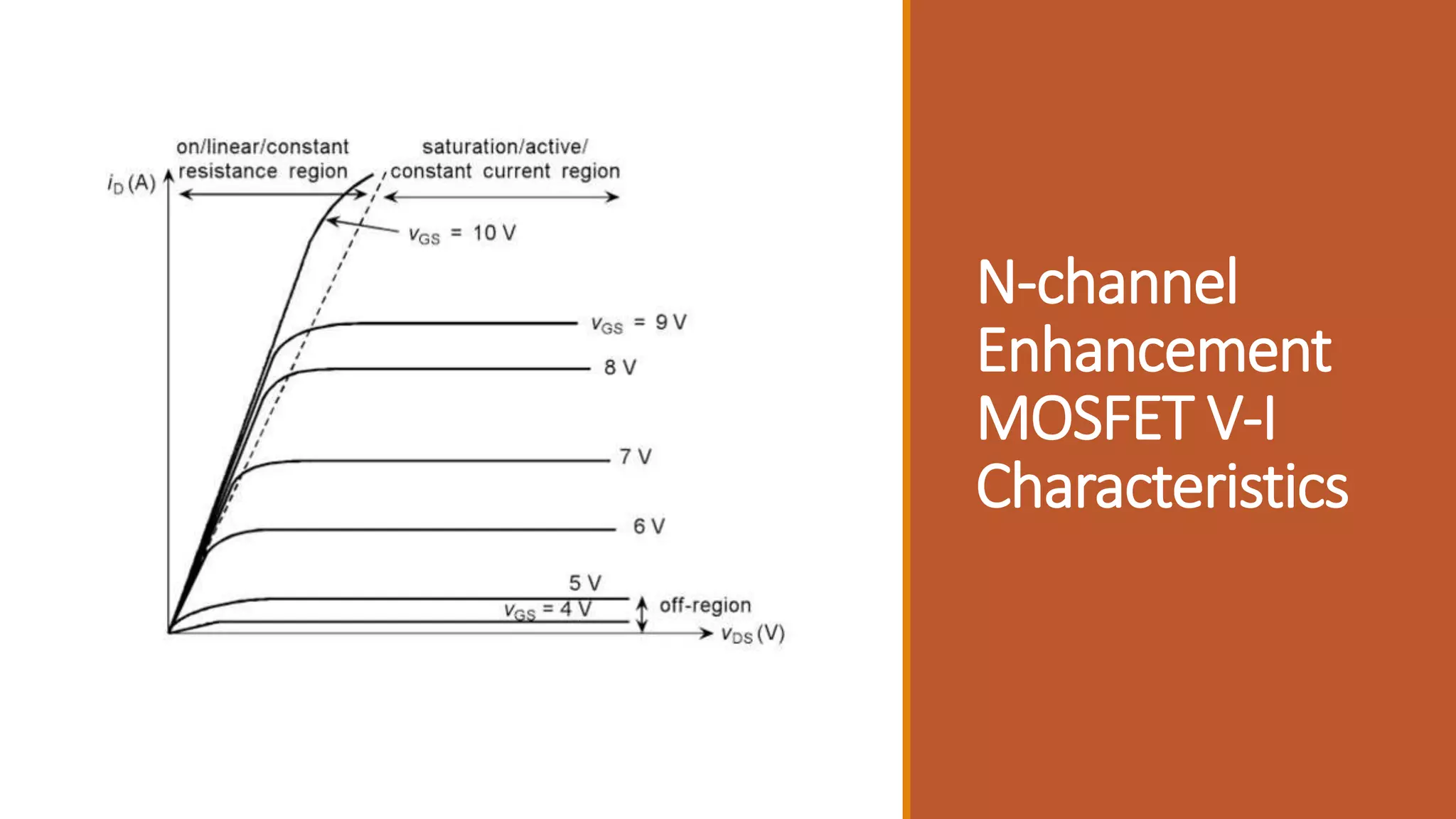
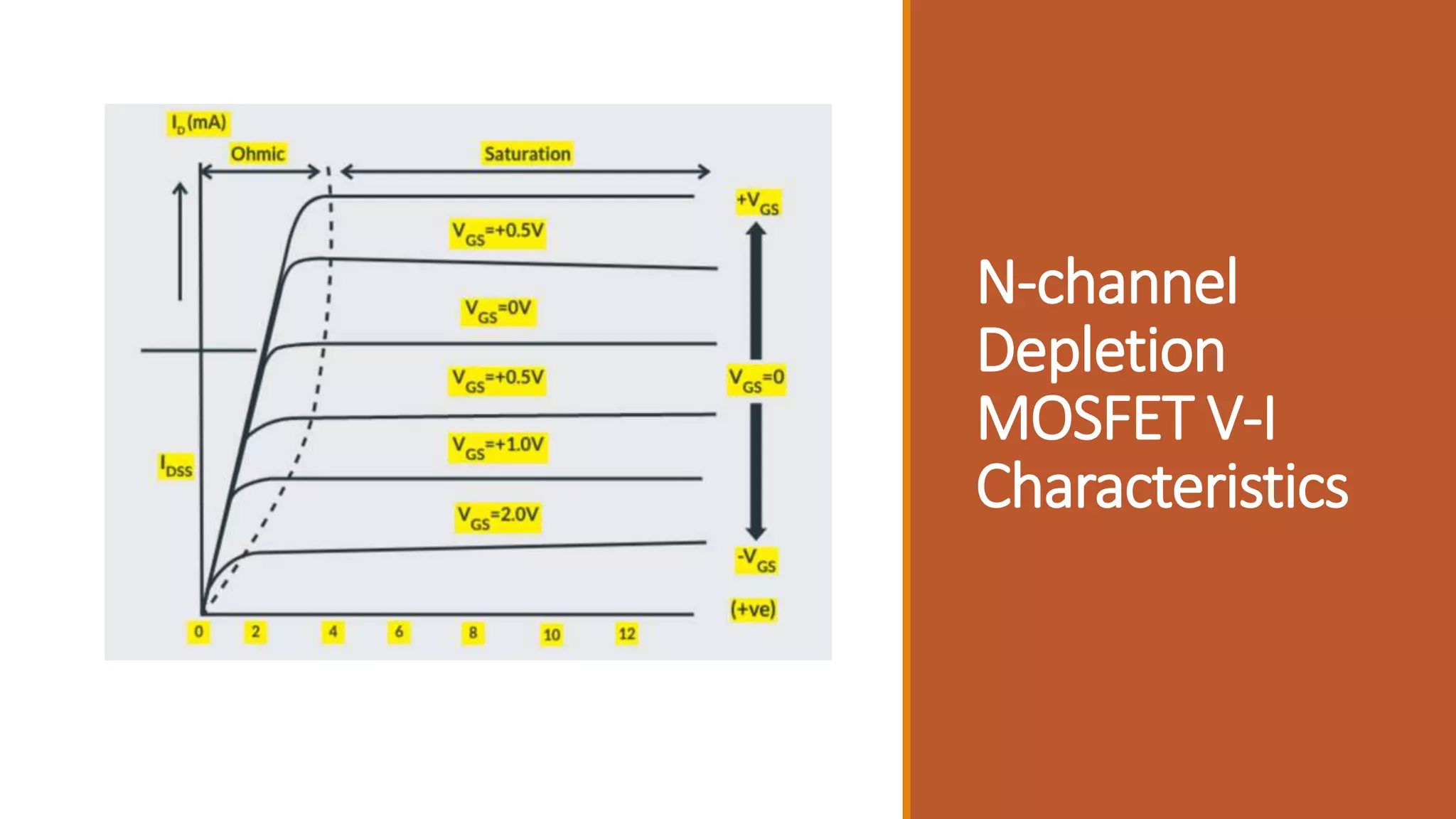
Details on N-channel enhancement and depletion MOSFETs, explaining their construction, operation, VGS, VDS, pinch-off voltage, saturation current, and V-I characteristics.
Overview of P-channel enhancement and depletion MOSFETs, detailing their structure, operational principles, VGS, pinch-off voltage, saturation current, and V-I characteristics.
Introduction
• MOSFETs aremost common type of Field Effect Transistor
• MOSFETs are used in switching or amplifying electronic signals
• MOSFETs are voltage-controlled device
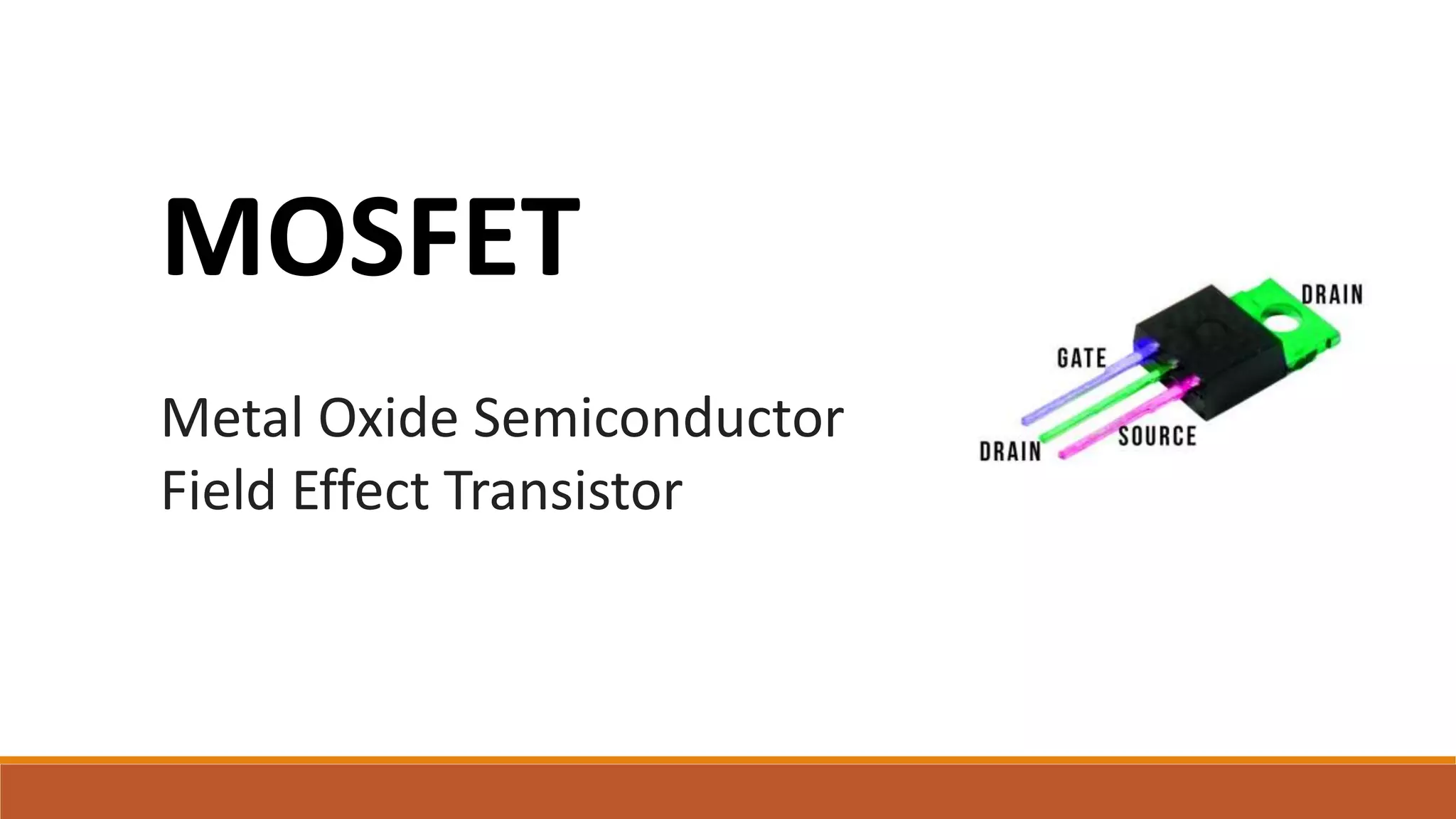
• MOSFETs are three terminal device with Source (S), Drain (D) and Gate (G) terminals.
• MOSFETs have very high switching speed
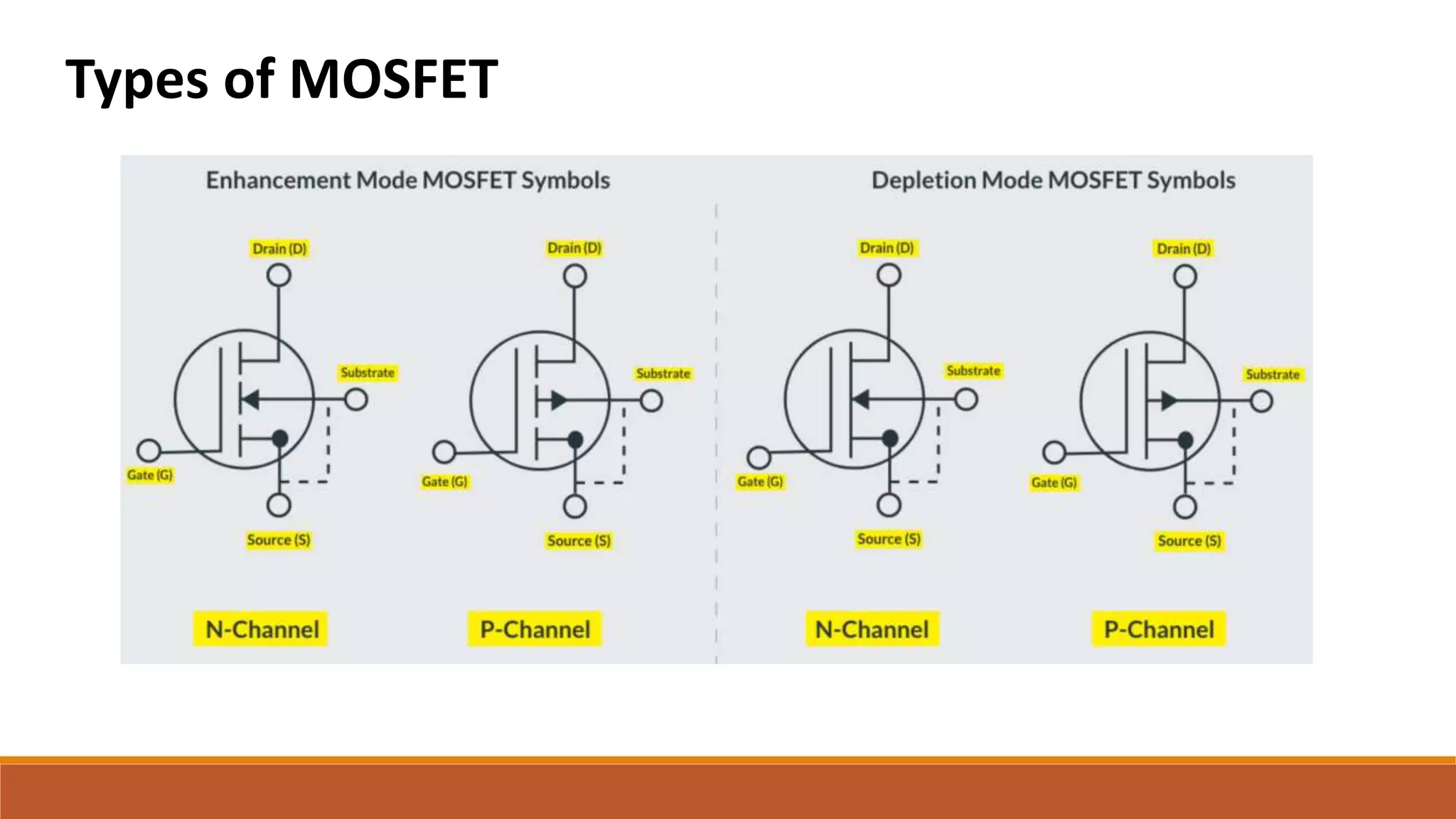
• There are 2 classes of MOFETS : Enhancement and Depletion type
• These 2 classes are further divided as N-channel and P-channel
N-channel Enhancement MOSFET
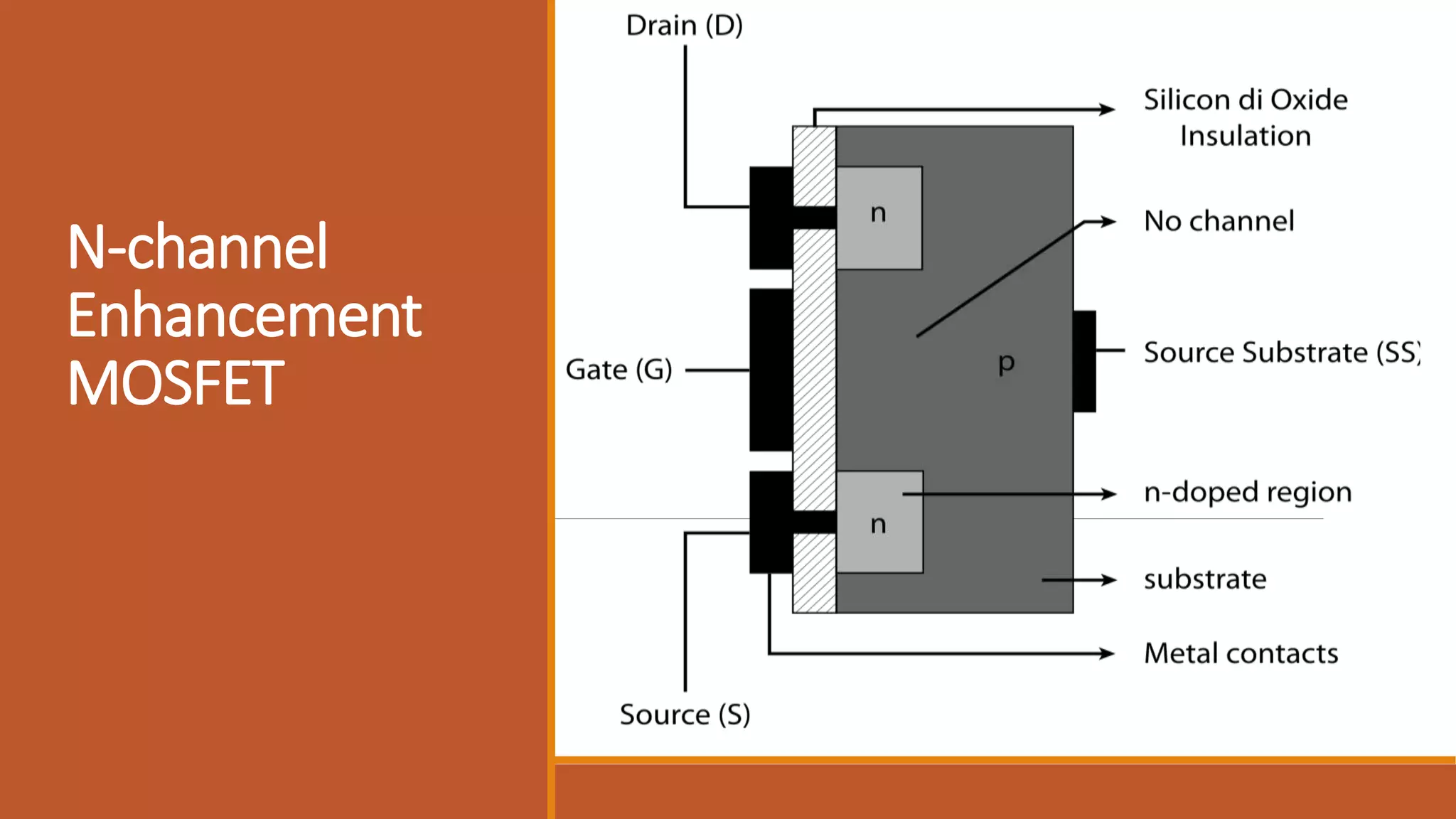
•It has P-type semiconductor material as body/substrate
• Two N-type wells are diffused on the body/substrate
• Two PN junctions are formed creating 2 depletion regions
• A metal contact is created at the bottom and a terminal is taken out known as body/ substrate terminal
• Same metal contacts are created on the top of N-type making source and drain terminals
• There is a layer of Silicon Dioxide in between the 2 N-type well which act as a dielectric
• A metal contact is created on the top of SiO2 layer and a terminal is taken out called Gate
• Generally Source and body terminal are internally connected and is grounded
6.
N-channel
Enhancement
MOSFET
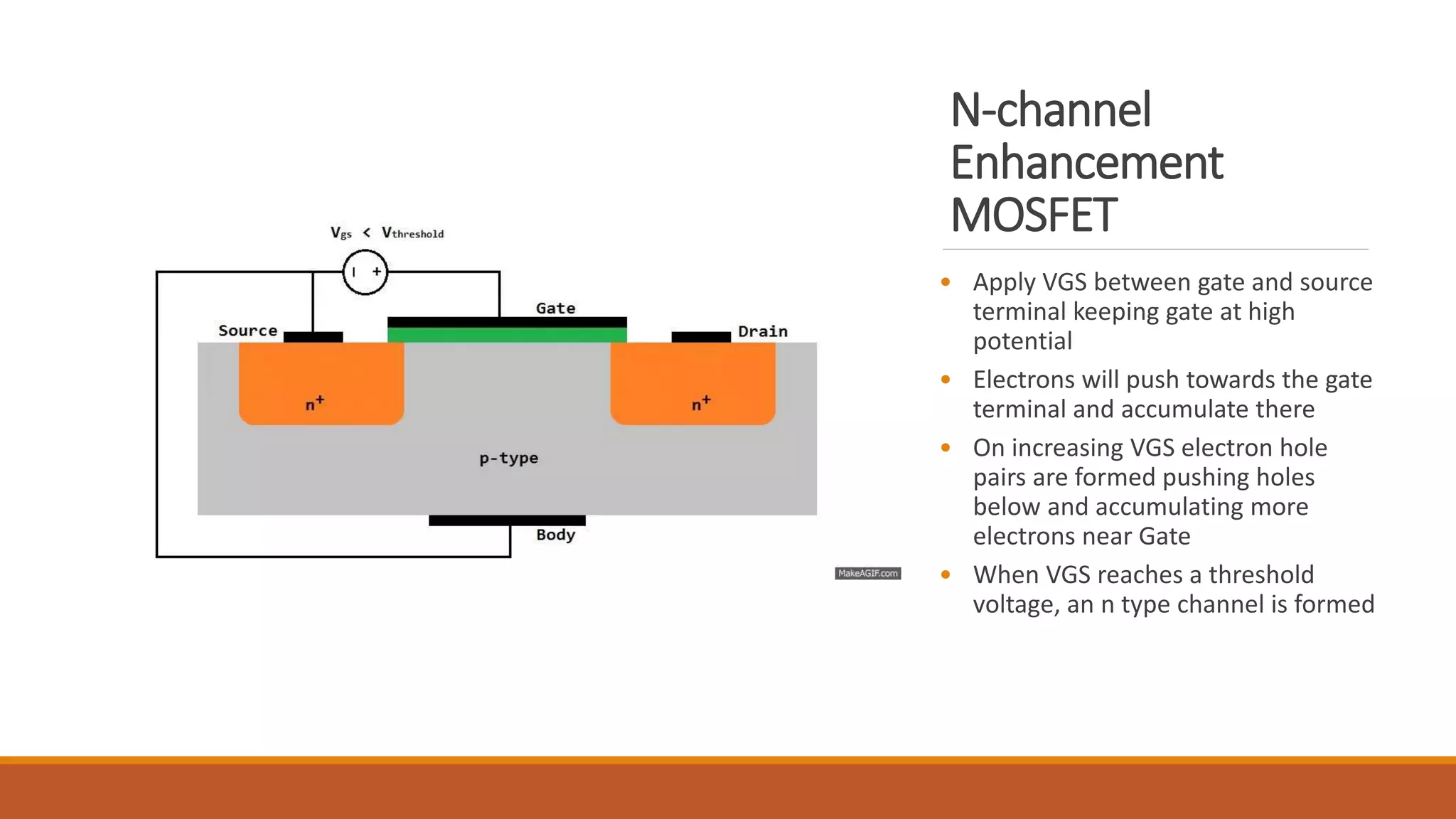
• Apply VGSbetween gate and source
terminal keeping gate at high
potential
• Electrons will push towards the gate
terminal and accumulate there
• On increasing VGS electron hole
pairs are formed pushing holes
below and accumulating more
electrons near Gate
• When VGS reaches a threshold
voltage, an n type channel is formed
7.
N-channel
Enhancement MOSFET
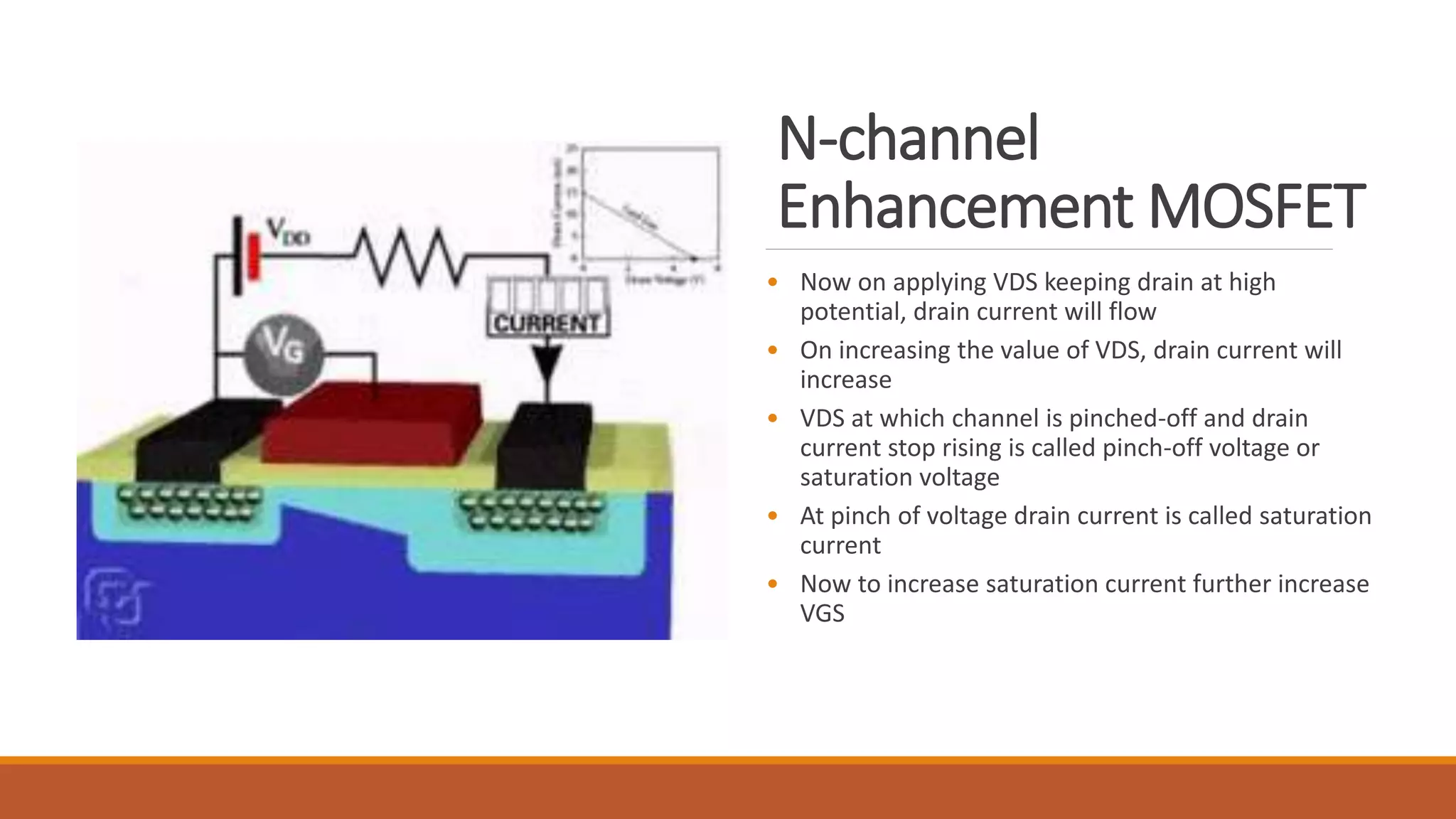
• Nowon applying VDS keeping drain at high
potential, drain current will flow
• On increasing the value of VDS, drain current will
increase
• VDS at which channel is pinched-off and drain
current stop rising is called pinch-off voltage or
saturation voltage
• At pinch of voltage drain current is called saturation
current
• Now to increase saturation current further increase
VGS
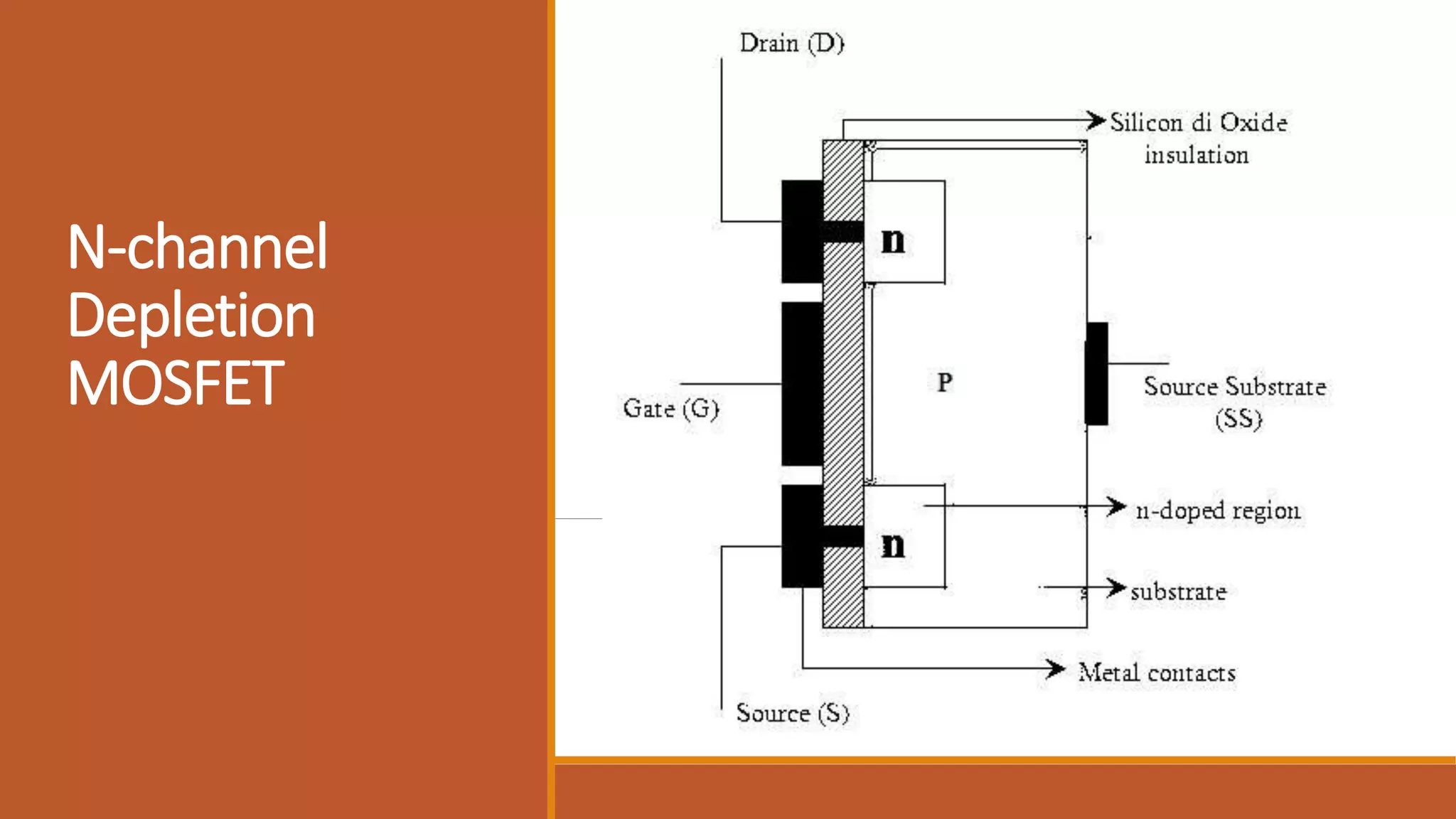
N-channel Depletion
MOSFET
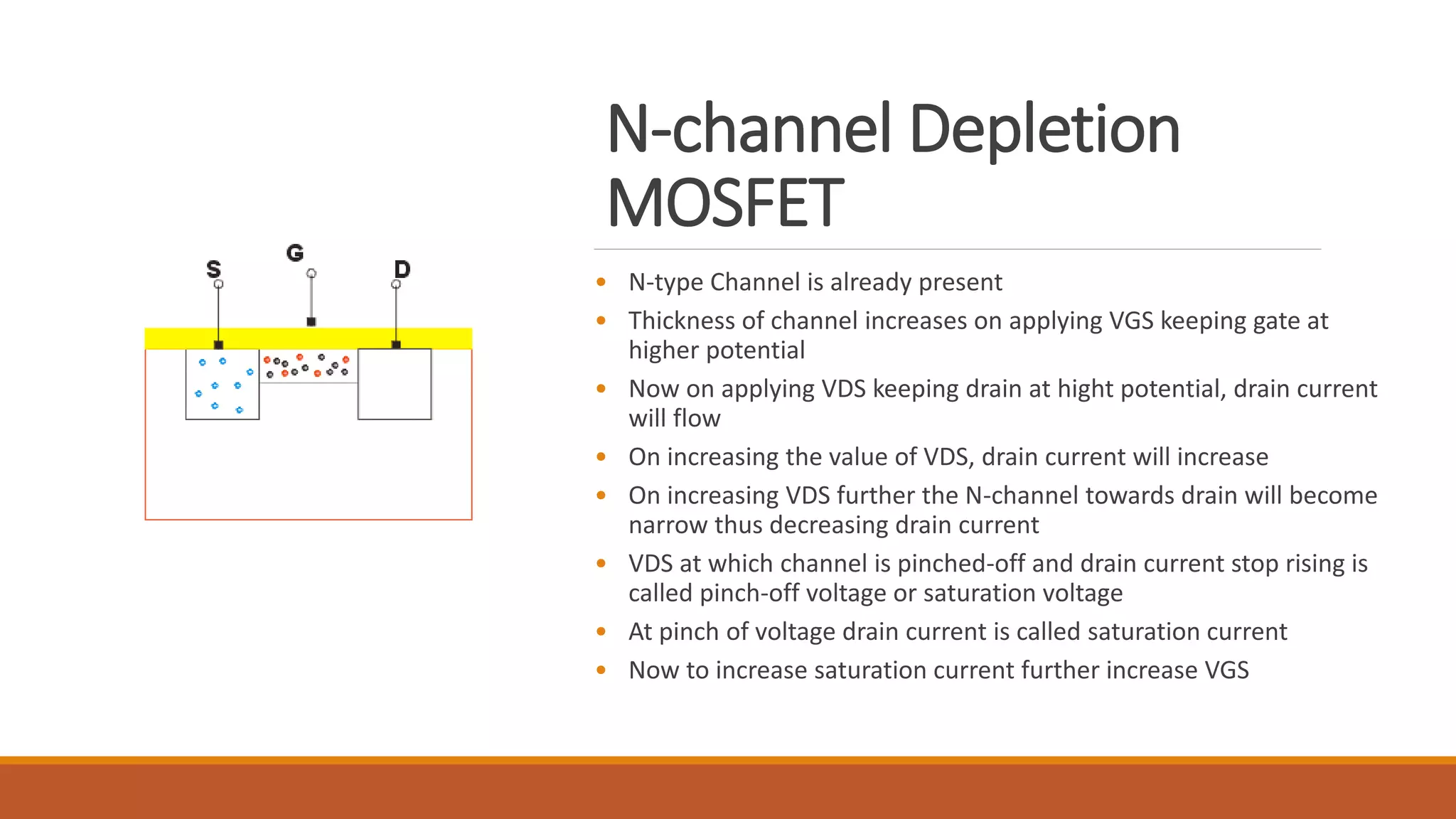
• N-typeChannel is already present
• Thickness of channel increases on applying VGS keeping gate at
higher potential
• Now on applying VDS keeping drain at hight potential, drain current
will flow
• On increasing the value of VDS, drain current will increase
• On increasing VDS further the N-channel towards drain will become
narrow thus decreasing drain current
• VDS at which channel is pinched-off and drain current stop rising is
called pinch-off voltage or saturation voltage
• At pinch of voltage drain current is called saturation current
• Now to increase saturation current further increase VGS
P-channel Enhancement MOSFET
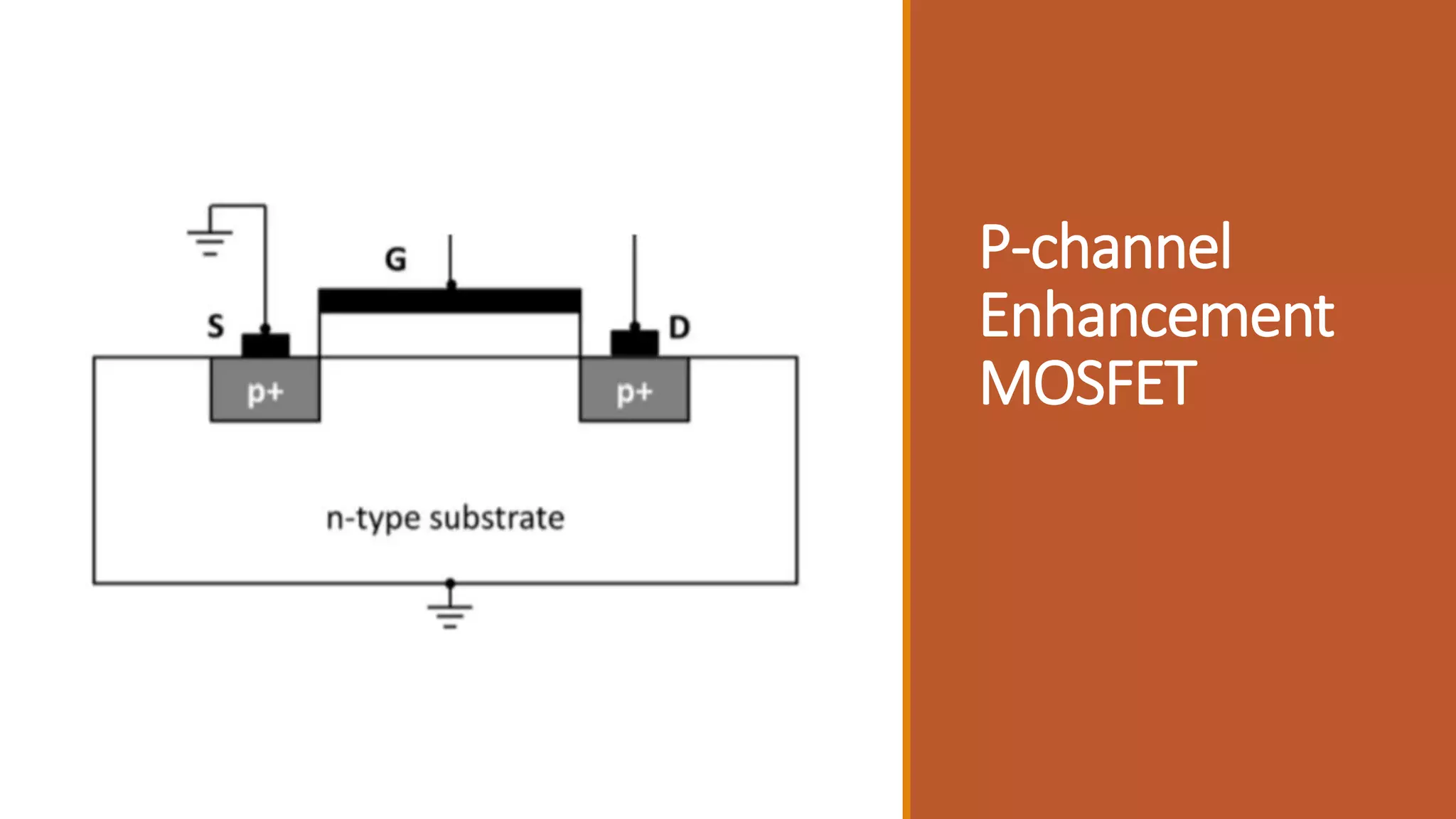
•It has N-type semiconductor material as body/substrate
• Two P-type wells are diffused on the body/substrate
• Two PN junctions are formed creating 2 depletion regions
• A metal contact is created at the bottom and a terminal is taken out known as body/ substrate terminal
• Same metal contacts are created on the top of P-type making source and drain terminals
• There is a layer of Silicon Dioxide in between the 2 P-type well which act as a dielectric
• A metal contact is created on the top of SiO2 layer and a terminal is taken out called Gate
• Generally Source and body terminal are internally connected and is grounded
15.
P-channel
Enhancement MOSFET
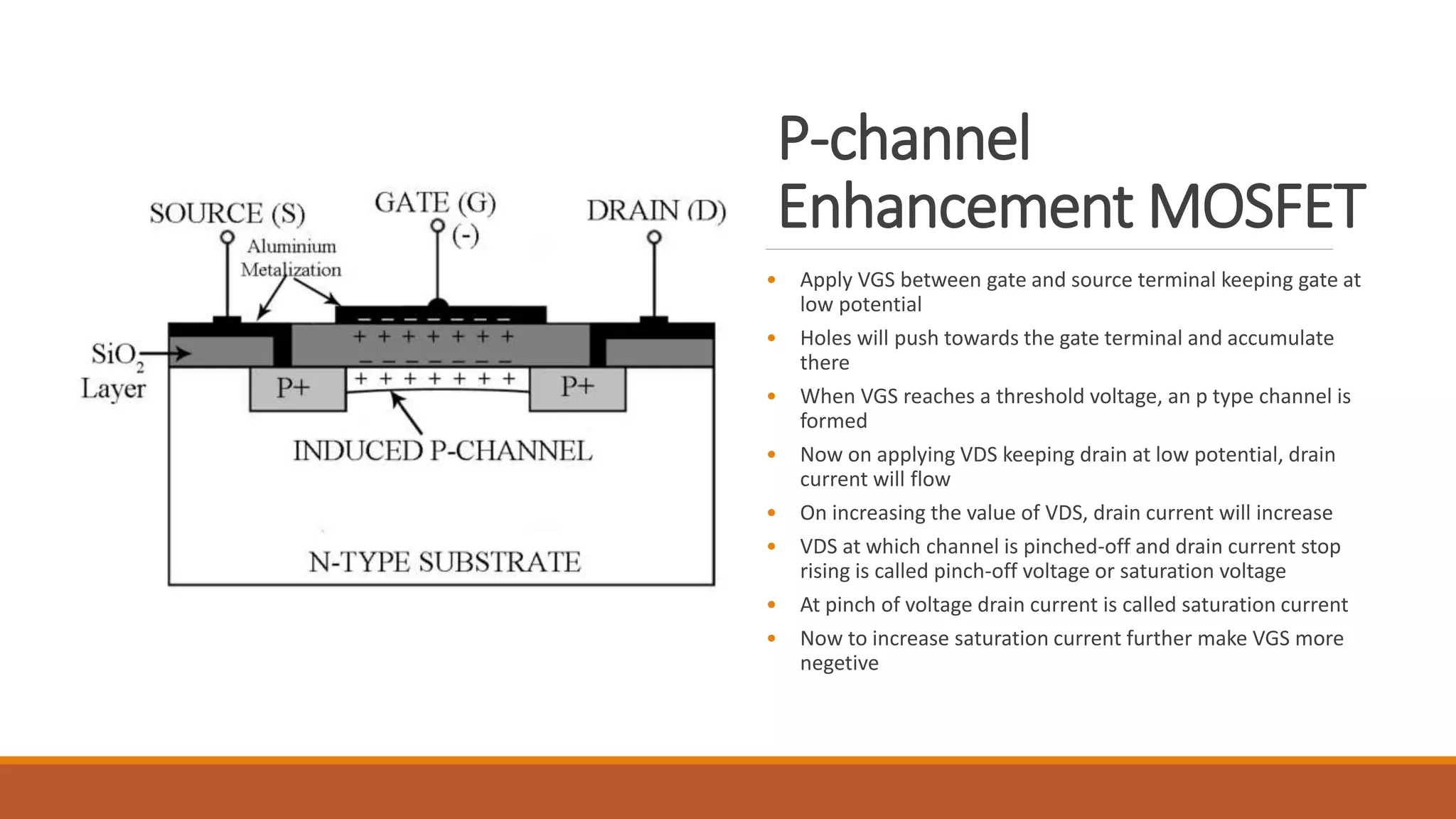
• ApplyVGS between gate and source terminal keeping gate at
low potential
• Holes will push towards the gate terminal and accumulate
there
• When VGS reaches a threshold voltage, an p type channel is
formed
• Now on applying VDS keeping drain at low potential, drain
current will flow
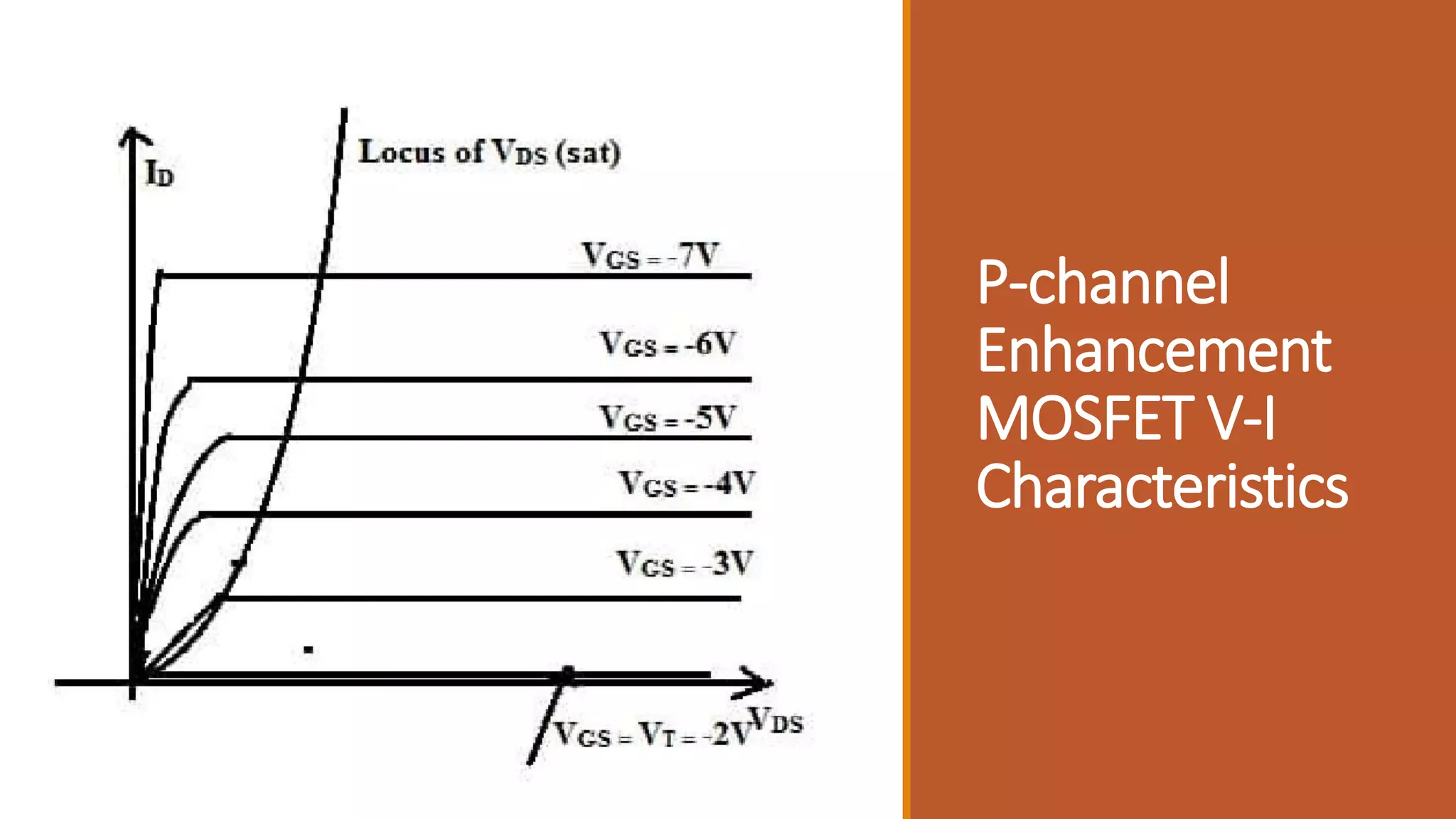
• On increasing the value of VDS, drain current will increase
• VDS at which channel is pinched-off and drain current stop
rising is called pinch-off voltage or saturation voltage
• At pinch of voltage drain current is called saturation current
• Now to increase saturation current further make VGS more
negetive
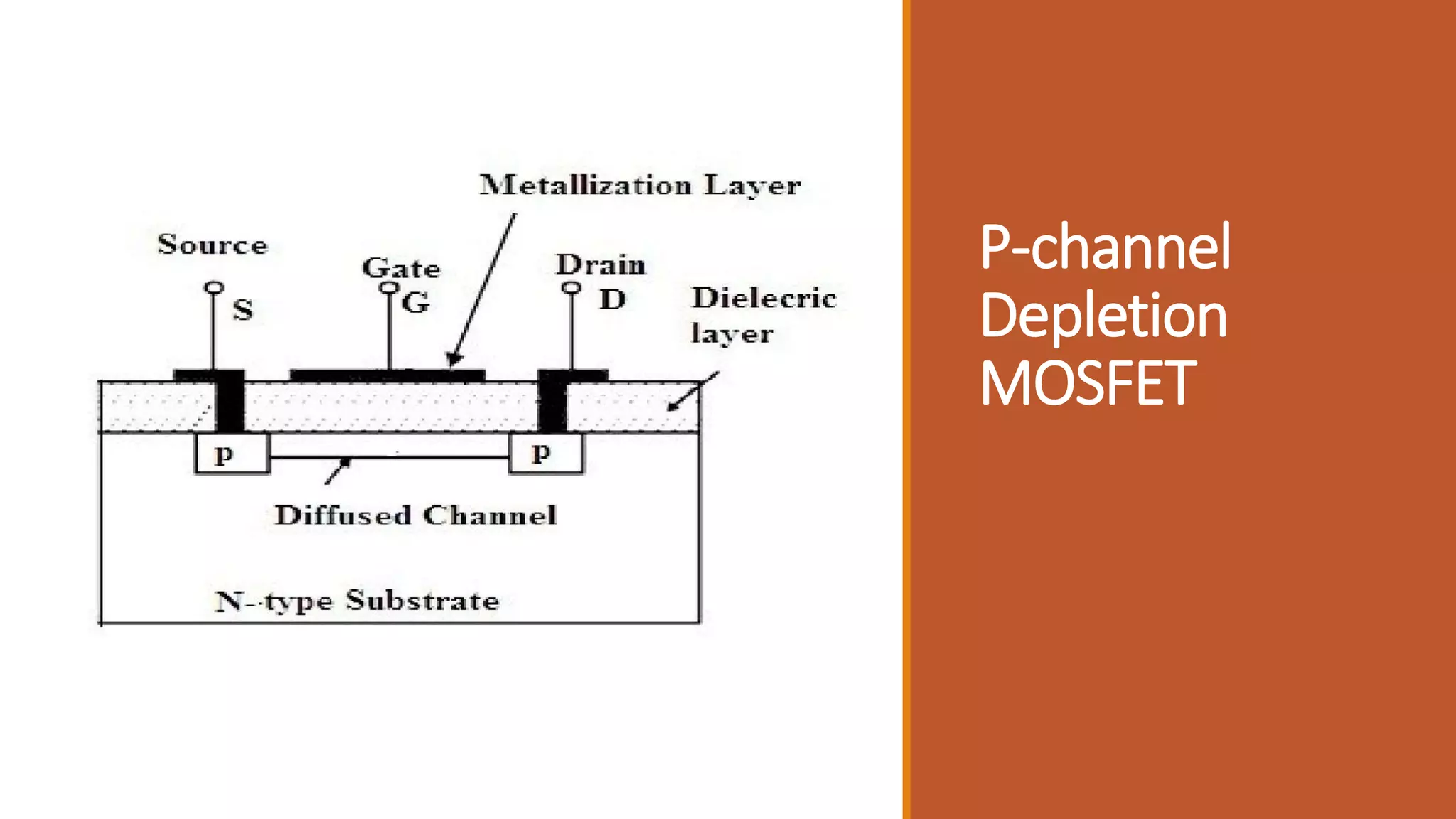
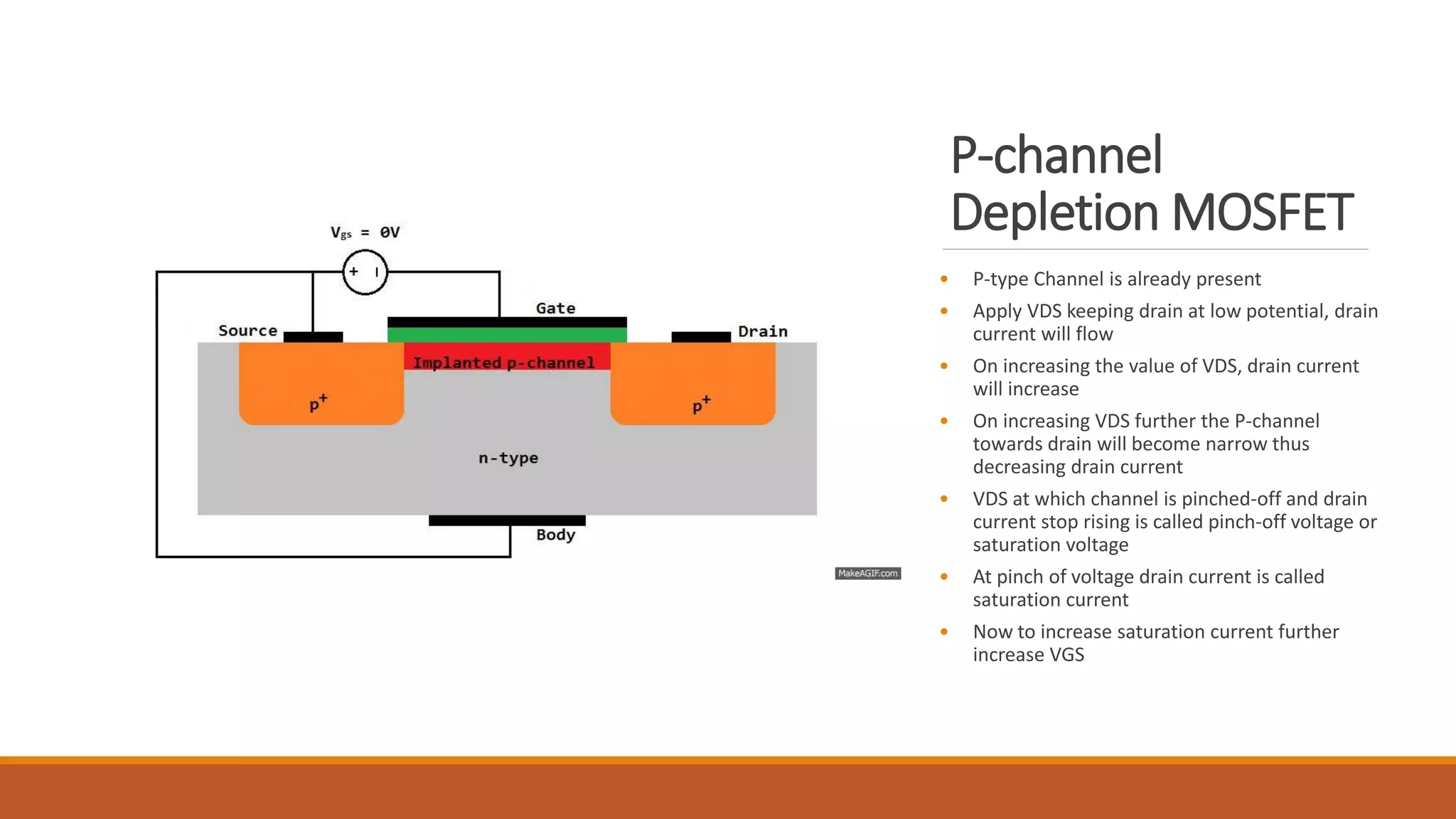
P-channel
Depletion MOSFET
• P-typeChannel is already present
• Apply VDS keeping drain at low potential, drain
current will flow
• On increasing the value of VDS, drain current
will increase
• On increasing VDS further the P-channel
towards drain will become narrow thus
decreasing drain current
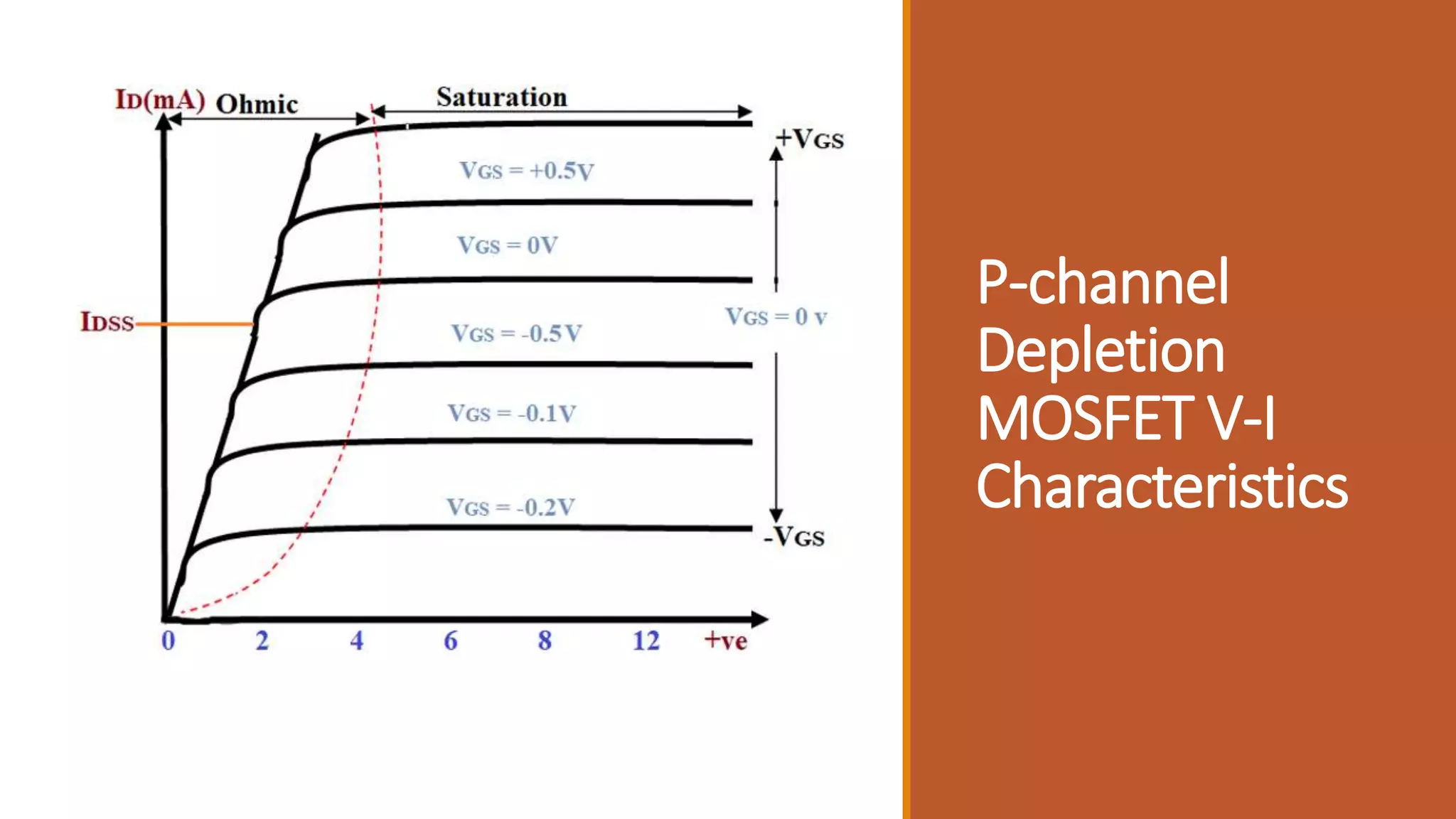
• VDS at which channel is pinched-off and drain
current stop rising is called pinch-off voltage or
saturation voltage
• At pinch of voltage drain current is called
saturation current
• Now to increase saturation current further
increase VGS