Metal Insulator
Semiconductor devices
MOSFET
 Importance for LSI/VLSI
 Low fabrication cost
 Small size
 Low power consumption
 Applications
 Microprocessors
 Memories
 Power Devices
 Basic Properties
 Unipolar device
 Very high input impedance
 Capable of power gain
 3/4 terminal device, G, S, D, B
 Two possible device types: enhancement mode;
depletion mode
 Two possible channel types: n-channel; p-channel
Transistors
 These are three
terminal devices,
where the current or
voltage at one
terminal, the input
terminal, controls the
flow of current
between the two
remaining terminals.
FETs
 Two primary types:
 MOSFET, Metal-Oxide-Semiconductor FET. Also
known as IGFET – Insulated Gate FET;
 JFET, Junction FET.
 MOS transistors can be:
 n-Channel;
 Enhancement mode;
 Depletion mode;
 p-Channel;
 Enhancement mode;
 Depletion mode;
Different types of FETs
 Metal-Semiconductor FET (MESFET)
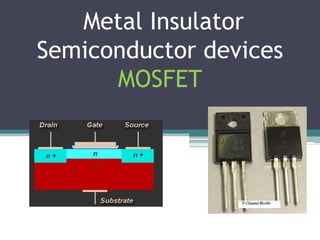
MOSFET Structure
MOSFET Structure
p-Si
n+
L
Source Gate Drain
Field Oxide
Gate Oxide
Bulk (Substrate)
MOSFET
(n-channel Enhancement-Mode)
 Device Structure
 Substrate, source connected to ground
 The drain-body n+p junction is reverse-biased.
 The body-source pn+ junction is reverse-biased.
 Enhancement MOSFET acts as an open circuit with no gate voltage.
MOSFET Operation
• Voltage at gate
controls the flow of
current between drain
and source.
• VGS – Voltage between
gate and source.
• VDS – Voltage between
drain and source.
MOSFET Operation
• When VGS = 0 then no
current flows between
drain and source.
• pn-Junction is reverse
biased.
Basic MOSFET (n-channel)
• The gate electrode is placed
on top of a very thin
insulating layer.
• There are a pair of small n-
type regions just under the
drain & source electrodes.
• If apply a +ve voltage to
gate, will push away the
‘holes’ inside the p-type
substrate and attracts the
moveable electrons in the
n-type regions under the
source & drain electrodes.
Basic MOSFET (n-channel)
• Increasing the +ve gate
voltage pushes the p-type
holes further away and
enlarges the thickness of
the created channel.
• As a result increases the
amount of current which
can go from source to
drain — this is why this
kind of transistor is called
an enhancement mode
device.
Carbon N-TE-DNA BioFET Whole Cell SummaryIntroduction
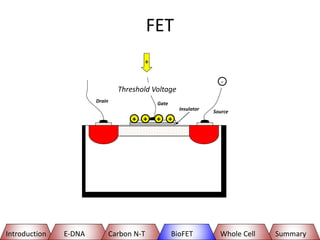
FET
Drain Gate
Source
-
-
-
-
-
-
Insulator
+
+ + + +
(Electron Channel)
(Not conductive enough)
Carbon N-TE-DNA BioFET Whole Cell SummaryIntroduction
FET
Drain Gate
Source
-
Insulator
+
+ + + +
Threshold Voltage
Carbon N-TE-DNA BioFET Whole Cell SummaryIntroduction
FET
Drain Gate
Source
-
-
-
-
-
-
- -
Insulator
+ + + +
+
+ + + +
- -- -- -
 Note the n-type
body and the p-
type source and
drain areas.
 Both VGS and VDD
are negative with
respect to ground.
January 2004ELEC 121 19
n-Channel E-MOSFET showing channel length L and channel width W
 A family of curves
representing the
V-I characteristics
of transistors.
 A plot of drain
current, ID, as a
function of drain-
to-source voltage,
VDS, for several
values of VGS.
Depletion Mode MOSFETs
• n-Channel is built in.
• VGS varies from
negative values to
positive values, where
negative values of VGS
depletes the channel
while positive values
enhance it further.
January 2004 ELEC 121 22
D-MOSFET Depletion Mode Operation
The transfer characteristics are similar to the JFET
In Depletion Mode operation:
When VGS = 0V, ID = IDSS
When VGS < 0V, ID < IDSS
When VGS > 0V, ID > IDSS
The formula used to plot the Transfer Curve, is:
 
 
 
2
GS
D DSS
P
V
I = I 1-
V
September 17, 2007 23
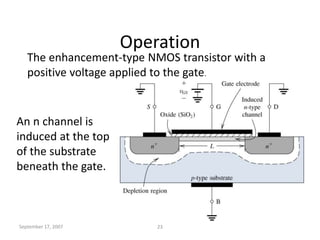
The enhancement-type NMOS transistor with a
positive voltage applied to the gate.
An n channel is
induced at the top
of the substrate
beneath the gate.
Operation
September 17, 2007 24
vGS > Vt ,small vDS
applied.
the channel
conductance is
proportional to
vGS - Vt, and is
proportional to
(vGS - Vt) vDS.
Triode Region
September 17, 2007 25
The induced
channel acquires a
tapered shape and
its resistance
increases as vDS is
increased.
vGS > Vt.
Saturation Region
September 17, 2007 26
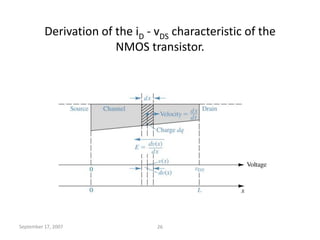
Derivation of the iD - vDS characteristic of the
NMOS transistor.
September 17, 2007 27
Increasing vDS beyond vDSsat causes the channel
pinch-off point to move slightly away from the drain,
thus reducing the effective channel length (by L).
September 17, 2007 28
Enhancement-type NMOS transistor operated with vGS > Vt.
Drain current iD versus vDS
ECE 663
Drain current for REALLY small VD
 
  
 TGD
DTGinD
DDTGinD
VVV
VVVC
L
Z
I
VVVVC
L
Z
I








 2
2
1
Linear operation
Channel Conductance:
)( TGin
VD
D
D VVC
L
Z
V
I
g
G




Transconductance:
Din
VG
D
m VC
L
Z
V
I
g
D




ECE 663
In Saturation
• Channel Conductance:
• Transconductance:
 2
2
TGinD VVC
L
Z
satI 
0



GVD
D
D
V
I
g
 TGin
VG
D
m VVC
L
Z
V
I
g
D




January 2004 ELEC 121 31
Summary Table
JFET D-MOSFET E-MOSFET
I-V Characteristics of MOSFET
CMOS Circuit
September 17, 2007 34
Cross section of a CMOS integrated circuit. Note that the
PMOS transistor is formed in a separate n-type region, known
as an n well. Another arrangement is also possible in which
an n-type body is used and the n device is formed in a p well.
Fabrication and Layout Slide 35
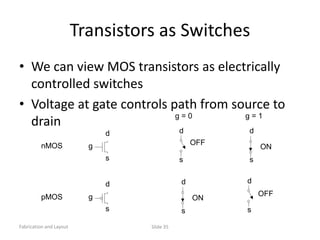
Transistors as Switches
• We can view MOS transistors as electrically
controlled switches
• Voltage at gate controls path from source to
drain
g
s
d
g = 0
s
d
g = 1
s
d
g
s
d
s
d
s
d
nMOS
pMOS
OFF
ON
ON
OFF
Fabrication and Layout Slide 36
CMOS Inverter
A Y
0
1
VDD
A Y
GND
A Y
Fabrication and Layout Slide 37
CMOS Inverter
A Y
0
1 0
VDD
A=1 Y=0
GND
ON
OFF
A Y
Fabrication and Layout Slide 38
CMOS Inverter
A Y
0 1
1 0
VDD
A=0 Y=1
GND
OFF
ON
A Y
MOS (complementary metal oxide semiconductor) logic
has a few desirable advantages:
• High input impedance. The input signal is driving electrodes
with a layer of insulation (the metal oxide) between them and
what they are controlling. This gives them a small amount of
capacitance, but virtually infinite resistance. The current into or
out of CMOS input held at one level is just leakage, usually 1
nanoAmpere or less
• CMOS logic takes very little power when held in a fixed state.
The current consumption comes from switching as those
capacitors are charged and discharged. Even then, it has good
speed to power ratio compared to other logic types.
• CMOS gates are very simple. The basic gate is an inverter,
which is only two transistors. This together with the low power
consumption means it lends itself well to dense integration. Or
conversely, you get a lot of logic for the size, cost and power.
Few Applications
41
CCD Image Sensors
• High QE and low dark current
• Serial readout:
– Slow readout
– Complex clocking and supply
requirements
– High power consumption
• Cannot integrate circuitry on
chip
42
CMOS Image Sensors
• Memory-like readout:
– Enables high speed operation
– Low power consumption
– Region of interest
• Integration
• Enable new applications:
– Embedded imaging
– High dynamic range
– Biometrics
– 3D imaging
Column Amplifiers / Caps
Column ADC / Mux
RowDecoder
Pixel
Word
Bit
Reset
Word
Bit
43
Image Sensor Market
0
20,000
40,000
60,000
80,000
100,000
120,000
140,000
160,000
180,000
200,000
2001 2002 2003 2004 2005 2006
Year
ThousandsofUnits
CMOS
CCD
Source: In-Stat/MDR, 8/02
44
Technology and Design Trends
• Recent developments in:
– Silicon processing
– Color Filter Array and Microlens
– Miniaturized packaging
– Pixel design
– Camera-on-chip
• Promise to broaden CMOS image sensor applicability
and enhance their performance
45
Problems with standard CMOS
• Low photoresponsivity -- shallow junctions,
high doping
• High junction leakage -- STI, salicide
• High transistor leakage – off-current, thin gate
oxide
• Poor analog circuit performance
Wong IEDM’96
Some Recent Developments
Carbon N-TE-DNA BioFET Whole Cell SummaryIntroduction
BioFET
• Draws upon versatility of common electronic
component (Field-Effect Transistor)
• Well understood expectations/results
Carbon N-TE-DNA BioFET Whole Cell SummaryIntroduction
Source: Im et al., 2007
BioFET
Carbon N-TE-DNA BioFET Whole Cell SummaryIntroduction
Source: Im et al., 2007
BioFET
Carbon N-TE-DNA BioFET Whole Cell SummaryIntroduction
Source: Im et al., 2007
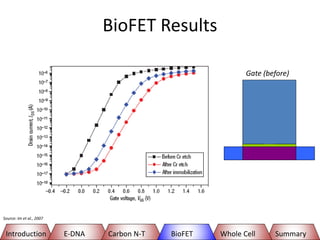
BioFET Results
Gate (before)
Carbon N-TE-DNA BioFET Whole Cell SummaryIntroduction
Source: Im et al., 2007
BioFET Results
Gate
(after etch, w/biotin)
Gate
(w/ complete
Biomolecule)
d
Thank You

Metal Insulator Semiconductor devices

  • 1.
  • 2.
     Importance forLSI/VLSI  Low fabrication cost  Small size  Low power consumption  Applications  Microprocessors  Memories  Power Devices  Basic Properties  Unipolar device  Very high input impedance  Capable of power gain  3/4 terminal device, G, S, D, B  Two possible device types: enhancement mode; depletion mode  Two possible channel types: n-channel; p-channel
  • 3.
    Transistors  These arethree terminal devices, where the current or voltage at one terminal, the input terminal, controls the flow of current between the two remaining terminals.
  • 4.
    FETs  Two primarytypes:  MOSFET, Metal-Oxide-Semiconductor FET. Also known as IGFET – Insulated Gate FET;  JFET, Junction FET.  MOS transistors can be:  n-Channel;  Enhancement mode;  Depletion mode;  p-Channel;  Enhancement mode;  Depletion mode;
  • 5.
    Different types ofFETs  Metal-Semiconductor FET (MESFET)
  • 6.
  • 7.
    MOSFET Structure p-Si n+ L Source GateDrain Field Oxide Gate Oxide Bulk (Substrate)
  • 8.
    MOSFET (n-channel Enhancement-Mode)  DeviceStructure  Substrate, source connected to ground  The drain-body n+p junction is reverse-biased.  The body-source pn+ junction is reverse-biased.  Enhancement MOSFET acts as an open circuit with no gate voltage.
  • 10.
    MOSFET Operation • Voltageat gate controls the flow of current between drain and source. • VGS – Voltage between gate and source. • VDS – Voltage between drain and source.
  • 11.
    MOSFET Operation • WhenVGS = 0 then no current flows between drain and source. • pn-Junction is reverse biased.
  • 12.
    Basic MOSFET (n-channel) •The gate electrode is placed on top of a very thin insulating layer. • There are a pair of small n- type regions just under the drain & source electrodes. • If apply a +ve voltage to gate, will push away the ‘holes’ inside the p-type substrate and attracts the moveable electrons in the n-type regions under the source & drain electrodes.
  • 13.
    Basic MOSFET (n-channel) •Increasing the +ve gate voltage pushes the p-type holes further away and enlarges the thickness of the created channel. • As a result increases the amount of current which can go from source to drain — this is why this kind of transistor is called an enhancement mode device.
  • 14.
    Carbon N-TE-DNA BioFETWhole Cell SummaryIntroduction FET Drain Gate Source - - - - - - Insulator + + + + + (Electron Channel) (Not conductive enough)
  • 15.
    Carbon N-TE-DNA BioFETWhole Cell SummaryIntroduction FET Drain Gate Source - Insulator + + + + + Threshold Voltage
  • 16.
    Carbon N-TE-DNA BioFETWhole Cell SummaryIntroduction FET Drain Gate Source - - - - - - - - Insulator + + + + + + + + + - -- -- -
  • 17.
     Note then-type body and the p- type source and drain areas.  Both VGS and VDD are negative with respect to ground.
  • 18.
    January 2004ELEC 12119 n-Channel E-MOSFET showing channel length L and channel width W
  • 19.
     A familyof curves representing the V-I characteristics of transistors.  A plot of drain current, ID, as a function of drain- to-source voltage, VDS, for several values of VGS.
  • 20.
    Depletion Mode MOSFETs •n-Channel is built in. • VGS varies from negative values to positive values, where negative values of VGS depletes the channel while positive values enhance it further.
  • 21.
    January 2004 ELEC121 22 D-MOSFET Depletion Mode Operation The transfer characteristics are similar to the JFET In Depletion Mode operation: When VGS = 0V, ID = IDSS When VGS < 0V, ID < IDSS When VGS > 0V, ID > IDSS The formula used to plot the Transfer Curve, is:       2 GS D DSS P V I = I 1- V
  • 22.
    September 17, 200723 The enhancement-type NMOS transistor with a positive voltage applied to the gate. An n channel is induced at the top of the substrate beneath the gate. Operation
  • 23.
    September 17, 200724 vGS > Vt ,small vDS applied. the channel conductance is proportional to vGS - Vt, and is proportional to (vGS - Vt) vDS. Triode Region
  • 24.
    September 17, 200725 The induced channel acquires a tapered shape and its resistance increases as vDS is increased. vGS > Vt. Saturation Region
  • 25.
    September 17, 200726 Derivation of the iD - vDS characteristic of the NMOS transistor.
  • 26.
    September 17, 200727 Increasing vDS beyond vDSsat causes the channel pinch-off point to move slightly away from the drain, thus reducing the effective channel length (by L).
  • 27.
    September 17, 200728 Enhancement-type NMOS transistor operated with vGS > Vt. Drain current iD versus vDS
  • 28.
    ECE 663 Drain currentfor REALLY small VD       TGD DTGinD DDTGinD VVV VVVC L Z I VVVVC L Z I          2 2 1 Linear operation Channel Conductance: )( TGin VD D D VVC L Z V I g G     Transconductance: Din VG D m VC L Z V I g D    
  • 29.
    ECE 663 In Saturation •Channel Conductance: • Transconductance:  2 2 TGinD VVC L Z satI  0    GVD D D V I g  TGin VG D m VVC L Z V I g D    
  • 30.
    January 2004 ELEC121 31 Summary Table JFET D-MOSFET E-MOSFET
  • 31.
  • 32.
  • 33.
    September 17, 200734 Cross section of a CMOS integrated circuit. Note that the PMOS transistor is formed in a separate n-type region, known as an n well. Another arrangement is also possible in which an n-type body is used and the n device is formed in a p well.
  • 34.
    Fabrication and LayoutSlide 35 Transistors as Switches • We can view MOS transistors as electrically controlled switches • Voltage at gate controls path from source to drain g s d g = 0 s d g = 1 s d g s d s d s d nMOS pMOS OFF ON ON OFF
  • 35.
    Fabrication and LayoutSlide 36 CMOS Inverter A Y 0 1 VDD A Y GND A Y
  • 36.
    Fabrication and LayoutSlide 37 CMOS Inverter A Y 0 1 0 VDD A=1 Y=0 GND ON OFF A Y
  • 37.
    Fabrication and LayoutSlide 38 CMOS Inverter A Y 0 1 1 0 VDD A=0 Y=1 GND OFF ON A Y
  • 38.
    MOS (complementary metaloxide semiconductor) logic has a few desirable advantages: • High input impedance. The input signal is driving electrodes with a layer of insulation (the metal oxide) between them and what they are controlling. This gives them a small amount of capacitance, but virtually infinite resistance. The current into or out of CMOS input held at one level is just leakage, usually 1 nanoAmpere or less • CMOS logic takes very little power when held in a fixed state. The current consumption comes from switching as those capacitors are charged and discharged. Even then, it has good speed to power ratio compared to other logic types. • CMOS gates are very simple. The basic gate is an inverter, which is only two transistors. This together with the low power consumption means it lends itself well to dense integration. Or conversely, you get a lot of logic for the size, cost and power.
  • 39.
  • 40.
    41 CCD Image Sensors •High QE and low dark current • Serial readout: – Slow readout – Complex clocking and supply requirements – High power consumption • Cannot integrate circuitry on chip
  • 41.
    42 CMOS Image Sensors •Memory-like readout: – Enables high speed operation – Low power consumption – Region of interest • Integration • Enable new applications: – Embedded imaging – High dynamic range – Biometrics – 3D imaging Column Amplifiers / Caps Column ADC / Mux RowDecoder Pixel Word Bit Reset Word Bit
  • 42.
    43 Image Sensor Market 0 20,000 40,000 60,000 80,000 100,000 120,000 140,000 160,000 180,000 200,000 20012002 2003 2004 2005 2006 Year ThousandsofUnits CMOS CCD Source: In-Stat/MDR, 8/02
  • 43.
    44 Technology and DesignTrends • Recent developments in: – Silicon processing – Color Filter Array and Microlens – Miniaturized packaging – Pixel design – Camera-on-chip • Promise to broaden CMOS image sensor applicability and enhance their performance
  • 44.
    45 Problems with standardCMOS • Low photoresponsivity -- shallow junctions, high doping • High junction leakage -- STI, salicide • High transistor leakage – off-current, thin gate oxide • Poor analog circuit performance Wong IEDM’96
  • 45.
  • 49.
    Carbon N-TE-DNA BioFETWhole Cell SummaryIntroduction BioFET • Draws upon versatility of common electronic component (Field-Effect Transistor) • Well understood expectations/results
  • 50.
    Carbon N-TE-DNA BioFETWhole Cell SummaryIntroduction Source: Im et al., 2007 BioFET
  • 51.
    Carbon N-TE-DNA BioFETWhole Cell SummaryIntroduction Source: Im et al., 2007 BioFET
  • 52.
    Carbon N-TE-DNA BioFETWhole Cell SummaryIntroduction Source: Im et al., 2007 BioFET Results Gate (before)
  • 53.
    Carbon N-TE-DNA BioFETWhole Cell SummaryIntroduction Source: Im et al., 2007 BioFET Results Gate (after etch, w/biotin) Gate (w/ complete Biomolecule) d
  • 54.