Civil Engineering Department
Student name - Munshi Shehzadkhan Y
Roll No - T-12CL218
Presentation Title - Stairs
Guide Faculty - Dipti Raval
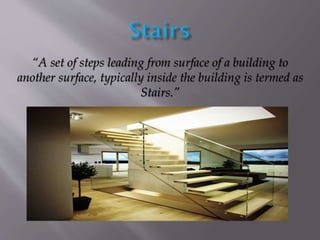
“A set of steps leading from surface of a building to
another surface, typically inside the building is termed as
Stairs.”
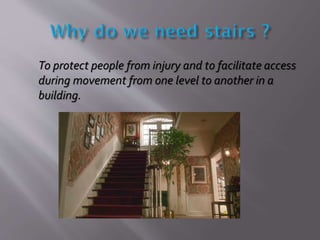
To protect people from injury and to facilitate access
during movement from one level to another in a
building.
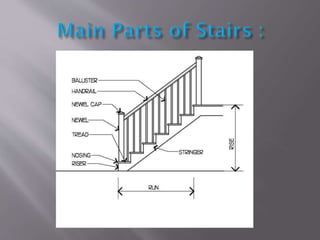
1. Step :
It is a portion of stair which permits ascent & descent.
2. Tread :
It is the upper horizontal portion of step upon which the feet is placed.
3. Riser :
The vertical portion between each tread on the stair.
4. Handrail :
A handrail is a rail that is designed to be grasped by the hand so as to
provide stability or support
5. Baluster :
It is vertical member of wood or metal supporting the handrail.
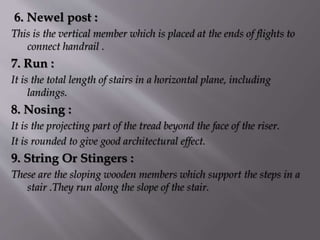
6. Newel post :
This is the vertical member which is placed at the ends of flights to
connect handrail .
7. Run :
It is the total length of stairs in a horizontal plane, including
landings.
8. Nosing :
It is the projecting part of the tread beyond the face of the riser.
It is rounded to give good architectural effect.
9. String Or Stingers :
These are the sloping wooden members which support the steps in a
stair .They run along the slope of the stair.
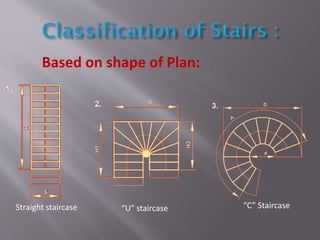
Based on shape of Plan:
Straight staircase “U” staircase “C” Staircase
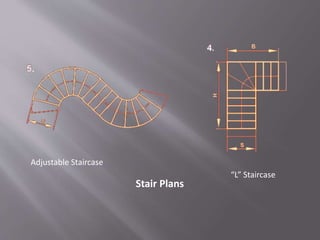
Stair Plans
“L” Staircase
Adjustable Staircase
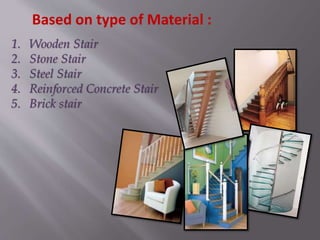
Based on type of Material :
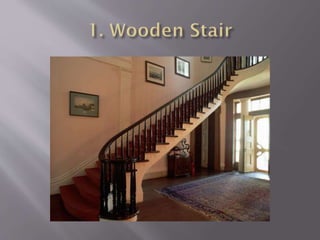
1. Wooden Stair
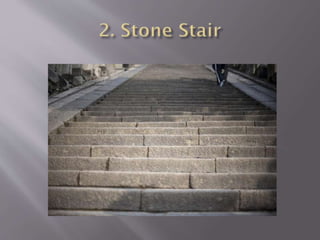
2. Stone Stair
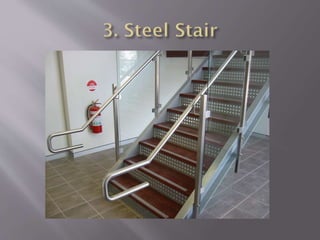
3. Steel Stair
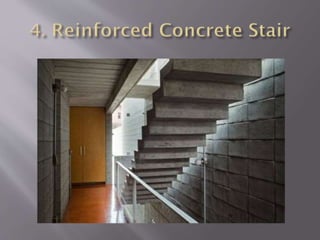
4. Reinforced Concrete Stair
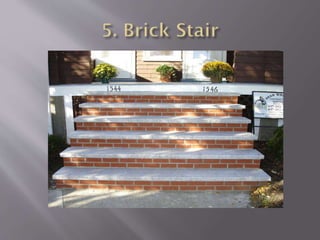
5. Brick stair
Types of Stairs :
1. Straight Stair
2. Dog legged Stair
3. Quarter turn Stair
4. Open newel Stair
5. Three quarter turn Stair
6. Bifurcated Stair
7. Geometrical Stair
8. Circular Stair
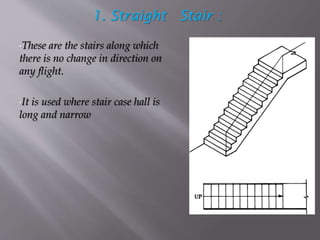
1. Straight Stair :
•These are the stairs along which
there is no change in direction on
any flight.
•It is used where stair case hall is
long and narrow
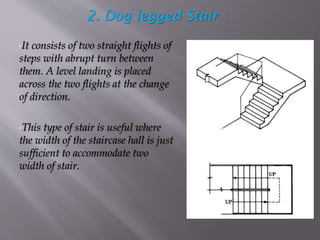
2. Dog legged Stair :
•It consists of two straight flights of
steps with abrupt turn between
them. A level landing is placed
across the two flights at the change
of direction.
•This type of stair is useful where
the width of the staircase hall is just
sufficient to accommodate two
width of stair.
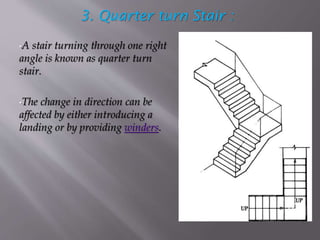
3. Quarter turn Stair :
•A stair turning through one right
angle is known as quarter turn
stair.
•The change in direction can be
affected by either introducing a
landing or by providing winders.
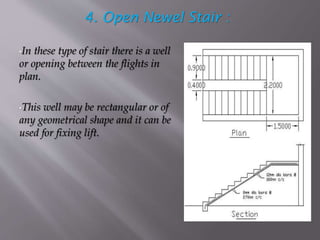
4. Open Newel Stair :
•In these type of stair there is a well
or opening between the flights in
plan.
•This well may be rectangular or of
any geometrical shape and it can be
used for fixing lift.
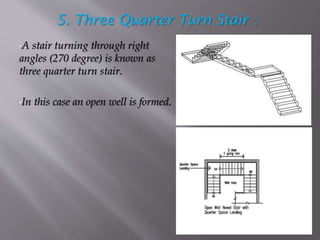
5. Three Quarter Turn Stair :
•A stair turning through right
angles (270 degree) is known as
three quarter turn stair.
•In this case an open well is formed.
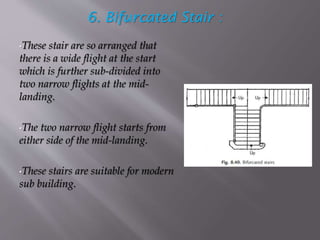
6. Bifurcated Stair :
•These stair are so arranged that
there is a wide flight at the start
which is further sub-divided into
two narrow flights at the mid-
landing.
•The two narrow flight starts from
either side of the mid-landing.
•These stairs are suitable for modern
sub building.
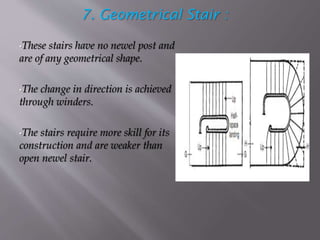
7. Geometrical Stair :
•These stairs have no newel post and
are of any geometrical shape.
•The change in direction is achieved
through winders.
•The stairs require more skill for its
construction and are weaker than
open newel stair.
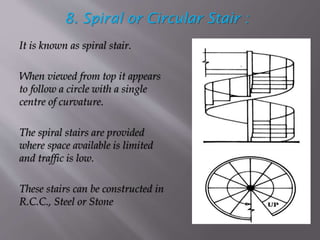
8. Spiral or Circular Stair :
It is known as spiral stair.
When viewed from top it appears
to follow a circle with a single
centre of curvature.
The spiral stairs are provided
where space available is limited
and traffic is low.
These stairs can be constructed in
R.C.C., Steel or Stone
Stairs Ppt
Stairs Ppt
Stairs Ppt
Stairs Ppt
Stairs Ppt

Stairs Ppt

  • 1.
    Civil Engineering Department Studentname - Munshi Shehzadkhan Y Roll No - T-12CL218 Presentation Title - Stairs Guide Faculty - Dipti Raval
  • 2.
    “A set ofsteps leading from surface of a building to another surface, typically inside the building is termed as Stairs.”
  • 3.
    To protect peoplefrom injury and to facilitate access during movement from one level to another in a building.
  • 4.
    1. Step : Itis a portion of stair which permits ascent & descent. 2. Tread : It is the upper horizontal portion of step upon which the feet is placed. 3. Riser : The vertical portion between each tread on the stair. 4. Handrail : A handrail is a rail that is designed to be grasped by the hand so as to provide stability or support 5. Baluster : It is vertical member of wood or metal supporting the handrail.
  • 5.
    6. Newel post: This is the vertical member which is placed at the ends of flights to connect handrail . 7. Run : It is the total length of stairs in a horizontal plane, including landings. 8. Nosing : It is the projecting part of the tread beyond the face of the riser. It is rounded to give good architectural effect. 9. String Or Stingers : These are the sloping wooden members which support the steps in a stair .They run along the slope of the stair.
  • 7.
    Based on shapeof Plan: Straight staircase “U” staircase “C” Staircase
  • 8.
  • 9.
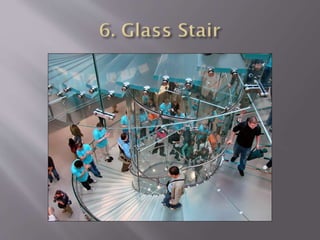
    Based on typeof Material : 1. Wooden Stair 2. Stone Stair 3. Steel Stair 4. Reinforced Concrete Stair 5. Brick stair
  • 16.
    Types of Stairs: 1. Straight Stair 2. Dog legged Stair 3. Quarter turn Stair 4. Open newel Stair 5. Three quarter turn Stair 6. Bifurcated Stair 7. Geometrical Stair 8. Circular Stair
  • 17.
    1. Straight Stair: •These are the stairs along which there is no change in direction on any flight. •It is used where stair case hall is long and narrow
  • 18.
    2. Dog leggedStair : •It consists of two straight flights of steps with abrupt turn between them. A level landing is placed across the two flights at the change of direction. •This type of stair is useful where the width of the staircase hall is just sufficient to accommodate two width of stair.
  • 19.
    3. Quarter turnStair : •A stair turning through one right angle is known as quarter turn stair. •The change in direction can be affected by either introducing a landing or by providing winders.
  • 20.
    4. Open NewelStair : •In these type of stair there is a well or opening between the flights in plan. •This well may be rectangular or of any geometrical shape and it can be used for fixing lift.
  • 21.
    5. Three QuarterTurn Stair : •A stair turning through right angles (270 degree) is known as three quarter turn stair. •In this case an open well is formed.
  • 22.
    6. Bifurcated Stair: •These stair are so arranged that there is a wide flight at the start which is further sub-divided into two narrow flights at the mid- landing. •The two narrow flight starts from either side of the mid-landing. •These stairs are suitable for modern sub building.
  • 23.
    7. Geometrical Stair: •These stairs have no newel post and are of any geometrical shape. •The change in direction is achieved through winders. •The stairs require more skill for its construction and are weaker than open newel stair.
  • 24.
    8. Spiral orCircular Stair : It is known as spiral stair. When viewed from top it appears to follow a circle with a single centre of curvature. The spiral stairs are provided where space available is limited and traffic is low. These stairs can be constructed in R.C.C., Steel or Stone