BLOCKS
CONCRETE BLOCKS.
CONTENTS:
• Introduction
• Manufacturing
• Types
• Advantages
• Disadvantages
• Uses
INTRODUCTION
• It is a standard size rectangular block used in building construction.
• Also known as “Concrete masonry unit (CMU)”.
• Concrete blocks are precast.
• Mostly concrete blocks have one or more cavities and their sides may be smooth
or contain a design.
• Concrete blocks are held together with fresh concrete mortar.
MANUFACTURING OF CONCRETE BLOCKS
• Concrete blocks are manufactured in fully automatic plants which produces
concrete blocks of superior quality and high strength
• Production of concrete blocks in such plants is expensive.
• Manually operated machines are also available which can be installed at project
site itself.
• Manually operated machines reduces the transportation cost of concrete blocks.
• It is manufactured in 4 steps:
1.SELECTION AND PROPORTION OF INGREDIENTS
• Concrete blocks are made up of aggregates (fine and coarse), cement and water.
• Ingredients are selected according to the desired strength.
• Strength, texture and economy of concrete blocks depends upon the careful grading of
aggregates.
• Crushed stones, gravel, volcanic cinders and furnace clinker etc. are used as aggregates.
• Aggregates are selected by considering the weight, texture or composition of unit designed.
• Cement used is ordinary Portland cement.
• Water required is normal potable water
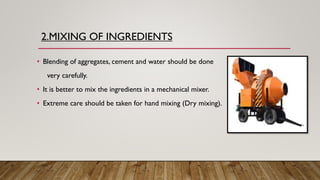
2.MIXING OF INGREDIENTS
• Blending of aggregates, cement and water should be done
very carefully.
• It is better to mix the ingredients in a mechanical mixer.
• Extreme care should be taken for hand mixing (Dry mixing).
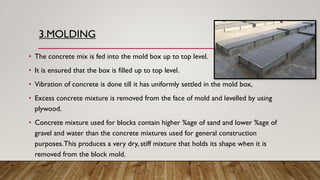
3.MOLDING
• The concrete mix is fed into the mold box up to top level.
• It is ensured that the box is filled up to top level.
• Vibration of concrete is done till it has uniformly settled in the mold box,
• Excess concrete mixture is removed from the face of mold and levelled by using
plywood.
• Concrete mixture used for blocks contain higher %age of sand and lower %age of
gravel and water than the concrete mixtures used for general construction
purposes.This produces a very dry, stiff mixture that holds its shape when it is
removed from the block mold.
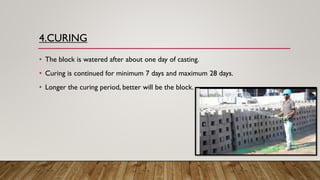
4.CURING
• The block is watered after about one day of casting.
• Curing is continued for minimum 7 days and maximum 28 days.
• Longer the curing period, better will be the block.
TYPES OF CONCRETE BLOCKS
• Classified into 2 types:
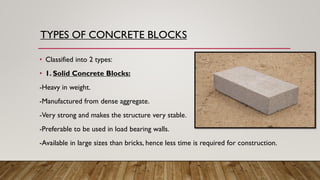
• 1. Solid Concrete Blocks:
-Heavy in weight.
-Manufactured from dense aggregate.
-Very strong and makes the structure very stable.
-Preferable to be used in load bearing walls.
-Available in large sizes than bricks, hence less time is required for construction.
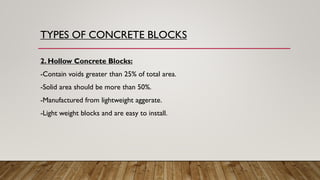
2. Hollow Concrete Blocks:
-Contain voids greater than 25% of total area.
-Solid area should be more than 50%.
-Manufactured from lightweight aggerate.
-Light weight blocks and are easy to install.
TYPES OF CONCRETE BLOCKS
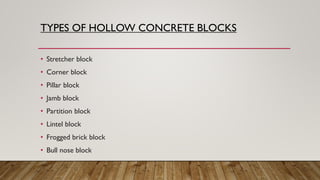
TYPES OF HOLLOW CONCRETE BLOCKS
• Stretcher block
• Corner block
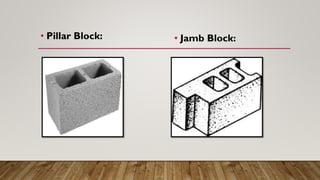
• Pillar block
• Jamb block
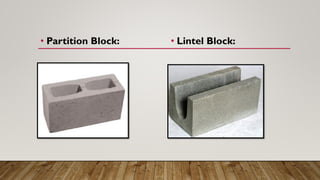
• Partition block
• Lintel block
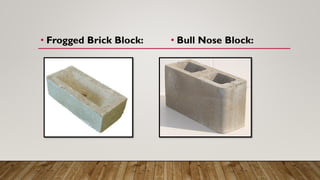
• Frogged brick block
• Bull nose block
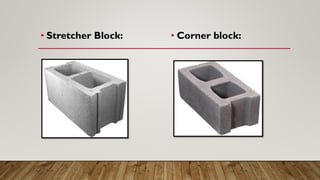
• Stretcher Block: • Corner block:
• Pillar Block: • Jamb Block:
• Partition Block: • Lintel Block:
• Frogged Brick Block: • Bull Nose Block:
ADVANTAGES
• Its width is less than bricks due to which carpet area increases.
• Better thermal insulation, fire resistance and sound absorption.
• Saves precious agricultural lands which are used for manufacturing bricks.
• Construction of blocks is easier, faster and is stronger than brick.
• Perfect shape makes the masonry work very simpler.
• No real need for plastering.
• Environment friendly.
DISADVANTAGES
• Wider and larger cracks.
• Shrinkage due to movement of moisture.
• Expensive.
• Plumbing issues.
USES
• Retaining walls, to keep soil and water away from certain areas.
• Security Barriers.
• Buildings and houses.
THANKYOU

Concrete blocks and their types

  • 1.
  • 2.
    CONTENTS: • Introduction • Manufacturing •Types • Advantages • Disadvantages • Uses
  • 3.
    INTRODUCTION • It isa standard size rectangular block used in building construction. • Also known as “Concrete masonry unit (CMU)”. • Concrete blocks are precast. • Mostly concrete blocks have one or more cavities and their sides may be smooth or contain a design. • Concrete blocks are held together with fresh concrete mortar.
  • 4.
    MANUFACTURING OF CONCRETEBLOCKS • Concrete blocks are manufactured in fully automatic plants which produces concrete blocks of superior quality and high strength • Production of concrete blocks in such plants is expensive. • Manually operated machines are also available which can be installed at project site itself. • Manually operated machines reduces the transportation cost of concrete blocks. • It is manufactured in 4 steps:
  • 5.
    1.SELECTION AND PROPORTIONOF INGREDIENTS • Concrete blocks are made up of aggregates (fine and coarse), cement and water. • Ingredients are selected according to the desired strength. • Strength, texture and economy of concrete blocks depends upon the careful grading of aggregates. • Crushed stones, gravel, volcanic cinders and furnace clinker etc. are used as aggregates. • Aggregates are selected by considering the weight, texture or composition of unit designed. • Cement used is ordinary Portland cement. • Water required is normal potable water
  • 6.
    2.MIXING OF INGREDIENTS •Blending of aggregates, cement and water should be done very carefully. • It is better to mix the ingredients in a mechanical mixer. • Extreme care should be taken for hand mixing (Dry mixing).
  • 7.
    3.MOLDING • The concretemix is fed into the mold box up to top level. • It is ensured that the box is filled up to top level. • Vibration of concrete is done till it has uniformly settled in the mold box, • Excess concrete mixture is removed from the face of mold and levelled by using plywood. • Concrete mixture used for blocks contain higher %age of sand and lower %age of gravel and water than the concrete mixtures used for general construction purposes.This produces a very dry, stiff mixture that holds its shape when it is removed from the block mold.
  • 8.
    4.CURING • The blockis watered after about one day of casting. • Curing is continued for minimum 7 days and maximum 28 days. • Longer the curing period, better will be the block.
  • 9.
    TYPES OF CONCRETEBLOCKS • Classified into 2 types: • 1. Solid Concrete Blocks: -Heavy in weight. -Manufactured from dense aggregate. -Very strong and makes the structure very stable. -Preferable to be used in load bearing walls. -Available in large sizes than bricks, hence less time is required for construction.
  • 10.
    2. Hollow ConcreteBlocks: -Contain voids greater than 25% of total area. -Solid area should be more than 50%. -Manufactured from lightweight aggerate. -Light weight blocks and are easy to install. TYPES OF CONCRETE BLOCKS
  • 11.
    TYPES OF HOLLOWCONCRETE BLOCKS • Stretcher block • Corner block • Pillar block • Jamb block • Partition block • Lintel block • Frogged brick block • Bull nose block
  • 12.
    • Stretcher Block:• Corner block:
  • 13.
    • Pillar Block:• Jamb Block:
  • 14.
    • Partition Block:• Lintel Block:
  • 15.
    • Frogged BrickBlock: • Bull Nose Block:
  • 16.
    ADVANTAGES • Its widthis less than bricks due to which carpet area increases. • Better thermal insulation, fire resistance and sound absorption. • Saves precious agricultural lands which are used for manufacturing bricks. • Construction of blocks is easier, faster and is stronger than brick. • Perfect shape makes the masonry work very simpler. • No real need for plastering. • Environment friendly.
  • 17.
    DISADVANTAGES • Wider andlarger cracks. • Shrinkage due to movement of moisture. • Expensive. • Plumbing issues.
  • 18.
    USES • Retaining walls,to keep soil and water away from certain areas. • Security Barriers. • Buildings and houses.
  • 19.