MOLECULAR
MODELING
ENERGY MINIMIZATION METHODS
Prepared by:
Chandni Pathak
(180821101075)
8th Sem, B.Pharm
Parul Institute of Pharmacy
Contents
- Molecular Modeling
- Energy Minimization
- Basic Steps of EM
- EM techniques
MOLECULAR MODELING
Molecular Modeling is a group of computerized techniques which are
being used to predict molecular and biological properties or to analyze
molecular systems using the basic principles of theoretical chemistry in
conjunction with or without available experimental data.
ENERGY MINIMIZATION
The main objective of molecular mechanics is to find the lowest energy
conformation of a molecule and this process is termed as Energy minimization
or Geometry optimisation method.
Definition:-
It is the process of finding an arrangement in space of a collection of atoms
where, according to some computational model of chemical bonding, the net
interatomic force on each atom is acceptably close to zero and the position on
the Potential Energy Surface (PES) is a stationary point.
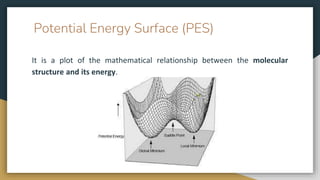
Potential Energy Surface (PES)
It is a plot of the mathematical relationship between the molecular
structure and its energy.
ENERGY MINIMIZATION
In short, it is a procedure that attempts to minimize the potential energy of the
system to the lowest possible point.
The system makes several changes in the atom position through rotation and
calculates energy in every position. This process is repeated many times to find
the position with lowest energy until an overall minimum energy is attained.
In every move the energy is kept lowered, otherwise the atom will return to its
original position.
The one full round of an atom rotation is called minimization step or iteration.
ENERGY MINIMIZATION
EM is used for :
1) Locating a stable conformation
2) Locating Global and Local minima
3) Locating a saddle point
4 MAIN STEPS:
1. Computation of the potential energy of the starting geometry
2. Alterations of the atomic positions of each atom and computing the
energy of the entire molecule
3. If the energy of the new conformer is less than the starting one, adopt this
conformation and proceed for next alteration otherwise retain the first
one
4. Repeat the process till there is no more decrease in the potential energy
TECHNIQUES OF GEOMETRY OPTIMIZATION
A. Steepest descent
B. Newton-Raphson method
C. Conjugate gradient
D. Quasi-Newton Raphson or variable matrix method
E. Downhill Simplex
A. Steepest Descent Method
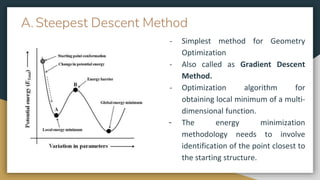
- Simplest method for Geometry
Optimization
- Also called as Gradient Descent
Method.
- Optimization algorithm for
obtaining local minimum of a multi-
dimensional function.
- The energy minimization
methodology needs to involve
identification of the point closest to
the starting structure.
A. Steepest Descent Method
Simplest technique which uses the first derivative (dE/dXi= 0).
Ri+1 = Ri - 𝞪Fi
Where, i = iteration number
Ri = Old coordinates
Ri+1 = New coordinates
Fi = Force (energy gradient) on the atoms at step ‘i’ and ‘𝛂’, a constant,
determining the extent to which force is applied
A. Steepest Descent Method
- This method converges rapidly when first derivatives are large, i.e.
the geometry is far away from the minimum.
- The method slows down considerably when it comes close to a
minimum.
- Near the minimum, its progress is so slow that it almost never
reaches the bottom.
B. Newton - Raphson minimization methods
- In this method, inverse of the second derivative matrix (Hessian) is
used.
- The method can be implemented in full or partial [Block diagonal
(BDNR)] matrix form.
- The method is the most computationally expensive per step of all the
methods utilized to perform EM.
- Advantage:- The minimization could converge in one or two steps.
- Disadvantage:- This method requires the calculation of the second
derivatives.
C. Conjugate Gradient Method
● It is a first order minimization technique.
● It uses for both the current gradient and the previous search direction
to drive the minimization.
● The number of computing cycles required for a conjugated gradient
calculation is approximately proportional to the number of atoms (N,
and the time per cycle is proportional to N2.
● Require fewer energy evaluations and gradient calculations
● Convergence characterizations are better than the steepest gradient.
D. Quasi - Newton Raphson Method
- These methods avoid the difficult evaluation of the generalized
inverse of the Hessian matrix.
- Consequently, these methods are faster ones.
- DFP (Davidson, Fletcher and Powell) and BFGS (Broyden, Fletcher,
Goldfard and Shanno) methods are representatives of this class.
F. Downhill Simplex Method
- It is a robust and non-derivative-based method which probably is one
of the easiest method to implement.
- It requires only function evaluation.
REFERENCE
1) https://www.slideshare.net/PavanBadgujar/seminar-energy-minimization-mettthod
2) https://vlab.amrita.edu/?sub=3&brch=277&sim=1491&cnt=1
3) A textbook of drug design and development by M.R. Yadav and P.R. Murumkar
THANK YOU

Energy minimization methods - Molecular Modeling

  • 1.
    MOLECULAR MODELING ENERGY MINIMIZATION METHODS Preparedby: Chandni Pathak (180821101075) 8th Sem, B.Pharm Parul Institute of Pharmacy
  • 2.
    Contents - Molecular Modeling -Energy Minimization - Basic Steps of EM - EM techniques
  • 3.
    MOLECULAR MODELING Molecular Modelingis a group of computerized techniques which are being used to predict molecular and biological properties or to analyze molecular systems using the basic principles of theoretical chemistry in conjunction with or without available experimental data.
  • 4.
    ENERGY MINIMIZATION The mainobjective of molecular mechanics is to find the lowest energy conformation of a molecule and this process is termed as Energy minimization or Geometry optimisation method. Definition:- It is the process of finding an arrangement in space of a collection of atoms where, according to some computational model of chemical bonding, the net interatomic force on each atom is acceptably close to zero and the position on the Potential Energy Surface (PES) is a stationary point.
  • 5.
    Potential Energy Surface(PES) It is a plot of the mathematical relationship between the molecular structure and its energy.
  • 6.
    ENERGY MINIMIZATION In short,it is a procedure that attempts to minimize the potential energy of the system to the lowest possible point. The system makes several changes in the atom position through rotation and calculates energy in every position. This process is repeated many times to find the position with lowest energy until an overall minimum energy is attained. In every move the energy is kept lowered, otherwise the atom will return to its original position. The one full round of an atom rotation is called minimization step or iteration.
  • 7.
    ENERGY MINIMIZATION EM isused for : 1) Locating a stable conformation 2) Locating Global and Local minima 3) Locating a saddle point
  • 8.
    4 MAIN STEPS: 1.Computation of the potential energy of the starting geometry 2. Alterations of the atomic positions of each atom and computing the energy of the entire molecule 3. If the energy of the new conformer is less than the starting one, adopt this conformation and proceed for next alteration otherwise retain the first one 4. Repeat the process till there is no more decrease in the potential energy
  • 9.
    TECHNIQUES OF GEOMETRYOPTIMIZATION A. Steepest descent B. Newton-Raphson method C. Conjugate gradient D. Quasi-Newton Raphson or variable matrix method E. Downhill Simplex
  • 10.
    A. Steepest DescentMethod - Simplest method for Geometry Optimization - Also called as Gradient Descent Method. - Optimization algorithm for obtaining local minimum of a multi- dimensional function. - The energy minimization methodology needs to involve identification of the point closest to the starting structure.
  • 11.
    A. Steepest DescentMethod Simplest technique which uses the first derivative (dE/dXi= 0). Ri+1 = Ri - 𝞪Fi Where, i = iteration number Ri = Old coordinates Ri+1 = New coordinates Fi = Force (energy gradient) on the atoms at step ‘i’ and ‘𝛂’, a constant, determining the extent to which force is applied
  • 12.
    A. Steepest DescentMethod - This method converges rapidly when first derivatives are large, i.e. the geometry is far away from the minimum. - The method slows down considerably when it comes close to a minimum. - Near the minimum, its progress is so slow that it almost never reaches the bottom.
  • 13.
    B. Newton -Raphson minimization methods - In this method, inverse of the second derivative matrix (Hessian) is used. - The method can be implemented in full or partial [Block diagonal (BDNR)] matrix form. - The method is the most computationally expensive per step of all the methods utilized to perform EM. - Advantage:- The minimization could converge in one or two steps. - Disadvantage:- This method requires the calculation of the second derivatives.
  • 14.
    C. Conjugate GradientMethod ● It is a first order minimization technique. ● It uses for both the current gradient and the previous search direction to drive the minimization. ● The number of computing cycles required for a conjugated gradient calculation is approximately proportional to the number of atoms (N, and the time per cycle is proportional to N2. ● Require fewer energy evaluations and gradient calculations ● Convergence characterizations are better than the steepest gradient.
  • 15.
    D. Quasi -Newton Raphson Method - These methods avoid the difficult evaluation of the generalized inverse of the Hessian matrix. - Consequently, these methods are faster ones. - DFP (Davidson, Fletcher and Powell) and BFGS (Broyden, Fletcher, Goldfard and Shanno) methods are representatives of this class.
  • 16.
    F. Downhill SimplexMethod - It is a robust and non-derivative-based method which probably is one of the easiest method to implement. - It requires only function evaluation.
  • 17.
  • 18.