Presented by                                            Guided by
Mr. Pradeep V. Kore                                           Mr.
M. Pharm. ( II Sem )                                       M. Pharm.

       Department of Pharmaceutical Chemistry
           JSPM’s Charak College of Pharmacy & Research,
             Gat No. 720(1/2), Wagholi, Pune-Nagar road,
                           Wagholi-412 207.
                                                                       1 1
CONTENTS:


5/9/2012          2
INTRODUCTION
  In computational chemistry energy minimization (also called
     energy optimization or geometry optimization) methods are
     used to compute the equilibrium configuration of molecules
     and solids.

  Energy minimizatiom methods can precisely locate minimum
     energy confirmation by mathematically “homing in” on the
     energy function minima (one at a time).

  The goal of energy minimization is to find a route (consisting
     of variation of the intramolecular degrees of freedom) from an
     initial confirmation to nearest minimum energy confirmation
     using the smallest number of calculations possible.

5/9/2012                                                              3
 In molecular modeling we are interested in minimum points on
     the energy surface.

  Minimum energy arrangments of the atoms corresponds to
     stable states of the system:

  Any movement away from a minimum gives a configuration
     with higher energy.

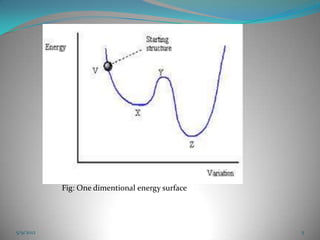
  There may be a very large number of minima on energy
     surface. The minimum with very lowest energy is known as the
     Global Energy Minimum.


5/9/2012                                                            4
Fig: One dimentional energy surface


5/9/2012                                         5
What can energy minimization do?

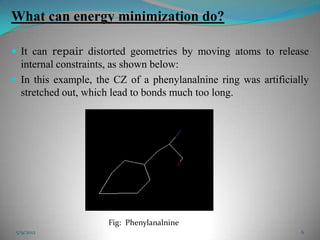
 It can repair distorted geometries by moving atoms to release
  internal constraints, as shown below:
 In this example, the CZ of a phenylanalnine ring was artificially
  stretched out, which lead to bonds much too long.


                     Fig: Phenylanalnine
 5/9/2012                                                        6
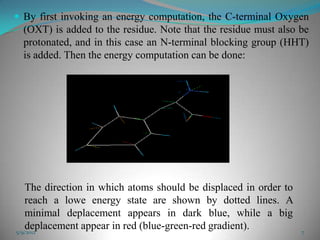
 By first invoking an energy computation, the C-terminal Oxygen
  (OXT) is added to the residue. Note that the residue must also be
  protonated, and in this case an N-terminal blocking group (HHT)
  is added. Then the energy computation can be done:


   The direction in which atoms should be displaced in order to
   reach a lowe energy state are shown by dotted lines. A
   minimal deplacement appears in dark blue, while a big
   deplacement appear in red (blue-green-red gradient).
5/9/2012                                                          7
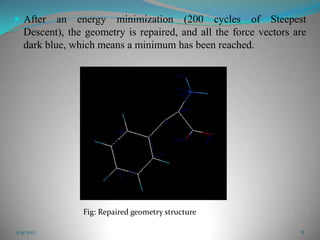
 After    an energy minimization (200 cycles of Steepest
   Descent), the geometry is repaired, and all the force vectors are
   dark blue, which means a minimum has been reached.


                Fig: Repaired geometry structure

5/9/2012                                                          8
Energy minimising procedures

     1) Conformational energy searching

     2) Energy minimisation

     3) Minimisation algorithms


5/9/2012                                  9
Conformational energy searching
 Energy is a function of the degrees of freedom in a molecule:
  bonds, angles, dihedrals.

 Conformational energy searching is used to find all of the
  energetically preferred conformations of a molecule.

 This is mathematically equivalent to locating all of the minima of
  the energy function of the molecule.

 The possible conformations for a molecule lie on an n-dim.
  Lattice, with n being the number of degrees of freedom.

  5/9/2012                                                      10
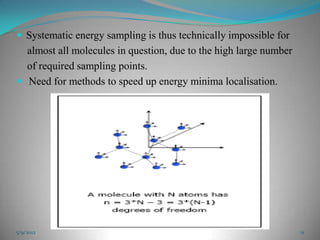
 Systematic energy sampling is thus technically impossible for
  almost all molecules in question, due to the high large number
  of required sampling points.
 Need for methods to speed up energy minima localisation.


5/9/2012                                                           11
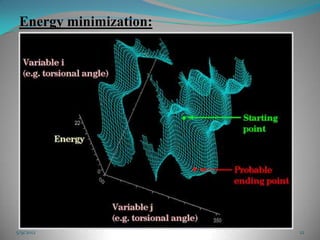
Energy minimization:


5/9/2012                12
 Minimisation algorithms are designed to head down-hill towards
  the nearest minimum.

 Remote minima are not detected, because this would require some
  period of up-hill movement.

 Minimisation algorithms monitor the energy surface along a series
  of incremental steps to determine a down-hill direction.


 5/9/2012                                                        13
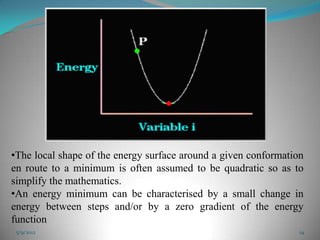
•The local shape of the energy surface around a given conformation
en route to a minimum is often assumed to be quadratic so as to
simplify the mathematics.
•An energy minimum can be characterised by a small change in
energy between steps and/or by a zero gradient of the energy
function
 5/9/2012                                                        14
Approximation of the quadratic energy function
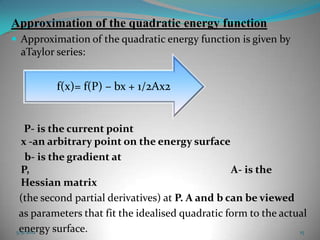
 Approximation of the quadratic energy function is given by
  aTaylor series:


          f(x)= f(P) – bx + 1/2Ax2


    P- is the current point
   x -an arbitrary point on the energy surface
    b- is the gradient at
   P,                                             A- is the
   Hessian matrix
  (the second partial derivatives) at P. A and b can be viewed
  as parameters that fit the idealised quadratic form to the actual
  energy surface.
 5/9/2012                                                        15
Minimisation algorithms

Simplex algorithm
   - Not a gradient minimization method.
   - Used mainly for very crude, high energy starting structures.

Steepest descent minimiser
  - Follows the gradient of the energy function (b) at each step.
   This results in successive steps that are always mutually
 perpendicular, which can lead to backtracking.
  - Works best when the gradient is large (far from a minimum).
  - Tends to have poor convergence because the gradient becomes
 smaller as a minimum is approached.

 5/9/2012                                                           16
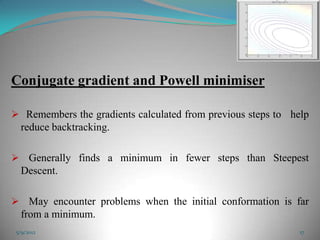
Conjugate gradient and Powell minimiser

 Remembers the gradients calculated from previous steps to help
  reduce backtracking.

 Generally finds a minimum in fewer steps than Steepest
  Descent.

 May encounter problems when the initial conformation is far
  from a minimum.
 5/9/2012                                                     17
Newton-Raphson and BFGS minimiser

 - Predicts the location of a minimum, and heads in that direction.

- Calculates (Newton-Raphson) or approximates (BFGS) the second
 derivatives in A.

- Storage of the A term can require substantial amounts of
 computer memory

- May find a minimum in fewer steps than the gradient-only
 methods.

- May encounter serious problems when the initial conformation is
 far from a minimum.

 5/9/2012                                                             18
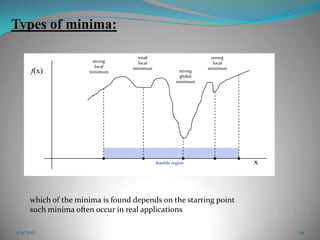
Types of minima:

                                    weak                         strong
                      strong        local                         local
                       local      minimum                       minimum
      f(x)           minimum                           strong
                                                       global
                                                      minimum


                                            feasible region               x


     which of the minima is found depends on the starting point
     such minima often occur in real applications

5/9/2012                                                                      19

energy minimization

  • 1.
    Presented by Guided by Mr. Pradeep V. Kore Mr. M. Pharm. ( II Sem ) M. Pharm. Department of Pharmaceutical Chemistry JSPM’s Charak College of Pharmacy & Research, Gat No. 720(1/2), Wagholi, Pune-Nagar road, Wagholi-412 207. 1 1
  • 2.
  • 3.
    INTRODUCTION  Incomputational chemistry energy minimization (also called energy optimization or geometry optimization) methods are used to compute the equilibrium configuration of molecules and solids.  Energy minimizatiom methods can precisely locate minimum energy confirmation by mathematically “homing in” on the energy function minima (one at a time).  The goal of energy minimization is to find a route (consisting of variation of the intramolecular degrees of freedom) from an initial confirmation to nearest minimum energy confirmation using the smallest number of calculations possible. 5/9/2012 3
  • 4.
     In molecularmodeling we are interested in minimum points on the energy surface.  Minimum energy arrangments of the atoms corresponds to stable states of the system:  Any movement away from a minimum gives a configuration with higher energy.  There may be a very large number of minima on energy surface. The minimum with very lowest energy is known as the Global Energy Minimum. 5/9/2012 4
  • 5.
    Fig: One dimentionalenergy surface 5/9/2012 5
  • 6.
    What can energyminimization do?  It can repair distorted geometries by moving atoms to release internal constraints, as shown below:  In this example, the CZ of a phenylanalnine ring was artificially stretched out, which lead to bonds much too long. Fig: Phenylanalnine 5/9/2012 6
  • 7.
     By firstinvoking an energy computation, the C-terminal Oxygen (OXT) is added to the residue. Note that the residue must also be protonated, and in this case an N-terminal blocking group (HHT) is added. Then the energy computation can be done: The direction in which atoms should be displaced in order to reach a lowe energy state are shown by dotted lines. A minimal deplacement appears in dark blue, while a big deplacement appear in red (blue-green-red gradient). 5/9/2012 7
  • 8.
     After an energy minimization (200 cycles of Steepest Descent), the geometry is repaired, and all the force vectors are dark blue, which means a minimum has been reached. Fig: Repaired geometry structure 5/9/2012 8
  • 9.
    Energy minimising procedures 1) Conformational energy searching 2) Energy minimisation 3) Minimisation algorithms 5/9/2012 9
  • 10.
    Conformational energy searching Energy is a function of the degrees of freedom in a molecule: bonds, angles, dihedrals.  Conformational energy searching is used to find all of the energetically preferred conformations of a molecule.  This is mathematically equivalent to locating all of the minima of the energy function of the molecule.  The possible conformations for a molecule lie on an n-dim. Lattice, with n being the number of degrees of freedom. 5/9/2012 10
  • 11.
     Systematic energysampling is thus technically impossible for almost all molecules in question, due to the high large number of required sampling points.  Need for methods to speed up energy minima localisation. 5/9/2012 11
  • 12.
  • 13.
     Minimisation algorithmsare designed to head down-hill towards the nearest minimum.  Remote minima are not detected, because this would require some period of up-hill movement.  Minimisation algorithms monitor the energy surface along a series of incremental steps to determine a down-hill direction. 5/9/2012 13
  • 14.
    •The local shapeof the energy surface around a given conformation en route to a minimum is often assumed to be quadratic so as to simplify the mathematics. •An energy minimum can be characterised by a small change in energy between steps and/or by a zero gradient of the energy function 5/9/2012 14
  • 15.
    Approximation of thequadratic energy function  Approximation of the quadratic energy function is given by aTaylor series: f(x)= f(P) – bx + 1/2Ax2 P- is the current point x -an arbitrary point on the energy surface b- is the gradient at P, A- is the Hessian matrix (the second partial derivatives) at P. A and b can be viewed as parameters that fit the idealised quadratic form to the actual energy surface. 5/9/2012 15
  • 16.
    Minimisation algorithms Simplex algorithm - Not a gradient minimization method. - Used mainly for very crude, high energy starting structures. Steepest descent minimiser - Follows the gradient of the energy function (b) at each step. This results in successive steps that are always mutually perpendicular, which can lead to backtracking. - Works best when the gradient is large (far from a minimum). - Tends to have poor convergence because the gradient becomes smaller as a minimum is approached. 5/9/2012 16
  • 17.
    Conjugate gradient andPowell minimiser  Remembers the gradients calculated from previous steps to help reduce backtracking.  Generally finds a minimum in fewer steps than Steepest Descent.  May encounter problems when the initial conformation is far from a minimum. 5/9/2012 17
  • 18.
    Newton-Raphson and BFGSminimiser - Predicts the location of a minimum, and heads in that direction. - Calculates (Newton-Raphson) or approximates (BFGS) the second derivatives in A. - Storage of the A term can require substantial amounts of computer memory - May find a minimum in fewer steps than the gradient-only methods. - May encounter serious problems when the initial conformation is far from a minimum. 5/9/2012 18
  • 19.
    Types of minima: weak strong strong local local local minimum minimum f(x) minimum strong global minimum feasible region x which of the minima is found depends on the starting point such minima often occur in real applications 5/9/2012 19