

Mobile Computing:
Protocols Used In Bluetooth
Presented By: Ms. Sonali. Parab.
MscIT Part 1, Semester 2.
Incharge: Mr. Jadhav.
▪
▪
▪
▪
▪
▪
▪
▪
▪

Overview of the content:
Introduction.
Technology Review.
Specification of Bluetooth technology.
Architecture of Bluetooth Protocol.
Protocols in Bluetooth Stack.
Advantages And Disadvantages Bluetooth.
Future of Bluetooth
Conclusion
Bibliography
Introduction.
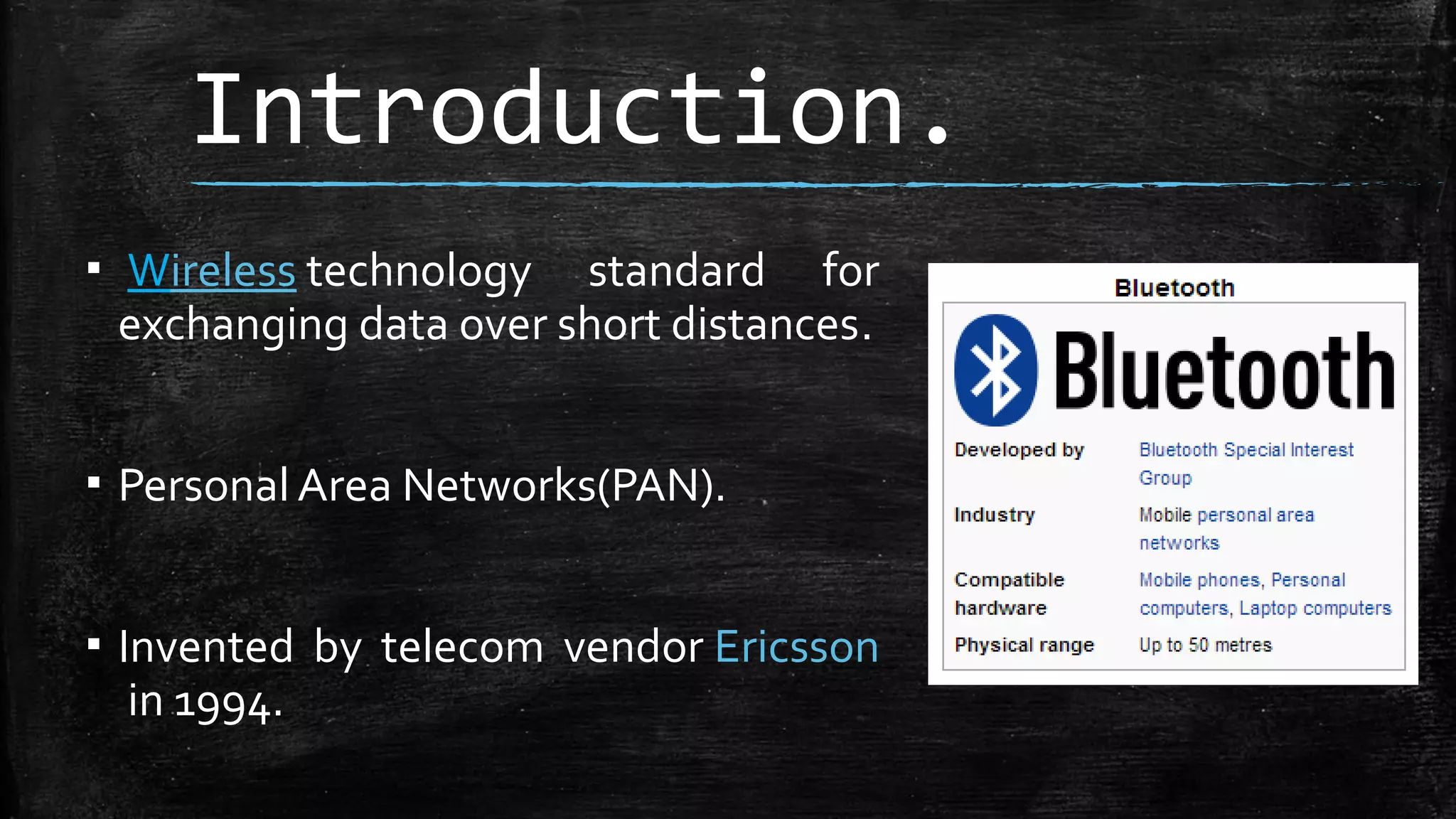
▪ Wireless technology standard for
exchanging data over short distances.
▪ Personal Area Networks(PAN).
▪ Invented by telecom vendor Ericsson
in 1994.
Introduction.
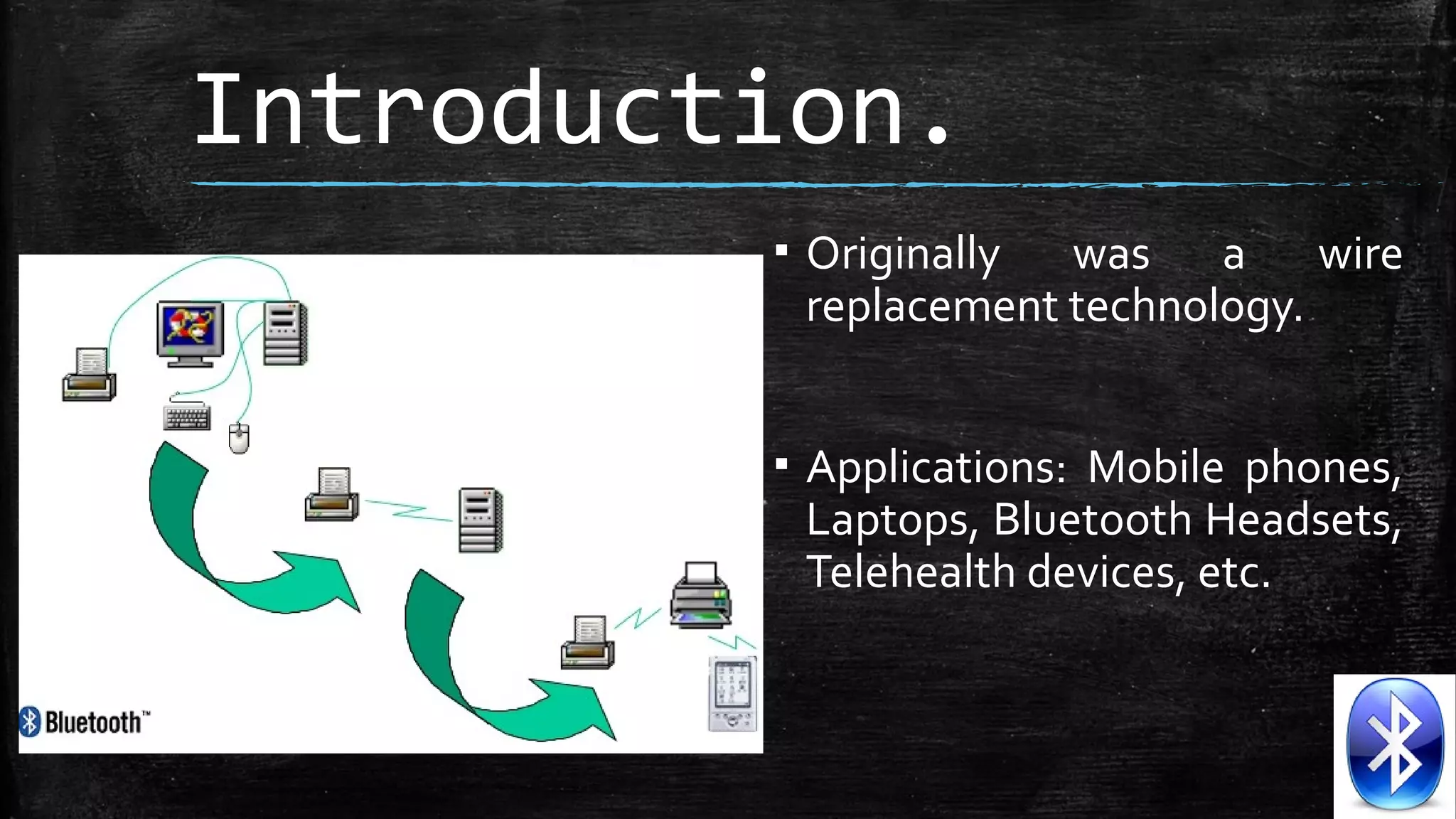
▪ Originally was a wire
replacement technology.
▪ Applications: Mobile phones,
Laptops, Bluetooth Headsets,
Telehealth devices, etc.
Technology Review.
▪ Bluetooth uses radio technology called “Frequency Hopping
spread Spectrum”.
▪ Supports data rate of I mb/s (originally).
▪ Managed by the Bluetooth Special Interest Group (SIG).
▪ Bluetooth was standardized as IEEE 802.15.1, but the
standard is no longer maintained.
Specification of Bluetooth technology.
▪ Core Specification
Deals with lower layers of architecture and describes how
technology works.

▪ Profile Specification
Focuses on how to build inter operating devices using the core
technology.
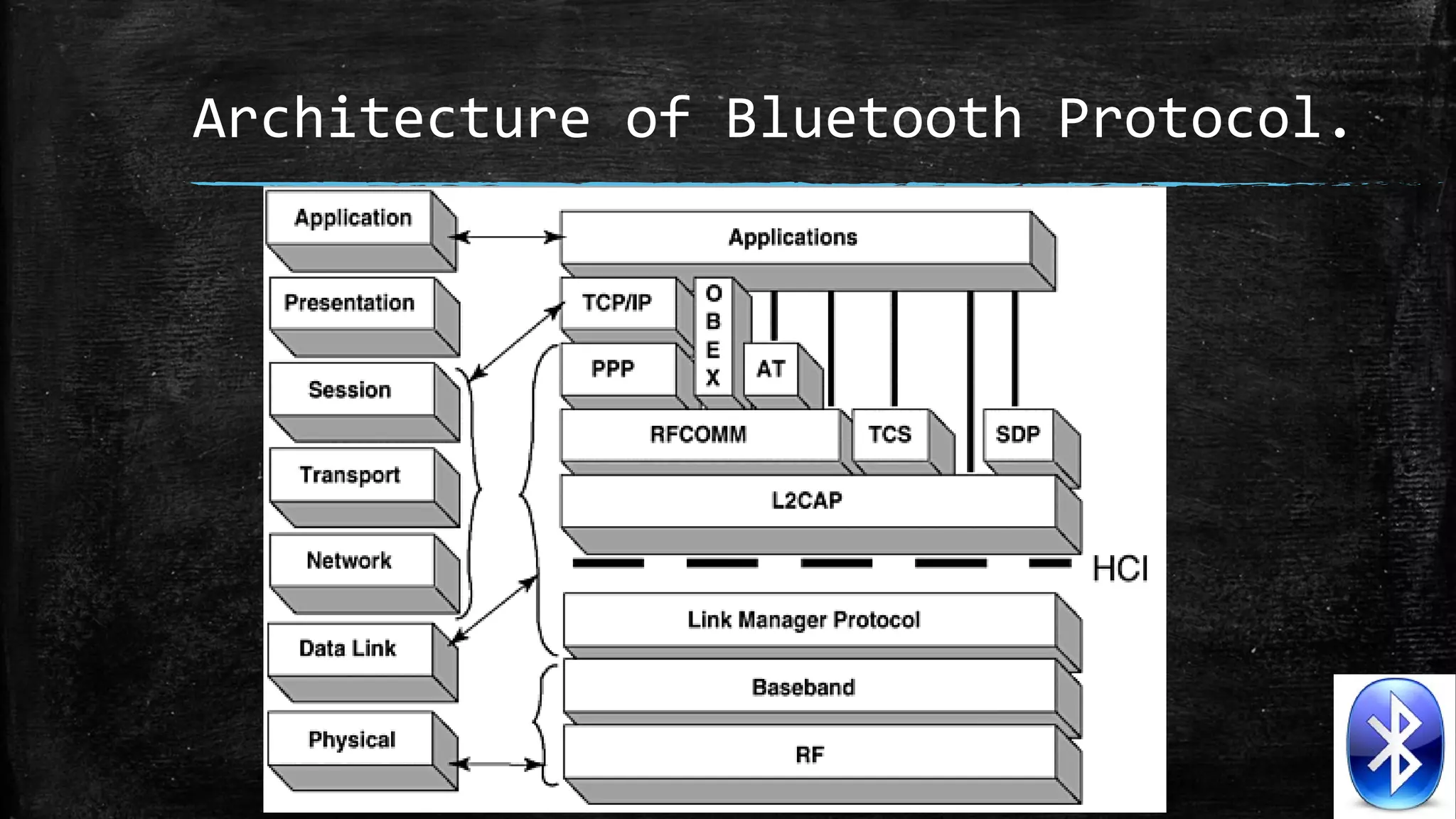
Architecture of Bluetooth Protocol.
Protocols Used In Bluetooth.
Radio:
▪ Is situated at the most bottom of all the layers.
▪ Used in the specification of the air interfaces like frequencies,
modulation, transmit power
▪ Bluetooth radio is a transceiver which transmits and receives modulated
electrical signals from peer Bluetooth devices
Protocols Used In Bluetooth.
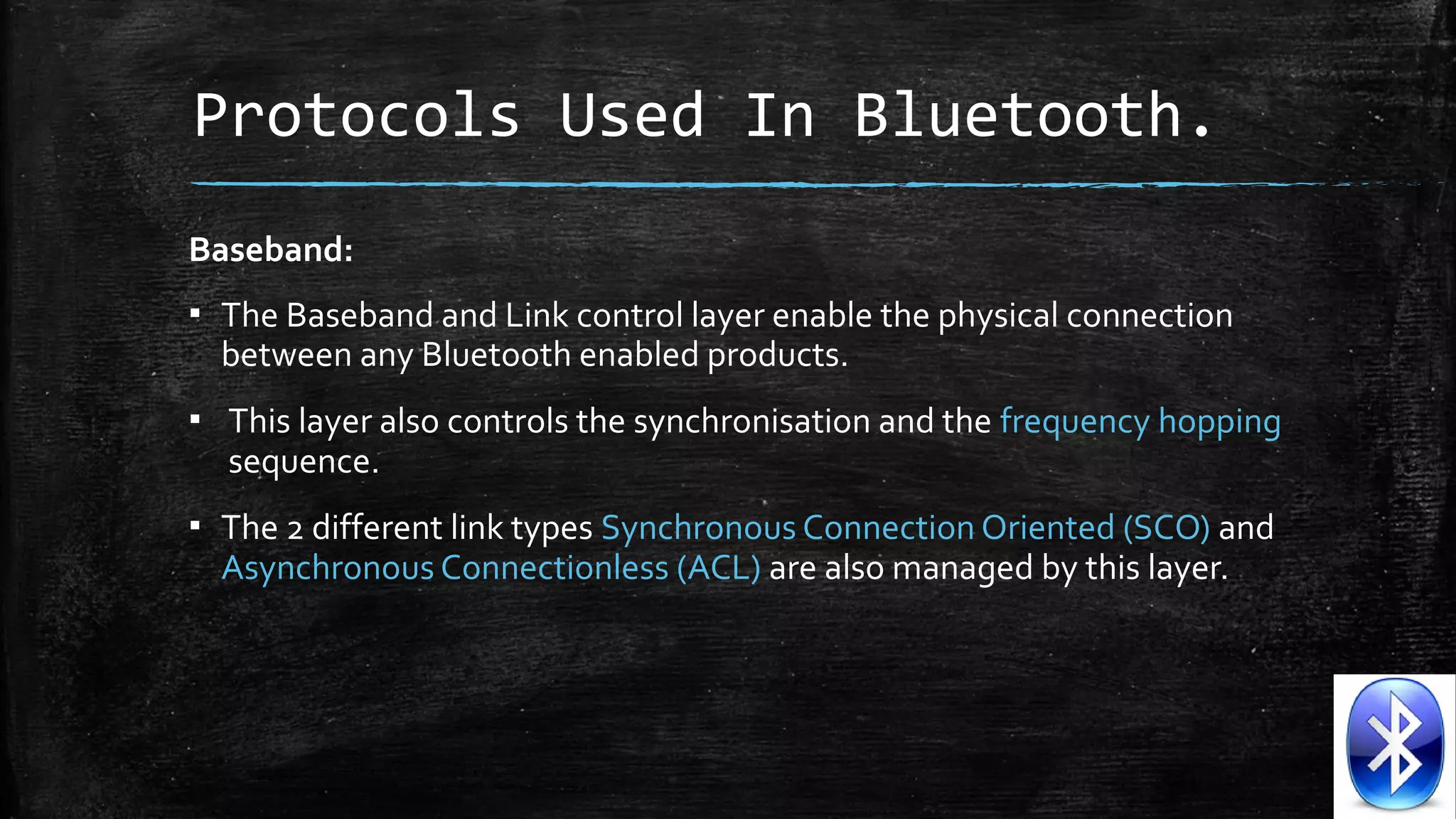
Baseband:
▪ The Baseband and Link control layer enable the physical connection
between any Bluetooth enabled products.
▪ This layer also controls the synchronisation and the frequency hopping
sequence.
▪ The 2 different link types Synchronous Connection Oriented (SCO) and
Asynchronous Connectionless (ACL) are also managed by this layer.
Protocols Used In Bluetooth.
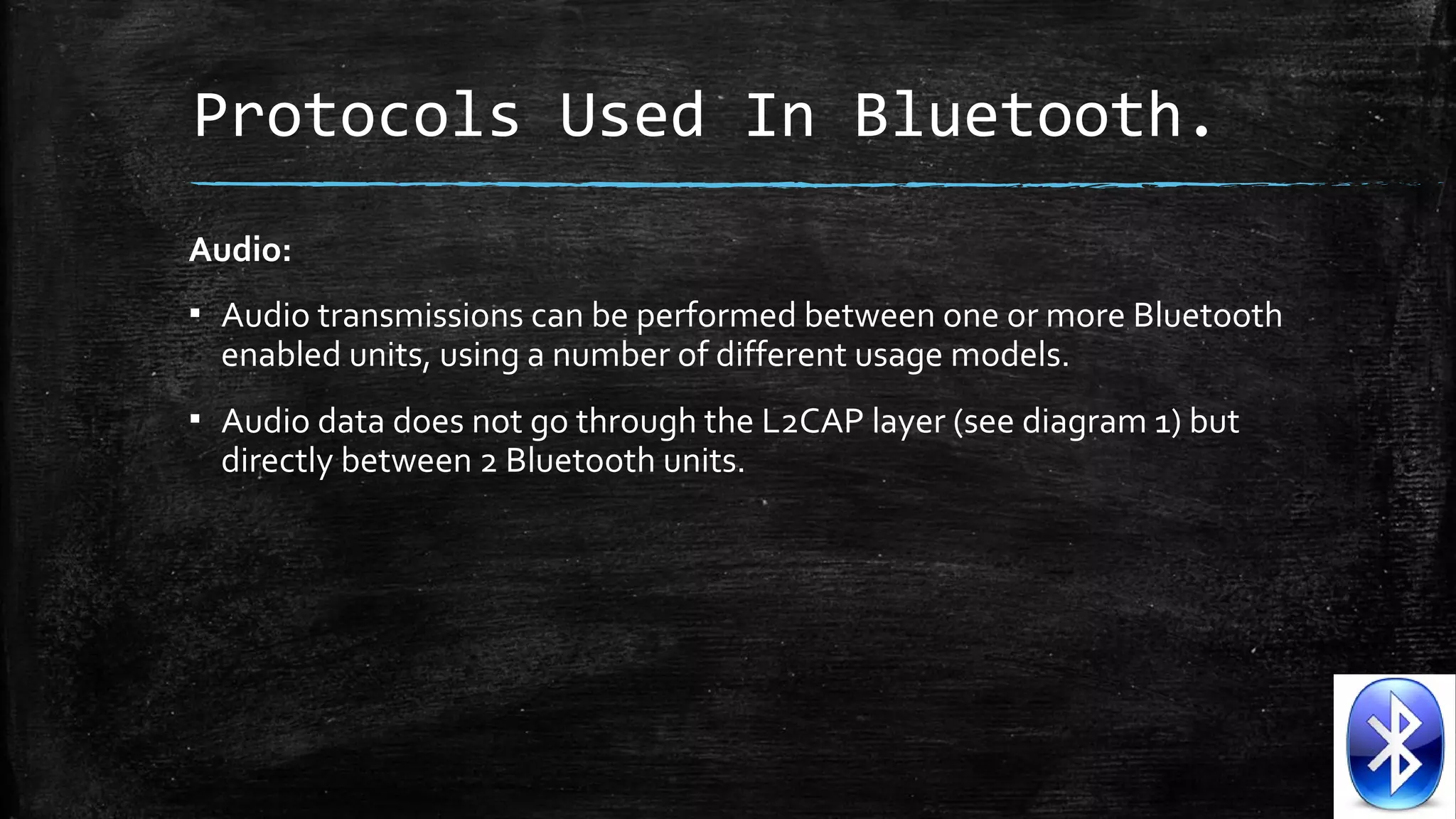
Audio:
▪ Audio transmissions can be performed between one or more Bluetooth
enabled units, using a number of different usage models.
▪ Audio data does not go through the L2CAP layer (see diagram 1) but
directly between 2 Bluetooth units.
Protocols Used In Bluetooth.
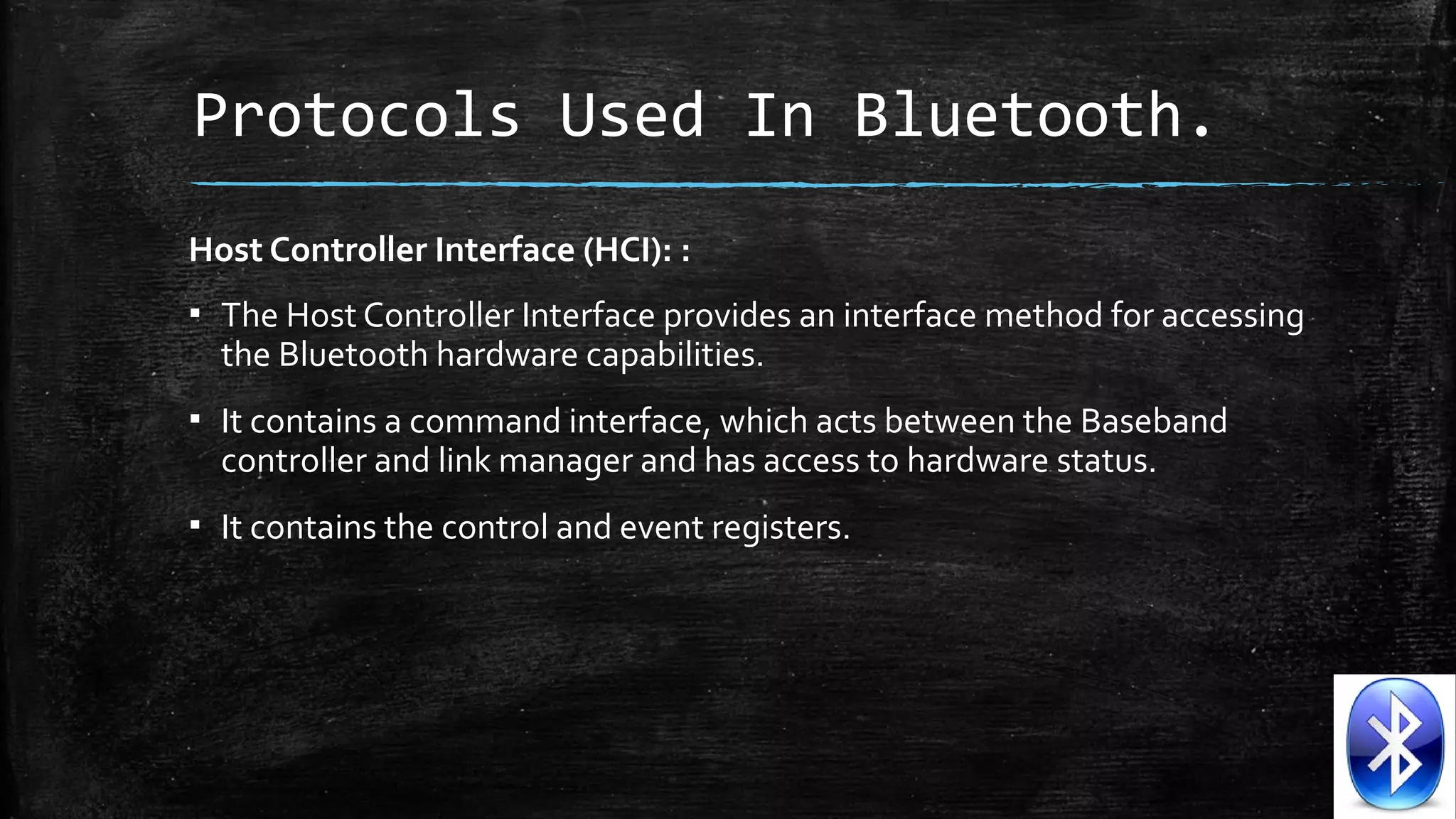
Host Controller Interface (HCI): :
▪ The Host Controller Interface provides an interface method for accessing
the Bluetooth hardware capabilities.
▪ It contains a command interface, which acts between the Baseband
controller and link manager and has access to hardware status.
▪ It contains the control and event registers.
Protocols Used In Bluetooth.
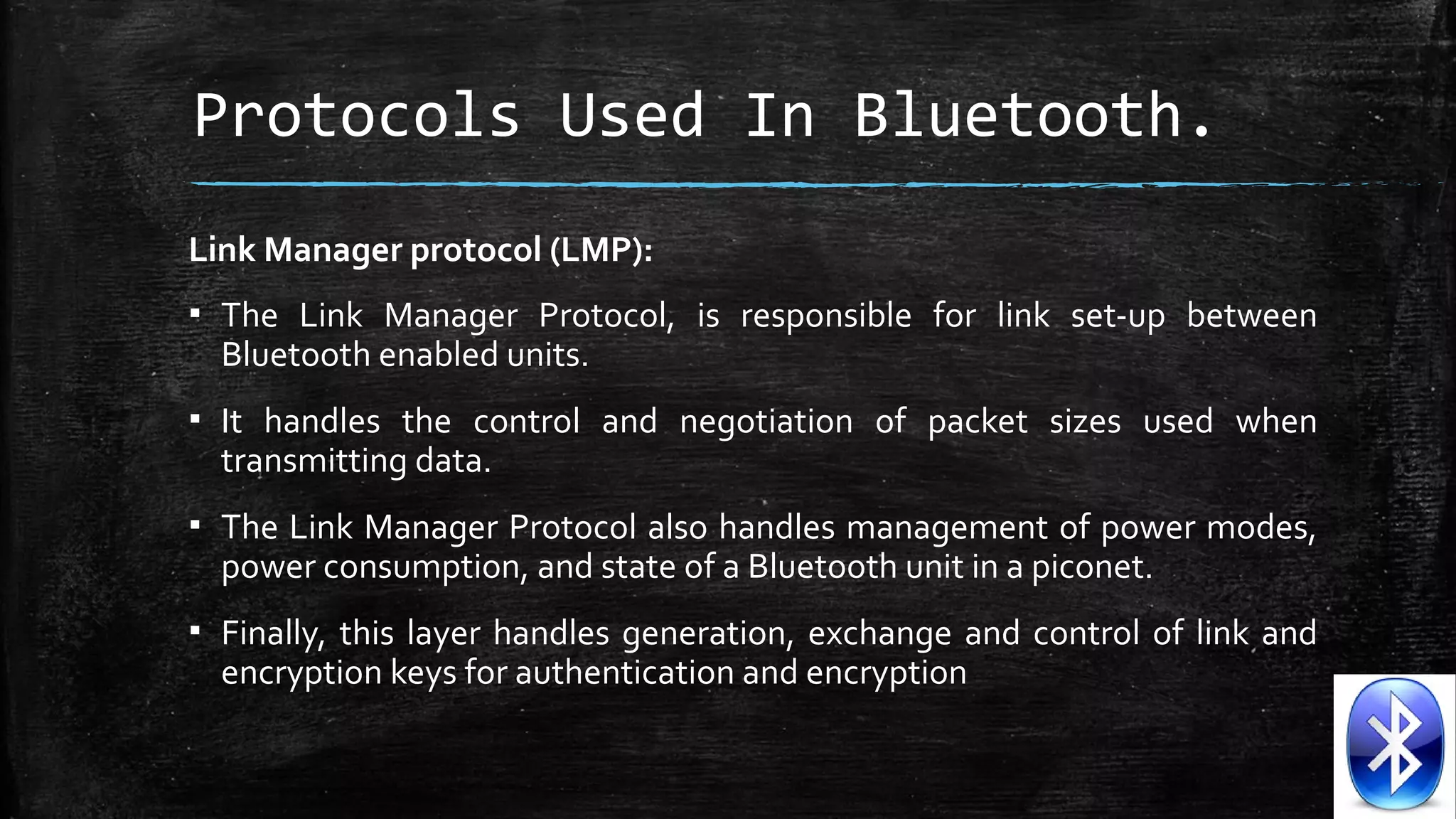
Link Manager protocol (LMP):
▪ The Link Manager Protocol, is responsible for link set-up between
Bluetooth enabled units.
▪ It handles the control and negotiation of packet sizes used when
transmitting data.
▪ The Link Manager Protocol also handles management of power modes,
power consumption, and state of a Bluetooth unit in a piconet.
▪ Finally, this layer handles generation, exchange and control of link and
encryption keys for authentication and encryption
Protocols Used In Bluetooth.
Logical Link Control and Adaption Protocol (L2CAP):
▪ The Bluetooth logical link control and adaptation protocol is situated over the Baseband
layer and beside the Link Manager Protocol in the Bluetooth protocol stack. The L2CAP
layer provides connection-oriented and connectionless data services to upper layers.
▪ The four main tasks for L2CAP are:
▪ Multiplexing - L2CAP must support protocol multiplexing since a number of protocols
(e.g. SDP, RFCOMM and TCS Binary) can operate over L2CAP.
▪ Segmentation and Reassembly - Data packets exceeding the Maximum Transmission
Unit, MTU, must be segmented before being transmitted. This and the reverse
functionality, reassemble, is performed by L2CAP.
▪ Quality of Service - The establishment of an L2CAP connection allows the exchange of
information regarding current Quality of Service for the connection between the two
Bluetooth units.
▪ Groups - The L2CAP specification supports the mapping of groups on to a piconet.
Protocols Used In Bluetooth.
Service Discovery Protocol (SDP):
▪ The Service Disocvery Protocol defines how a client's Bluetooth enabled
application will discover available Bluetooth server' services and
characteristics upon entering a Bluetooth server area.
▪ SDP also provides functionality for detecting when a service is no longer
available.
Protocols Used In Bluetooth.
RFCOMM: 
▪ RFCOMM protocol is a serial port protocol. 
▪ The protocol covers applications that make use of serial ports of the unit. 
▪ RFCOMM emulates RS-232 control and data signals over the baseband. 
▪ It also provides capabilities for the upper service levels such as OBEX, 
which uses a serial line as a transport mechanism.
Protocols Used In Bluetooth.
Telephony control protocol:
a. Telephony Control – Binary

b.Telephony Control – AT Commands

▪Bit-oriented  protocol,  which  defines 
the  call  control  signalling  for  the 
establishment  of  speech  and  data 
calls between Bluetooth units. 

▪Are supported for transmitting 
control signals for telephony control. 

▪Provides  functionality  to  exchange 
signalling  information  unrelated  to 
ongoing calls. 
▪ITU-T Recommended.

▪These use the serial port emulation, 
RFCOMM, for transmission.
Protocols Used In Bluetooth.
Adopted protocols
▪  This  section  describes  a  number  of  protocols  that  are  defined  to  be 
adopted to the Bluetooth protocol stack. 
▪ Note some of these adaptations are at the moment incomplete.
a. Point-to-Point Protocol - PPP
– Designed  to  run  over  RFCOMM  to  accomplish  point-to-point 
connections.
– packet-oriented  protocol  and  must  therefore  use  its  serial 
mechanisms  to  convert  the  packet  data  stream  into  a  serial  data 
streams.
Protocols Used In Bluetooth.
Adopted protocols
▪

b. TCP/UDP/IP
– Defined  to  operate  in  Bluetooth  units  allowing  them  to 
communicate  with  other  units  connected,  for  instance,  to  the 
Internet. 
– Bluetooth can acts like a bridge to internet
– The  TCP/IP/PPP  protocol  configuration  is  used  for  all  Internet 
Bridge  usage  scenarios  in  Bluetooth  1.0  and  for  OBEX  in  future 
versions. 
– The UDP/IP/PPP configuration is available as transport for WAP.
Protocols Used In Bluetooth.
Adopted protocols
▪

c. IrOBEX, shortly OBEX Protocol
– Optional  application  layer  protocol  designed  to  enable  units 
supporting  infrared  communication  to  exchange a  wide  variety  of 
data and commands in a resource-sensitive standardized fashion.
– Client-server  model  and  is  independent  of  the  transport 
mechanism and transport API.
– Defines a folder-listing object, which is used to browse the contents 
of folders on remote device. 
– RFCOMM is used as the main transport layer for OBEX.
Protocols Used In Bluetooth.
Adopted protocols
▪

d. Wireless Application Protocol, WAP
– wireless protocol specification that works across a variety of widearea wireless network technologies bringing the Internet to mobile 
devices. 
– Bluetooth can be used like other wireless networks with regard to 
WAP,  it  can  be  used  to  provide  a  bearer  for  transporting  data 
between the WAP Client and its adjacent WAP Server. 
– Furthermore,  Bluetooth’s  ad  hoc  networking  capability  gives  a 
WAP  client  unique  possibilities  regarding  mobility  compared  with 
other WAP bearers.
Protocols Used In Bluetooth.
Adopted protocols
▪

e. Content formats
– Formats for transmitting vCard and vCalendar information are also 
defined in the Bluetooth specification. 
– The formats do not define transport mechanisms but the format in 
which electronic business cards and personal calendar entries and 
scheduling information are transported. 
– vCard and vCalendar is transferred by OBEX.
Advantages And Disadvantages Bluetooth.
Disadvantages

Advantages

▪ Short ranged.

▪ Eliminates wires.
▪ Facilities data
communication.

and

▪ Standardized protocols.
▪ Free of charge.
▪ Easy to use.

voice

▪ Less secured
▪ Interference
devices.

with

other
Future Of Bluetooth.
▪ Very good future ahead as it need basic needs of connectivity.
▪ Latest versions are improving both in securities and capabilities.
▪ New versions will meet high speed and large range.
▪ Many companies are developing Bluetooth applications in
demand.
Conclusion
▪ A new global standard for voice and data.
▪ Eliminates cables.
▪ Low power, low range, low cost network device.
▪ Further improvements are planned to made in
– Data Rate.
– Power Reduction
– Range
Bibliography
▪ http://
www.tech.plym.ac.uk/dcee/postgrad/reference/BlueTooth/page2.html#architecture
▪ http://www.althos.com/tutorial/Bluetooth-tutorial-protocol-layers.html
▪ http://www.bluetooth.com/Pages/Bluetooth-Home.aspx
▪ www.palowireless.com/infotooth/tutorial.asp
▪ http://en.wikipedia.org/wiki/Bluetooth_protocols
▪ http://msdn.microsoft.com/en-us/library/ms890956.aspx
▪ http://www.thestudymaterial.com/presentation-seminar/electronicspresentation/51-bluetooth-technology.html?start=3
▪ http://www.scribd.com/doc/135626916/Bluetooth-Protocol-Stack
Protols used in bluetooth

Protols used in bluetooth

  • 1.
    Mobile Computing: Protocols UsedIn Bluetooth Presented By: Ms. Sonali. Parab. MscIT Part 1, Semester 2. Incharge: Mr. Jadhav.
  • 2.
    ▪ ▪ ▪ ▪ ▪ ▪ ▪ ▪ ▪ Overview of thecontent: Introduction. Technology Review. Specification of Bluetooth technology. Architecture of Bluetooth Protocol. Protocols in Bluetooth Stack. Advantages And Disadvantages Bluetooth. Future of Bluetooth Conclusion Bibliography
  • 3.
    Introduction. ▪ Wireless technologystandard for exchanging data over short distances. ▪ Personal Area Networks(PAN). ▪ Invented by telecom vendor Ericsson in 1994.
  • 4.
    Introduction. ▪ Originally wasa wire replacement technology. ▪ Applications: Mobile phones, Laptops, Bluetooth Headsets, Telehealth devices, etc.
  • 5.
    Technology Review. ▪ Bluetoothuses radio technology called “Frequency Hopping spread Spectrum”. ▪ Supports data rate of I mb/s (originally). ▪ Managed by the Bluetooth Special Interest Group (SIG). ▪ Bluetooth was standardized as IEEE 802.15.1, but the standard is no longer maintained.
  • 6.
    Specification of Bluetoothtechnology. ▪ Core Specification Deals with lower layers of architecture and describes how technology works. ▪ Profile Specification Focuses on how to build inter operating devices using the core technology.
  • 7.
  • 8.
    Protocols Used InBluetooth. Radio: ▪ Is situated at the most bottom of all the layers. ▪ Used in the specification of the air interfaces like frequencies, modulation, transmit power ▪ Bluetooth radio is a transceiver which transmits and receives modulated electrical signals from peer Bluetooth devices
  • 9.
    Protocols Used InBluetooth. Baseband: ▪ The Baseband and Link control layer enable the physical connection between any Bluetooth enabled products. ▪ This layer also controls the synchronisation and the frequency hopping sequence. ▪ The 2 different link types Synchronous Connection Oriented (SCO) and Asynchronous Connectionless (ACL) are also managed by this layer.
  • 10.
    Protocols Used InBluetooth. Audio: ▪ Audio transmissions can be performed between one or more Bluetooth enabled units, using a number of different usage models. ▪ Audio data does not go through the L2CAP layer (see diagram 1) but directly between 2 Bluetooth units.
  • 11.
    Protocols Used InBluetooth. Host Controller Interface (HCI): : ▪ The Host Controller Interface provides an interface method for accessing the Bluetooth hardware capabilities. ▪ It contains a command interface, which acts between the Baseband controller and link manager and has access to hardware status. ▪ It contains the control and event registers.
  • 12.
    Protocols Used InBluetooth. Link Manager protocol (LMP): ▪ The Link Manager Protocol, is responsible for link set-up between Bluetooth enabled units. ▪ It handles the control and negotiation of packet sizes used when transmitting data. ▪ The Link Manager Protocol also handles management of power modes, power consumption, and state of a Bluetooth unit in a piconet. ▪ Finally, this layer handles generation, exchange and control of link and encryption keys for authentication and encryption
  • 13.
    Protocols Used InBluetooth. Logical Link Control and Adaption Protocol (L2CAP): ▪ The Bluetooth logical link control and adaptation protocol is situated over the Baseband layer and beside the Link Manager Protocol in the Bluetooth protocol stack. The L2CAP layer provides connection-oriented and connectionless data services to upper layers. ▪ The four main tasks for L2CAP are: ▪ Multiplexing - L2CAP must support protocol multiplexing since a number of protocols (e.g. SDP, RFCOMM and TCS Binary) can operate over L2CAP. ▪ Segmentation and Reassembly - Data packets exceeding the Maximum Transmission Unit, MTU, must be segmented before being transmitted. This and the reverse functionality, reassemble, is performed by L2CAP. ▪ Quality of Service - The establishment of an L2CAP connection allows the exchange of information regarding current Quality of Service for the connection between the two Bluetooth units. ▪ Groups - The L2CAP specification supports the mapping of groups on to a piconet.
  • 14.
    Protocols Used InBluetooth. Service Discovery Protocol (SDP): ▪ The Service Disocvery Protocol defines how a client's Bluetooth enabled application will discover available Bluetooth server' services and characteristics upon entering a Bluetooth server area. ▪ SDP also provides functionality for detecting when a service is no longer available.
  • 15.
    Protocols Used InBluetooth. RFCOMM:  ▪ RFCOMM protocol is a serial port protocol.  ▪ The protocol covers applications that make use of serial ports of the unit.  ▪ RFCOMM emulates RS-232 control and data signals over the baseband.  ▪ It also provides capabilities for the upper service levels such as OBEX,  which uses a serial line as a transport mechanism.
  • 16.
    Protocols Used InBluetooth. Telephony control protocol: a. Telephony Control – Binary b.Telephony Control – AT Commands ▪Bit-oriented  protocol,  which  defines  the  call  control  signalling  for  the  establishment  of  speech  and  data  calls between Bluetooth units.  ▪Are supported for transmitting  control signals for telephony control.  ▪Provides  functionality  to  exchange  signalling  information  unrelated  to  ongoing calls.  ▪ITU-T Recommended. ▪These use the serial port emulation,  RFCOMM, for transmission.
  • 17.
    Protocols Used InBluetooth. Adopted protocols ▪  This  section  describes  a  number  of  protocols  that  are  defined  to  be  adopted to the Bluetooth protocol stack.  ▪ Note some of these adaptations are at the moment incomplete. a. Point-to-Point Protocol - PPP – Designed  to  run  over  RFCOMM  to  accomplish  point-to-point  connections. – packet-oriented  protocol  and  must  therefore  use  its  serial  mechanisms  to  convert  the  packet  data  stream  into  a  serial  data  streams.
  • 18.
    Protocols Used InBluetooth. Adopted protocols ▪ b. TCP/UDP/IP – Defined  to  operate  in  Bluetooth  units  allowing  them  to  communicate  with  other  units  connected,  for  instance,  to  the  Internet.  – Bluetooth can acts like a bridge to internet – The  TCP/IP/PPP  protocol  configuration  is  used  for  all  Internet  Bridge  usage  scenarios  in  Bluetooth  1.0  and  for  OBEX  in  future  versions.  – The UDP/IP/PPP configuration is available as transport for WAP.
  • 19.
    Protocols Used InBluetooth. Adopted protocols ▪ c. IrOBEX, shortly OBEX Protocol – Optional  application  layer  protocol  designed  to  enable  units  supporting  infrared  communication  to  exchange a  wide  variety  of  data and commands in a resource-sensitive standardized fashion. – Client-server  model  and  is  independent  of  the  transport  mechanism and transport API. – Defines a folder-listing object, which is used to browse the contents  of folders on remote device.  – RFCOMM is used as the main transport layer for OBEX.
  • 20.
    Protocols Used InBluetooth. Adopted protocols ▪ d. Wireless Application Protocol, WAP – wireless protocol specification that works across a variety of widearea wireless network technologies bringing the Internet to mobile  devices.  – Bluetooth can be used like other wireless networks with regard to  WAP,  it  can  be  used  to  provide  a  bearer  for  transporting  data  between the WAP Client and its adjacent WAP Server.  – Furthermore,  Bluetooth’s  ad  hoc  networking  capability  gives  a  WAP  client  unique  possibilities  regarding  mobility  compared  with  other WAP bearers.
  • 21.
    Protocols Used InBluetooth. Adopted protocols ▪ e. Content formats – Formats for transmitting vCard and vCalendar information are also  defined in the Bluetooth specification.  – The formats do not define transport mechanisms but the format in  which electronic business cards and personal calendar entries and  scheduling information are transported.  – vCard and vCalendar is transferred by OBEX.
  • 22.
    Advantages And DisadvantagesBluetooth. Disadvantages Advantages ▪ Short ranged. ▪ Eliminates wires. ▪ Facilities data communication. and ▪ Standardized protocols. ▪ Free of charge. ▪ Easy to use. voice ▪ Less secured ▪ Interference devices. with other
  • 23.
    Future Of Bluetooth. ▪Very good future ahead as it need basic needs of connectivity. ▪ Latest versions are improving both in securities and capabilities. ▪ New versions will meet high speed and large range. ▪ Many companies are developing Bluetooth applications in demand.
  • 24.
    Conclusion ▪ A newglobal standard for voice and data. ▪ Eliminates cables. ▪ Low power, low range, low cost network device. ▪ Further improvements are planned to made in – Data Rate. – Power Reduction – Range
  • 25.
    Bibliography ▪ http:// www.tech.plym.ac.uk/dcee/postgrad/reference/BlueTooth/page2.html#architecture ▪ http://www.althos.com/tutorial/Bluetooth-tutorial-protocol-layers.html ▪http://www.bluetooth.com/Pages/Bluetooth-Home.aspx ▪ www.palowireless.com/infotooth/tutorial.asp ▪ http://en.wikipedia.org/wiki/Bluetooth_protocols ▪ http://msdn.microsoft.com/en-us/library/ms890956.aspx ▪ http://www.thestudymaterial.com/presentation-seminar/electronicspresentation/51-bluetooth-technology.html?start=3 ▪ http://www.scribd.com/doc/135626916/Bluetooth-Protocol-Stack