Inheritance
Ronak Chhajed
What is Inheritance ?
Inheritance is a relationship between two or more
classes where derived class inherits properties of pre-
existing (base) classes.
Base Class: It is the class whose properties are inherited
by another class. It is also called Super Class or Parent
Class.
Derived Class: It is the class that inherit properties from
base class(es). It is also called Sub Class or Child Class.
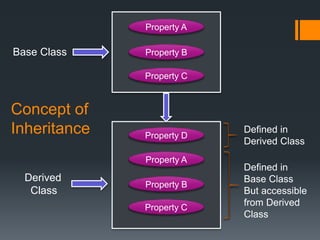
Concept of
Inheritance
Base Class
Property A
Property B
Property C
Property D
Property C
Property B
Property A
Derived
Class
Defined in
Derived Class
Defined in
Base Class
But accessible
from Derived
Class
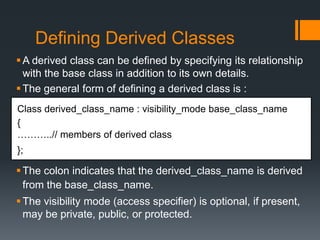
Defining Derived Classes
A derived class can be defined by specifying its relationship
with the base class in addition to its own details.
The general form of defining a derived class is :
The colon indicates that the derived_class_name is derived
from the base_class_name.
The visibility mode (access specifier) is optional, if present,
may be private, public, or protected.
Class derived_class_name : visibility_mode base_class_name
{
………..// members of derived class
};
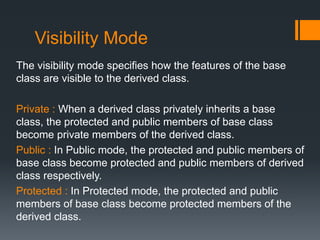
Visibility Mode
The visibility mode specifies how the features of the base
class are visible to the derived class.
Private : When a derived class privately inherits a base
class, the protected and public members of base class
become private members of the derived class.
Public : In Public mode, the protected and public members of
base class become protected and public members of derived
class respectively.
Protected : In Protected mode, the protected and public
members of base class become protected members of the
derived class.
Types of Inheritance
1. Single Inheritance
2. Multilevel Inheritance
3. Multiple Inheritance
4. Hierarchical Inheritance
5. Hybrid Inheritance
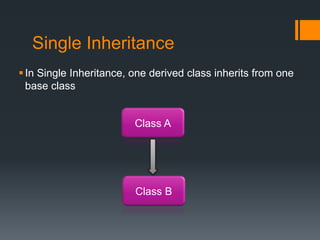
Single Inheritance
In Single Inheritance, one derived class inherits from one
base class
Class A
Class B
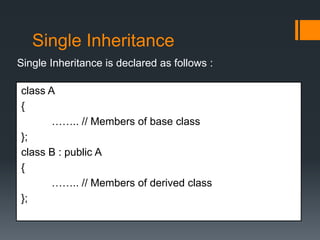
Single Inheritance
class A
{
…….. // Members of base class
};
class B : public A
{
…….. // Members of derived class
};
Single Inheritance is declared as follows :
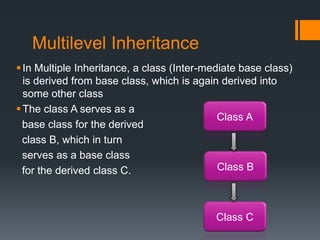
Multilevel Inheritance
In Multiple Inheritance, a class (Inter-mediate base class)
is derived from base class, which is again derived into
some other class
The class A serves as a
base class for the derived
class B, which in turn
serves as a base class
for the derived class C.
Class A
Class B
Class C
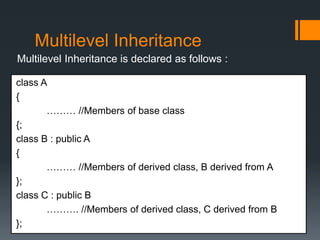
Multilevel Inheritance
class A
{
……… //Members of base class
{;
class B : public A
{
……… //Members of derived class, B derived from A
};
class C : public B
………. //Members of derived class, C derived from B
};
Multilevel Inheritance is declared as follows :
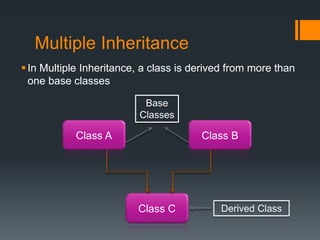
Multiple Inheritance
In Multiple Inheritance, a class is derived from more than
one base classes
Class C
Class BClass A
Base
Classes
Derived Class
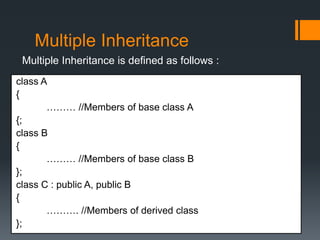
Multiple Inheritance
class A
{
……… //Members of base class A
{;
class B
{
……… //Members of base class B
};
class C : public A, public B
{
………. //Members of derived class
};
Multiple Inheritance is defined as follows :
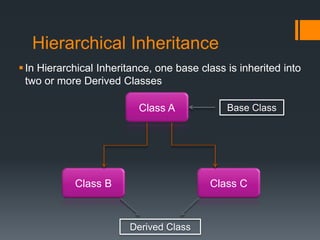
Hierarchical Inheritance
In Hierarchical Inheritance, one base class is inherited into
two or more Derived Classes
Class A
Class B Class C
Base Class
Derived Class
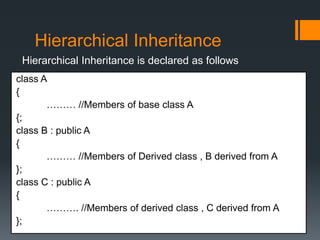
Hierarchical Inheritance
class A
{
……… //Members of base class A
{;
class B : public A
{
……… //Members of Derived class , B derived from A
};
class C : public A
{
………. //Members of derived class , C derived from A
};
Hierarchical Inheritance is declared as follows
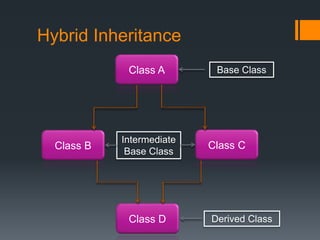
Hybrid Inheritance
In Hybrid Inheritance, more than one type of inheritances
are used to derive a new Sub Class.
For example, inheriting a class from two different classes,
which in turn have been derived from the same base class.
Any legal combination of other four types of inheritance
comes under Hybrid Inheritance
Hybrid Inheritance
Class A
Class B Class C
Base Class
Class D Derived Class
Intermediate
Base Class
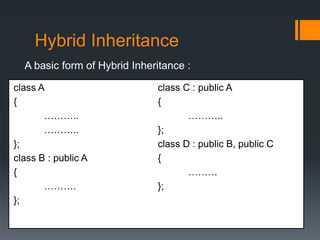
Hybrid Inheritance
class A
{
………..
………..
};
class B : public A
{
……….
};
class C : public A
{
………..
};
class D : public B, public C
{
………
};
A basic form of Hybrid Inheritance :
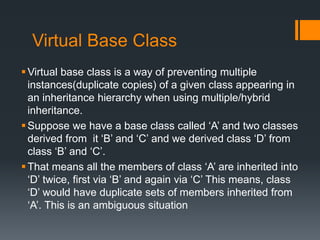
Virtual Base Class
Virtual base class is a way of preventing multiple
instances(duplicate copies) of a given class appearing in
an inheritance hierarchy when using multiple/hybrid
inheritance.
Suppose we have a base class called ‘A’ and two classes
derived from it ‘B’ and ‘C’ and we derived class ‘D’ from
class ‘B’ and ‘C’.
That means all the members of class ‘A’ are inherited into
‘D’ twice, first via ‘B’ and again via ‘C’ This means, class
‘D’ would have duplicate sets of members inherited from
‘A’. This is an ambiguous situation
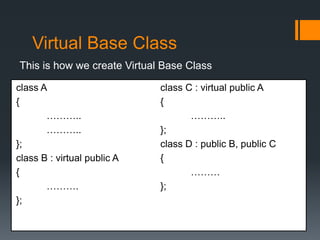
Virtual Base Class
class A
{
………..
………..
};
class B : virtual public A
{
……….
};
class C : virtual public A
{
………..
};
class D : public B, public C
{
………
};
This is how we create Virtual Base Class
Abstract Class
An abstract class is one that is not used to create
objects.
An abstract class is designed only to act as a base class
to be inherited by other classes.
It is a design concept in program development and
provides a base upon which other classes may be built
Advantages of Inheritance
Reusability : Inheritance helps the code to be reused in
many situations. The base class is defines and once it is
compiled, it need not be reworked. Using the concept of
Inheritance, the programmer can create as many derived
classes from the base class as needed while adding
specific features to each derived class as needed
Saves Time and Effort : The above concept of reusability
achieved by inheritance saves the programmer’s time
and effort. Since the main code written can be reused in
various situations as needed

Inheritance in OOPS

  • 1.
  • 2.
    What is Inheritance? Inheritance is a relationship between two or more classes where derived class inherits properties of pre- existing (base) classes. Base Class: It is the class whose properties are inherited by another class. It is also called Super Class or Parent Class. Derived Class: It is the class that inherit properties from base class(es). It is also called Sub Class or Child Class.
  • 3.
    Concept of Inheritance Base Class PropertyA Property B Property C Property D Property C Property B Property A Derived Class Defined in Derived Class Defined in Base Class But accessible from Derived Class
  • 4.
    Defining Derived Classes Aderived class can be defined by specifying its relationship with the base class in addition to its own details. The general form of defining a derived class is : The colon indicates that the derived_class_name is derived from the base_class_name. The visibility mode (access specifier) is optional, if present, may be private, public, or protected. Class derived_class_name : visibility_mode base_class_name { ………..// members of derived class };
  • 5.
    Visibility Mode The visibilitymode specifies how the features of the base class are visible to the derived class. Private : When a derived class privately inherits a base class, the protected and public members of base class become private members of the derived class. Public : In Public mode, the protected and public members of base class become protected and public members of derived class respectively. Protected : In Protected mode, the protected and public members of base class become protected members of the derived class.
  • 6.
    Types of Inheritance 1.Single Inheritance 2. Multilevel Inheritance 3. Multiple Inheritance 4. Hierarchical Inheritance 5. Hybrid Inheritance
  • 7.
    Single Inheritance In SingleInheritance, one derived class inherits from one base class Class A Class B
  • 8.
    Single Inheritance class A { ……..// Members of base class }; class B : public A { …….. // Members of derived class }; Single Inheritance is declared as follows :
  • 9.
    Multilevel Inheritance In MultipleInheritance, a class (Inter-mediate base class) is derived from base class, which is again derived into some other class The class A serves as a base class for the derived class B, which in turn serves as a base class for the derived class C. Class A Class B Class C
  • 10.
    Multilevel Inheritance class A { ………//Members of base class {; class B : public A { ……… //Members of derived class, B derived from A }; class C : public B ………. //Members of derived class, C derived from B }; Multilevel Inheritance is declared as follows :
  • 11.
    Multiple Inheritance In MultipleInheritance, a class is derived from more than one base classes Class C Class BClass A Base Classes Derived Class
  • 12.
    Multiple Inheritance class A { ………//Members of base class A {; class B { ……… //Members of base class B }; class C : public A, public B { ………. //Members of derived class }; Multiple Inheritance is defined as follows :
  • 13.
    Hierarchical Inheritance In HierarchicalInheritance, one base class is inherited into two or more Derived Classes Class A Class B Class C Base Class Derived Class
  • 14.
    Hierarchical Inheritance class A { ………//Members of base class A {; class B : public A { ……… //Members of Derived class , B derived from A }; class C : public A { ………. //Members of derived class , C derived from A }; Hierarchical Inheritance is declared as follows
  • 15.
    Hybrid Inheritance In HybridInheritance, more than one type of inheritances are used to derive a new Sub Class. For example, inheriting a class from two different classes, which in turn have been derived from the same base class. Any legal combination of other four types of inheritance comes under Hybrid Inheritance
  • 16.
    Hybrid Inheritance Class A ClassB Class C Base Class Class D Derived Class Intermediate Base Class
  • 17.
    Hybrid Inheritance class A { ……….. ……….. }; classB : public A { ………. }; class C : public A { ……….. }; class D : public B, public C { ……… }; A basic form of Hybrid Inheritance :
  • 18.
    Virtual Base Class Virtualbase class is a way of preventing multiple instances(duplicate copies) of a given class appearing in an inheritance hierarchy when using multiple/hybrid inheritance. Suppose we have a base class called ‘A’ and two classes derived from it ‘B’ and ‘C’ and we derived class ‘D’ from class ‘B’ and ‘C’. That means all the members of class ‘A’ are inherited into ‘D’ twice, first via ‘B’ and again via ‘C’ This means, class ‘D’ would have duplicate sets of members inherited from ‘A’. This is an ambiguous situation
  • 19.
    Virtual Base Class classA { ……….. ……….. }; class B : virtual public A { ………. }; class C : virtual public A { ……….. }; class D : public B, public C { ……… }; This is how we create Virtual Base Class
  • 20.
    Abstract Class An abstractclass is one that is not used to create objects. An abstract class is designed only to act as a base class to be inherited by other classes. It is a design concept in program development and provides a base upon which other classes may be built
  • 21.
    Advantages of Inheritance Reusability: Inheritance helps the code to be reused in many situations. The base class is defines and once it is compiled, it need not be reworked. Using the concept of Inheritance, the programmer can create as many derived classes from the base class as needed while adding specific features to each derived class as needed Saves Time and Effort : The above concept of reusability achieved by inheritance saves the programmer’s time and effort. Since the main code written can be reused in various situations as needed

Editor's Notes

  • #14 This is just opposite of Multiple Inheritance
  • #16 This is a combine form of Multiple and Hierarchical Inheritance.