Technical Seminar
on
BLUETOOTH TECHNOLOGY
Presented by
Swati Pathare
(116T1A0554)
Agenda
 Introduction
 Bluetooth states
 Features
 Bluetooth Protocol Stack
 RFCOMM/SDP
 L2CAP
 Host Controller Interface
 Link Controller and Link
Manager
 Baseband
 Packet Format
 Security
 Advantages
 Bluetooth Conclusion
 Conclusion
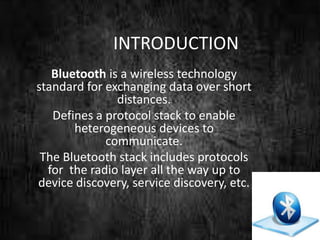
INTRODUCTION
Bluetooth is a wireless technology
standard for exchanging data over short
distances.
Defines a protocol stack to enable
heterogeneous devices to
communicate.
The Bluetooth stack includes protocols
for the radio layer all the way up to
device discovery, service discovery, etc.
4
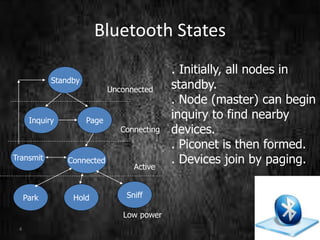
Bluetooth States
Standby
Inquiry Page
Transmit Connected
Park Hold Sniff
Unconnected
Connecting
Active
Low power
. Initially, all nodes in
standby.
. Node (master) can begin
inquiry to find nearby
devices.
. Piconet is then formed.
. Devices join by paging.
Features
-Short range (up to 10m on average)
- Low bandwidth (about 720kps max)
- Low component cost
- Unlicensed radio band
- Low power
- Limited interference issues
- Secure (has a built in encryption)
6
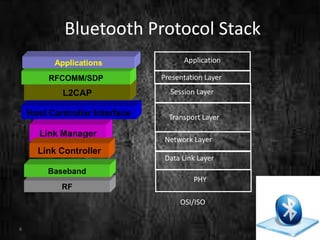
Bluetooth Protocol Stack
RF
Baseband
Link Manager
L2CAP
RFCOMM/SDP
Applications
Link Controller
Host Controller Interface
PHY
Data Link Layer
Network Layer
Transport Layer
Session Layer
Presentation Layer
Application
OSI/ISO
7
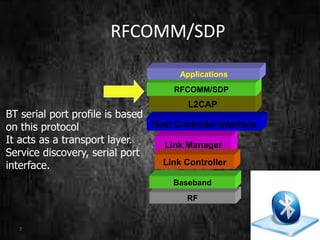
RFCOMM/SDP
RF
Baseband
Link Manager
L2CAP
RFCOMM/SDP
Applications
Link Controller
Host Controller Interface
BT serial port profile is based
on this protocol
It acts as a transport layer.
Service discovery, serial port
interface.
8
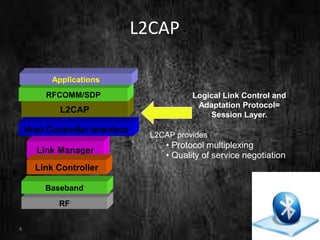
L2CAP
Logical Link Control and
Adaptation Protocol=
Session Layer.
L2CAP provides
• Protocol multiplexing
• Quality of service negotiation
RF
Baseband
Link Manager
L2CAP
RFCOMM/SDP
Applications
Link Controller
Host Controller Interface
9
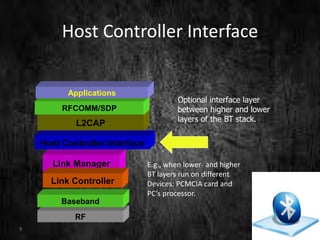
Host Controller Interface
RF
Baseband
Link Manager
L2CAP
RFCOMM/SDP
Applications
Link Controller
Host Controller Interface
Optional interface layer
between higher and lower
layers of the BT stack.
E.g., when lower- and higher
BT layers run on different
Devices: PCMCIA card and
PC’s processor.
10
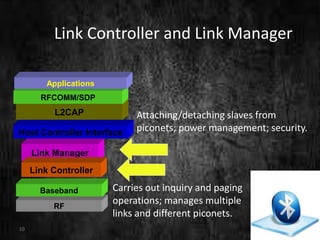
Link Controller and Link Manager
RF
Baseband
Link Manager
L2CAP
RFCOMM/SDP
Applications
Link Controller
Host Controller Interface
Carries out inquiry and paging
operations; manages multiple
links and different piconets.
Attaching/detaching slaves from
piconets; power management; security.
11
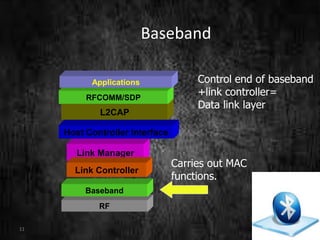
Baseband
Carries out MAC
functions.
RF
Baseband
Link Manager
L2CAP
RFCOMM/SDP
Applications
Link Controller
Host Controller Interface
Control end of baseband
+link controller=
Data link layer
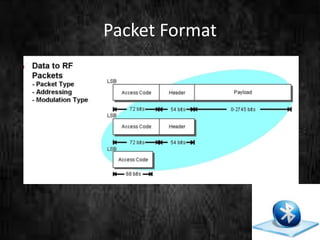
Packet Format
13
Security
• Authentication and encryption.
• LMP provides mechanisms for negotiation of
encryption modes, keys, etc.
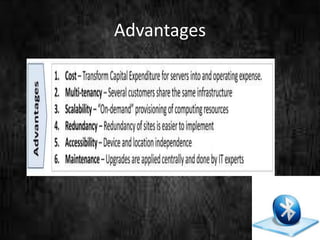
Advantages
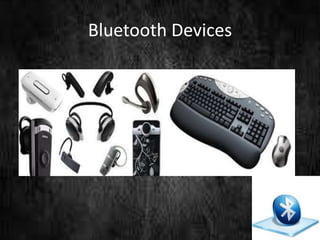
Bluetooth Devices
Conclusion
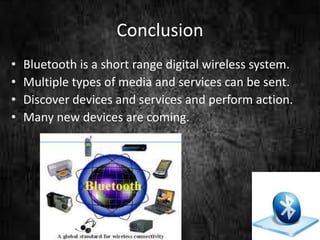
• Bluetooth is a short range digital wireless system.
• Multiple types of media and services can be sent.
• Discover devices and services and perform action.
• Many new devices are coming.
Any Query…????
Bluetooth Power point presentation

Bluetooth Power point presentation

  • 1.
  • 2.
    Agenda  Introduction  Bluetoothstates  Features  Bluetooth Protocol Stack  RFCOMM/SDP  L2CAP  Host Controller Interface  Link Controller and Link Manager  Baseband  Packet Format  Security  Advantages  Bluetooth Conclusion  Conclusion
  • 3.
    INTRODUCTION Bluetooth is awireless technology standard for exchanging data over short distances. Defines a protocol stack to enable heterogeneous devices to communicate. The Bluetooth stack includes protocols for the radio layer all the way up to device discovery, service discovery, etc.
  • 4.
    4 Bluetooth States Standby Inquiry Page TransmitConnected Park Hold Sniff Unconnected Connecting Active Low power . Initially, all nodes in standby. . Node (master) can begin inquiry to find nearby devices. . Piconet is then formed. . Devices join by paging.
  • 5.
    Features -Short range (upto 10m on average) - Low bandwidth (about 720kps max) - Low component cost - Unlicensed radio band - Low power - Limited interference issues - Secure (has a built in encryption)
  • 6.
    6 Bluetooth Protocol Stack RF Baseband LinkManager L2CAP RFCOMM/SDP Applications Link Controller Host Controller Interface PHY Data Link Layer Network Layer Transport Layer Session Layer Presentation Layer Application OSI/ISO
  • 7.
    7 RFCOMM/SDP RF Baseband Link Manager L2CAP RFCOMM/SDP Applications Link Controller HostController Interface BT serial port profile is based on this protocol It acts as a transport layer. Service discovery, serial port interface.
  • 8.
    8 L2CAP Logical Link Controland Adaptation Protocol= Session Layer. L2CAP provides • Protocol multiplexing • Quality of service negotiation RF Baseband Link Manager L2CAP RFCOMM/SDP Applications Link Controller Host Controller Interface
  • 9.
    9 Host Controller Interface RF Baseband LinkManager L2CAP RFCOMM/SDP Applications Link Controller Host Controller Interface Optional interface layer between higher and lower layers of the BT stack. E.g., when lower- and higher BT layers run on different Devices: PCMCIA card and PC’s processor.
  • 10.
    10 Link Controller andLink Manager RF Baseband Link Manager L2CAP RFCOMM/SDP Applications Link Controller Host Controller Interface Carries out inquiry and paging operations; manages multiple links and different piconets. Attaching/detaching slaves from piconets; power management; security.
  • 11.
    11 Baseband Carries out MAC functions. RF Baseband LinkManager L2CAP RFCOMM/SDP Applications Link Controller Host Controller Interface Control end of baseband +link controller= Data link layer
  • 12.
  • 13.
    13 Security • Authentication andencryption. • LMP provides mechanisms for negotiation of encryption modes, keys, etc.
  • 14.
  • 15.
  • 16.
    Conclusion • Bluetooth isa short range digital wireless system. • Multiple types of media and services can be sent. • Discover devices and services and perform action. • Many new devices are coming.
  • 17.