DR.PV.NISHANTH,DM
NIMS,Hyderabad,India.
   Dysfunction or altered anatomy of any one of
    the components of the mitral valve apparatus
    can result in mitral regurgitation.
•   determining the suitability of the mitral valve
    for repair
•   most likely in patients with mitral
    regurgitation due to myxomatous degeneration
    and is least likely in patients with regurgitation
    due to endocarditis
•   most likely with posterior prolapse or flail,
    whereas bileaflet involvement and isolated
    anterior leaflet prolapse reduce the likelihood
    of successful repair substantially
   thorough examination of the mitral valve and
    mitral apparatus and to determine the origin
    and geometry of the regurgitant jet
   long-axis imaging planes are best for
    determining which mitral leaflet is involved
   TTE-PLAX/apical long axis/SHORT
    AXIS/A4C
   Long-axis views of the mitral valve are
    obtained by imaging from midesophageal TEE
    planes
   Typically, when viewing the left ventricle in a
    longitudinal plane (120 degrees), the imaging
    plane intersects the A2/P2 boundary
   Imaging at a multiplane angle of about 135
    degrees cuts perpendicular to this
    intercommissural line.
   short-axis views also are useful for determining
    which portion of the anterior or posterior
    leaflet is involved.
   approximately 50 to 60 degrees in most
    patients, the imaging plane parallel to a line
    between the commissures, is very useful for
    determining which portion of the anterior or
    posterior leaflet is involved.
   papillary muscles and chordae usually are well
    visualized from the transgastric long-axis
    views of the left ventricle
Etiology                                   Presumed Mechanism
Annular dilation                           Inadequate leaflet coaptation
MAC                                        Increased rigidity of annulus impairing
                                           systolic contraction
Myxomatous mitral valve disease            Inadequate coaptation and apposition, fail
                                           segments
Rheumatic mitral valve disease             Increased rigidity of leaflets
Endocarditis                               Leaflet perforation or deformity
Age-related degenerative leaflet changes   Abnormal coaptation
Hypertrophic cardiomyopathy                Abnormal leaflet motion and anatomy
Chordae disruption or elongation           Inadequate systolic support of leaflet
Regional left ventricular dysfunction      Inadequate systolic support of leaflets
Left ventricular dilation                  Abnormal papillary muscle orientation
Papillary muscle rupture                   Inadequate systolic support of leaflets
   elongation or disruption of any portion of the
    mitral valve or of the mitral apparatus,
    including the papillary muscles and chordae
   Myxomatous disease
    endocarditis
    papillary muscle infarction
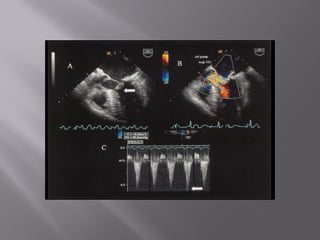
   Flail leaflet-not uncommon sequela of a
    myxomatous mitral valve
   anatomic disruption of a portion of the mitral
    apparatus results in aneccentric direction of the
    regurgitation jet with an orientation opposite in
    direction to the leaflet with the anatomic defect
   regurgitant jet is directed away from the affected
    leaflet
   chordae to the commissures are ruptured, then
    a jet originating at the commissures is seen in
    the transgastric short-axis view.
    Jets originating at the commissure also are
    seen in infarction of a papillary muscle, most
    commonly the posteromedial one
   papillary muscle ruptures in an acute
    myocardial infarct-differentiated from acute
    chordal rupture by detecting a mass attached to
    the flail leaflet that is a portion of the muscle
   Postoperative prognosis is best in those with
    excessive leaflet motion.
   rheumatic disease
    ischemic heart disease
    the chronic phase oflupus
    acquired valvular disease caused by certain
    drugs such as ergot derivatives and
    anorexigenic drugs such as the fen-phen
   rheumatic, lupus, and drug-induced diseases,
    the leaflets are thickened
   rheumaTIC-pml more affected than AML
   relatively normal anterior leaflet "over-rides"
    the restricted posterior leaflet.
    The direction of the regurgitant jet in this
    situation is posterior, toward the affected leaflet
   Echocardiographic findings consistent with
    rheumatic valve involvement include
    (1) leaflet thickening, deformation, and
    retraction
    (2) fusion, shortening, and fibrosis of the
    subvalvular apparatus
    (3) accompanying aortic and/or tricuspid
    valve involvement
   Chordal rupture is mc in chordae to AML in
    rheumatic while it is MC in chordae to PML in
    myxomatous valve.
   Rheumatic valve is more likely to have IE than
    spontaneous rupture.
   commonly seen in patients with mitral
    regurgitation secondary to left ventricular
    dilation of any cause
    dilated cardiomyopathy,or severe ischemic
    cardiomyopathy
   Perforation of the valve leaflet causing mitral
    regurgitation occurs most commonly because
    of endocarditis or because of a congenital cleft
    in the valve
    Occasionally it is iatrogenic, after attempted
    repair.
    jet origin is eccentric, arising from the
    midportion of the leaflets rather than from the
    coaptation line.
   Chronic MR, occurring >2 weeks after
    infarction and in the absence of structural
    mitral valve disease
   disease of abnormal left ventricular (LV) shape
    and function with a valvular manifestation
   Greater degrees of morphologic disturbance
    are predictive of greater likelihood of
    persistence of MR following mitral
    annuloplasty, with the optimal cut-offs for
    distinguishing patients with persistent MR
    being a
   coaptation distance of .0.6 cm
    tenting area of >2.5 cm2
    posterior leaflet angle >45u.
   Annular dilatation more than 40 mm
   Post annuloplasty PL is relatively fixed ,it is the
    AL that has to coapt.
   So instead of PL angle/AL base angle ,AL tip
    angle is more determining factor
   Evaluation of mechanisms of MR needs a
    systematic approach utilising both TTE and
    TEE for visualising all scallops of leaflets.
   Excessive leaflet motion has the best chance of
    surgical correction
   Ischemic MR/ventricular annular dilatation is
    a complex and needs evaluation by multiple
    variables to predict result of annuloplasty.
   3D echo gives excellent visualisation of mitral
    valve and its structures and provides both
    aetiological and prognostic information
THANK YOU

Mitral regurgitation

  • 1.
  • 3.
    Dysfunction or altered anatomy of any one of the components of the mitral valve apparatus can result in mitral regurgitation.
  • 5.
    determining the suitability of the mitral valve for repair • most likely in patients with mitral regurgitation due to myxomatous degeneration and is least likely in patients with regurgitation due to endocarditis • most likely with posterior prolapse or flail, whereas bileaflet involvement and isolated anterior leaflet prolapse reduce the likelihood of successful repair substantially
  • 6.
    thorough examination of the mitral valve and mitral apparatus and to determine the origin and geometry of the regurgitant jet  long-axis imaging planes are best for determining which mitral leaflet is involved  TTE-PLAX/apical long axis/SHORT AXIS/A4C
  • 8.
    Long-axis views of the mitral valve are obtained by imaging from midesophageal TEE planes  Typically, when viewing the left ventricle in a longitudinal plane (120 degrees), the imaging plane intersects the A2/P2 boundary
  • 9.
    Imaging at a multiplane angle of about 135 degrees cuts perpendicular to this intercommissural line.  short-axis views also are useful for determining which portion of the anterior or posterior leaflet is involved.
  • 11.
    approximately 50 to 60 degrees in most patients, the imaging plane parallel to a line between the commissures, is very useful for determining which portion of the anterior or posterior leaflet is involved.
  • 13.
    papillary muscles and chordae usually are well visualized from the transgastric long-axis views of the left ventricle
  • 14.
    Etiology Presumed Mechanism Annular dilation Inadequate leaflet coaptation MAC Increased rigidity of annulus impairing systolic contraction Myxomatous mitral valve disease Inadequate coaptation and apposition, fail segments Rheumatic mitral valve disease Increased rigidity of leaflets Endocarditis Leaflet perforation or deformity Age-related degenerative leaflet changes Abnormal coaptation Hypertrophic cardiomyopathy Abnormal leaflet motion and anatomy Chordae disruption or elongation Inadequate systolic support of leaflet Regional left ventricular dysfunction Inadequate systolic support of leaflets Left ventricular dilation Abnormal papillary muscle orientation Papillary muscle rupture Inadequate systolic support of leaflets
  • 18.
    elongation or disruption of any portion of the mitral valve or of the mitral apparatus, including the papillary muscles and chordae  Myxomatous disease  endocarditis  papillary muscle infarction
  • 19.
    Flail leaflet-not uncommon sequela of a myxomatous mitral valve  anatomic disruption of a portion of the mitral apparatus results in aneccentric direction of the regurgitation jet with an orientation opposite in direction to the leaflet with the anatomic defect
  • 21.
    regurgitant jet is directed away from the affected leaflet  chordae to the commissures are ruptured, then a jet originating at the commissures is seen in the transgastric short-axis view.  Jets originating at the commissure also are seen in infarction of a papillary muscle, most commonly the posteromedial one
  • 22.
    papillary muscle ruptures in an acute myocardial infarct-differentiated from acute chordal rupture by detecting a mass attached to the flail leaflet that is a portion of the muscle  Postoperative prognosis is best in those with excessive leaflet motion.
  • 26.
    rheumatic disease  ischemic heart disease  the chronic phase oflupus  acquired valvular disease caused by certain drugs such as ergot derivatives and anorexigenic drugs such as the fen-phen
  • 27.
    rheumatic, lupus, and drug-induced diseases, the leaflets are thickened  rheumaTIC-pml more affected than AML  relatively normal anterior leaflet "over-rides" the restricted posterior leaflet.  The direction of the regurgitant jet in this situation is posterior, toward the affected leaflet
  • 28.
    Echocardiographic findings consistent with rheumatic valve involvement include  (1) leaflet thickening, deformation, and retraction  (2) fusion, shortening, and fibrosis of the subvalvular apparatus  (3) accompanying aortic and/or tricuspid valve involvement
  • 29.
    Chordal rupture is mc in chordae to AML in rheumatic while it is MC in chordae to PML in myxomatous valve.  Rheumatic valve is more likely to have IE than spontaneous rupture.
  • 30.
    commonly seen in patients with mitral regurgitation secondary to left ventricular dilation of any cause  dilated cardiomyopathy,or severe ischemic cardiomyopathy
  • 31.
    Perforation of the valve leaflet causing mitral regurgitation occurs most commonly because of endocarditis or because of a congenital cleft in the valve  Occasionally it is iatrogenic, after attempted repair.  jet origin is eccentric, arising from the midportion of the leaflets rather than from the coaptation line.
  • 32.
    Chronic MR, occurring >2 weeks after infarction and in the absence of structural mitral valve disease  disease of abnormal left ventricular (LV) shape and function with a valvular manifestation
  • 38.
    Greater degrees of morphologic disturbance are predictive of greater likelihood of persistence of MR following mitral annuloplasty, with the optimal cut-offs for distinguishing patients with persistent MR being a  coaptation distance of .0.6 cm  tenting area of >2.5 cm2  posterior leaflet angle >45u.  Annular dilatation more than 40 mm
  • 39.
    Post annuloplasty PL is relatively fixed ,it is the AL that has to coapt.  So instead of PL angle/AL base angle ,AL tip angle is more determining factor
  • 44.
    Evaluation of mechanisms of MR needs a systematic approach utilising both TTE and TEE for visualising all scallops of leaflets.  Excessive leaflet motion has the best chance of surgical correction  Ischemic MR/ventricular annular dilatation is a complex and needs evaluation by multiple variables to predict result of annuloplasty.
  • 45.
    3D echo gives excellent visualisation of mitral valve and its structures and provides both aetiological and prognostic information
  • 46.