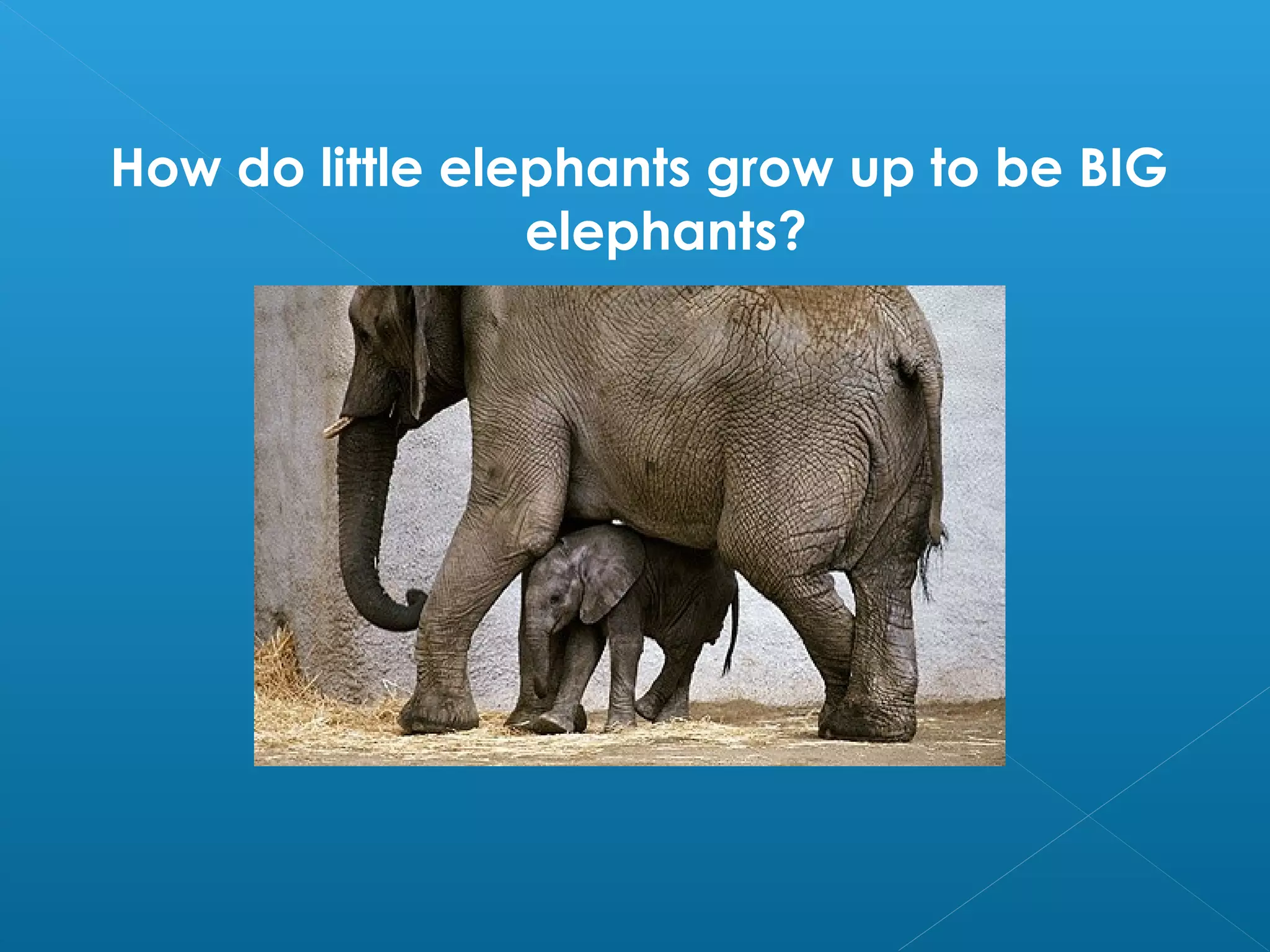
How do little elephants grow up to be BIG
elephants?
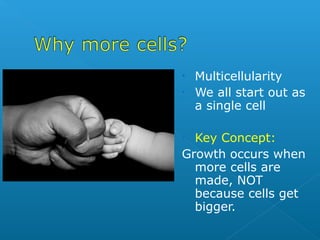
• Multicellularity
• We all start out as
a single cell
• Key Concept:
Growth occurs when
more cells are
made, NOT
because cells get
bigger.
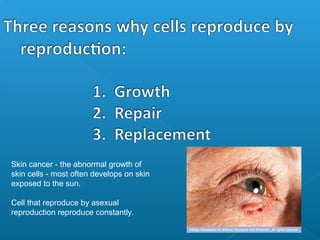
Skin cancer - the abnormal
growth of skin cells - most
often develops on skin
exposed to the sun.
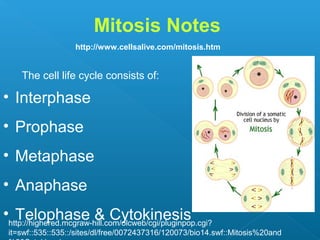
Mitosis Notes
http://www.cellsalive.com/mitosis.htm
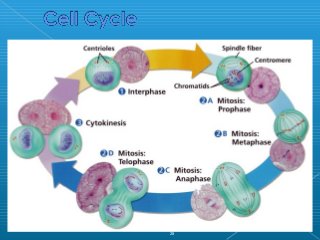
• Interphase
• Prophase
• Metaphase
• Anaphase
• Telophase & Cytokinesishttp://highered.mcgraw-hill.com/olcweb/cgi/pluginpop.cgi?
it=swf::535::535::/sites/dl/free/0072437316/120073/bio14.swf::Mitosis%20and
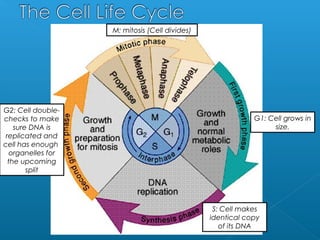
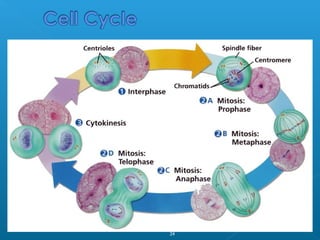
The cell life cycle consists of:
G2: Cell double-
checks to make
sure DNA is
replicated and
cell has enough
organelles for
the upcoming
split
G1: Cell grows in
size.
S: Cell makes
identical copy
of its DNA
M: mitosis (Cell divides)
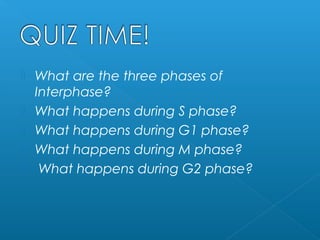
 What are the three phases of
Interphase?
 What happens during G1 phase?
 What happens during S phase?
 What happens during G2 phase?
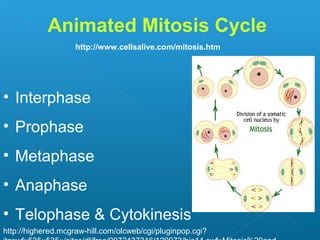
Animated Mitosis Cycle
http://www.cellsalive.com/mitosis.htm
• Interphase
• Prophase
• Metaphase
• Anaphase
• Telophase & Cytokinesis
http://highered.mcgraw-hill.com/olcweb/cgi/pluginpop.cgi?
 What is binary
fission?
 Why does the
DNA need to
move to
either side of
the cell
before the
cell divides?
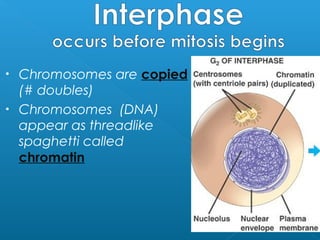
• Chromosomes are copied
(# doubles)
• Chromosomes (DNA)
appear as threadlike
spaghetti called
chromatin
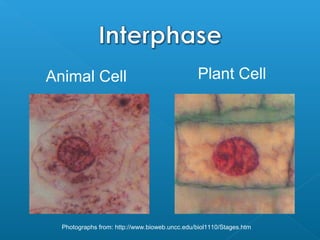
Animal Cell Plant Cell
Photographs from: http://www.bioweb.uncc.edu/biol1110/Stages.htm
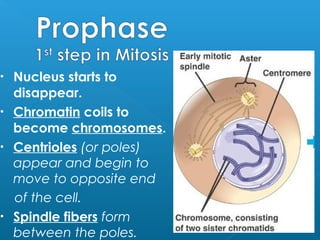
• Nucleus starts to
disappear.
• Chromatin coils to
become chromosomes.
• Centrioles (or poles)
appear and begin to
move to opposite end
of the cell.
• Spindle fibers form
between the poles.
centriole
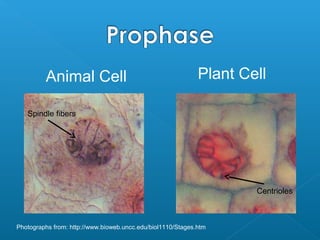
Animal Cell Plant Cell
Photographs from: http://www.bioweb.uncc.edu/biol1110/Stages.htm
Spindle fibers
Centrioles
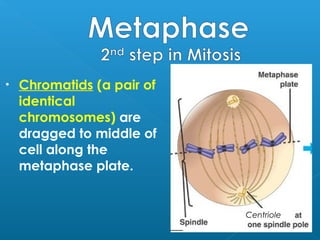
• Chromatids are
dragged to middle of
cell along the
metaphase plate.
Centriole
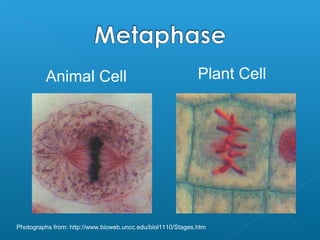
Animal Cell Plant Cell
Photographs from: http://www.bioweb.uncc.edu/biol1110/Stages.htm
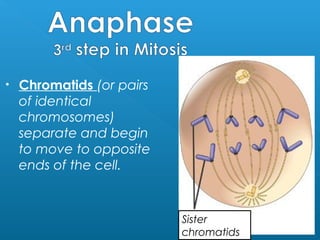
• Chromatids (or pairs
of homologous
chromosomes)
separate and begin
to move to opposite
ends of the cell.
Sister
chromatids
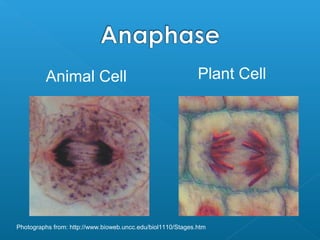
Animal Cell Plant Cell
Photographs from: http://www.bioweb.uncc.edu/biol1110/Stages.htm
 What are the
steps of
mitosis?
 What is the
spaghetti –like
DNA called?
 What is the
coiled,
bundled DNA
called?
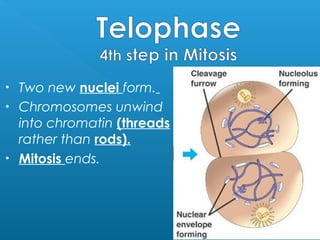
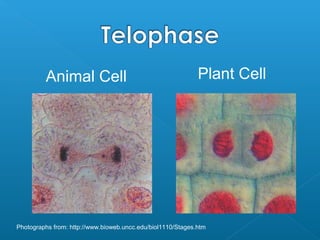
• Two new nuclei form.
• Chromosomes unwind
into chromatin (threads
instead of bundles).
• Mitosis ends.
Animal Cell Plant Cell
Photographs from: http://www.bioweb.uncc.edu/biol1110/Stages.htm
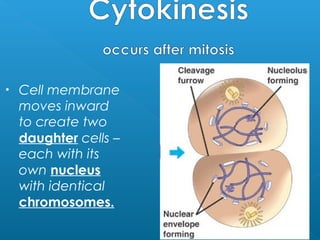
• Cell
membrane
moves inward
to create two
daughter cells
– each with its
own nucleus.
Cytokinesis is
different in plants!
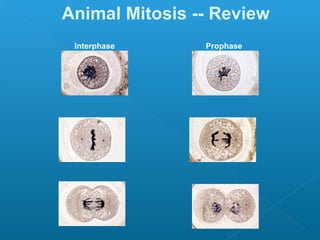
Animal Mitosis -- Review
Interphase Prophase
Metaphase Anaphase
Telophase Interphase
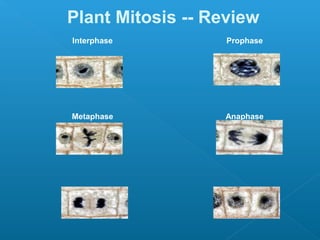
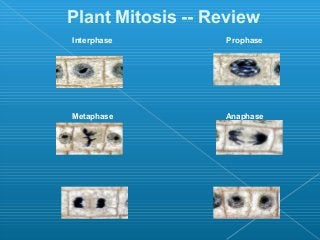
Plant Mitosis -- Review
Interphase Prophase
Metaphase Anaphase
Telophase Interphase
28
29
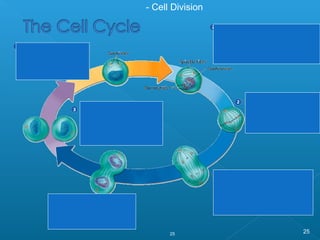
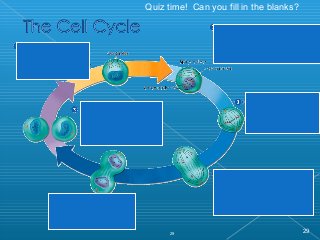
Quiz time! Can you fill in the blanks?
29
http://www.cellsalive.com/mitosis.htm

Mitosis ppt

  • 2.
    How do littleelephants grow up to be BIG elephants?
  • 3.
    • Multicellularity • Weall start out as a single cell • Key Concept: Growth occurs when more cells are made, NOT because cells get bigger.
  • 4.
    Skin cancer -the abnormal growth of skin cells - most often develops on skin exposed to the sun.
  • 5.
    Mitosis Notes http://www.cellsalive.com/mitosis.htm • Interphase •Prophase • Metaphase • Anaphase • Telophase & Cytokinesishttp://highered.mcgraw-hill.com/olcweb/cgi/pluginpop.cgi? it=swf::535::535::/sites/dl/free/0072437316/120073/bio14.swf::Mitosis%20and The cell life cycle consists of:
  • 6.
    G2: Cell double- checksto make sure DNA is replicated and cell has enough organelles for the upcoming split G1: Cell grows in size. S: Cell makes identical copy of its DNA M: mitosis (Cell divides)
  • 7.
     What arethe three phases of Interphase?  What happens during G1 phase?  What happens during S phase?  What happens during G2 phase?
  • 8.
    Animated Mitosis Cycle http://www.cellsalive.com/mitosis.htm •Interphase • Prophase • Metaphase • Anaphase • Telophase & Cytokinesis http://highered.mcgraw-hill.com/olcweb/cgi/pluginpop.cgi?
  • 9.
     What isbinary fission?  Why does the DNA need to move to either side of the cell before the cell divides?
  • 10.
    • Chromosomes arecopied (# doubles) • Chromosomes (DNA) appear as threadlike spaghetti called chromatin
  • 11.
    Animal Cell PlantCell Photographs from: http://www.bioweb.uncc.edu/biol1110/Stages.htm
  • 12.
    • Nucleus startsto disappear. • Chromatin coils to become chromosomes. • Centrioles (or poles) appear and begin to move to opposite end of the cell. • Spindle fibers form between the poles. centriole
  • 13.
    Animal Cell PlantCell Photographs from: http://www.bioweb.uncc.edu/biol1110/Stages.htm Spindle fibers Centrioles
  • 14.
    • Chromatids are draggedto middle of cell along the metaphase plate. Centriole
  • 15.
    Animal Cell PlantCell Photographs from: http://www.bioweb.uncc.edu/biol1110/Stages.htm
  • 16.
    • Chromatids (orpairs of homologous chromosomes) separate and begin to move to opposite ends of the cell. Sister chromatids
  • 17.
    Animal Cell PlantCell Photographs from: http://www.bioweb.uncc.edu/biol1110/Stages.htm
  • 18.
     What arethe steps of mitosis?  What is the spaghetti –like DNA called?  What is the coiled, bundled DNA called?
  • 19.
    • Two newnuclei form. • Chromosomes unwind into chromatin (threads instead of bundles). • Mitosis ends.
  • 20.
    Animal Cell PlantCell Photographs from: http://www.bioweb.uncc.edu/biol1110/Stages.htm
  • 21.
    • Cell membrane moves inward tocreate two daughter cells – each with its own nucleus.
  • 22.
  • 25.
    Animal Mitosis --Review Interphase Prophase Metaphase Anaphase Telophase Interphase
  • 26.
    Plant Mitosis --Review Interphase Prophase Metaphase Anaphase Telophase Interphase
  • 27.
  • 28.
    29 Quiz time! Canyou fill in the blanks? 29
  • 29.

Editor's Notes

  • #28 A mnemonic to help remember the stages of mitosis.