Quickstart! 9/17
Do gel shoes make you run faster?
Talk to your table about what you think.
Come up with some way to test your idea.
The Scientific Method
What is it?
The Scientific Method
A series of steps used to
answer questions and solve
problems.
Are roses beautiful? (Sorry, science can’t answer a
question like this)
Will roses grow in zero gravity? (Yes! science can
help us with this question – and personally – I would
like to be the one to test it!)
The steps to the scientific method
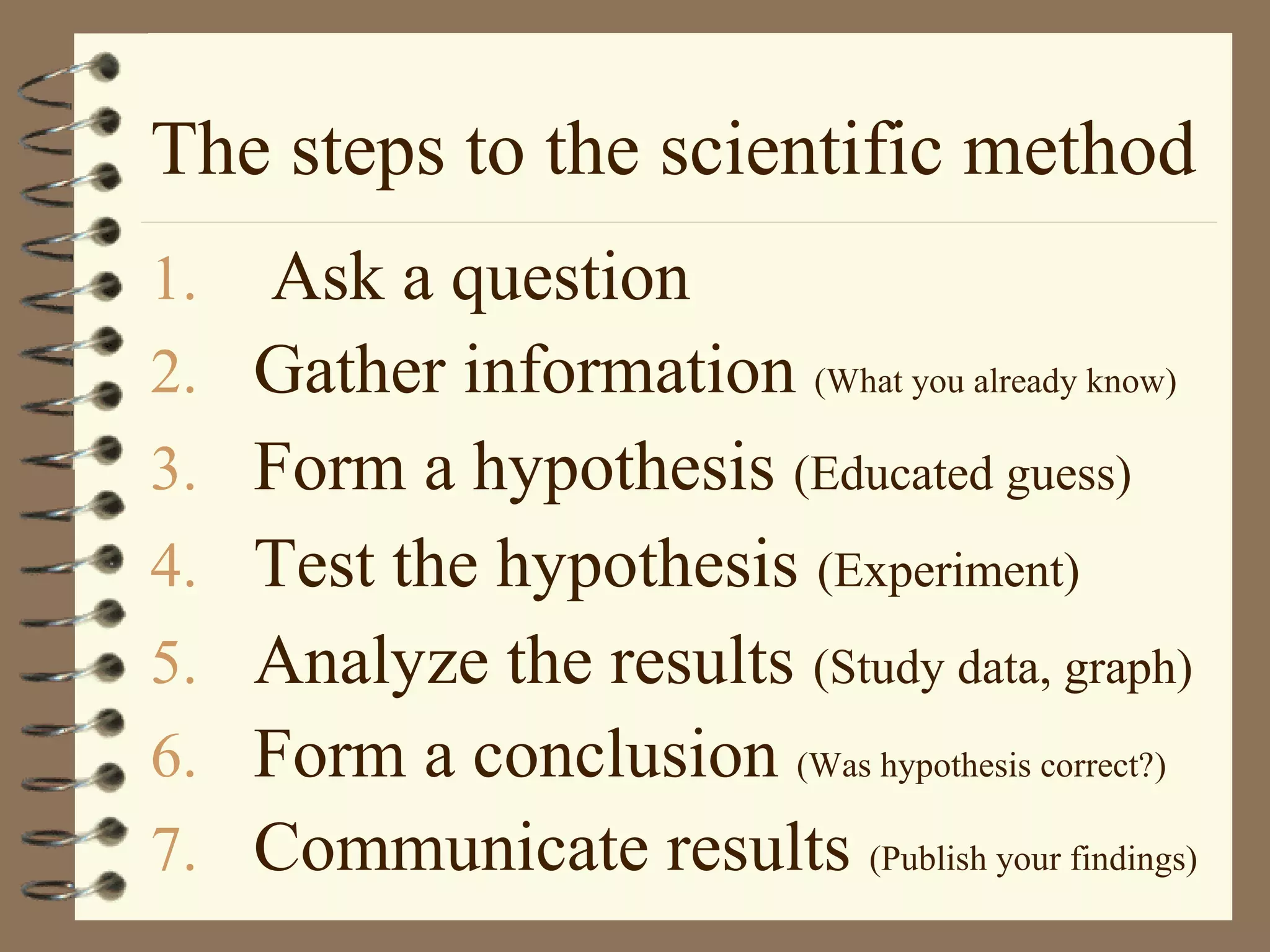
1. Ask a question
2. Gather information (What you already know)
3. Form a hypothesis (Educated guess)
4. Test the hypothesis (Experiment)
5. Analyze the results (Study data, graph)
6. Form a conclusion (Was hypothesis correct?)
7. Communicate results (Publish your findings)
Ask a Question
The question should identify
something you do not already know
and want to find out.
The question is usually asked after you
have made a lot of observations.
An observation is any use of the senses
to gather information.
Form a Hypothesis
A hypothesis is a possible explanation
or answer to a question.
Scientists use observations they have
already made to form a hypothesis.
A hypothesis is stated in “If … then”
format.
Test the Hypothesis
After you have formed your hypothesis you
must test to see whether it is a reasonable
answer to your question.
One way to test a hypothesis is through a
controlled experiment.
In a controlled experiment, there is a control
group and a experimental group. The two
groups are the same except for one variable.
Analyze the Results
You must analyze your data and other
observations you have made to see
whether your test(s) support your
hypothesis.
Sometimes this step requires doing
calculations, and making tables or
graphs.
Draw Conclusions
After analyzing your results you can
conclude:
– Your results supported your hypothesis
– Your results did not support your hypothesis
– You need more information
In order to draw conclusions you may need
to perform more tests or modify your
hypothesis.
Communicate Results
Telling others what you have learned
You may do this by writing a scientific
paper, making a presentation, or
creating a Web site.

Scientific Method Notes

  • 1.
    Quickstart! 9/17 Do gelshoes make you run faster? Talk to your table about what you think. Come up with some way to test your idea.
  • 2.
  • 3.
    The Scientific Method Aseries of steps used to answer questions and solve problems. Are roses beautiful? (Sorry, science can’t answer a question like this) Will roses grow in zero gravity? (Yes! science can help us with this question – and personally – I would like to be the one to test it!)
  • 4.
    The steps tothe scientific method 1. Ask a question 2. Gather information (What you already know) 3. Form a hypothesis (Educated guess) 4. Test the hypothesis (Experiment) 5. Analyze the results (Study data, graph) 6. Form a conclusion (Was hypothesis correct?) 7. Communicate results (Publish your findings)
  • 5.
    Ask a Question Thequestion should identify something you do not already know and want to find out. The question is usually asked after you have made a lot of observations. An observation is any use of the senses to gather information.
  • 6.
    Form a Hypothesis Ahypothesis is a possible explanation or answer to a question. Scientists use observations they have already made to form a hypothesis. A hypothesis is stated in “If … then” format.
  • 7.
    Test the Hypothesis Afteryou have formed your hypothesis you must test to see whether it is a reasonable answer to your question. One way to test a hypothesis is through a controlled experiment. In a controlled experiment, there is a control group and a experimental group. The two groups are the same except for one variable.
  • 8.
    Analyze the Results Youmust analyze your data and other observations you have made to see whether your test(s) support your hypothesis. Sometimes this step requires doing calculations, and making tables or graphs.
  • 9.
    Draw Conclusions After analyzingyour results you can conclude: – Your results supported your hypothesis – Your results did not support your hypothesis – You need more information In order to draw conclusions you may need to perform more tests or modify your hypothesis.
  • 10.
    Communicate Results Telling otherswhat you have learned You may do this by writing a scientific paper, making a presentation, or creating a Web site.