THE CELL CYCLE
MAKING BRAND NEW
CELLS!
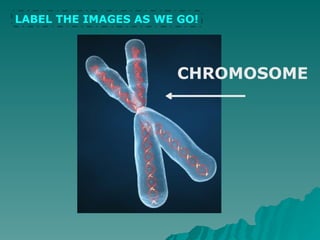
CHROMOSOME
LABEL THE IMAGES AS WE GO!
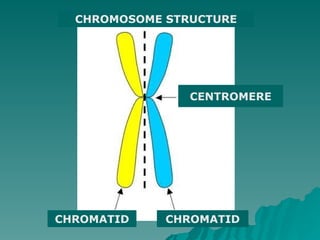
CHROMOSOME STRUCTURE
CENTROMERE
CHROMATID
CHROMATID
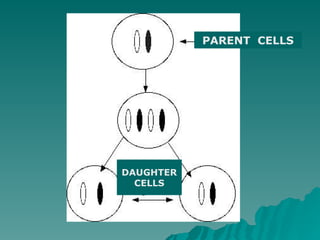
PARENT CELLS
DAUGHTER
CELLS
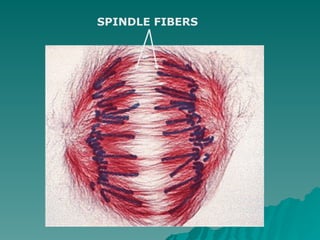
SPINDLE FIBERS
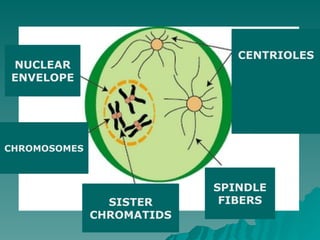
NUCLEAR
ENVELOPE
CENTRIOLES
SPINDLE
FIBERS
SISTER
CHROMATIDS
CHROMOSOMES
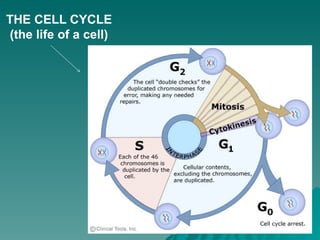
THE CELL CYCLE
(the life of a cell)
What is the Cell Cycle?
It is the life of a eukaryotic cell: The
way the cells grow, make new copies
and divide!
It happens in all of your
somatic(body) cells in order to get
the same DNA inside each cell.
(your reproductive cells do
something different)
What is the Cell Cycle?
 Parent cells are diploid and make 2
daughter cells that are also diploid with
their own new nuclei.
 Diploid means 2 of each chromosome:
2 (n)= 2 (23) = 46
chromosomes
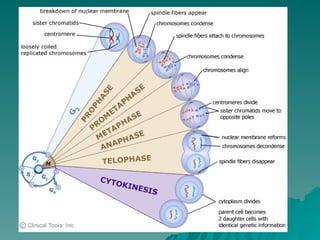
 Phases of the cell cycle: Interphase,
Prophase, Metaphase, Anaphase,
Telophase and Cytokinesis
I P M A T C
I Peed on the MAT, see?
INTERPHASE
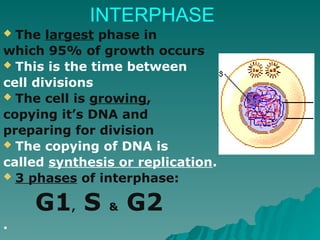
 The largest phase in
which 95% of growth occurs
 This is the time between
cell divisions
 The cell is growing,
copying it’s DNA and
preparing for division
 The copying of DNA is
called synthesis or replication.
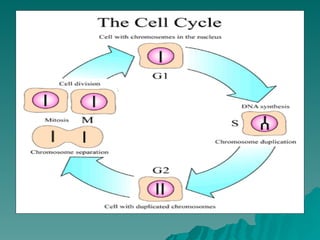
 3 phases of interphase:
G1, S & G2
.
1. G1
Growth of the cell in size and development
(differentiation-the cell is told what to become).
2. S
Synthesis of DNA, also called REPLICATION:
1. The DNA double helix is unzipped completely by an
enzyme called HELICASE.
2. One DNA nucleotide at a time is added to BOTH sides
of the DNA strand (AT and CG) with the help of
another enzyme called DNA POLYMERASE.
3. The nucleus is left with TWO exact copies of ALL the
chromosomes/DNA.
3. G2
the cell prepares for division and checks for
errors.
INTERPHASE (3 phases)
REPLICATION:
 http://www.johnkyrk.com/DNAreplication.html
 http://www.stolaf.edu/people/giannini/flashanimat/mol
genetics/dna-rna2.swf
NOW, YOU PRACTICE!
Go back to the DNA template in your
notebooks.
Open the strand of DNA (you are helicase).
DRAW in each individual nucleotide that
matches the bases you have already glued
in… YOU HAVE JUST REPLICATED DNA!
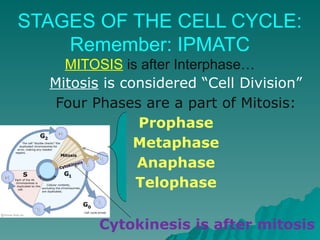
Mitosis is considered “Cell Division”
Four Phases are a part of Mitosis:
Prophase
Metaphase
Anaphase
Telophase
Cytokinesis is after mitosis
STAGES OF THE CELL CYCLE:
Remember: IPMATC
MITOSIS is after Interphase…
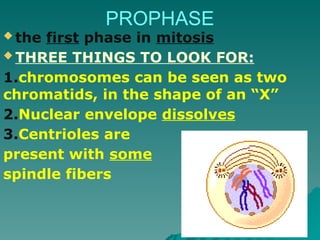
PROPHASE
 the first phase in mitosis
 THREE THINGS TO LOOK FOR:
1.chromosomes can be seen as two
chromatids, in the shape of an “X”
2.Nuclear envelope dissolves
3.Centrioles are
present with some
spindle fibers
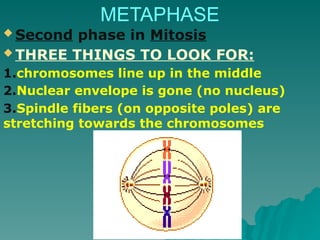
METAPHASE
 Second phase in Mitosis
 THREE THINGS TO LOOK FOR:
1.chromosomes line up in the middle
2.Nuclear envelope is gone (no nucleus)
3.Spindle fibers (on opposite poles) are
stretching towards the chromosomes
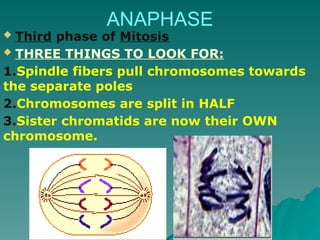
ANAPHASE
 Third phase of Mitosis
 THREE THINGS TO LOOK FOR:
1.Spindle fibers pull chromosomes towards
the separate poles
2.Chromosomes are split in HALF
3.Sister chromatids are now their OWN
chromosome.
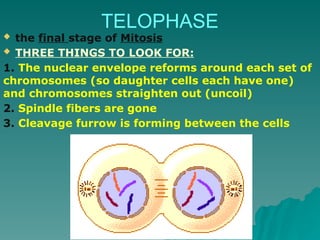
TELOPHASE
 the final stage of Mitosis
 THREE THINGS TO LOOK FOR:
1. The nuclear envelope reforms around each set of
chromosomes (so daughter cells each have one)
and chromosomes straighten out (uncoil)
2. Spindle fibers are gone
3. Cleavage furrow is forming between the cells
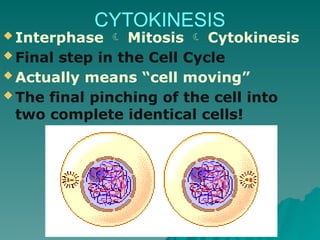
CYTOKINESIS
 Interphase  Mitosis  Cytokinesis
 Final step in the Cell Cycle
 Actually means “cell moving”
 The final pinching of the cell into
two complete identical cells!
Certain genes and enzymes
trigger the start of the cell cycle
(replication) and also tell the
cells what to do.
Importance of the cell cycle to
the growth of organisms:
 UNICELLULAR:
Cell cycle is how they reproduce offspring
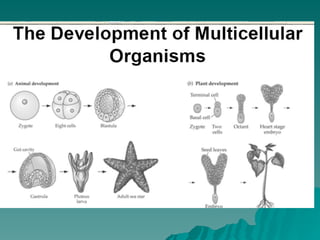
 MULTICELLULAR:
Cell cycle is how they become an adult
from only one fertilized zygote cell.
Cell Cycle in Multicellular
Organisms:
 GROWTH: increase in number of cells and
the size of cells (interphase G1)
 DIFFERENTIATION: cells are told by a
gene to become specialized (ex. Muscle
cells are told to do that job)
 MORPHOGENESIS: the patterned
formation of specialized cells to become
TISSUES!
Disruptions in the cell cycle:
 If certain enzymes and genes tell the
cell cycle to begin too rapidly, cell
division becomes out of control.
=CANCER!
cell cycle and cell division (mitosis).pptx

cell cycle and cell division (mitosis).pptx

  • 1.
    THE CELL CYCLE MAKINGBRAND NEW CELLS!
  • 2.
  • 3.
  • 4.
  • 5.
  • 6.
  • 7.
    THE CELL CYCLE (thelife of a cell)
  • 8.
    What is theCell Cycle? It is the life of a eukaryotic cell: The way the cells grow, make new copies and divide! It happens in all of your somatic(body) cells in order to get the same DNA inside each cell. (your reproductive cells do something different)
  • 9.
    What is theCell Cycle?  Parent cells are diploid and make 2 daughter cells that are also diploid with their own new nuclei.  Diploid means 2 of each chromosome: 2 (n)= 2 (23) = 46 chromosomes  Phases of the cell cycle: Interphase, Prophase, Metaphase, Anaphase, Telophase and Cytokinesis I P M A T C I Peed on the MAT, see?
  • 10.
    INTERPHASE  The largestphase in which 95% of growth occurs  This is the time between cell divisions  The cell is growing, copying it’s DNA and preparing for division  The copying of DNA is called synthesis or replication.  3 phases of interphase: G1, S & G2 .
  • 11.
    1. G1 Growth ofthe cell in size and development (differentiation-the cell is told what to become). 2. S Synthesis of DNA, also called REPLICATION: 1. The DNA double helix is unzipped completely by an enzyme called HELICASE. 2. One DNA nucleotide at a time is added to BOTH sides of the DNA strand (AT and CG) with the help of another enzyme called DNA POLYMERASE. 3. The nucleus is left with TWO exact copies of ALL the chromosomes/DNA. 3. G2 the cell prepares for division and checks for errors. INTERPHASE (3 phases)
  • 13.
    REPLICATION:  http://www.johnkyrk.com/DNAreplication.html  http://www.stolaf.edu/people/giannini/flashanimat/mol genetics/dna-rna2.swf NOW,YOU PRACTICE! Go back to the DNA template in your notebooks. Open the strand of DNA (you are helicase). DRAW in each individual nucleotide that matches the bases you have already glued in… YOU HAVE JUST REPLICATED DNA!
  • 14.
    Mitosis is considered“Cell Division” Four Phases are a part of Mitosis: Prophase Metaphase Anaphase Telophase Cytokinesis is after mitosis STAGES OF THE CELL CYCLE: Remember: IPMATC MITOSIS is after Interphase…
  • 15.
    PROPHASE  the firstphase in mitosis  THREE THINGS TO LOOK FOR: 1.chromosomes can be seen as two chromatids, in the shape of an “X” 2.Nuclear envelope dissolves 3.Centrioles are present with some spindle fibers
  • 16.
    METAPHASE  Second phasein Mitosis  THREE THINGS TO LOOK FOR: 1.chromosomes line up in the middle 2.Nuclear envelope is gone (no nucleus) 3.Spindle fibers (on opposite poles) are stretching towards the chromosomes
  • 17.
    ANAPHASE  Third phaseof Mitosis  THREE THINGS TO LOOK FOR: 1.Spindle fibers pull chromosomes towards the separate poles 2.Chromosomes are split in HALF 3.Sister chromatids are now their OWN chromosome.
  • 18.
    TELOPHASE  the finalstage of Mitosis  THREE THINGS TO LOOK FOR: 1. The nuclear envelope reforms around each set of chromosomes (so daughter cells each have one) and chromosomes straighten out (uncoil) 2. Spindle fibers are gone 3. Cleavage furrow is forming between the cells
  • 19.
    CYTOKINESIS  Interphase Mitosis  Cytokinesis  Final step in the Cell Cycle  Actually means “cell moving”  The final pinching of the cell into two complete identical cells!
  • 21.
    Certain genes andenzymes trigger the start of the cell cycle (replication) and also tell the cells what to do.
  • 22.
    Importance of thecell cycle to the growth of organisms:  UNICELLULAR: Cell cycle is how they reproduce offspring  MULTICELLULAR: Cell cycle is how they become an adult from only one fertilized zygote cell.
  • 23.
    Cell Cycle inMulticellular Organisms:  GROWTH: increase in number of cells and the size of cells (interphase G1)  DIFFERENTIATION: cells are told by a gene to become specialized (ex. Muscle cells are told to do that job)  MORPHOGENESIS: the patterned formation of specialized cells to become TISSUES!
  • 24.
    Disruptions in thecell cycle:  If certain enzymes and genes tell the cell cycle to begin too rapidly, cell division becomes out of control. =CANCER!