Cell Notes #1, #2, #3, and #4
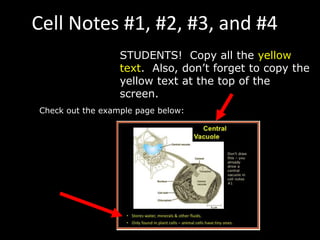
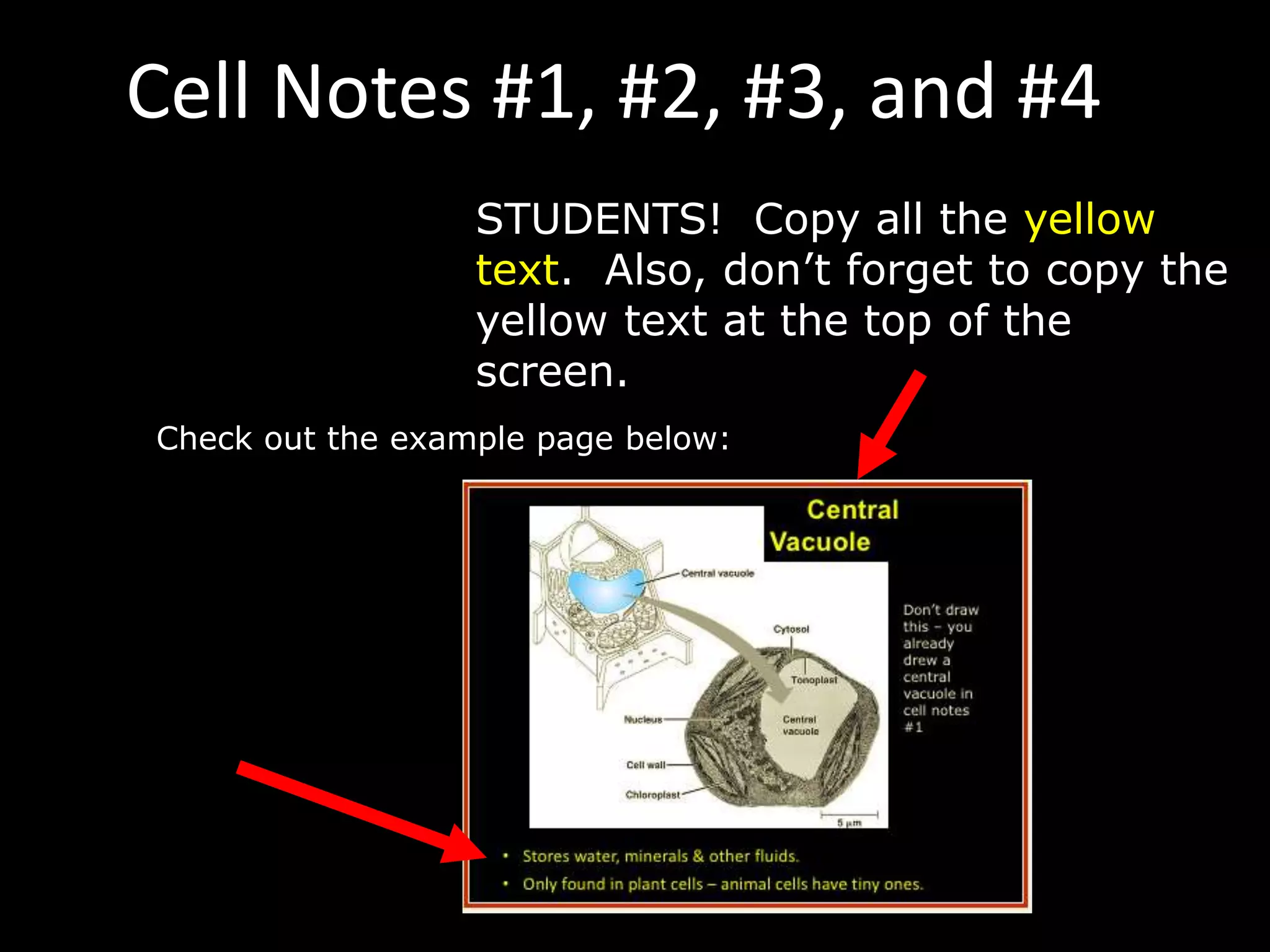
STUDENTS! Copy all the yellow
text. Also, don’t forget to copy the
yellow text at the top of the
screen.
Check out the example page below:
STOP!
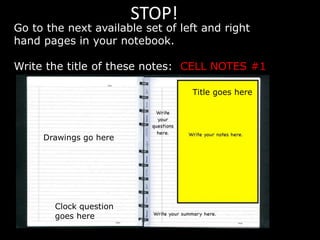
Go to the next available set of left and right
hand pages in your notebook.
Write the title of these notes: CELL NOTES #1
Title goes here
Drawings go here
Clock question
goes here
Cell Facts
• Cells are microscopic - too small to be
seen without a microscope.
• Humans are made of about 90 trillion cells.
• If a single cell can live on its own, it is
called a unicellular organism.
• Humans are multicellular organisms.
Bacteria are unicellular.
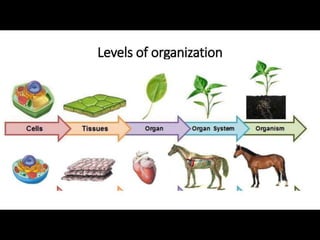
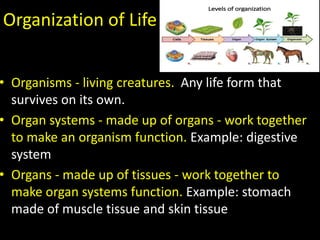
Organization of Life
• Organisms - living creatures. Any life form that
survives on its own.
• Organ systems - made up of organs - work together
to make an organism function. Example: digestive
system
• Organs - made up of tissues - work together to
make organ systems function. Example: stomach
made of muscle tissue and skin tissue
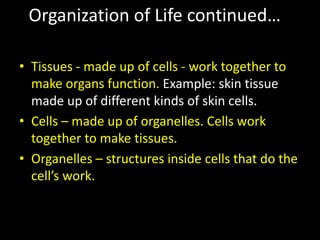
• Tissues - made up of cells - work together to
make organs function. Example: skin tissue
made up of different kinds of skin cells.
• Cells – made up of organelles. Cells work
together to make tissues.
• Organelles – structures inside cells that do the
cell’s work.
Organization of Life continued…
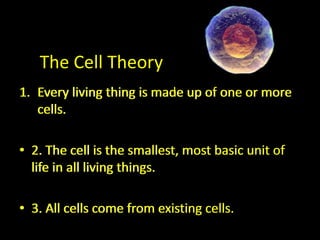
1. Every living thing is made up of one or more
cells.
• 2. The cell is the smallest, most basic unit of
life in all living things.
• 3. All cells come from existing cells.
1. Every living thing is made up of one or more
cells.
• 2. The cell is the smallest, most basic unit of
life in all living things.
• 3. All cells come from existing cells.
The Cell Theory
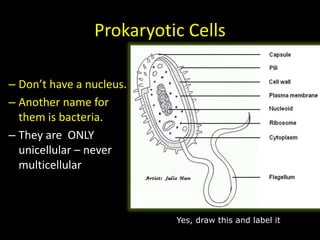
Prokaryotic Cells
– Don’t have a nucleus.
– Another name for
them is bacteria.
– They are ONLY
unicellular – never
multicellular
Yes, draw this and label it
• Congratulations! You have reached the end of
Cell Notes #1. Don’t forget to do the reflection
activity your teacher assigned on the left hand
page (clock question, one pager, learning log
question, etc..)
• The next slide will start Cell Notes #2. Enjoy!
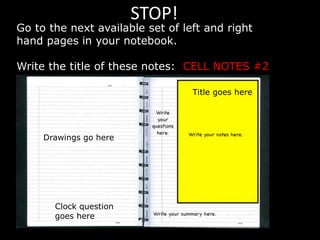
STOP!
Go to the next available set of left and right
hand pages in your notebook.
Write the title of these notes: CELL NOTES #2
Title goes here
Drawings go here
Clock question
goes here
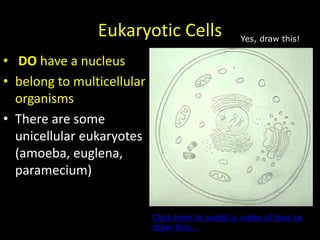
Eukaryotic Cells
• DO have a nucleus
• belong to multicellular
organisms
• There are some
unicellular eukaryotes
(amoeba, euglena,
paramecium)
Click here to watch a video of how to
draw this...
Yes, draw this!
Eukaryotic Cells continued…
• Eukaryotes:
– have membrane-
covered organelles.
– Their DNA is linear
(organized in lines)
– They’re 100 x bigger
than prokaryotes.
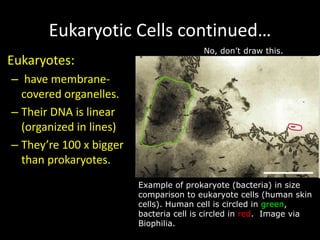
Example of prokaryote (bacteria) in size
comparison to eukaryote cells (human skin
cells). Human cell is circled in green,
bacteria cell is circled in red. Image via
Biophilia.
No, don’t draw this.
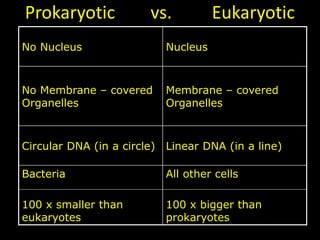
Prokaryotic vs. Eukaryotic
No Nucleus Nucleus
No Membrane – covered
Organelles
Membrane – covered
Organelles
Circular DNA (in a circle) Linear DNA (in a line)
Bacteria
100 x smaller than
eukaryotes
All other cells
100 x bigger than
prokaryotes
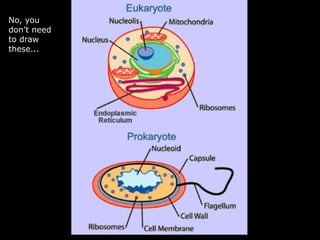
No, you
don’t need
to draw
these...
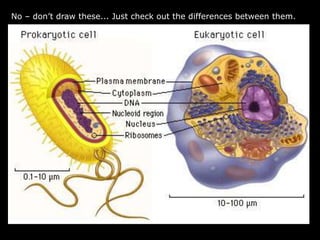
No – don’t draw these... Just check out the differences between them.
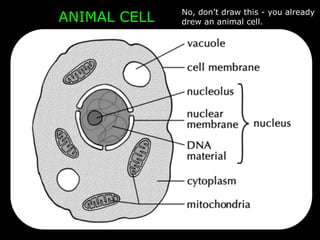
ANIMAL CELL No, don’t draw this - you already
drew an animal cell.
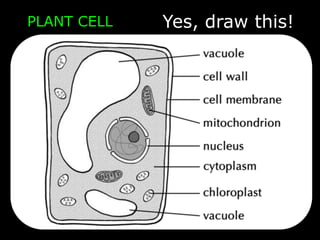
PLANT CELL Yes, draw this!
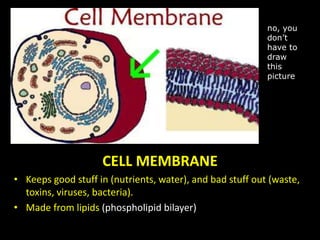
CELL MEMBRANE
• Keeps good stuff in (nutrients, water), and bad stuff out (waste,
toxins, viruses, bacteria).
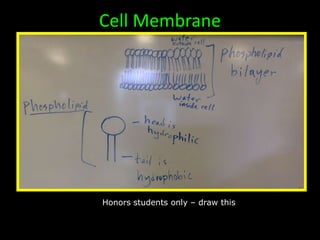
• Made from lipids (phospholipid bilayer)
no, you
don’t
have to
draw
this
picture
Cell Membrane
Honors students only – draw this
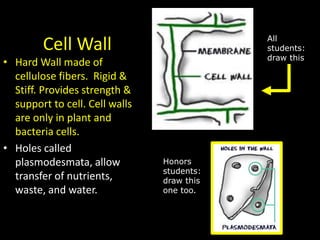
Cell Wall
• Hard Wall made of
cellulose fibers. Rigid &
Stiff. Provides strength &
support to cell. Cell walls
are only in plant and
bacteria cells.
• Holes called
plasmodesmata, allow
transfer of nutrients,
waste, and water.
All
students:
draw this
Honors
students:
draw this
one too.
• Congratulations! You have reached the end of
Cell Notes #2. Don’t forget to do the reflection
activity your teacher assigned on the left hand
page (clock question, one pager, learning log
question, etc..)
• The next slide will start Cell Notes #3. Enjoy!
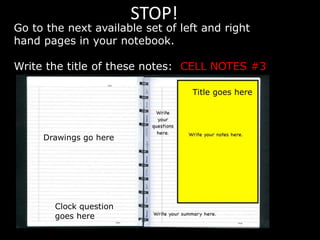
STOP!
Go to the next available set of left and right
hand pages in your notebook.
Write the title of these notes: CELL NOTES #3
Title goes here
Drawings go here
Clock question
goes here
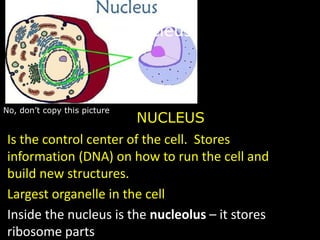
• Is the control center of the cell. Stores
information (DNA) on how to run the cell and
build new structures.
• Largest organelle in the cell
• Inside the nucleus is the nucleolus – it stores
ribosome parts
No, don’t copy this picture
NUCLEUS
Nucleus
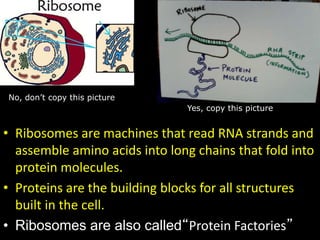
• Ribosomes are machines that read RNA strands and
assemble amino acids into long chains that fold into
protein molecules.
• Proteins are the building blocks for all structures
built in the cell.
• Ribosomes are also called“Protein Factories”
No, don’t copy this picture
Yes, copy this picture
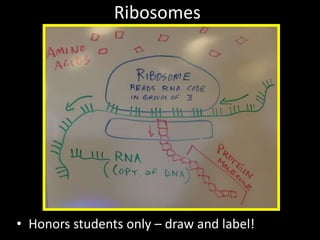
Ribosomes
• Honors students only – draw and label!
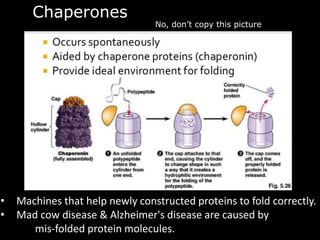
Chaperones
• Machines that help newly constructed proteins to fold correctly.
• Mad cow disease & Alzheimer's disease are caused by
mis-folded protein molecules.
Chaperones
No, don’t copy this picture
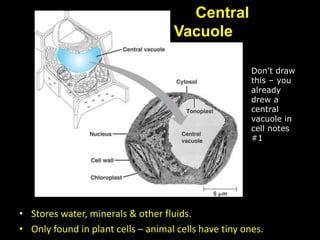
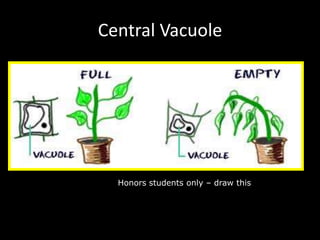
• Stores water, minerals & other fluids.
• Only found in plant cells – animal cells have tiny ones.
Central
Vacuole
Don’t draw
this – you
already
drew a
central
vacuole in
cell notes
#1
Central Vacuole
Honors students only – draw this
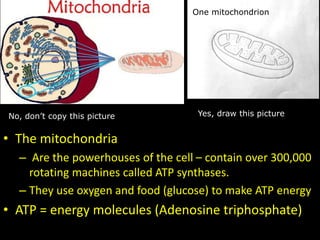
No, don’t copy this picture Yes, draw this picture
One mitochondrion
• The mitochondria
– Are the powerhouses of the cell – contain over 300,000
rotating machines called ATP synthases.
– They use oxygen and food (glucose) to make ATP energy
• ATP = energy molecules (Adenosine triphosphate)
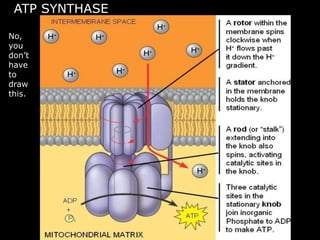
ATP SYNTHASE
No,
you
don’t
have
to
draw
this.
ATP SYNTHASE – hundreds of these machines in each mitochondrion CLICK FOR LINK
CLICK FOR A short
VIDEO – It’s cool –
I promise!
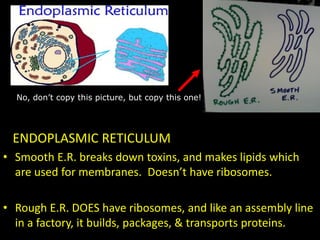
ENDOPLASMIC RETICULUM
• Smooth E.R. breaks down toxins, and makes lipids which
are used for membranes. Doesn’t have ribosomes.
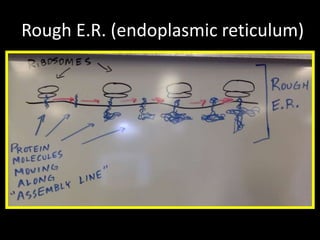
• Rough E.R. DOES have ribosomes, and like an assembly line
in a factory, it builds, packages, & transports proteins.
No, don’t copy this picture, but copy this one!
Rough E.R. (endoplasmic reticulum)
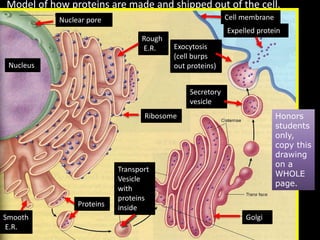
Model of how proteins are made and shipped out of the cell.
Rough
E.R. Exocytosis
(cell burps
out proteins)
Nuclear pore
Ribosome
Secretory
vesicle
Cell membrane
Expelled protein
Nucleus
Golgi
Transport
Vesicle
with
proteins
insideProteins
Smooth
E.R.
Honors
students
only,
copy this
drawing
on a
WHOLE
page.
• Congratulations! You have reached the end of
Cell Notes #3. Don’t forget to do the reflection
activity your teacher assigned on the left hand
page (clock question, one pager, learning log
question, etc..)
• The next slide will start Cell Notes #4. Enjoy!
STOP!
Go to the next available set of left and right
hand pages in your notebook.
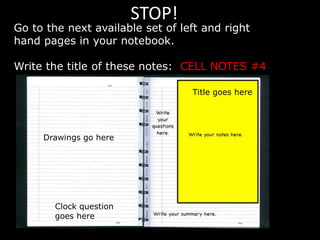
Write the title of these notes: CELL NOTES #4
Title goes here
Drawings go here
Clock question
goes here
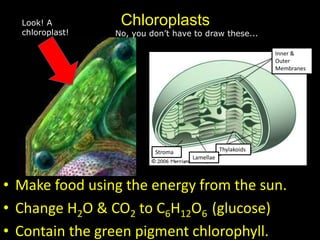
• Make food using the energy from the sun.
• Change H2O & CO2 to C6H12O6 (glucose)
• Contain the green pigment chlorophyll.
ChloroplastsLook! A
chloroplast!
Inner &
Outer
Membranes
Thylakoids
Lamellae
Stroma
No, you don’t have to draw these...
Chloroplasts
• Make food using the energy from the sun.
• Change H2O & CO2 to C6H12O6 (glucose)
• Contain the green pigment chlorophyll.
Yes, everyone gets to draw this. Honors, label it please.
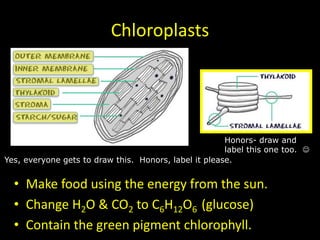
Honors- draw and
label this one too. 
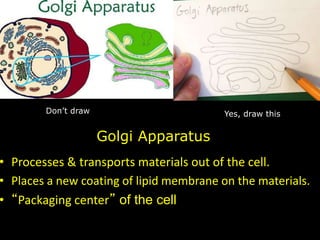
• Processes & transports materials out of the cell.
• Places a new coating of lipid membrane on the materials.
• “Packaging center” of the cell
Golgi Apparatus
Yes, draw thisDon’t draw
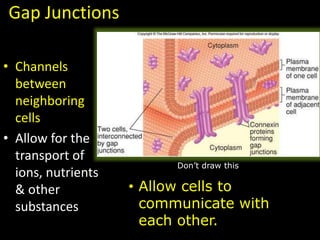
Gap Junctions
• Channels
between
neighboring
cells
• Allow for the
transport of
ions, nutrients
& other
substances
• Allow cells to
communicate with
each other.
Don’t draw this
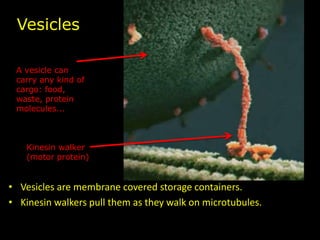
• Vesicles are membrane covered storage containers.
• Kinesin walkers pull them as they walk on microtubules.
A vesicle can
carry any kind of
cargo: food,
waste, protein
molecules...
Vesicles
Kinesin walker
(motor protein)
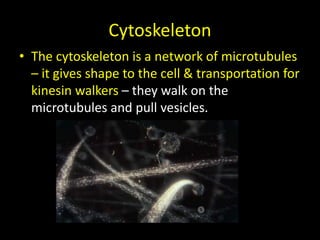
Cytoskeleton
• The cytoskeleton is a network of microtubules
– it gives shape to the cell & transportation for
kinesin walkers – they walk on the
microtubules and pull vesicles.
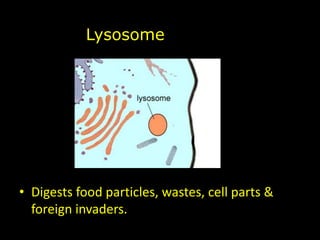
• Digests food particles, wastes, cell parts &
foreign invaders.
Lysosome
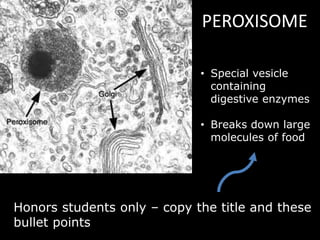
PEROXISOME
• Special vesicle
containing
digestive enzymes
• Breaks down large
molecules of food
Honors students only – copy the title and these
bullet points
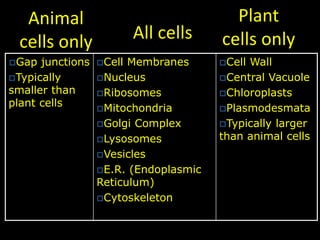
All cells
Gap junctions
Typically
smaller than
plant cells
Cell Membranes
Nucleus
Ribosomes
Mitochondria
Golgi Complex
Lysosomes
Vesicles
E.R. (Endoplasmic
Reticulum)
Cytoskeleton
Cell Wall
Central Vacuole
Chloroplasts
Plasmodesmata
Typically larger
than animal cells
Plant
cells only
Animal
cells only
• Congratulations! You have reached the end of
Cell Notes #4. Don’t forget to do the reflection
activity your teacher assigned on the left hand
page (clock question, one pager, learning log
question, etc..)
• The next slide will show you some upcoming
test questions… Enjoy!
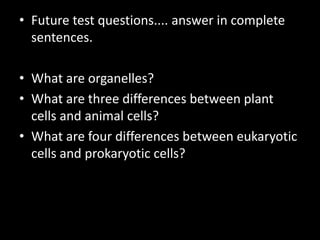
• Future test questions.... answer in complete
sentences.
• What are organelles?
• What are three differences between plant
cells and animal cells?
• What are four differences between eukaryotic
cells and prokaryotic cells?

Cell Notes - presentation for middle and high school

  • 1.
    Cell Notes #1,#2, #3, and #4 STUDENTS! Copy all the yellow text. Also, don’t forget to copy the yellow text at the top of the screen. Check out the example page below:
  • 2.
    STOP! Go to thenext available set of left and right hand pages in your notebook. Write the title of these notes: CELL NOTES #1 Title goes here Drawings go here Clock question goes here
  • 3.
    Cell Facts • Cellsare microscopic - too small to be seen without a microscope. • Humans are made of about 90 trillion cells. • If a single cell can live on its own, it is called a unicellular organism. • Humans are multicellular organisms. Bacteria are unicellular.
  • 5.
    Organization of Life •Organisms - living creatures. Any life form that survives on its own. • Organ systems - made up of organs - work together to make an organism function. Example: digestive system • Organs - made up of tissues - work together to make organ systems function. Example: stomach made of muscle tissue and skin tissue
  • 6.
    • Tissues -made up of cells - work together to make organs function. Example: skin tissue made up of different kinds of skin cells. • Cells – made up of organelles. Cells work together to make tissues. • Organelles – structures inside cells that do the cell’s work. Organization of Life continued…
  • 7.
    1. Every livingthing is made up of one or more cells. • 2. The cell is the smallest, most basic unit of life in all living things. • 3. All cells come from existing cells. 1. Every living thing is made up of one or more cells. • 2. The cell is the smallest, most basic unit of life in all living things. • 3. All cells come from existing cells. The Cell Theory
  • 8.
    Prokaryotic Cells – Don’thave a nucleus. – Another name for them is bacteria. – They are ONLY unicellular – never multicellular Yes, draw this and label it
  • 9.
    • Congratulations! Youhave reached the end of Cell Notes #1. Don’t forget to do the reflection activity your teacher assigned on the left hand page (clock question, one pager, learning log question, etc..) • The next slide will start Cell Notes #2. Enjoy!
  • 10.
    STOP! Go to thenext available set of left and right hand pages in your notebook. Write the title of these notes: CELL NOTES #2 Title goes here Drawings go here Clock question goes here
  • 11.
    Eukaryotic Cells • DOhave a nucleus • belong to multicellular organisms • There are some unicellular eukaryotes (amoeba, euglena, paramecium) Click here to watch a video of how to draw this... Yes, draw this!
  • 12.
    Eukaryotic Cells continued… •Eukaryotes: – have membrane- covered organelles. – Their DNA is linear (organized in lines) – They’re 100 x bigger than prokaryotes. Example of prokaryote (bacteria) in size comparison to eukaryote cells (human skin cells). Human cell is circled in green, bacteria cell is circled in red. Image via Biophilia. No, don’t draw this.
  • 13.
    Prokaryotic vs. Eukaryotic NoNucleus Nucleus No Membrane – covered Organelles Membrane – covered Organelles Circular DNA (in a circle) Linear DNA (in a line) Bacteria 100 x smaller than eukaryotes All other cells 100 x bigger than prokaryotes
  • 14.
  • 15.
    No – don’tdraw these... Just check out the differences between them.
  • 16.
    ANIMAL CELL No,don’t draw this - you already drew an animal cell.
  • 17.
    PLANT CELL Yes,draw this!
  • 18.
    CELL MEMBRANE • Keepsgood stuff in (nutrients, water), and bad stuff out (waste, toxins, viruses, bacteria). • Made from lipids (phospholipid bilayer) no, you don’t have to draw this picture
  • 19.
  • 20.
    Cell Wall • HardWall made of cellulose fibers. Rigid & Stiff. Provides strength & support to cell. Cell walls are only in plant and bacteria cells. • Holes called plasmodesmata, allow transfer of nutrients, waste, and water. All students: draw this Honors students: draw this one too.
  • 21.
    • Congratulations! Youhave reached the end of Cell Notes #2. Don’t forget to do the reflection activity your teacher assigned on the left hand page (clock question, one pager, learning log question, etc..) • The next slide will start Cell Notes #3. Enjoy!
  • 22.
    STOP! Go to thenext available set of left and right hand pages in your notebook. Write the title of these notes: CELL NOTES #3 Title goes here Drawings go here Clock question goes here
  • 23.
    • Is thecontrol center of the cell. Stores information (DNA) on how to run the cell and build new structures. • Largest organelle in the cell • Inside the nucleus is the nucleolus – it stores ribosome parts No, don’t copy this picture NUCLEUS Nucleus
  • 24.
    • Ribosomes aremachines that read RNA strands and assemble amino acids into long chains that fold into protein molecules. • Proteins are the building blocks for all structures built in the cell. • Ribosomes are also called“Protein Factories” No, don’t copy this picture Yes, copy this picture
  • 25.
    Ribosomes • Honors studentsonly – draw and label!
  • 26.
    Chaperones • Machines thathelp newly constructed proteins to fold correctly. • Mad cow disease & Alzheimer's disease are caused by mis-folded protein molecules. Chaperones No, don’t copy this picture
  • 27.
    • Stores water,minerals & other fluids. • Only found in plant cells – animal cells have tiny ones. Central Vacuole Don’t draw this – you already drew a central vacuole in cell notes #1
  • 28.
  • 29.
    No, don’t copythis picture Yes, draw this picture One mitochondrion • The mitochondria – Are the powerhouses of the cell – contain over 300,000 rotating machines called ATP synthases. – They use oxygen and food (glucose) to make ATP energy • ATP = energy molecules (Adenosine triphosphate)
  • 30.
  • 31.
    ATP SYNTHASE –hundreds of these machines in each mitochondrion CLICK FOR LINK CLICK FOR A short VIDEO – It’s cool – I promise!
  • 32.
    ENDOPLASMIC RETICULUM • SmoothE.R. breaks down toxins, and makes lipids which are used for membranes. Doesn’t have ribosomes. • Rough E.R. DOES have ribosomes, and like an assembly line in a factory, it builds, packages, & transports proteins. No, don’t copy this picture, but copy this one!
  • 33.
  • 34.
    Model of howproteins are made and shipped out of the cell. Rough E.R. Exocytosis (cell burps out proteins) Nuclear pore Ribosome Secretory vesicle Cell membrane Expelled protein Nucleus Golgi Transport Vesicle with proteins insideProteins Smooth E.R. Honors students only, copy this drawing on a WHOLE page.
  • 35.
    • Congratulations! Youhave reached the end of Cell Notes #3. Don’t forget to do the reflection activity your teacher assigned on the left hand page (clock question, one pager, learning log question, etc..) • The next slide will start Cell Notes #4. Enjoy!
  • 36.
    STOP! Go to thenext available set of left and right hand pages in your notebook. Write the title of these notes: CELL NOTES #4 Title goes here Drawings go here Clock question goes here
  • 37.
    • Make foodusing the energy from the sun. • Change H2O & CO2 to C6H12O6 (glucose) • Contain the green pigment chlorophyll. ChloroplastsLook! A chloroplast! Inner & Outer Membranes Thylakoids Lamellae Stroma No, you don’t have to draw these...
  • 38.
    Chloroplasts • Make foodusing the energy from the sun. • Change H2O & CO2 to C6H12O6 (glucose) • Contain the green pigment chlorophyll. Yes, everyone gets to draw this. Honors, label it please. Honors- draw and label this one too. 
  • 39.
    • Processes &transports materials out of the cell. • Places a new coating of lipid membrane on the materials. • “Packaging center” of the cell Golgi Apparatus Yes, draw thisDon’t draw
  • 40.
    Gap Junctions • Channels between neighboring cells •Allow for the transport of ions, nutrients & other substances • Allow cells to communicate with each other. Don’t draw this
  • 41.
    • Vesicles aremembrane covered storage containers. • Kinesin walkers pull them as they walk on microtubules. A vesicle can carry any kind of cargo: food, waste, protein molecules... Vesicles Kinesin walker (motor protein)
  • 42.
    Cytoskeleton • The cytoskeletonis a network of microtubules – it gives shape to the cell & transportation for kinesin walkers – they walk on the microtubules and pull vesicles.
  • 43.
    • Digests foodparticles, wastes, cell parts & foreign invaders. Lysosome
  • 44.
    PEROXISOME • Special vesicle containing digestiveenzymes • Breaks down large molecules of food Honors students only – copy the title and these bullet points
  • 45.
    All cells Gap junctions Typically smallerthan plant cells Cell Membranes Nucleus Ribosomes Mitochondria Golgi Complex Lysosomes Vesicles E.R. (Endoplasmic Reticulum) Cytoskeleton Cell Wall Central Vacuole Chloroplasts Plasmodesmata Typically larger than animal cells Plant cells only Animal cells only
  • 46.
    • Congratulations! Youhave reached the end of Cell Notes #4. Don’t forget to do the reflection activity your teacher assigned on the left hand page (clock question, one pager, learning log question, etc..) • The next slide will show you some upcoming test questions… Enjoy!
  • 47.
    • Future testquestions.... answer in complete sentences. • What are organelles? • What are three differences between plant cells and animal cells? • What are four differences between eukaryotic cells and prokaryotic cells?