Cardiovascular System Notes
All students: Copy yellow text
Honors students copy green
text also.
Cardiovascular System
components
•Blood vessels
•Heart
•Blood
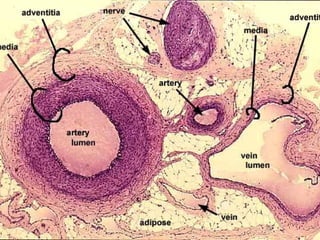
Arteries
• Carry blood away from
the heart.
• Under higher pressure
– smaller tubes.
• Carry oxygenated
blood.
• Surrounded by smooth
muscle.
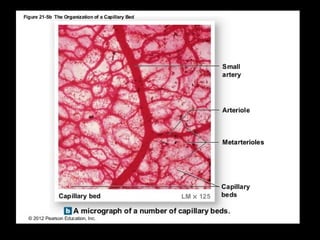
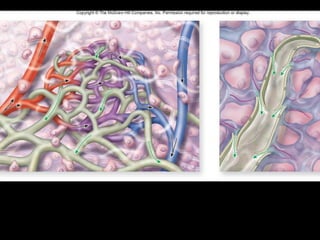
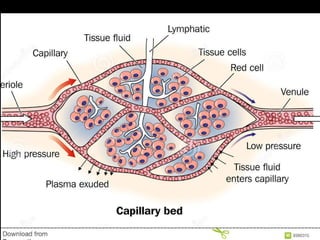
Capillaries
• Tiny tubes
• Run close to every cell in yer body.
• Blood cells have to travel in single file.
• Capillary walls are so thin that oxygen,
CO2 and nutrients can pass through them.
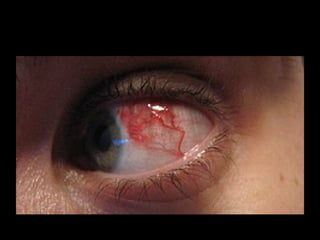
• What’s a bruise?
Veins
• Carry blood back to the heart.
• Blood is deoxygenated- it’s carrying CO2
• Lower pressure – larger tubes.
• Veins have one-way valves.
• Contracting muscle squeezes veins,
forcing blood back to heart.
Parts of your blood:
• Red Blood Cells (RBCs)
• White Blood Cells (WBCs)
• Platelets
• Plasma
RBCs (Red Blood Cells)
• RBCs carry oxygen (O2) AND carbon dioxide
(CO2)
• Each RBC has a protein called hemoglobin,
which binds to the O2 or CO2
• Hemoglobin needs iron to work. If you don’t eat
food with enough iron, you could get dizzy or
faint.
RED BLOOD CELLS
Unlike most other cells in the body, red blood cells
have no nuclei. Lacking this large internal structure,
each red blood cell has more room to carry the
oxygen the body needs. But without a nucleus, the
cells cannot divide or synthesize new cellular
components.
After circulating within the body for about 120 days,
a red blood cell will die from aging or damage. But
don't worry — your red bone marrow constantly
manufactures new red blood cells to replace those
that perish - at the rate of 2 million per second!
WBCs (White Blood Cells)
• WBCs kill viruses and bacteria
• Pathogens – bacteria, viruses, or other
microscopic particles that make you sick.
• If pathogens enter the body, WBCs will engulf
(swallow) and digest them.
• Other WBCs release Antibodies – tags that
stick to pathogens. CLICK HERE TO SEE
Platelets
• Platelets – tiny particles that clot your blood.
This requires a multi step chemical process,
called a cascade.
• If an artery or capillary or vein is broken or
damaged, platelets clump together in the
damaged area, forming a plug that helps save
blood from leaking out.
• Clotting: platelets also release chemicals that
react with proteins in the plasma, starting a
chemical reaction that causes tiny fibers to form
a “net” that stops the bleeding.
Plasma
• Plasma – the fluid part of the blood.
• Consists of water, minerals, nutrients, sugars,
proteins and more!
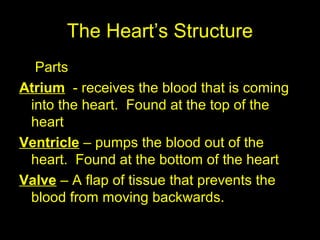
The Heart’s Structure
Parts
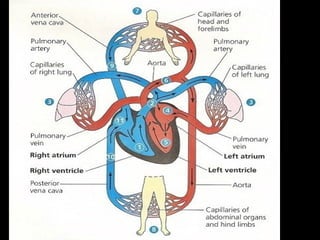
Atrium - receives the blood that is coming
into the heart. Found at the top of the
heart
Ventricle – pumps the blood out of the
heart. Found at the bottom of the heart
Valve – A flap of tissue that prevents the
blood from moving backwards.
How the heart works
First Phase – The heart muscles relax,
blood fills the heart
Second Phase – the heart muscles contract,
the blood is pumped out of the heart
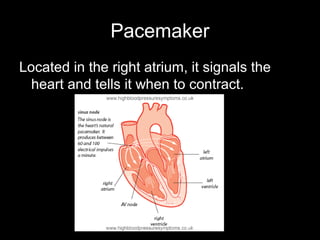
Pacemaker
Located in the right atrium, it signals the
heart and tells it when to contract.
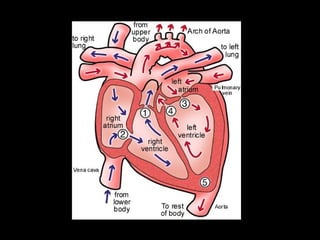
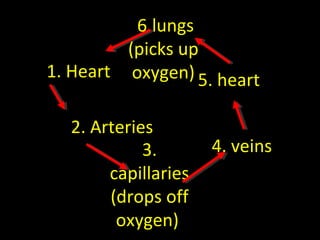
1. Heart
2. Arteries
3.
capillaries
(drops off
oxygen)
4. veins
5. heart
6.lungs
(picks up
oxygen)
Circulation Systems
Pulmonary Circulation
From the heart to the
lungs and back to the
heart
Picks up oxygen, drops
off carbon dioxide
Systemic Circulation
From the heart to the
body and back to the
heart
Drops off oxygen and
picks UP carbon
dioxide
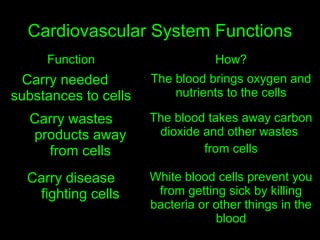
Cardiovascular System Functions
Function How?
Carry needed
substances to cells
The blood brings oxygen and
nutrients to the cells
Carry wastes
products away
from cells
The blood takes away carbon
dioxide and other wastes
from cells
Carry disease
fighting cells
White blood cells prevent you
from getting sick by killing
bacteria or other things in the
blood
Fun Fact – you’ve got a lot of blood
tubes!
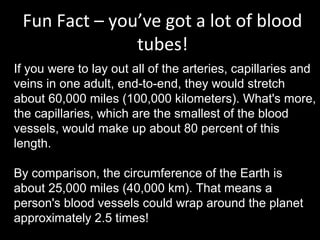
If you were to lay out all of the arteries, capillaries and
veins in one adult, end-to-end, they would stretch
about 60,000 miles (100,000 kilometers). What's more,
the capillaries, which are the smallest of the blood
vessels, would make up about 80 percent of this
length.
By comparison, the circumference of the Earth is
about 25,000 miles (40,000 km). That means a
person's blood vessels could wrap around the planet
approximately 2.5 times!
Fun Fact – the bigger the slower
Across the animal kingdom, heart rate is inversely related to
body size: In general, the bigger the animal, the slower its resting
heart rate.
An adult human has an average resting heart rate of about 75
beats per minute, the same rate as an adult sheep.
But a blue whale's heart is about the size of a compact car, and
only beats five times per minute. A shrew, on the other hand, has
a heart rate of about 1,000 beats per minute. Hummingbirds
have a heart rate of 1,260 beats per minute, but their hearts slow
to 50 beats per minute at night when they enter a hibernation
state known as torpor.
Fun Fact – your heart doesn’t need
your body to beat!
The heart actually can still beat after
being removed from the body.
This eerie pulsing occurs because the
heart generates its own electrical
impulses, which cause it to beat. As long
as the heart continues to receive oxygen,
it will keep going, even if separated from
the rest of the body.
Not so Fun Fact – you can have a
“broken heart.”
A condition called stress cardiomyopathy entails a
sudden, temporary weakening of the muscle of the
heart (the myocardium). This results in symptoms
akin to those of a heart attack, including chest pain,
shortness of breath and arm aches.
The condition is also commonly known as "broken
heart syndrome" because it can be caused by an
emotionally stressful event, such as the death of a
loved one or a divorce, breakup or physical
separation from a loved one.

Cardiovascular system notes

  • 1.
    Cardiovascular System Notes Allstudents: Copy yellow text Honors students copy green text also.
  • 7.
  • 8.
    Arteries • Carry bloodaway from the heart. • Under higher pressure – smaller tubes. • Carry oxygenated blood. • Surrounded by smooth muscle.
  • 10.
    Capillaries • Tiny tubes •Run close to every cell in yer body. • Blood cells have to travel in single file. • Capillary walls are so thin that oxygen, CO2 and nutrients can pass through them. • What’s a bruise?
  • 15.
    Veins • Carry bloodback to the heart. • Blood is deoxygenated- it’s carrying CO2 • Lower pressure – larger tubes. • Veins have one-way valves. • Contracting muscle squeezes veins, forcing blood back to heart.
  • 16.
    Parts of yourblood: • Red Blood Cells (RBCs) • White Blood Cells (WBCs) • Platelets • Plasma
  • 17.
    RBCs (Red BloodCells) • RBCs carry oxygen (O2) AND carbon dioxide (CO2) • Each RBC has a protein called hemoglobin, which binds to the O2 or CO2 • Hemoglobin needs iron to work. If you don’t eat food with enough iron, you could get dizzy or faint.
  • 18.
    RED BLOOD CELLS Unlikemost other cells in the body, red blood cells have no nuclei. Lacking this large internal structure, each red blood cell has more room to carry the oxygen the body needs. But without a nucleus, the cells cannot divide or synthesize new cellular components. After circulating within the body for about 120 days, a red blood cell will die from aging or damage. But don't worry — your red bone marrow constantly manufactures new red blood cells to replace those that perish - at the rate of 2 million per second!
  • 19.
    WBCs (White BloodCells) • WBCs kill viruses and bacteria • Pathogens – bacteria, viruses, or other microscopic particles that make you sick. • If pathogens enter the body, WBCs will engulf (swallow) and digest them. • Other WBCs release Antibodies – tags that stick to pathogens. CLICK HERE TO SEE
  • 20.
    Platelets • Platelets –tiny particles that clot your blood. This requires a multi step chemical process, called a cascade. • If an artery or capillary or vein is broken or damaged, platelets clump together in the damaged area, forming a plug that helps save blood from leaking out. • Clotting: platelets also release chemicals that react with proteins in the plasma, starting a chemical reaction that causes tiny fibers to form a “net” that stops the bleeding.
  • 21.
    Plasma • Plasma –the fluid part of the blood. • Consists of water, minerals, nutrients, sugars, proteins and more!
  • 22.
    The Heart’s Structure Parts Atrium- receives the blood that is coming into the heart. Found at the top of the heart Ventricle – pumps the blood out of the heart. Found at the bottom of the heart Valve – A flap of tissue that prevents the blood from moving backwards.
  • 23.
    How the heartworks First Phase – The heart muscles relax, blood fills the heart Second Phase – the heart muscles contract, the blood is pumped out of the heart
  • 24.
    Pacemaker Located in theright atrium, it signals the heart and tells it when to contract.
  • 27.
    1. Heart 2. Arteries 3. capillaries (dropsoff oxygen) 4. veins 5. heart 6.lungs (picks up oxygen)
  • 28.
    Circulation Systems Pulmonary Circulation Fromthe heart to the lungs and back to the heart Picks up oxygen, drops off carbon dioxide Systemic Circulation From the heart to the body and back to the heart Drops off oxygen and picks UP carbon dioxide
  • 29.
    Cardiovascular System Functions FunctionHow? Carry needed substances to cells The blood brings oxygen and nutrients to the cells Carry wastes products away from cells The blood takes away carbon dioxide and other wastes from cells Carry disease fighting cells White blood cells prevent you from getting sick by killing bacteria or other things in the blood
  • 30.
    Fun Fact –you’ve got a lot of blood tubes! If you were to lay out all of the arteries, capillaries and veins in one adult, end-to-end, they would stretch about 60,000 miles (100,000 kilometers). What's more, the capillaries, which are the smallest of the blood vessels, would make up about 80 percent of this length. By comparison, the circumference of the Earth is about 25,000 miles (40,000 km). That means a person's blood vessels could wrap around the planet approximately 2.5 times!
  • 31.
    Fun Fact –the bigger the slower Across the animal kingdom, heart rate is inversely related to body size: In general, the bigger the animal, the slower its resting heart rate. An adult human has an average resting heart rate of about 75 beats per minute, the same rate as an adult sheep. But a blue whale's heart is about the size of a compact car, and only beats five times per minute. A shrew, on the other hand, has a heart rate of about 1,000 beats per minute. Hummingbirds have a heart rate of 1,260 beats per minute, but their hearts slow to 50 beats per minute at night when they enter a hibernation state known as torpor.
  • 32.
    Fun Fact –your heart doesn’t need your body to beat! The heart actually can still beat after being removed from the body. This eerie pulsing occurs because the heart generates its own electrical impulses, which cause it to beat. As long as the heart continues to receive oxygen, it will keep going, even if separated from the rest of the body.
  • 33.
    Not so FunFact – you can have a “broken heart.” A condition called stress cardiomyopathy entails a sudden, temporary weakening of the muscle of the heart (the myocardium). This results in symptoms akin to those of a heart attack, including chest pain, shortness of breath and arm aches. The condition is also commonly known as "broken heart syndrome" because it can be caused by an emotionally stressful event, such as the death of a loved one or a divorce, breakup or physical separation from a loved one.

Editor's Notes

  • #8 Good question for evolution: How did this system evolve? Which evolved first? The heart – but what would it pump if there wasn’t any blood? The blood – how would it get around if there wasn’t a heart to pump it or tubes to carry it? The blood vessels – why would blood vessels evolve without blood? The whole system has to be in place – all working together. Take out one piece and doesn’t work.