Introduction to Bacteria
USDA NIFSI Food Safety in the Classroom©
University of Tennessee, Knoxville 2006
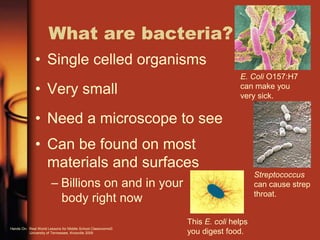
What are bacteria?
• Single celled organisms
• Very small
• Need a microscope to see
• Can be found on most
materials and surfaces
– Billions on and in your
body right now
E. Coli O157:H7
can make you
very sick.
Streptococcus
can cause strep
throat.
This E. coli helps
you digest food.
Hands On: Real World Lessons for Middle School Classrooms©
University of Tennessee, Knoxville 2009
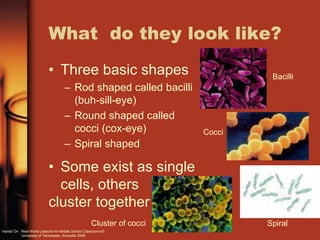
What do they look like?
• Three basic shapes
– Rod shaped called bacilli
(buh-sill-eye)
– Round shaped called
cocci (cox-eye)
– Spiral shaped
• Some exist as single
cells, others
cluster together
Bacilli
Spiral
Cocci
Cluster of cocci
Hands On: Real World Lessons for Middle School Classrooms©
University of Tennessee, Knoxville 2009
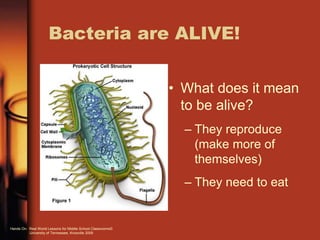
Bacteria are ALIVE!
• What does it mean
to be alive?
– They reproduce
(make more of
themselves)
– They need to eat
Hands On: Real World Lessons for Middle School Classrooms©
University of Tennessee, Knoxville 2009
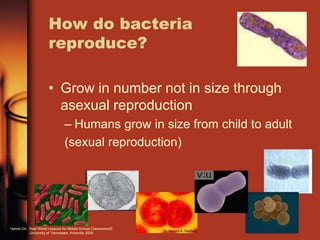
How do bacteria
reproduce?
• Grow in number not in size through
asexual reproduction
– Humans grow in size from child to adult
(sexual reproduction)
Hands On: Real World Lessons for Middle School Classrooms©
University of Tennessee, Knoxville 2009
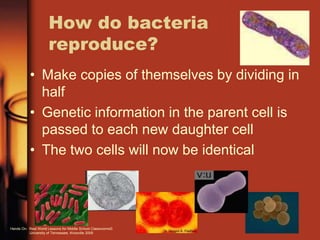
• Make copies of themselves by dividing in
half
• Genetic information in the parent cell is
passed to each new daughter cell
• The two cells will now be identical
How do bacteria
reproduce?
Hands On: Real World Lessons for Middle School Classrooms©
University of Tennessee, Knoxville 2009
How do bacteria eat?
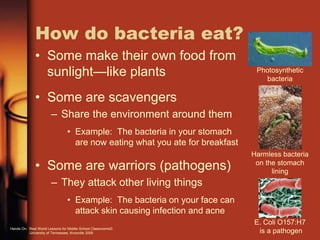
• Some make their own food from
sunlight—like plants
• Some are scavengers
– Share the environment around them
• Example: The bacteria in your stomach
are now eating what you ate for breakfast
• Some are warriors (pathogens)
– They attack other living things
• Example: The bacteria on your face can
attack skin causing infection and acne
Photosynthetic
bacteria
Harmless bacteria
on the stomach
lining
E. Coli O157:H7
is a pathogenHands On: Real World Lessons for Middle School Classrooms©
University of Tennessee, Knoxville 2009
What is a pathogen?
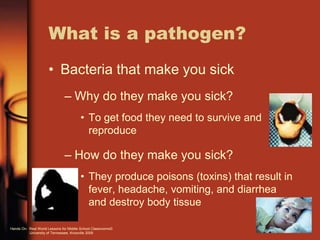
• Bacteria that make you sick
– Why do they make you sick?
• To get food they need to survive and
reproduce
– How do they make you sick?
• They produce poisons (toxins) that result in
fever, headache, vomiting, and diarrhea
and destroy body tissue
Hands On: Real World Lessons for Middle School Classrooms©
University of Tennessee, Knoxville 2009
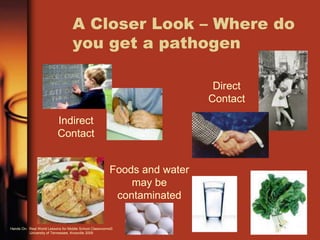
Where do you get a
pathogen?
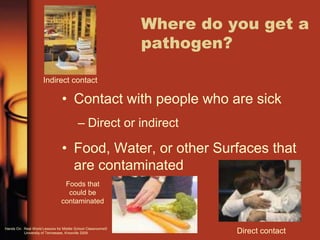
• Contact with people who are sick
– Direct or indirect
• Food, Water, or other Surfaces that
are contaminated
Indirect contact
Direct contact
Foods that
could be
contaminated
Hands On: Real World Lessons for Middle School Classrooms©
University of Tennessee, Knoxville 2009
A Closer Look – Where do
you get a pathogen
Indirect
Contact
Direct
Contact
Foods and water
may be
contaminated
Hands On: Real World Lessons for Middle School Classrooms©
University of Tennessee, Knoxville 2009
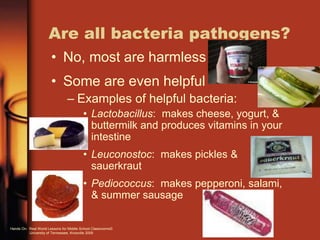
Are all bacteria pathogens?
• No, most are harmless
• Some are even helpful
– Examples of helpful bacteria:
• Lactobacillus: makes cheese, yogurt, &
buttermilk and produces vitamins in your
intestine
• Leuconostoc: makes pickles &
sauerkraut
• Pediococcus: makes pepperoni, salami,
& summer sausage
Hands On: Real World Lessons for Middle School Classrooms©
University of Tennessee, Knoxville 2009
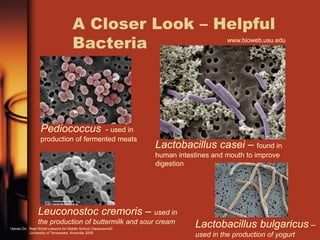
A Closer Look – Helpful
Bacteria
Pediococcus - used in
production of fermented meats
Leuconostoc cremoris – used in
the production of buttermilk and sour cream
Lactobacillus casei – found in
human intestines and mouth to improve
digestion
Lactobacillus bulgaricus –
used in the production of yogurt
www.bioweb.usu.edu
Hands On: Real World Lessons for Middle School Classrooms©
University of Tennessee, Knoxville 2009
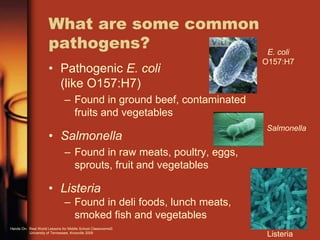
What are some common
pathogens?
• Pathogenic E. coli
(like O157:H7)
– Found in ground beef, contaminated
fruits and vegetables
• Salmonella
– Found in raw meats, poultry, eggs,
sprouts, fruit and vegetables
• Listeria
– Found in deli foods, lunch meats,
smoked fish and vegetables
E. coli
O157:H7
Salmonella
Listeria
Hands On: Real World Lessons for Middle School Classrooms©
University of Tennessee, Knoxville 2009
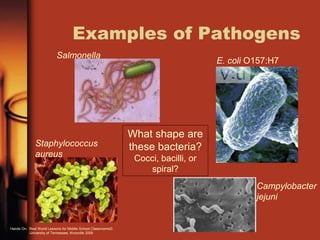
Examples of Pathogens
Salmonella
Staphylococcus
aureus
Campylobacter
jejuni
E. coli O157:H7
What shape are
these bacteria?
Cocci, bacilli, or
spiral?
Hands On: Real World Lessons for Middle School Classrooms©
University of Tennessee, Knoxville 2009
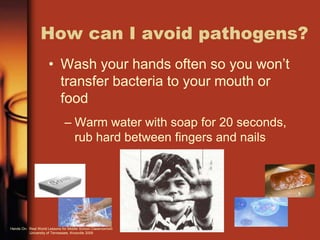
How can I avoid pathogens?
• Wash your hands often so you won’t
transfer bacteria to your mouth or
food
– Warm water with soap for 20 seconds,
rub hard between fingers and nails
Hands On: Real World Lessons for Middle School Classrooms©
University of Tennessee, Knoxville 2009
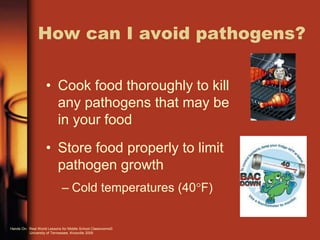
• Cook food thoroughly to kill
any pathogens that may be
in your food
• Store food properly to limit
pathogen growth
– Cold temperatures (40F)
How can I avoid pathogens?
Hands On: Real World Lessons for Middle School Classrooms©
University of Tennessee, Knoxville 2009
Review
• Bacteria are living organisms
• Most are harmless
• A few are pathogens that make
you sick
• You can reduce the risk of
getting sick by washing your
hands and handling food
properly.
Hands On: Real World Lessons for Middle School Classrooms©
University of Tennessee, Knoxville 2009

Introduction to bacteria

  • 1.
    Introduction to Bacteria USDANIFSI Food Safety in the Classroom© University of Tennessee, Knoxville 2006
  • 2.
    What are bacteria? •Single celled organisms • Very small • Need a microscope to see • Can be found on most materials and surfaces – Billions on and in your body right now E. Coli O157:H7 can make you very sick. Streptococcus can cause strep throat. This E. coli helps you digest food. Hands On: Real World Lessons for Middle School Classrooms© University of Tennessee, Knoxville 2009
  • 3.
    What do theylook like? • Three basic shapes – Rod shaped called bacilli (buh-sill-eye) – Round shaped called cocci (cox-eye) – Spiral shaped • Some exist as single cells, others cluster together Bacilli Spiral Cocci Cluster of cocci Hands On: Real World Lessons for Middle School Classrooms© University of Tennessee, Knoxville 2009
  • 4.
    Bacteria are ALIVE! •What does it mean to be alive? – They reproduce (make more of themselves) – They need to eat Hands On: Real World Lessons for Middle School Classrooms© University of Tennessee, Knoxville 2009
  • 5.
    How do bacteria reproduce? •Grow in number not in size through asexual reproduction – Humans grow in size from child to adult (sexual reproduction) Hands On: Real World Lessons for Middle School Classrooms© University of Tennessee, Knoxville 2009
  • 6.
    • Make copiesof themselves by dividing in half • Genetic information in the parent cell is passed to each new daughter cell • The two cells will now be identical How do bacteria reproduce? Hands On: Real World Lessons for Middle School Classrooms© University of Tennessee, Knoxville 2009
  • 7.
    How do bacteriaeat? • Some make their own food from sunlight—like plants • Some are scavengers – Share the environment around them • Example: The bacteria in your stomach are now eating what you ate for breakfast • Some are warriors (pathogens) – They attack other living things • Example: The bacteria on your face can attack skin causing infection and acne Photosynthetic bacteria Harmless bacteria on the stomach lining E. Coli O157:H7 is a pathogenHands On: Real World Lessons for Middle School Classrooms© University of Tennessee, Knoxville 2009
  • 8.
    What is apathogen? • Bacteria that make you sick – Why do they make you sick? • To get food they need to survive and reproduce – How do they make you sick? • They produce poisons (toxins) that result in fever, headache, vomiting, and diarrhea and destroy body tissue Hands On: Real World Lessons for Middle School Classrooms© University of Tennessee, Knoxville 2009
  • 9.
    Where do youget a pathogen? • Contact with people who are sick – Direct or indirect • Food, Water, or other Surfaces that are contaminated Indirect contact Direct contact Foods that could be contaminated Hands On: Real World Lessons for Middle School Classrooms© University of Tennessee, Knoxville 2009
  • 10.
    A Closer Look– Where do you get a pathogen Indirect Contact Direct Contact Foods and water may be contaminated Hands On: Real World Lessons for Middle School Classrooms© University of Tennessee, Knoxville 2009
  • 11.
    Are all bacteriapathogens? • No, most are harmless • Some are even helpful – Examples of helpful bacteria: • Lactobacillus: makes cheese, yogurt, & buttermilk and produces vitamins in your intestine • Leuconostoc: makes pickles & sauerkraut • Pediococcus: makes pepperoni, salami, & summer sausage Hands On: Real World Lessons for Middle School Classrooms© University of Tennessee, Knoxville 2009
  • 12.
    A Closer Look– Helpful Bacteria Pediococcus - used in production of fermented meats Leuconostoc cremoris – used in the production of buttermilk and sour cream Lactobacillus casei – found in human intestines and mouth to improve digestion Lactobacillus bulgaricus – used in the production of yogurt www.bioweb.usu.edu Hands On: Real World Lessons for Middle School Classrooms© University of Tennessee, Knoxville 2009
  • 13.
    What are somecommon pathogens? • Pathogenic E. coli (like O157:H7) – Found in ground beef, contaminated fruits and vegetables • Salmonella – Found in raw meats, poultry, eggs, sprouts, fruit and vegetables • Listeria – Found in deli foods, lunch meats, smoked fish and vegetables E. coli O157:H7 Salmonella Listeria Hands On: Real World Lessons for Middle School Classrooms© University of Tennessee, Knoxville 2009
  • 14.
    Examples of Pathogens Salmonella Staphylococcus aureus Campylobacter jejuni E.coli O157:H7 What shape are these bacteria? Cocci, bacilli, or spiral? Hands On: Real World Lessons for Middle School Classrooms© University of Tennessee, Knoxville 2009
  • 15.
    How can Iavoid pathogens? • Wash your hands often so you won’t transfer bacteria to your mouth or food – Warm water with soap for 20 seconds, rub hard between fingers and nails Hands On: Real World Lessons for Middle School Classrooms© University of Tennessee, Knoxville 2009
  • 16.
    • Cook foodthoroughly to kill any pathogens that may be in your food • Store food properly to limit pathogen growth – Cold temperatures (40F) How can I avoid pathogens? Hands On: Real World Lessons for Middle School Classrooms© University of Tennessee, Knoxville 2009
  • 17.
    Review • Bacteria areliving organisms • Most are harmless • A few are pathogens that make you sick • You can reduce the risk of getting sick by washing your hands and handling food properly. Hands On: Real World Lessons for Middle School Classrooms© University of Tennessee, Knoxville 2009