@EducateCareers
What is a scientist?
If you’re interested in science there are lots of
jobs out there for you. Here you’ll be
presented with 10 science related jobs and
you must decide whether the job is real or
fake.
@EducateCareers
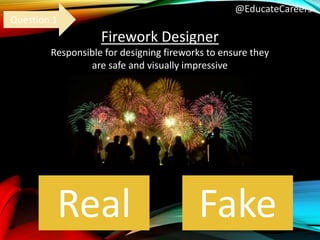
Firework Designer
Responsible for designing fireworks to ensure they
are safe and visually impressive
Real Fake
Question 1
@EducateCareers
Firework Designer
Responsible for designing fireworks to ensure they
are safe and visually impressive
Real
Question 1
A firework designer must have
a good understanding of
explosives.
@EducateCareers
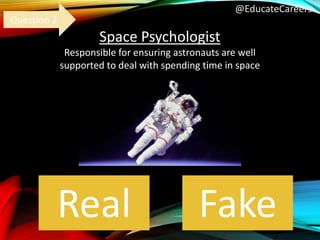
Space Psychologist
Responsible for ensuring astronauts are well
supported to deal with spending time in space
Real Fake
Question 2
@EducateCareers
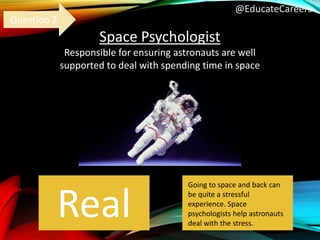
Space Psychologist
Responsible for ensuring astronauts are well
supported to deal with spending time in space
Real
Question 2
Going to space and back can
be quite a stressful
experience. Space
psychologists help astronauts
deal with the stress.
@EducateCareers
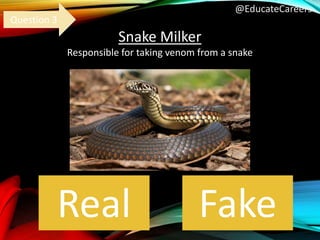
Snake Milker
Responsible for taking venom from a snake
Real Fake
Question 3
@EducateCareers
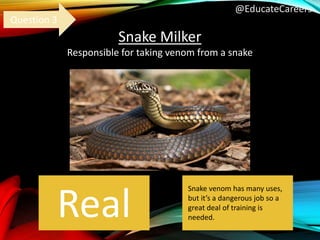
Snake Milker
Responsible for taking venom from a snake
Real
Question 3
Snake venom has many uses,
but it’s a dangerous job so a
great deal of training is
needed.
@EducateCareers
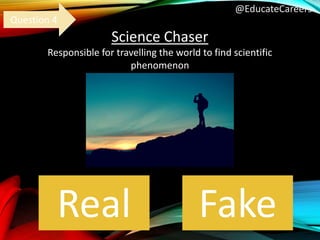
Science Chaser
Responsible for travelling the world to find scientific
phenomenon
Real Fake
Question 4
@EducateCareers
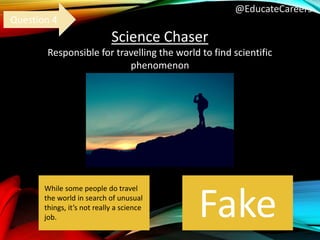
Science Chaser
Responsible for travelling the world to find scientific
phenomenon
Fake
Question 4
While some people do travel
the world in search of unusual
things, it’s not really a science
job.
@EducateCareers
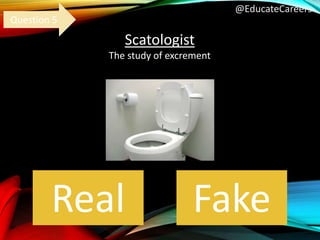
Scatologist
The study of excrement
Real Fake
Question 5
@EducateCareers
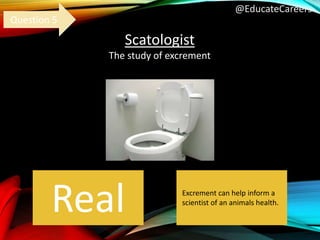
Scatologist
The study of excrement
Real
Question 5
Excrement can help inform a
scientist of an animals health.
@EducateCareers
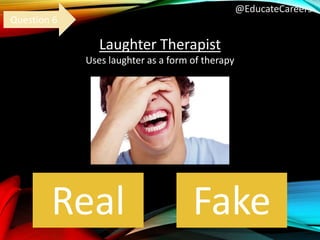
Laughter Therapist
Uses laughter as a form of therapy
Real Fake
Question 6
@EducateCareers
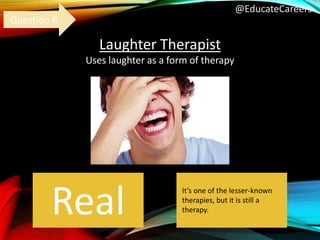
Laughter Therapist
Uses laughter as a form of therapy
Real
Question 6
It’s one of the lesser-known
therapies, but it is still a
therapy.
@EducateCareers
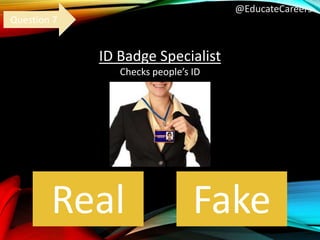
ID Badge Specialist
Checks people’s ID
Real Fake
Question 7
@EducateCareers
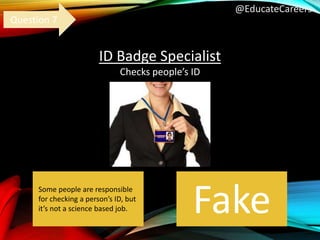
ID Badge Specialist
Checks people’s ID
Fake
Question 7
Some people are responsible
for checking a person’s ID, but
it’s not a science based job.
@EducateCareers
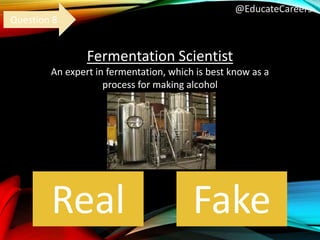
Fermentation Scientist
An expert in fermentation, which is best know as a
process for making alcohol
Real Fake
Question 8
@EducateCareers
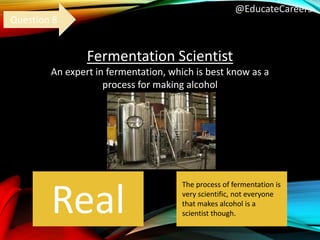
Fermentation Scientist
An expert in fermentation, which is best know as a
process for making alcohol
Real
Question 8
The process of fermentation is
very scientific, not everyone
that makes alcohol is a
scientist though.
@EducateCareers
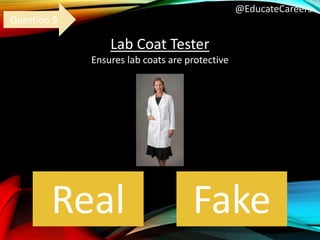
Lab Coat Tester
Ensures lab coats are protective
Real Fake
Question 9
@EducateCareers
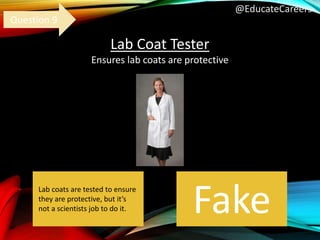
Lab Coat Tester
Ensures lab coats are protective
Fake
Question 9
Lab coats are tested to ensure
they are protective, but it’s
not a scientists job to do it.
@EducateCareers
Scientific TV Consultant
Advises TV shows on what they should do or say
Real Fake
Question 10
@EducateCareers
Scientific TV Consultant
Advises TV shows on what they should do or say
Real
Question 10
Many TV shows have
employed scientists to help
advise them on what they
should say or do to make it
more realistic
@EducateCareers
Nanotechnology engineer
Geospatial analyst
Food science technologist
Photonics engineer
Zoo endocrinologist
Climate change analyst
Forensic anthropologist
Volcanologist
A few other unusual jobs in science…
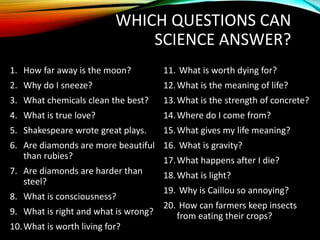
WHICH QUESTIONS CAN
SCIENCE ANSWER?
1. How far away is the moon?
2. Why do I sneeze?
3. What chemicals clean the best?
4. What is true love?
5. Shakespeare wrote great plays.
6. Are diamonds are more beautiful
than rubies?
7. Are diamonds are harder than
steel?
8. What is consciousness?
9. What is right and what is wrong?
10.What is worth living for?
11. What is worth dying for?
12.What is the meaning of life?
13.What is the strength of concrete?
14.Where do I come from?
15.What gives my life meaning?
16. What is gravity?
17.What happens after I die?
18.What is light?
19. Why is Caillou so annoying?
20. How can farmers keep insects
from eating their crops?
ON THE VERY BACK PAGE OF
YOUR NOTEBOOK, WRITE
THIS QUICKSTART:
• Quickstart! 8/21
• Write down some questions science can answer.
• Write down some questions science can’t answer.
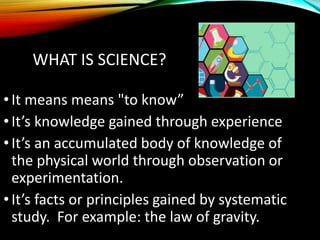
WHAT IS SCIENCE?
•It means means "to know”
•It’s knowledge gained through experience
•It’s an accumulated body of knowledge of
the physical world through observation or
experimentation.
•It’s facts or principles gained by systematic
study. For example: the law of gravity.
•There is order to the universe (if it works here,
then it should work over there).
•The human mind can understand this order.
•If conditions are the same, the results of any
study will be the same. (you should get the
same results if you do the same experiment as
another scientist).
THE ONLY WAY WE CAN DO SCIENCE
IS TO ASSUME THE FOLLOWING:
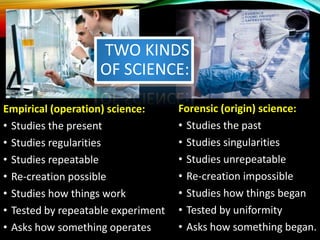
Empirical (operation) science:
• Studies the present
• Studies regularities
• Studies repeatable
• Re-creation possible
• Studies how things work
• Tested by repeatable experiment
• Asks how something operates
Forensic (origin) science:
• Studies the past
• Studies singularities
• Studies unrepeatable
• Re-creation impossible
• Studies how things began
• Tested by uniformity
• Asks how something began.
TWO KINDS
OF SCIENCE:
DIFFERENT QUESTIONS FOR DIFFERENT
SCIENCES:
Empirical (operation) science:
• How does rock erode?
• How does an engine work?
• How does ink adhere to paper?
• How does life function?
• How does the universe operate?
Forensic (origin) science:
• What’s the origin of Grand Canyon?
• What’s the origin of an engine?
• What’s the origin of a book?
• What’s the origin of life?
• What’s the origin of the universe?
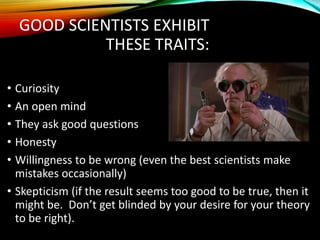
GOOD SCIENTISTS EXHIBIT
THESE TRAITS:
• Curiosity
• An open mind
• They ask good questions
• Honesty
• Willingness to be wrong (even the best scientists make
mistakes occasionally)
• Skepticism (if the result seems too good to be true, then it
might be. Don’t get blinded by your desire for your theory
to be right).
YOUR TIMED EXERCISE:
• Did you feel rushed? (often, scientists work under time
constraints or feel pressure to produce exciting results, so
they can get university or government funding).
• Were some of you were given bad info by other students?
Sometimes this happens with scientists too.
• Did some of you follow the crowd and turn in your paper
early because other “scientists were too? Did you assume
they knew the right answer?

What is Science?

  • 1.
    @EducateCareers What is ascientist? If you’re interested in science there are lots of jobs out there for you. Here you’ll be presented with 10 science related jobs and you must decide whether the job is real or fake.
  • 2.
    @EducateCareers Firework Designer Responsible fordesigning fireworks to ensure they are safe and visually impressive Real Fake Question 1
  • 3.
    @EducateCareers Firework Designer Responsible fordesigning fireworks to ensure they are safe and visually impressive Real Question 1 A firework designer must have a good understanding of explosives.
  • 4.
    @EducateCareers Space Psychologist Responsible forensuring astronauts are well supported to deal with spending time in space Real Fake Question 2
  • 5.
    @EducateCareers Space Psychologist Responsible forensuring astronauts are well supported to deal with spending time in space Real Question 2 Going to space and back can be quite a stressful experience. Space psychologists help astronauts deal with the stress.
  • 6.
    @EducateCareers Snake Milker Responsible fortaking venom from a snake Real Fake Question 3
  • 7.
    @EducateCareers Snake Milker Responsible fortaking venom from a snake Real Question 3 Snake venom has many uses, but it’s a dangerous job so a great deal of training is needed.
  • 8.
    @EducateCareers Science Chaser Responsible fortravelling the world to find scientific phenomenon Real Fake Question 4
  • 9.
    @EducateCareers Science Chaser Responsible fortravelling the world to find scientific phenomenon Fake Question 4 While some people do travel the world in search of unusual things, it’s not really a science job.
  • 10.
    @EducateCareers Scatologist The study ofexcrement Real Fake Question 5
  • 11.
    @EducateCareers Scatologist The study ofexcrement Real Question 5 Excrement can help inform a scientist of an animals health.
  • 12.
    @EducateCareers Laughter Therapist Uses laughteras a form of therapy Real Fake Question 6
  • 13.
    @EducateCareers Laughter Therapist Uses laughteras a form of therapy Real Question 6 It’s one of the lesser-known therapies, but it is still a therapy.
  • 14.
    @EducateCareers ID Badge Specialist Checkspeople’s ID Real Fake Question 7
  • 15.
    @EducateCareers ID Badge Specialist Checkspeople’s ID Fake Question 7 Some people are responsible for checking a person’s ID, but it’s not a science based job.
  • 16.
    @EducateCareers Fermentation Scientist An expertin fermentation, which is best know as a process for making alcohol Real Fake Question 8
  • 17.
    @EducateCareers Fermentation Scientist An expertin fermentation, which is best know as a process for making alcohol Real Question 8 The process of fermentation is very scientific, not everyone that makes alcohol is a scientist though.
  • 18.
    @EducateCareers Lab Coat Tester Ensureslab coats are protective Real Fake Question 9
  • 19.
    @EducateCareers Lab Coat Tester Ensureslab coats are protective Fake Question 9 Lab coats are tested to ensure they are protective, but it’s not a scientists job to do it.
  • 20.
    @EducateCareers Scientific TV Consultant AdvisesTV shows on what they should do or say Real Fake Question 10
  • 21.
    @EducateCareers Scientific TV Consultant AdvisesTV shows on what they should do or say Real Question 10 Many TV shows have employed scientists to help advise them on what they should say or do to make it more realistic
  • 22.
    @EducateCareers Nanotechnology engineer Geospatial analyst Foodscience technologist Photonics engineer Zoo endocrinologist Climate change analyst Forensic anthropologist Volcanologist A few other unusual jobs in science…
  • 23.
    WHICH QUESTIONS CAN SCIENCEANSWER? 1. How far away is the moon? 2. Why do I sneeze? 3. What chemicals clean the best? 4. What is true love? 5. Shakespeare wrote great plays. 6. Are diamonds are more beautiful than rubies? 7. Are diamonds are harder than steel? 8. What is consciousness? 9. What is right and what is wrong? 10.What is worth living for? 11. What is worth dying for? 12.What is the meaning of life? 13.What is the strength of concrete? 14.Where do I come from? 15.What gives my life meaning? 16. What is gravity? 17.What happens after I die? 18.What is light? 19. Why is Caillou so annoying? 20. How can farmers keep insects from eating their crops?
  • 24.
    ON THE VERYBACK PAGE OF YOUR NOTEBOOK, WRITE THIS QUICKSTART: • Quickstart! 8/21 • Write down some questions science can answer. • Write down some questions science can’t answer.
  • 25.
    WHAT IS SCIENCE? •Itmeans means "to know” •It’s knowledge gained through experience •It’s an accumulated body of knowledge of the physical world through observation or experimentation. •It’s facts or principles gained by systematic study. For example: the law of gravity.
  • 26.
    •There is orderto the universe (if it works here, then it should work over there). •The human mind can understand this order. •If conditions are the same, the results of any study will be the same. (you should get the same results if you do the same experiment as another scientist). THE ONLY WAY WE CAN DO SCIENCE IS TO ASSUME THE FOLLOWING:
  • 27.
    Empirical (operation) science: •Studies the present • Studies regularities • Studies repeatable • Re-creation possible • Studies how things work • Tested by repeatable experiment • Asks how something operates Forensic (origin) science: • Studies the past • Studies singularities • Studies unrepeatable • Re-creation impossible • Studies how things began • Tested by uniformity • Asks how something began. TWO KINDS OF SCIENCE:
  • 28.
    DIFFERENT QUESTIONS FORDIFFERENT SCIENCES: Empirical (operation) science: • How does rock erode? • How does an engine work? • How does ink adhere to paper? • How does life function? • How does the universe operate? Forensic (origin) science: • What’s the origin of Grand Canyon? • What’s the origin of an engine? • What’s the origin of a book? • What’s the origin of life? • What’s the origin of the universe?
  • 29.
    GOOD SCIENTISTS EXHIBIT THESETRAITS: • Curiosity • An open mind • They ask good questions • Honesty • Willingness to be wrong (even the best scientists make mistakes occasionally) • Skepticism (if the result seems too good to be true, then it might be. Don’t get blinded by your desire for your theory to be right).
  • 30.
    YOUR TIMED EXERCISE: •Did you feel rushed? (often, scientists work under time constraints or feel pressure to produce exciting results, so they can get university or government funding). • Were some of you were given bad info by other students? Sometimes this happens with scientists too. • Did some of you follow the crowd and turn in your paper early because other “scientists were too? Did you assume they knew the right answer?

Editor's Notes

  • #24 Make laminated cards with these questions – have students separate them on the tables.
  • #29 Make laminated cards with these questions and have kids sort them out on their tables