Cell Division and Genetics – Mechanisms for a Knit of Identity and Thread of Distinction
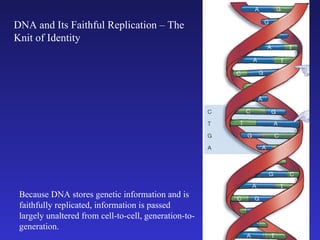
DNA and Its Faithful Replication – The Knit of Identity Because DNA stores genetic information and is faithfully replicated, information is passed largely unaltered from cell-to-cell, generation-to- generation.
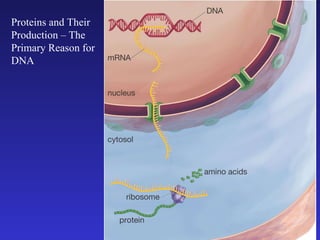
Proteins and Their Production – The Primary Reason for DNA
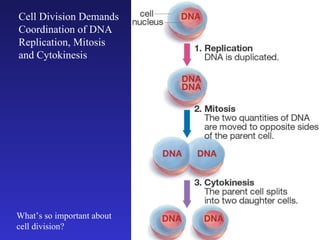
Cell Division Demands Coordination of DNA Replication, Mitosis and Cytokinesis What’s so important about cell division?
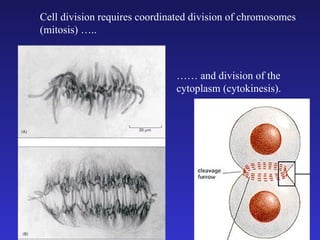
Cell division requires coordinated division of chromosomes (mitosis) ….. ……  and division of the cytoplasm (cytokinesis).
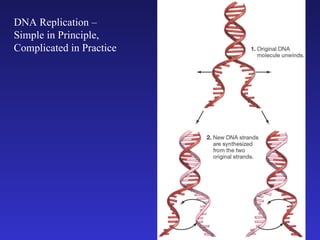
DNA Replication – Simple in Principle, Complicated in Practice
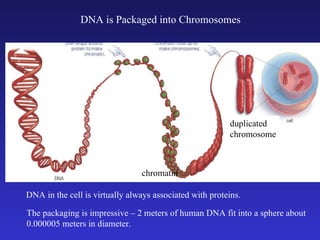
DNA is Packaged into Chromosomes DNA in the cell is virtually always associated with proteins. The packaging is impressive – 2 meters of human DNA fit into a sphere about 0.000005 meters in diameter. chromatin duplicated chromosome
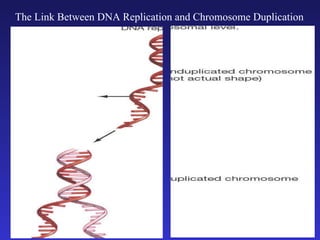
The Link Between DNA Replication and Chromosome Duplication
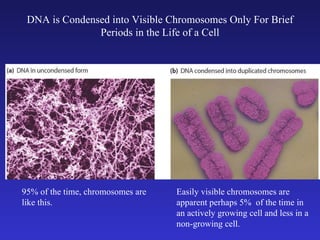
DNA is Condensed into Visible Chromosomes Only For Brief Periods in the Life of a Cell 95% of the time, chromosomes are like this. Easily visible chromosomes are apparent perhaps 5%  of the time in an actively growing cell and less in a non-growing cell.
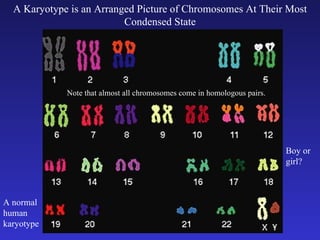
A Karyotype is an Arranged Picture of Chromosomes At Their Most Condensed State A normal human karyotype Boy or girl? Note that almost all chromosomes come in homologous pairs.
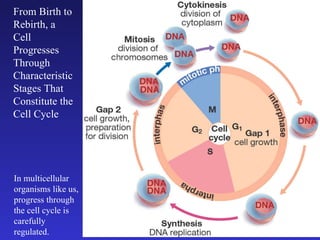
From Birth to Rebirth, a Cell Progresses Through Characteristic Stages That Constitute the Cell Cycle In multicellular organisms like us, progress through the cell cycle is carefully regulated.
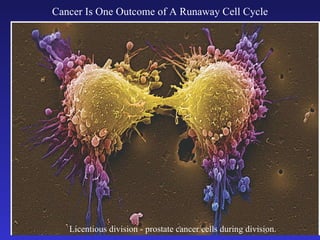
Cancer Is One Outcome of A Runaway Cell Cycle Licentious division - prostate cancer cells during division.
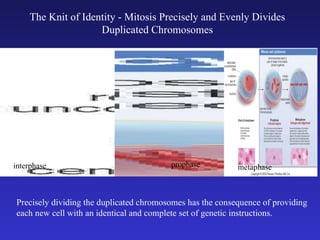
The Knit of Identity - Mitosis Precisely and Evenly Divides Duplicated Chromosomes Precisely dividing the duplicated chromosomes has the consequence of providing each new cell with an identical and complete set of genetic instructions. interphase prophase metaphase
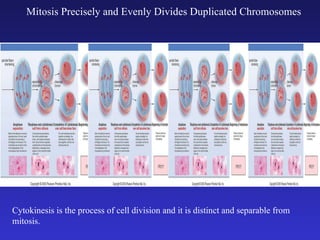
Mitosis Precisely and Evenly Divides Duplicated Chromosomes Cytokinesis is the process of cell division and it is distinct and separable from mitosis.
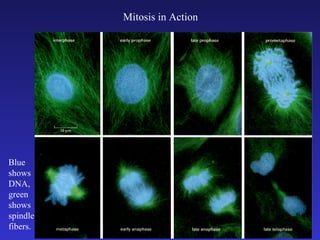
Mitosis in Action Blue shows DNA, green shows spindle fibers.
In Animal Cells, a Cleavage Furrow Forms and Separates Daughter Cells Cleave furrow in a dividing frog cell.
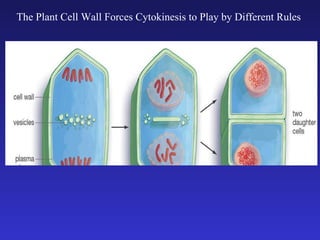
The Plant Cell Wall Forces Cytokinesis to Play by Different Rules
Part 1: Cell Division Cell division is the cornerstone of life Genome : an organisms complete set of genetic material (DNA)
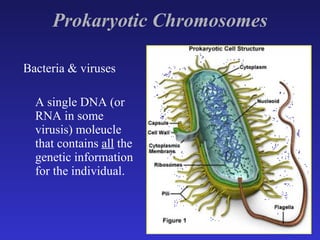
Prokaryotic Chromosomes Bacteria & viruses  A single DNA (or RNA in some virusis) moleucle that contains  all  the genetic information for the individual.
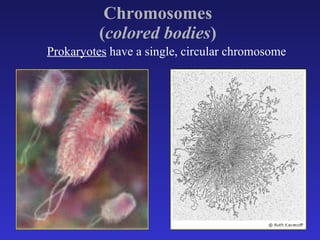
Chromosomes  ( colored bodies )   Prokaryotes  have a single, circular chromosome
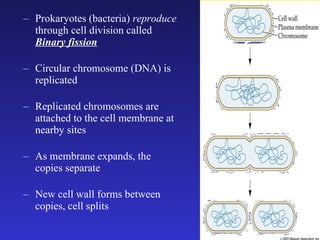
Prokaryotes (bacteria)  reproduce  through cell division called  Binary fission Circular chromosome (DNA) is replicated Replicated chromosomes are attached to the cell membrane at nearby sites As membrane expands, the copies separate New cell wall forms between copies, cell splits
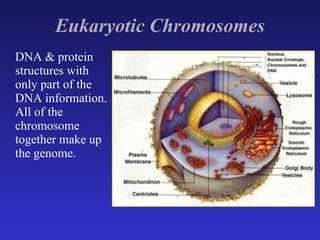
Eukaryotic Chromosomes DNA & protein structures with only part of the DNA information. All of the chromosome together make up the genome.
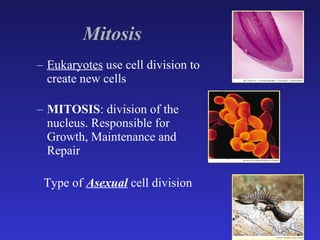
Mitosis   Eukaryotes  use cell division to create new cells  MITOSIS : division of the nucleus. Responsible for Growth, Maintenance and Repair Type of   Asexual   cell division
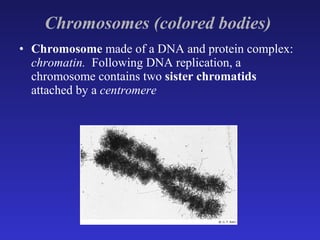
Chromosomes (colored bodies)   Chromosome  made of a DNA and protein complex:  chromatin.  Following DNA replication, a chromosome contains two  sister chromatids  attached by a  centromere
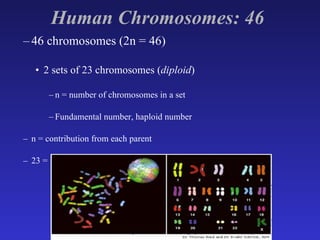
Human Chromosomes: 46   46 chromosomes (2n = 46) 2 sets of 23 chromosomes ( diploid )  n = number of chromosomes in a set Fundamental number, haploid number  n = contribution from each parent 23 = 1  sex chromosome , 22  autosomes
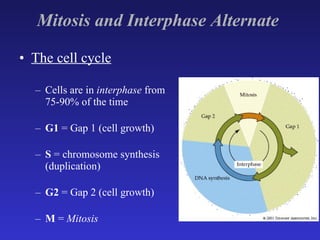
Mitosis and Interphase Alternate   The cell cycle Cells are in  interphase  from 75-90% of the time G1  = Gap 1 (cell growth) S  = chromosome synthesis (duplication) G2  = Gap 2 (cell growth) M  =  Mitosis
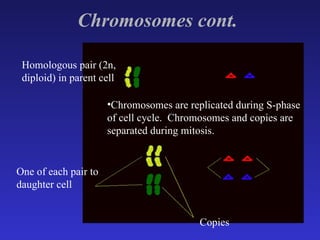
Chromosomes cont.   Homologous pair (2n, diploid) in parent cell Chromosomes are replicated during S-phase of cell cycle.  Chromosomes and copies are separated during mitosis.  One of each pair to  daughter cell Copies
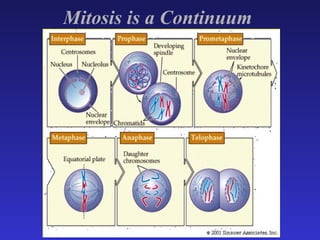
Mitosis is a Continuum
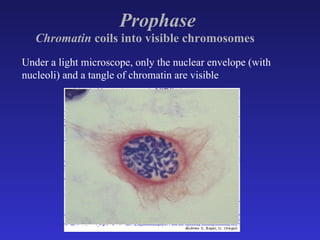
Prophase   Chromatin  coils into visible chromosomes   Under a light microscope, only the nuclear envelope (with nucleoli) and a tangle of chromatin are visible
Pro-metaphase  (late prophase) Nuclear envelope breaks Microtubules  attach centromere to  centrioles
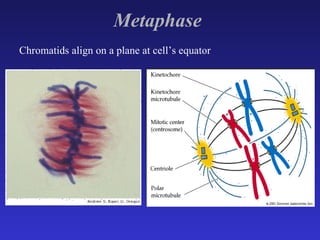
Metaphase   Chromatids align on a plane at cell’s equator
Anaphase  Chromatids separate simultanously Sister chromatids  become  daughter chromosomes
Telophase   Daughter chromosomes stop moving Chromosomes uncoil, nucleus and nucleoli reform resulting in two new, identical cells.
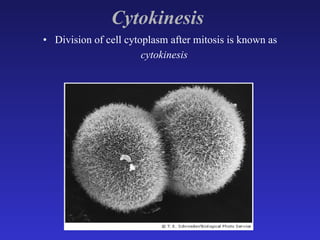
Cytokinesis   Division of cell cytoplasm after mitosis is known as  cytokinesis
Phases of the Cell Cycle The cell cycle consists of Interphase Mitosis Cytokinesis INTERPHASE G 1 S (DNA synthesis) G 2 Cytokinesis Mitosis MITOTIC (M) PHASE Figure 12.5
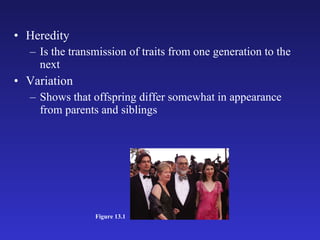
Heredity Is the transmission of traits from one generation to the next Variation Shows that offspring differ somewhat in appearance from parents and siblings Figure 13.1
Genetics Is the scientific study of heredity and hereditary variation Offspring acquire genes from parents by inheriting chromosomes
Inheritance of Genes Genes Are the units of heredity Are segments of DNA
Each gene in an organism’s DNA Has a specific locus (location) on a certain chromosome We inherit One set of chromosomes from our mother and one set from our father
Comparison of Asexual and Sexual Reproduction  In  asexual  reproduction (mitosis) One parent produces genetically identical offspring by mitosis Figure 13.2 Parent Bud 0.5 mm
In  sexual  reproduction Two parents give rise to offspring that have unique combinations of genes inherited from the two parents
Genes are located on  Chromosomes Individuals inherit two sets of genes (chromosome) – one from each parent These “Matching” chromosomes are called  Homologous  chromosomes, because they carry genes for the “same” (homo) traits Have genes for  the same characteristics Are also be called autosomes
Sex  chromosomes Are distinct from each other and carry genes for different triats We all inherit two sex chromosomes, one from each parent represented as X and Y  Determine the sex of the individual XX = female, XY = male
A  diploid  cell (2n) Has two sets of each of its chromosomes Human have 46 chromosomes (2 n  = 46)
We have a “Problem” in sexual reproduction How can we have 46 chromosomes in our cells, combine a cell from a father and a mother, and still have only 46 chromosomes in the offspring’s cells? 46 (father) + 46 (mother) = 46 (offspring) There must be a way to  reduce  the number of chromosomes in the parents to  half  the number (23 for humans)
Behavior of Chromosome Sets in the Human Life Cycle At sexual maturity The ovaries and testes produce special  haploid  (n)  cells by  meiosis The cells are called gametes Gametes , sperm and egg cells are haploid cells, containing only one set of chromosomes In humans, the haploid (n) number is = 23, ½ of our diploid number (2n)
Meiosis reduces the number of chromosome sets from diploid to haploid Meiosis Takes place in two sets of divisions, meiosis I and meiosis II
Meiosis I Reduces the number of chromosomes from diploid to haploid Meiosis II Produces  four  haploid daughter cells
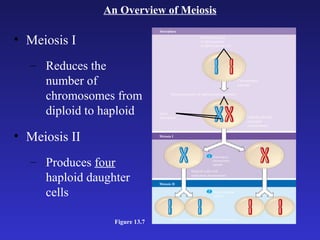
An Overview of Meiosis Meiosis I Reduces the number of chromosomes from diploid to haploid Meiosis II Produces  four  haploid daughter cells Figure 13.7 Interphase Homologous pair of chromosomes in diploid parent cell Chromosomes replicate Homologous pair of replicated chromosomes Sister chromatids Diploid cell with replicated chromosomes 1 2 Homologous chromosomes separate Haploid cells with replicated chromosomes Sister chromatids separate Haploid cells with unreplicated chromosomes Meiosis I Meiosis II
The haploid reproductive cells are the gametes Meiosis only occurs in the sex organs  Males    testes to produce sperm Females    ovaries to produce eggs Gametes are not produced until the individual reaches puberty and special hormones “kick” in and start the process Males    testosterone Females    estrogen & progesterone
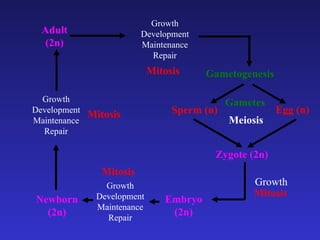
Newborn (2n) Growth Development Maintenance Repair Gametogenesis Adult (2n) Growth Development Maintenance Repair Mitosis Gametes Egg (n) Sperm (n) Meiosis Zygote (2n) Embryo (2n) Mitosis Growth Development Maintenance Repair Mitosis Growth Mitosis
Reshuffling of genetic material in meiosis Produces  genetic variation
Origins of Genetic Variation Among Offspring In species that produce sexually The behavior of chromosomes during meiosis and fertilization is responsible for most of the variation that arises each generation
Independent Assortment of Chromosomes Homologous pairs of chromosomes Orient  randomly  at metaphase I of meiosis
In independent assortment Each pair of chromosomes sorts its maternal and paternal homologues into daughter cells independently of the other pairs Figure 13.10 Key Maternal set of chromosomes Paternal set of chromosomes Possibility 1 Two equally probable  arrangements of chromosomes at metaphase I Possibility 2 Metaphase II Daughter cells Combination 1 Combination 2 Combination 3 Combination 4
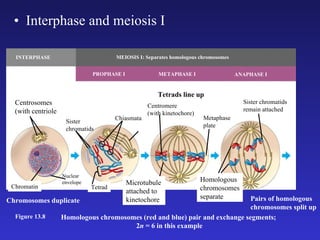
Interphase and meiosis I Figure 13.8 Centrosomes (with centriole  pairs) Sister chromatids Chiasmata Spindle Tetrad Nuclear envelope Chromatin Centromere (with kinetochore) Microtubule attached to kinetochore Tetrads line up Metaphase plate Homologous chromosomes separate Sister chromatids remain attached Pairs of homologous chromosomes split up Chromosomes duplicate Homologous chromosomes (red and blue) pair and exchange segments;  2 n  = 6 in this example INTERPHASE MEIOSIS I: Separates homologous chromosomes PROPHASE I METAPHASE I ANAPHASE I
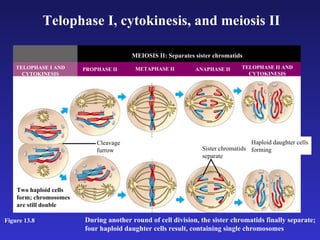
Telophase I, cytokinesis, and meiosis II TELOPHASE I AND CYTOKINESIS PROPHASE II METAPHASE II ANAPHASE II TELOPHASE II AND CYTOKINESIS MEIOSIS II: Separates sister chromatids Cleavage furrow Sister chromatids separate During another round of cell division, the sister chromatids finally separate; four haploid daughter cells result, containing single chromosomes Two haploid cells form; chromosomes are still double Haploid daughter cells forming Figure 13.8
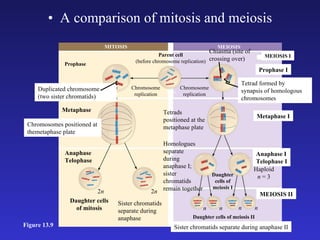
A comparison of mitosis and meiosis Figure 13.9 MITOSIS MEIOSIS Prophase Duplicated chromosome (two sister chromatids) Chromosome replication Chromosome replication Parent cell (before chromosome replication) Chiasma (site of crossing over) Prophase I Tetrad formed by synapsis of homologous chromosomes Metaphase Chromosomes positioned at themetaphase plate Tetrads positioned at the metaphase plate Metaphase I Anaphase I Telophase I Haploid n  = 3 MEIOSIS II Daughter cells of meiosis I Homologues separate during anaphase I; sister chromatids remain together Daughter cells of meiosis II n n n n Sister chromatids separate during anaphase II Anaphase Telophase Sister chromatids separate during anaphase 2 n 2 n Daughter cells of mitosis 2 n  = 6 MEIOSIS I
A Comparison of Mitosis and Meiosis Meiosis and mitosis can be distinguished from mitosis by three events in Meiosis l Crossing over: homologous chromosomes physically connect and exchange genetic information paired  homologous chromosomes (tetrads) are positioned in the middle of the cell At anaphase I of  meiosis , homologous pairs move toward opposite poles of the cell In anaphase II of  meiosis , the sister chromatids separate

Mitosis and cytokinesis

  • 1.
    Cell Division andGenetics – Mechanisms for a Knit of Identity and Thread of Distinction
  • 2.
    DNA and ItsFaithful Replication – The Knit of Identity Because DNA stores genetic information and is faithfully replicated, information is passed largely unaltered from cell-to-cell, generation-to- generation.
  • 3.
    Proteins and TheirProduction – The Primary Reason for DNA
  • 4.
    Cell Division DemandsCoordination of DNA Replication, Mitosis and Cytokinesis What’s so important about cell division?
  • 5.
    Cell division requirescoordinated division of chromosomes (mitosis) ….. …… and division of the cytoplasm (cytokinesis).
  • 6.
    DNA Replication –Simple in Principle, Complicated in Practice
  • 7.
    DNA is Packagedinto Chromosomes DNA in the cell is virtually always associated with proteins. The packaging is impressive – 2 meters of human DNA fit into a sphere about 0.000005 meters in diameter. chromatin duplicated chromosome
  • 8.
    The Link BetweenDNA Replication and Chromosome Duplication
  • 9.
    DNA is Condensedinto Visible Chromosomes Only For Brief Periods in the Life of a Cell 95% of the time, chromosomes are like this. Easily visible chromosomes are apparent perhaps 5% of the time in an actively growing cell and less in a non-growing cell.
  • 10.
    A Karyotype isan Arranged Picture of Chromosomes At Their Most Condensed State A normal human karyotype Boy or girl? Note that almost all chromosomes come in homologous pairs.
  • 11.
    From Birth toRebirth, a Cell Progresses Through Characteristic Stages That Constitute the Cell Cycle In multicellular organisms like us, progress through the cell cycle is carefully regulated.
  • 12.
    Cancer Is OneOutcome of A Runaway Cell Cycle Licentious division - prostate cancer cells during division.
  • 13.
    The Knit ofIdentity - Mitosis Precisely and Evenly Divides Duplicated Chromosomes Precisely dividing the duplicated chromosomes has the consequence of providing each new cell with an identical and complete set of genetic instructions. interphase prophase metaphase
  • 14.
    Mitosis Precisely andEvenly Divides Duplicated Chromosomes Cytokinesis is the process of cell division and it is distinct and separable from mitosis.
  • 15.
    Mitosis in ActionBlue shows DNA, green shows spindle fibers.
  • 16.
    In Animal Cells,a Cleavage Furrow Forms and Separates Daughter Cells Cleave furrow in a dividing frog cell.
  • 17.
    The Plant CellWall Forces Cytokinesis to Play by Different Rules
  • 18.
    Part 1: CellDivision Cell division is the cornerstone of life Genome : an organisms complete set of genetic material (DNA)
  • 19.
    Prokaryotic Chromosomes Bacteria& viruses A single DNA (or RNA in some virusis) moleucle that contains all the genetic information for the individual.
  • 20.
    Chromosomes (colored bodies ) Prokaryotes have a single, circular chromosome
  • 21.
    Prokaryotes (bacteria) reproduce through cell division called Binary fission Circular chromosome (DNA) is replicated Replicated chromosomes are attached to the cell membrane at nearby sites As membrane expands, the copies separate New cell wall forms between copies, cell splits
  • 22.
    Eukaryotic Chromosomes DNA& protein structures with only part of the DNA information. All of the chromosome together make up the genome.
  • 23.
    Mitosis Eukaryotes use cell division to create new cells MITOSIS : division of the nucleus. Responsible for Growth, Maintenance and Repair Type of Asexual cell division
  • 24.
    Chromosomes (colored bodies) Chromosome made of a DNA and protein complex: chromatin. Following DNA replication, a chromosome contains two sister chromatids attached by a centromere
  • 25.
    Human Chromosomes: 46 46 chromosomes (2n = 46) 2 sets of 23 chromosomes ( diploid ) n = number of chromosomes in a set Fundamental number, haploid number n = contribution from each parent 23 = 1 sex chromosome , 22 autosomes
  • 26.
    Mitosis and InterphaseAlternate The cell cycle Cells are in interphase from 75-90% of the time G1 = Gap 1 (cell growth) S = chromosome synthesis (duplication) G2 = Gap 2 (cell growth) M = Mitosis
  • 27.
    Chromosomes cont. Homologous pair (2n, diploid) in parent cell Chromosomes are replicated during S-phase of cell cycle. Chromosomes and copies are separated during mitosis. One of each pair to daughter cell Copies
  • 28.
    Mitosis is aContinuum
  • 29.
    Prophase Chromatin coils into visible chromosomes Under a light microscope, only the nuclear envelope (with nucleoli) and a tangle of chromatin are visible
  • 30.
    Pro-metaphase (lateprophase) Nuclear envelope breaks Microtubules attach centromere to centrioles
  • 31.
    Metaphase Chromatids align on a plane at cell’s equator
  • 32.
    Anaphase Chromatidsseparate simultanously Sister chromatids become daughter chromosomes
  • 33.
    Telophase Daughter chromosomes stop moving Chromosomes uncoil, nucleus and nucleoli reform resulting in two new, identical cells.
  • 34.
    Cytokinesis Division of cell cytoplasm after mitosis is known as cytokinesis
  • 35.
    Phases of theCell Cycle The cell cycle consists of Interphase Mitosis Cytokinesis INTERPHASE G 1 S (DNA synthesis) G 2 Cytokinesis Mitosis MITOTIC (M) PHASE Figure 12.5
  • 36.
    Heredity Is thetransmission of traits from one generation to the next Variation Shows that offspring differ somewhat in appearance from parents and siblings Figure 13.1
  • 37.
    Genetics Is thescientific study of heredity and hereditary variation Offspring acquire genes from parents by inheriting chromosomes
  • 38.
    Inheritance of GenesGenes Are the units of heredity Are segments of DNA
  • 39.
    Each gene inan organism’s DNA Has a specific locus (location) on a certain chromosome We inherit One set of chromosomes from our mother and one set from our father
  • 40.
    Comparison of Asexualand Sexual Reproduction In asexual reproduction (mitosis) One parent produces genetically identical offspring by mitosis Figure 13.2 Parent Bud 0.5 mm
  • 41.
    In sexual reproduction Two parents give rise to offspring that have unique combinations of genes inherited from the two parents
  • 42.
    Genes are locatedon Chromosomes Individuals inherit two sets of genes (chromosome) – one from each parent These “Matching” chromosomes are called Homologous chromosomes, because they carry genes for the “same” (homo) traits Have genes for the same characteristics Are also be called autosomes
  • 43.
    Sex chromosomesAre distinct from each other and carry genes for different triats We all inherit two sex chromosomes, one from each parent represented as X and Y Determine the sex of the individual XX = female, XY = male
  • 44.
    A diploid cell (2n) Has two sets of each of its chromosomes Human have 46 chromosomes (2 n = 46)
  • 45.
    We have a“Problem” in sexual reproduction How can we have 46 chromosomes in our cells, combine a cell from a father and a mother, and still have only 46 chromosomes in the offspring’s cells? 46 (father) + 46 (mother) = 46 (offspring) There must be a way to reduce the number of chromosomes in the parents to half the number (23 for humans)
  • 46.
    Behavior of ChromosomeSets in the Human Life Cycle At sexual maturity The ovaries and testes produce special haploid (n) cells by meiosis The cells are called gametes Gametes , sperm and egg cells are haploid cells, containing only one set of chromosomes In humans, the haploid (n) number is = 23, ½ of our diploid number (2n)
  • 47.
    Meiosis reduces thenumber of chromosome sets from diploid to haploid Meiosis Takes place in two sets of divisions, meiosis I and meiosis II
  • 48.
    Meiosis I Reducesthe number of chromosomes from diploid to haploid Meiosis II Produces four haploid daughter cells
  • 49.
    An Overview ofMeiosis Meiosis I Reduces the number of chromosomes from diploid to haploid Meiosis II Produces four haploid daughter cells Figure 13.7 Interphase Homologous pair of chromosomes in diploid parent cell Chromosomes replicate Homologous pair of replicated chromosomes Sister chromatids Diploid cell with replicated chromosomes 1 2 Homologous chromosomes separate Haploid cells with replicated chromosomes Sister chromatids separate Haploid cells with unreplicated chromosomes Meiosis I Meiosis II
  • 50.
    The haploid reproductivecells are the gametes Meiosis only occurs in the sex organs Males  testes to produce sperm Females  ovaries to produce eggs Gametes are not produced until the individual reaches puberty and special hormones “kick” in and start the process Males  testosterone Females  estrogen & progesterone
  • 51.
    Newborn (2n) GrowthDevelopment Maintenance Repair Gametogenesis Adult (2n) Growth Development Maintenance Repair Mitosis Gametes Egg (n) Sperm (n) Meiosis Zygote (2n) Embryo (2n) Mitosis Growth Development Maintenance Repair Mitosis Growth Mitosis
  • 52.
    Reshuffling of geneticmaterial in meiosis Produces genetic variation
  • 53.
    Origins of GeneticVariation Among Offspring In species that produce sexually The behavior of chromosomes during meiosis and fertilization is responsible for most of the variation that arises each generation
  • 54.
    Independent Assortment ofChromosomes Homologous pairs of chromosomes Orient randomly at metaphase I of meiosis
  • 55.
    In independent assortmentEach pair of chromosomes sorts its maternal and paternal homologues into daughter cells independently of the other pairs Figure 13.10 Key Maternal set of chromosomes Paternal set of chromosomes Possibility 1 Two equally probable arrangements of chromosomes at metaphase I Possibility 2 Metaphase II Daughter cells Combination 1 Combination 2 Combination 3 Combination 4
  • 56.
    Interphase and meiosisI Figure 13.8 Centrosomes (with centriole pairs) Sister chromatids Chiasmata Spindle Tetrad Nuclear envelope Chromatin Centromere (with kinetochore) Microtubule attached to kinetochore Tetrads line up Metaphase plate Homologous chromosomes separate Sister chromatids remain attached Pairs of homologous chromosomes split up Chromosomes duplicate Homologous chromosomes (red and blue) pair and exchange segments; 2 n = 6 in this example INTERPHASE MEIOSIS I: Separates homologous chromosomes PROPHASE I METAPHASE I ANAPHASE I
  • 57.
    Telophase I, cytokinesis,and meiosis II TELOPHASE I AND CYTOKINESIS PROPHASE II METAPHASE II ANAPHASE II TELOPHASE II AND CYTOKINESIS MEIOSIS II: Separates sister chromatids Cleavage furrow Sister chromatids separate During another round of cell division, the sister chromatids finally separate; four haploid daughter cells result, containing single chromosomes Two haploid cells form; chromosomes are still double Haploid daughter cells forming Figure 13.8
  • 58.
    A comparison ofmitosis and meiosis Figure 13.9 MITOSIS MEIOSIS Prophase Duplicated chromosome (two sister chromatids) Chromosome replication Chromosome replication Parent cell (before chromosome replication) Chiasma (site of crossing over) Prophase I Tetrad formed by synapsis of homologous chromosomes Metaphase Chromosomes positioned at themetaphase plate Tetrads positioned at the metaphase plate Metaphase I Anaphase I Telophase I Haploid n = 3 MEIOSIS II Daughter cells of meiosis I Homologues separate during anaphase I; sister chromatids remain together Daughter cells of meiosis II n n n n Sister chromatids separate during anaphase II Anaphase Telophase Sister chromatids separate during anaphase 2 n 2 n Daughter cells of mitosis 2 n = 6 MEIOSIS I
  • 59.
    A Comparison ofMitosis and Meiosis Meiosis and mitosis can be distinguished from mitosis by three events in Meiosis l Crossing over: homologous chromosomes physically connect and exchange genetic information paired homologous chromosomes (tetrads) are positioned in the middle of the cell At anaphase I of meiosis , homologous pairs move toward opposite poles of the cell In anaphase II of meiosis , the sister chromatids separate

Editor's Notes

  • #2 Genes, Mitosis and Cytokinesis 01/19/11 G. Podgorski, Biol. 1010
  • #3 Genes, Mitosis and Cytokinesis 01/19/11 G. Podgorski, Biol. 1010
  • #4 Genes, Mitosis and Cytokinesis 01/19/11 G. Podgorski, Biol. 1010
  • #5 Genes, Mitosis and Cytokinesis 01/19/11 G. Podgorski, Biol. 1010
  • #6 Genes, Mitosis and Cytokinesis 01/19/11 G. Podgorski, Biol. 1010
  • #7 Genes, Mitosis and Cytokinesis 01/19/11 G. Podgorski, Biol. 1010
  • #8 Genes, Mitosis and Cytokinesis 01/19/11 G. Podgorski, Biol. 1010
  • #9 Genes, Mitosis and Cytokinesis 01/19/11 G. Podgorski, Biol. 1010
  • #10 Genes, Mitosis and Cytokinesis 01/19/11 G. Podgorski, Biol. 1010
  • #11 Genes, Mitosis and Cytokinesis 01/19/11 G. Podgorski, Biol. 1010
  • #12 Genes, Mitosis and Cytokinesis 01/19/11 G. Podgorski, Biol. 1010
  • #13 Genes, Mitosis and Cytokinesis 01/19/11 G. Podgorski, Biol. 1010
  • #14 Genes, Mitosis and Cytokinesis 01/19/11 G. Podgorski, Biol. 1010
  • #15 Genes, Mitosis and Cytokinesis 01/19/11 G. Podgorski, Biol. 1010
  • #16 Genes, Mitosis and Cytokinesis 01/19/11 G. Podgorski, Biol. 1010
  • #17 Genes, Mitosis and Cytokinesis 01/19/11 G. Podgorski, Biol. 1010
  • #18 Genes, Mitosis and Cytokinesis 01/19/11 G. Podgorski, Biol. 1010