Cell DivisionCell Division
ChromosomesChromosomes
 Are made of DNAAre made of DNA
 Each chromosome consists of sisterEach chromosome consists of sister
chromatids attached at a centromerechromatids attached at a centromere
Cell CycleCell Cycle
 During the cell cycle, a cell grows,During the cell cycle, a cell grows,
prepares for division, and divides toprepares for division, and divides to
form 2 daughter cells, each of whichform 2 daughter cells, each of which
then begins the cycle again.then begins the cycle again.
 Interphase – time for growth andInterphase – time for growth and
regular cell activity.regular cell activity.
 Most of a cell’s life is spent inMost of a cell’s life is spent in
Interphase.Interphase.
InterphaseInterphase
Introduction to Cell DivisionIntroduction to Cell Division
A time when a cell performs its
usual functions, depending on the
location in the body.
MitosisMitosis
 The division of somatic or regularThe division of somatic or regular
cells.cells.
 Its divided into 4 phases.Its divided into 4 phases.
 Remember Interphase is NOT part ofRemember Interphase is NOT part of
Mitosis.Mitosis.
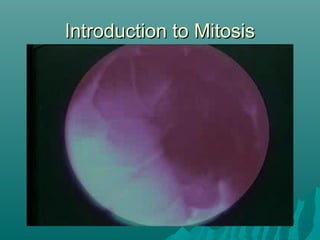
Introduction to MitosisIntroduction to Mitosis
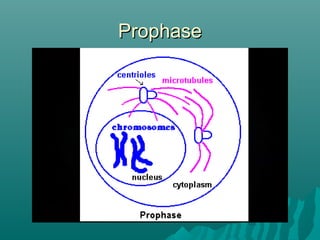
ProphaseProphase
 First stage of MitosisFirst stage of Mitosis
 Chromatin condenses intoChromatin condenses into
chromosomeschromosomes
 Centrioles separate and a spindleCentrioles separate and a spindle
fiber begins to form.fiber begins to form.
 Nuclear membrane breaks downNuclear membrane breaks down
ProphaseProphase
MetaphaseMetaphase
 Second Phase of MitosisSecond Phase of Mitosis
 Chromosomes line up in the middleChromosomes line up in the middle
of the cell.of the cell.
 Each chromosome is connected to aEach chromosome is connected to a
spindle fiber.spindle fiber.
MetaphaseMetaphase
AnaphaseAnaphase
 Third Phase of MitosisThird Phase of Mitosis
 The sister chromatids separate intoThe sister chromatids separate into
individual chromosomes and moveindividual chromosomes and move
apart to opposite ends of the cell.apart to opposite ends of the cell.
AnaphaseAnaphase
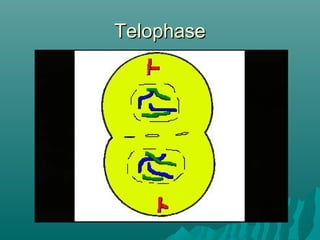
TelophaseTelophase
 Fourth and Final Stage of MitosisFourth and Final Stage of Mitosis
 Chromosomes gather at oppositeChromosomes gather at opposite
ends of the cell and lose their distinctends of the cell and lose their distinct
shapesshapes
 Two new nuclear membranes haveTwo new nuclear membranes have
formed.formed.
TelophaseTelophase
CytokinesisCytokinesis
 The cytoplasm pinches in half.The cytoplasm pinches in half.
 Each daughter cell has an identicalEach daughter cell has an identical
set of duplicate chromosomesset of duplicate chromosomes
Regulating the CycleRegulating the Cycle
 A protein called cyclin helps regulateA protein called cyclin helps regulate
the cell cycle in eukaryotic cells.the cell cycle in eukaryotic cells.
 They respond to internal andThey respond to internal and
external events. These proteins areexternal events. These proteins are
regulators.regulators.
When Things Go WrongWhen Things Go Wrong
 Cancer cells do not respond to theCancer cells do not respond to the
signals that regulate the growth ofsignals that regulate the growth of
most cells.most cells.
 As a result, they form masses of cellsAs a result, they form masses of cells
called tumors that can damagecalled tumors that can damage
surrounding tissues.surrounding tissues.
The Cell Cycle in DepthThe Cell Cycle in Depth
 InterphaseInterphase
 Mitotic StageMitotic Stage
 CytokinesisCytokinesis
 ApoptosisApoptosis
 Cell Cycle and CancerCell Cycle and Cancer
INTERPHASEINTERPHASE
 3 STAGES3 STAGES
– GG11 stagestage
– S StageS Stage
– GG22 StageStage
– Some cells such as nerve and muscleSome cells such as nerve and muscle
cells typically do NOT complete the cellcells typically do NOT complete the cell
cycle and are said to have entered thecycle and are said to have entered the
GG00 stage.stage.
– For adult mammalian cells, interphaseFor adult mammalian cells, interphase
lasts ~20 hours (90% of cell cycle)lasts ~20 hours (90% of cell cycle)
INTERPHASE: GINTERPHASE: G11 stagestage
 Stage BEFORE DNA replicationStage BEFORE DNA replication
 Cell doubles its organelles andCell doubles its organelles and
accumulates materials for DNAaccumulates materials for DNA
synthesissynthesis
 G used to stand for “gap” but now itG used to stand for “gap” but now it
stands for “growth”stands for “growth”
– Protein synthesis is a part of theseProtein synthesis is a part of these
growth stagesgrowth stages
INTERPHASE: S stageINTERPHASE: S stage
 DNA synthesis/replication occursDNA synthesis/replication occurs
– Each chromosome is composed of oneEach chromosome is composed of one
chromatid (DNA double helix) andchromatid (DNA double helix) and
makes 2 sister chromatids (2 identicalmakes 2 sister chromatids (2 identical
DNA double helix molecules)DNA double helix molecules)
INTERPHASE: GINTERPHASE: G22 stagestage
 Stage from the completion of DNAStage from the completion of DNA
replication to the onset of mitosisreplication to the onset of mitosis
– The cell synthesizes protein that willThe cell synthesizes protein that will
assist cell division (i.e. protein found inassist cell division (i.e. protein found in
microtubules)microtubules)
M (Mitotic Stage)M (Mitotic Stage)
 The cell division stage that includesThe cell division stage that includes
mitosis (nuclear division) andmitosis (nuclear division) and
cytokinesis (division of thecytokinesis (division of the
cytoplasm)cytoplasm)
ProphaseProphase
 Nucleolus is disappearingNucleolus is disappearing
 Nuclear envelope is fragmentingNuclear envelope is fragmenting
 Spindle is forming betweenSpindle is forming between
centrosomescentrosomes
 Asters radiate from the centriolesAsters radiate from the centrioles
within the centrosomeswithin the centrosomes
PrometaphasePrometaphase
 Kinetochores of sister chromatidsKinetochores of sister chromatids
attach to kinetochore spindle fibersattach to kinetochore spindle fibers
extending from opposite polesextending from opposite poles
 Chromosomes move back and forthChromosomes move back and forth
until they are aligned at theuntil they are aligned at the
metaphase platemetaphase plate
MetaphaseMetaphase
 Spindle is fully formedSpindle is fully formed
 Duplicated chromosomes align atDuplicated chromosomes align at
metaphase platemetaphase plate
 Spindle consists of polar spindleSpindle consists of polar spindle
fibers that overlap at the metaphasefibers that overlap at the metaphase
plateplate
 Kinetochore spindle fibers that areKinetochore spindle fibers that are
attached to chromosomesattached to chromosomes
Anaphase
 Sister chromatids separate to
become daughter chromosomes that
move toward the poles
 Polar spindle fibers slide past one
another
 Kinetochore spindle fibers
disassemble
 Cytokinesis by furrowing begins
Telophase
 Nuclear envelopes re-form
 Chromosomes begin changing back
to chromatin
 Nucleoli reappear
 Spindle disappears
Plant CellsPlant Cells
 Lack centrioles and astersLack centrioles and asters
 Mitotic spindle still forms and goesMitotic spindle still forms and goes
through the same 5 mitotic phasesthrough the same 5 mitotic phases
CytokinesisCytokinesis
 In animal cells, it’s a furrowingIn animal cells, it’s a furrowing
process that divides the cytoplasmprocess that divides the cytoplasm
 In plant cells, the formation of a cellIn plant cells, the formation of a cell
plate from which the plasmaplate from which the plasma
membrane and cell wall aremembrane and cell wall are
completedcompleted
The Cell Cycle and CancerThe Cell Cycle and Cancer
 Cancer is due to the mutation ofCancer is due to the mutation of
genes that control the cell cyclegenes that control the cell cycle
 Cancer cells are…Cancer cells are…
– Are NondifferentiatedAre Nondifferentiated
– Divide repeatedlyDivide repeatedly
– Have abnormal nucleiHave abnormal nuclei
– Don’t require growth factorsDon’t require growth factors
– Not constrained by their neighborsNot constrained by their neighbors
The Cell Cycle and CancerThe Cell Cycle and Cancer
 After forming a tumor, cancer cellsAfter forming a tumor, cancer cells
metastasize and start new tumorsmetastasize and start new tumors
elsewhere in body.elsewhere in body.
 What you can do to try to preventWhat you can do to try to prevent
cancer…cancer…
– Avoid unnecessary radiationAvoid unnecessary radiation
– Avoid exposure to organic chemicalsAvoid exposure to organic chemicals
(ex: tobacco smoke)(ex: tobacco smoke)
– Have a diet rich in fruits and vegetablesHave a diet rich in fruits and vegetables
Prokaryotic Cell DivisionProkaryotic Cell Division
 Prokaryotic chromosome has a fewProkaryotic chromosome has a few
proteins and a single, long loop of DNAproteins and a single, long loop of DNA
 Binary fission- the chromosome attachesBinary fission- the chromosome attaches
to the inside of the plasma membrane andto the inside of the plasma membrane and
replicates.replicates.
 As cell elongates, the chromosomes areAs cell elongates, the chromosomes are
pulled apartpulled apart
 Inward growth of the plasma membraneInward growth of the plasma membrane
and formation of new cell wall materialand formation of new cell wall material
divide the cell in 2.divide the cell in 2.
Prokaryotic vs. Eukaryotic CellsProkaryotic vs. Eukaryotic Cells
 Binary fission (in prokaryotes) andBinary fission (in prokaryotes) and
mitosis (in cellular eukaryotic protistsmitosis (in cellular eukaryotic protists
and fungi) allow organisms toand fungi) allow organisms to
reproduce asexuallyreproduce asexually
 Mitosis in multicellular eukaryotes isMitosis in multicellular eukaryotes is
primarily for the purpose ofprimarily for the purpose of
development, growth, and repair ofdevelopment, growth, and repair of
tissues.tissues.

Bio celldivision-100106220037-phpapp01

  • 1.
  • 2.
    ChromosomesChromosomes  Are madeof DNAAre made of DNA  Each chromosome consists of sisterEach chromosome consists of sister chromatids attached at a centromerechromatids attached at a centromere
  • 3.
    Cell CycleCell Cycle During the cell cycle, a cell grows,During the cell cycle, a cell grows, prepares for division, and divides toprepares for division, and divides to form 2 daughter cells, each of whichform 2 daughter cells, each of which then begins the cycle again.then begins the cycle again.  Interphase – time for growth andInterphase – time for growth and regular cell activity.regular cell activity.  Most of a cell’s life is spent inMost of a cell’s life is spent in Interphase.Interphase.
  • 4.
  • 5.
    Introduction to CellDivisionIntroduction to Cell Division A time when a cell performs its usual functions, depending on the location in the body.
  • 6.
    MitosisMitosis  The divisionof somatic or regularThe division of somatic or regular cells.cells.  Its divided into 4 phases.Its divided into 4 phases.  Remember Interphase is NOT part ofRemember Interphase is NOT part of Mitosis.Mitosis.
  • 7.
  • 8.
    ProphaseProphase  First stageof MitosisFirst stage of Mitosis  Chromatin condenses intoChromatin condenses into chromosomeschromosomes  Centrioles separate and a spindleCentrioles separate and a spindle fiber begins to form.fiber begins to form.  Nuclear membrane breaks downNuclear membrane breaks down
  • 9.
  • 10.
    MetaphaseMetaphase  Second Phaseof MitosisSecond Phase of Mitosis  Chromosomes line up in the middleChromosomes line up in the middle of the cell.of the cell.  Each chromosome is connected to aEach chromosome is connected to a spindle fiber.spindle fiber.
  • 11.
  • 12.
    AnaphaseAnaphase  Third Phaseof MitosisThird Phase of Mitosis  The sister chromatids separate intoThe sister chromatids separate into individual chromosomes and moveindividual chromosomes and move apart to opposite ends of the cell.apart to opposite ends of the cell.
  • 13.
  • 14.
    TelophaseTelophase  Fourth andFinal Stage of MitosisFourth and Final Stage of Mitosis  Chromosomes gather at oppositeChromosomes gather at opposite ends of the cell and lose their distinctends of the cell and lose their distinct shapesshapes  Two new nuclear membranes haveTwo new nuclear membranes have formed.formed.
  • 15.
  • 16.
    CytokinesisCytokinesis  The cytoplasmpinches in half.The cytoplasm pinches in half.  Each daughter cell has an identicalEach daughter cell has an identical set of duplicate chromosomesset of duplicate chromosomes
  • 17.
    Regulating the CycleRegulatingthe Cycle  A protein called cyclin helps regulateA protein called cyclin helps regulate the cell cycle in eukaryotic cells.the cell cycle in eukaryotic cells.  They respond to internal andThey respond to internal and external events. These proteins areexternal events. These proteins are regulators.regulators.
  • 18.
    When Things GoWrongWhen Things Go Wrong  Cancer cells do not respond to theCancer cells do not respond to the signals that regulate the growth ofsignals that regulate the growth of most cells.most cells.  As a result, they form masses of cellsAs a result, they form masses of cells called tumors that can damagecalled tumors that can damage surrounding tissues.surrounding tissues.
  • 19.
    The Cell Cyclein DepthThe Cell Cycle in Depth  InterphaseInterphase  Mitotic StageMitotic Stage  CytokinesisCytokinesis  ApoptosisApoptosis  Cell Cycle and CancerCell Cycle and Cancer
  • 20.
    INTERPHASEINTERPHASE  3 STAGES3STAGES – GG11 stagestage – S StageS Stage – GG22 StageStage – Some cells such as nerve and muscleSome cells such as nerve and muscle cells typically do NOT complete the cellcells typically do NOT complete the cell cycle and are said to have entered thecycle and are said to have entered the GG00 stage.stage. – For adult mammalian cells, interphaseFor adult mammalian cells, interphase lasts ~20 hours (90% of cell cycle)lasts ~20 hours (90% of cell cycle)
  • 21.
    INTERPHASE: GINTERPHASE: G11stagestage  Stage BEFORE DNA replicationStage BEFORE DNA replication  Cell doubles its organelles andCell doubles its organelles and accumulates materials for DNAaccumulates materials for DNA synthesissynthesis  G used to stand for “gap” but now itG used to stand for “gap” but now it stands for “growth”stands for “growth” – Protein synthesis is a part of theseProtein synthesis is a part of these growth stagesgrowth stages
  • 22.
    INTERPHASE: S stageINTERPHASE:S stage  DNA synthesis/replication occursDNA synthesis/replication occurs – Each chromosome is composed of oneEach chromosome is composed of one chromatid (DNA double helix) andchromatid (DNA double helix) and makes 2 sister chromatids (2 identicalmakes 2 sister chromatids (2 identical DNA double helix molecules)DNA double helix molecules)
  • 23.
    INTERPHASE: GINTERPHASE: G22stagestage  Stage from the completion of DNAStage from the completion of DNA replication to the onset of mitosisreplication to the onset of mitosis – The cell synthesizes protein that willThe cell synthesizes protein that will assist cell division (i.e. protein found inassist cell division (i.e. protein found in microtubules)microtubules)
  • 24.
    M (Mitotic Stage)M(Mitotic Stage)  The cell division stage that includesThe cell division stage that includes mitosis (nuclear division) andmitosis (nuclear division) and cytokinesis (division of thecytokinesis (division of the cytoplasm)cytoplasm)
  • 25.
    ProphaseProphase  Nucleolus isdisappearingNucleolus is disappearing  Nuclear envelope is fragmentingNuclear envelope is fragmenting  Spindle is forming betweenSpindle is forming between centrosomescentrosomes  Asters radiate from the centriolesAsters radiate from the centrioles within the centrosomeswithin the centrosomes
  • 26.
    PrometaphasePrometaphase  Kinetochores ofsister chromatidsKinetochores of sister chromatids attach to kinetochore spindle fibersattach to kinetochore spindle fibers extending from opposite polesextending from opposite poles  Chromosomes move back and forthChromosomes move back and forth until they are aligned at theuntil they are aligned at the metaphase platemetaphase plate
  • 27.
    MetaphaseMetaphase  Spindle isfully formedSpindle is fully formed  Duplicated chromosomes align atDuplicated chromosomes align at metaphase platemetaphase plate  Spindle consists of polar spindleSpindle consists of polar spindle fibers that overlap at the metaphasefibers that overlap at the metaphase plateplate  Kinetochore spindle fibers that areKinetochore spindle fibers that are attached to chromosomesattached to chromosomes
  • 28.
    Anaphase  Sister chromatidsseparate to become daughter chromosomes that move toward the poles  Polar spindle fibers slide past one another  Kinetochore spindle fibers disassemble  Cytokinesis by furrowing begins
  • 29.
    Telophase  Nuclear envelopesre-form  Chromosomes begin changing back to chromatin  Nucleoli reappear  Spindle disappears
  • 30.
    Plant CellsPlant Cells Lack centrioles and astersLack centrioles and asters  Mitotic spindle still forms and goesMitotic spindle still forms and goes through the same 5 mitotic phasesthrough the same 5 mitotic phases
  • 31.
    CytokinesisCytokinesis  In animalcells, it’s a furrowingIn animal cells, it’s a furrowing process that divides the cytoplasmprocess that divides the cytoplasm  In plant cells, the formation of a cellIn plant cells, the formation of a cell plate from which the plasmaplate from which the plasma membrane and cell wall aremembrane and cell wall are completedcompleted
  • 32.
    The Cell Cycleand CancerThe Cell Cycle and Cancer  Cancer is due to the mutation ofCancer is due to the mutation of genes that control the cell cyclegenes that control the cell cycle  Cancer cells are…Cancer cells are… – Are NondifferentiatedAre Nondifferentiated – Divide repeatedlyDivide repeatedly – Have abnormal nucleiHave abnormal nuclei – Don’t require growth factorsDon’t require growth factors – Not constrained by their neighborsNot constrained by their neighbors
  • 33.
    The Cell Cycleand CancerThe Cell Cycle and Cancer  After forming a tumor, cancer cellsAfter forming a tumor, cancer cells metastasize and start new tumorsmetastasize and start new tumors elsewhere in body.elsewhere in body.  What you can do to try to preventWhat you can do to try to prevent cancer…cancer… – Avoid unnecessary radiationAvoid unnecessary radiation – Avoid exposure to organic chemicalsAvoid exposure to organic chemicals (ex: tobacco smoke)(ex: tobacco smoke) – Have a diet rich in fruits and vegetablesHave a diet rich in fruits and vegetables
  • 34.
    Prokaryotic Cell DivisionProkaryoticCell Division  Prokaryotic chromosome has a fewProkaryotic chromosome has a few proteins and a single, long loop of DNAproteins and a single, long loop of DNA  Binary fission- the chromosome attachesBinary fission- the chromosome attaches to the inside of the plasma membrane andto the inside of the plasma membrane and replicates.replicates.  As cell elongates, the chromosomes areAs cell elongates, the chromosomes are pulled apartpulled apart  Inward growth of the plasma membraneInward growth of the plasma membrane and formation of new cell wall materialand formation of new cell wall material divide the cell in 2.divide the cell in 2.
  • 35.
    Prokaryotic vs. EukaryoticCellsProkaryotic vs. Eukaryotic Cells  Binary fission (in prokaryotes) andBinary fission (in prokaryotes) and mitosis (in cellular eukaryotic protistsmitosis (in cellular eukaryotic protists and fungi) allow organisms toand fungi) allow organisms to reproduce asexuallyreproduce asexually  Mitosis in multicellular eukaryotes isMitosis in multicellular eukaryotes is primarily for the purpose ofprimarily for the purpose of development, growth, and repair ofdevelopment, growth, and repair of tissues.tissues.