

Recommended
More Related Content
What's hot
What's hot (20)
Similar to 3rd unit drugs used in congestive heart faliure
Similar to 3rd unit drugs used in congestive heart faliure (20)
More from NikithaGopalpet
More from NikithaGopalpet (20)
Recently uploaded
Recently uploaded (20)
3rd unit drugs used in congestive heart faliure
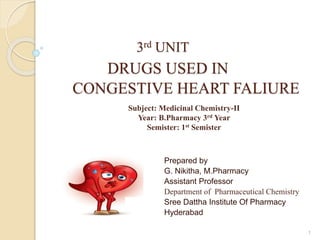
- 1. 3rd UNIT DRUGS USED IN CONGESTIVE HEART FALIURE Prepared by G. Nikitha, M.Pharmacy Assistant Professor Department of Pharmaceutical Chemistry Sree Dattha Institute Of Pharmacy Hyderabad 1 Subject: Medicinal Chemistry-II Year: B.Pharmacy 3rd Year Semister: 1st Semister
- 2. Contents Introduction. Signs and Symptoms. Types of CHF. Classification . Drugs used in CHF. Mechanism of action. Structure. Adverse Drug Reactions and Uses. Reference 2
- 3. Introduction Congestive heart failure (CHF) is defined as the inefficiency of the heart to pump sufficient amounts of oxygenated blood to the organs of the body to meet their normal metabolic demands. 3
- 4. Signs and Symptoms Signs Lateral displaced apex beats. Gallop rhythm (additional heart sound) Heart murmurs (Indicates the presence of valvular defect) Aortic stenosis (abnormal narrowing of heart valves) Pleural effusion (Increased volume of pleural cavity) Pleural cyanosis (decrease absorption of oxygen due to fluid accumulation). 4
- 5. Symptoms Paroxysmal nocturnal dyspnoea (night attacks of breathlessness). Dysponea (shortness of breath) Orthopnoea (increased breathlessness in lying posture) Poor circulation results in dizziness, confusion, diaphoresis (excessive sweating) Tachycardia (increased heart rate) Muscle fatigue Pulmonary oedema (accumulation of blood or fluid in lungs) Hepatomegaly (enlarged liver) Cardiomegaly (enlarged heart) 5
- 6. Types of CHF 1. Based on the amount of cardiac output: Low output cardiac failure High output cardiac failure 2. Based on the side of heart effected: Left sided cardiac failure Right sided cardiac failure 6
- 7. Classification Based on inotropic effects: 1. with positive inotropic effects: a. Cardiac Glycosides: Digitoxin, Digoxin, Ouabain b.Phosphodiesterase Inhibtors: Inamrinone, Levoimendan, Milrinone c. β-adrenergic agonist: Dobutamine, Dopamine, Dopexamine 7
- 8. 2. without positive inotropic effects: a. Angiotension converting enzyme (ACE)inhibitor: Captopril, Enalapril, Ramipril, Lisinopril b. β-adrenergic receptor antagonist: Bisoprolol, Carvedilol, Metorolol c. Diuretics: Acetazolamide, Bumetanide, Hydrochlorothiazine, Metolazone, Spironolactone d. Vasodilators: Hydralazine, Isosorbide dinitrate, sodium nitropruside, Nesiritide 8
- 10. Cardiac Glycosides Cardiac Glycosides are naturally occurring drugs with positive inotropic action. They are also termed cardiotonics. Cardiac glycosides are obtained from various sources. 10
- 11. 11 Glycosides sources Digitoxin, gitalin, gitoxin Leaves of Digitalis purpurea (Fox leaves) Digitoxin, lanatoide-C Leaves of Digitalis lanata Strophanthin-G, Ouabain Seeds of Strophanthus gratus Strophanthin-K Seeds of Strophanthus kmobe Proscillaridin-A Urginea scilla Thevetin Thevetia nerifolia Bufotoxin Bufo vulgaris (Toad skin)
- 12. General Mechanism of Action ionic movements occurring during the normal contraction of cardiac muscle are as follows: 1. Initially calcium ions enter into the cardiac myocytes via the voltage sensitive L-type calcium channel. 2. Such influx stimulates the release of large amounts of calcium ions from the sarcoplasmic reticulum (SR) and mitochondria of the myocytes. This results in contraction of cardiac muscles. 12
- 13. 3. The contractile process is followed by removal of calcium ions. This is achieved by two ways reuptake of calcium ions by sarcoplasmic reticulum and mitochondria as well as by sodium or calcium ion exchange pump located in the cell walls of myocytes which allows entry of 3 sodium ions for each effluxing calcium ions. 4. sodium or calcium ion exchange pump may increase the intracellular sodium ion channel, which each time effluxes 3 sodium ions and influxes 2 potassium ions. 13
- 14. Digitalis gets reversibly bound to the sodium or potassium ATPase pump and inhibits its activity. This results in progressive accumulation of intracellular sodium ions and loss of potassium ions. Due to the deposition of intercellular sodium ions, sodium or calcium exchange pump gets activated. 14
- 15. Sodium or calcium exchanger extrudes sodium ions in exchange for calcium ions. Intracellular calcium ions levels are further increased due to increase in calcium permeability via voltage sensitive L-type calcium channels. Increase in calcium levels by these two mechanisms triggers the release of calcium ions from the sarcoplasmic reticulum and mitochondria. Digitalis also inhibits the reuptake of calcium ions by sarcoplasmic reticulum. All these effects ultimately increases calcium levels in the cytosol which eventually triggers contractile process in the failing heart. 15
- 17. Properties: Digoxin appears as clear to white crystals or white crystalline powder, Odorless, Bitter taste, Practically insoluble in water, Very soluble in ethanol, Freely soluble in pyridine; soluble in mixture of chloroform and alcohol, More soluble in hot 80% alcohol than gitoxin, Slightly soluble in dilute alcohol, chloroform. Practically insoluble in ether, acetone, ethyl acetate, chloroform 17
- 18. Pharmacokinetics: Oral, Intravenous, Intramuscular route of administration, about 13% of a digoxin dose is found to be metabolized in healthy subjects. Several urinary metabolites of digoxin exist, including dihydrodigoxin and digoxigenin bisdigitoxoside. Their glucuronidated and sulfated conjugates are thought to be produced through the process of hydrolysis, oxidation, and additionally, conjugation. The cytochrome P-450 system does not play a major role in digoxin metabolism, nor does this drug induce or inhibit the enzymes in this system, excreted by kidneys in larger amounts i.e nearly 70% in an unchanged form. 18
- 19. Adverse Drug Reactions: Dizziness, Depression, Confusion, Anxiety Nausea, Vomiting, Diarrhea Head ache Rashes, weakness Irregular Heart rate Blurred vision Therapeutic Uses: Used in the treatment of heart failure, used to relieve symptoms of heart failure when the patient does not responding to ACE inhibitor and diuretics. It reduces the heart rate and increase the cardiac output. 19
- 21. Properties: White or pale buff microcrystalline powder, Odorless, Bitter taste, slightly soluble in water, very soluble in ethanol, soluble in ethyl ether, chloroform, methanol, pyridine Pharmacokinetics: Oral route of administration, absorption of digitoxin is decreased by the presence of food in stomach. 21
- 22. Adverse Drug Reactions: Dizziness, Anxiety Nausea, Vomiting Diarrhea Head ache Rashes, weakness Irregular Heart rate Visual problems Low platelet count Therapeutic Uses: Used in the treatment of heart failure Used to treat certain types of irregular heart beat can decrease the risk for blood clots that may reduce the risk for heart attacks 22
- 23. Vasodilators 23
- 24. General Mechanism of Action Vasodilators work on different substances in the body to help widen (dilate) blood vessels. It is easier for the heart to pump blood if the blood vessels are widened. Vasodilators can improve heart failure symptoms by: Dilating coronary arteries. This can help more blood reach your heart muscle. Dilating leg veins. This can lower the amount of blood returning to the heart and limit the buildup of fluid in your lungs. Dilating systemic arteries. Systemic arteries are blood vessels that carry blood to the rest of the body (excluding the heart and lungs). By dilating these arteries, vasodilators may relieve some of the work your heart needs to do. Dilating pulmonary arteries. Dilating the arteries of the lungs (pulmonary arteries) also reduces the amount of work your heart needs to do. 24
- 26. Properties: White- to off-white lyophilized powder, Bitter taste, Practically insoluble in water, Very soluble in ethanol Pharmacokinetics: Intravenous route of administration, Nesiritide undergoes proteolytic cleavage of the peptide by endopeptidases, such as neutral endopeptidase, which are present on the vascular lumenal surface. Human BNP is cleared from the circulation via the following three independent mechanisms, in order of decreasing importance: 1) binding to cell surface clearance receptors with subsequent cellular internalization and lysosomal proteolysis; 2) proteolytic cleavage of the peptide by endopeptidases, such as neutral endopeptidase, which are present on the vascular lumenal surface; and 3) renal filtration 26
- 27. Adverse Drug Reactions: Head ache, Nausea, Vomiting Rashes, Itching Hypotension, Sweating Anemia, Confusion Cough Increase creatinine Injection side reactions Therapeutic Uses: It will relax and dilutes blood pressure, lowering blood pressure improve the breathing in people with CHF. 27
- 28. Tezosentan Structure: IUPAC: N-[6-(2-hydroxyethoxy)-5-(2-methoxyphenoxy)-2-[2-(4H- 1,2,3,4-tetrazol-5-yl)pyridin-4-yl]pyrimidin-4-yl]-5-(propan-2- yl)pyridine-2-sulfonamide Properties: White solid, viscous, hygroscopic amino alcohol with an ammoniacal odor, soluble in Water . 28 Molecular Formula: C27H27N9O6S
- 29. Pharmacokinetics: Intravenous route of administration, metabolized in liver, eliminated through urine Adverse Drug Reactions: Nausea Head ache Hypotension Therapeutic Uses: Used in the treatment of heart failure Used to improve cardiac output 29
- 30. Besentan Structure: IUPAC: 4-tert-butyl-N-[6-(2-hydroxyethoxy)-5-(2-methoxyphenoxy)- 2-(pyrimidin-2-yl)pyrimidin-4-yl]benzene-1-sulfonamide Properties: white to yellowish powder, poorly soluble in water 30 Molecular Formula: C27H29N5O6S
- 31. Pharmacokinetics: Oral route of administration, metabolized in liver, eliminated through urine . Adverse Drug Reactions: Dizziness Allergic reaction Swelling Therapeutic Uses: It is used treat high blood pressure, It acts as a vasodilator and was designed as a therapy for patients with acute heart failure. 31
- 32. Reference books Text book of Medicinal chemistry volume-1-3rd edition by V.Alagarasamy. Text book of Medicinal chemistry volume-2-3rd edition by V.Alagarasamy. Medicinal chemistry by Rama Rao Nadendla. Medicinal and Pharmaceutical Chemistry by Harkishan Singh, V.K Kapoor. Wilson and Gisvolid’s Textbook of Organic Medicinal and Pharmaceutical chemistry-12th edition by John M. Beale, John. H. Block. 32
- 33. THANK YOU 33