STUDY OF UTILIZATION OF
RADIOACTIVE ISOTOPES IN THE
INVESTIGATION OF BIOGENETIC
STUDIES
Dr. Nitu Singh
Associate Professor
Oriental College of Pharmacy and Research
Oriental University
Investigation of Biogenetic Studies
• Various intermediate and steps are involved in
biosynthetic pathway in plants can be
investigated by means of following
techniques: -
• Use of isolated organ
• Grafting methods
• Tracer technique
Use of Isolated organ:
• Isolated parts of the plants are used like stem, root. It
is useful for determination of the site of biosynthesis
• E.g. roots and leaves for synthesis of Nicotina and
Dhatura, flower petals for synthesis of rose oil, tropane
alkaloids synthesis in solanaceae family roots
Grafting methods:
• It is used for the study of biosynthesis in grafted plants.
• E.g. tomato scions grafted on Dhatura produces large
amount of alkaloids while Dhatura scions grafted on
tomato produce very less alkaloids. It proves that the
main site for synthesis of alkaloids is root.
Radiotracer Technique: Basic terms
• Isotopes are made up of two word.
• Iso = same ,Topes =Place
• Means they occupy same place in Periodic table
• Elements with same Atomic number but different
atomic weight,
• Same no. of proton but different no. of neutron.
• For E.g Radio isotopes of 6C12 are 6C13 ,6C14
• Radioisotopes of 1H1 are
1H2 and 1H3
Types of Isotopes
1. Radio active isotopes :
• Unstable Isotopes
• Neutron and proton combination is unstable in
nature and have excess energy. They release
excess energy to become stable.
• Decays with the emission of radiation in the
form of alpha, beta and gamma rays
• E.g. 3H, 14C,35 S,131 I,24Na
2. Stable Isotopes
• They are stable in nature
• Do not emit radiations
• Ex 2H ,13 C,15 N
• Radio labeled Compound :when one or more atom
of a compound is replaced by the radio isotopes.
• When this radio labeled compound are used to trace
the various biosynthetic pathways they are called as
Radio tracers
• And this techniques is called as Radio tracer
techniques.
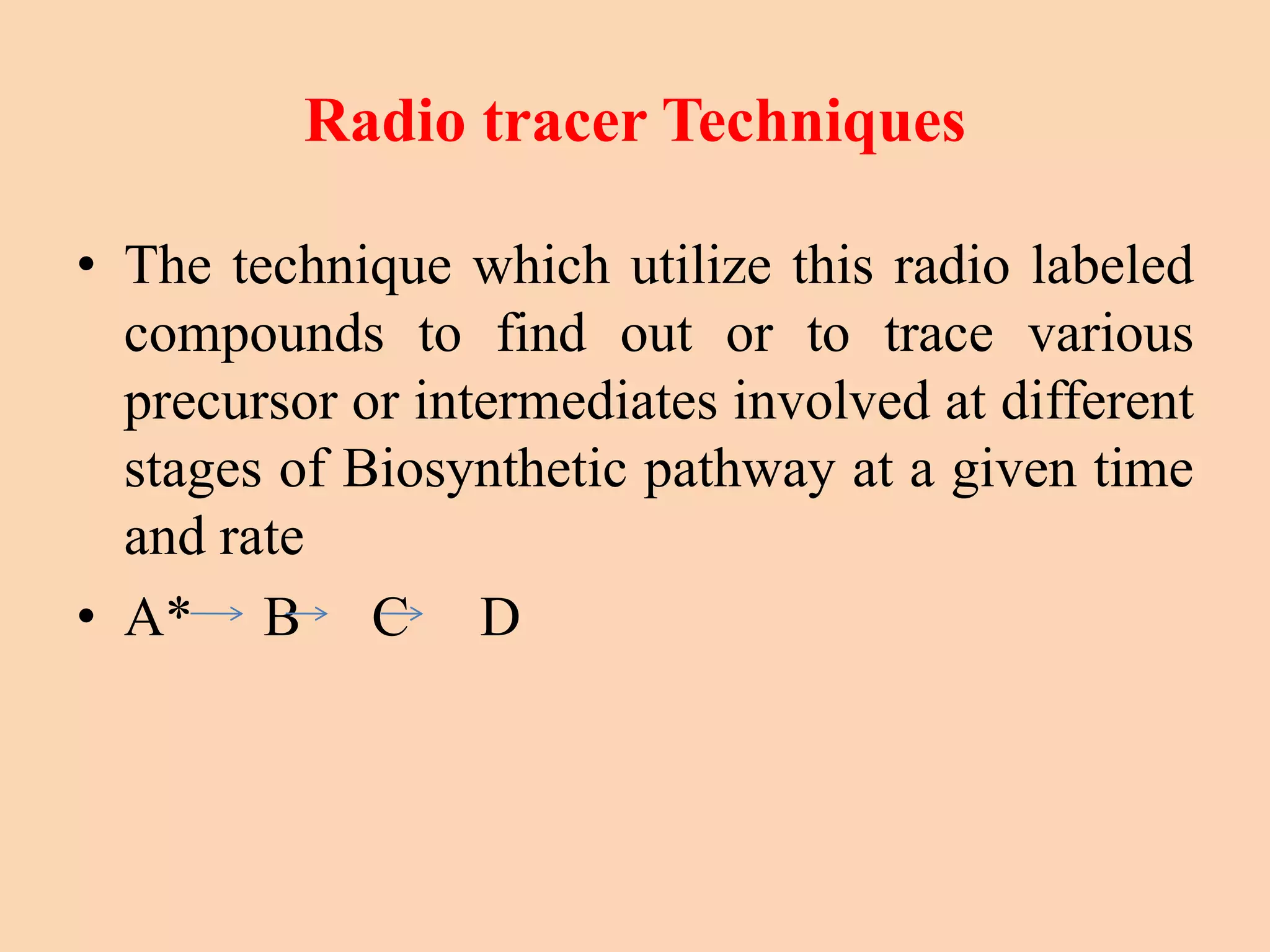
Radio tracer Techniques
• The technique which utilize this radio labeled
compounds to find out or to trace various
precursor or intermediates involved at different
stages of Biosynthetic pathway at a given time
and rate
• A* B C D
Tracer technique
• In this technique the radioactive substances are
frequently used as tracer or tagged in various fields.
Radio-isotope is added to the reactant and its
movement is studied by measuring radioactivity in
draft plant
• It can be defined as technique which utilizes a labeled
compound to find out or to trace the different
intermediates and various steps in biosynthetic
pathways in plants, at a given rate & time.
• When these isotopes are added into the plant they
become the part of metabolic pool and undergo
reaction characteristic to the metabolism of that
particular plant.
Criteria For Tracer Element
• The starting concentration of tracer must be
sufficient withstand resistance with dilution in
course of metabolism.
• Proper Labeling: - for proper labeling physical
& chemical nature of compound must be
known.
• Labeled compound should involve in the
synthesis reaction.
• Labeled compound should not damage the
system to which it is used
Different tracers for different studies:
• For studies on amino acids nitrogen gives more
specific information than C.
• For glycosides-O, N, S, C atoms
• For terpenoids- O atoms
• For studies on protein, alkaloids, and amino acid
labeled nitrogen atom give more specific
information.
Basic steps involved in tracer technique
• Selection of Radio isotopes
• Preparation of labeled compound
• Incorporation of labeled compound into tissue
system
• Separation or isolation of labeled compound
• Determination of natural metabolites
Selection of Radio isotopes
• Have long half life ,so that they can
continuously show their radioactivity through
out the investigation or study.
• Half decay of radio isotopes = half life
• 14 C half life = around 6000 years
• 3H= around 12 years
• That’s why they are mostly used in biogenetic
studies.
Preparation of labeled compound
• Labeled C compound can be prepared by growing
Cholera in 14CO2 environment
• Cholera is a green algae when it is grown in 14CO2
environment all C compound are 14C labeled
• Those can be further isolated.
• The tritium 3H compound are commercially
available. Tritium labeling is done by catalytically
exchange in aqueous media by hydrogenation of
unsaturated compounds with tritium gas
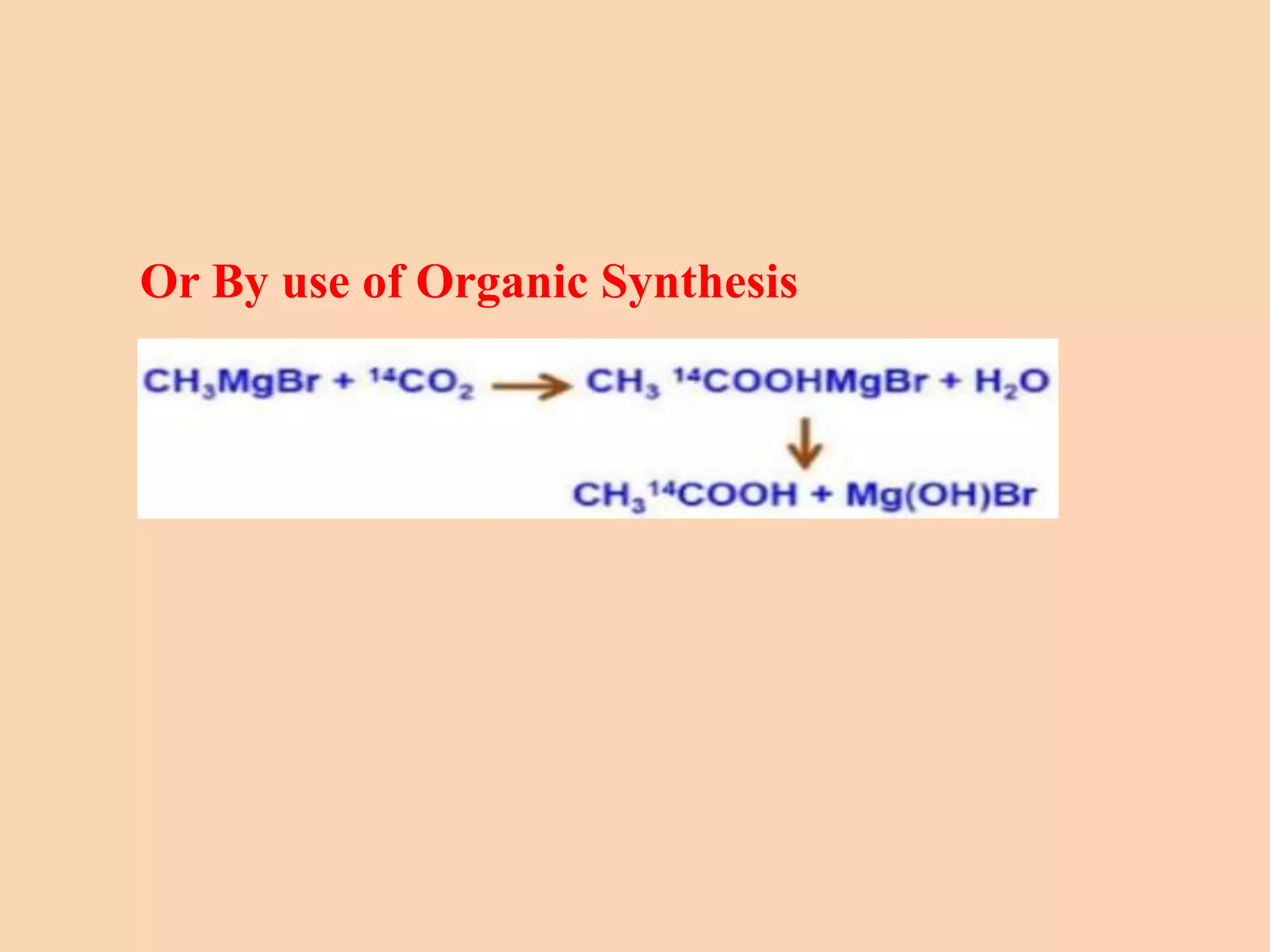
Or By use of Organic Synthesis
Incorporation of labeled compound into tissue
system
• Root feeding : Plants are cultivated
hydroponically to avoid microbial contamination
• Eg tobacco
• Stem feeding : Substrate can be administered
through cut stems immersed into the solution
containing radioisotope
• Not useful for latex containing plants
• Direct injection :For plants with hallow stem
• Eg Umbelliferous plants ,Capsular fruits
• Radioisotope Infiltration/ Wick feeding: For
feeding the plant root in the soil or any other
support without disturbing it
• A thread dipped in the solution containing
radioisotope is drowned through the stem
• A flap cut on the stem can be dipped into the
solution containing
• Floating method :The plant material is allowed
to float on the solution containing radioisotope
• Spraying technique :Solution containing
radioisotope is sprayed on the plant part
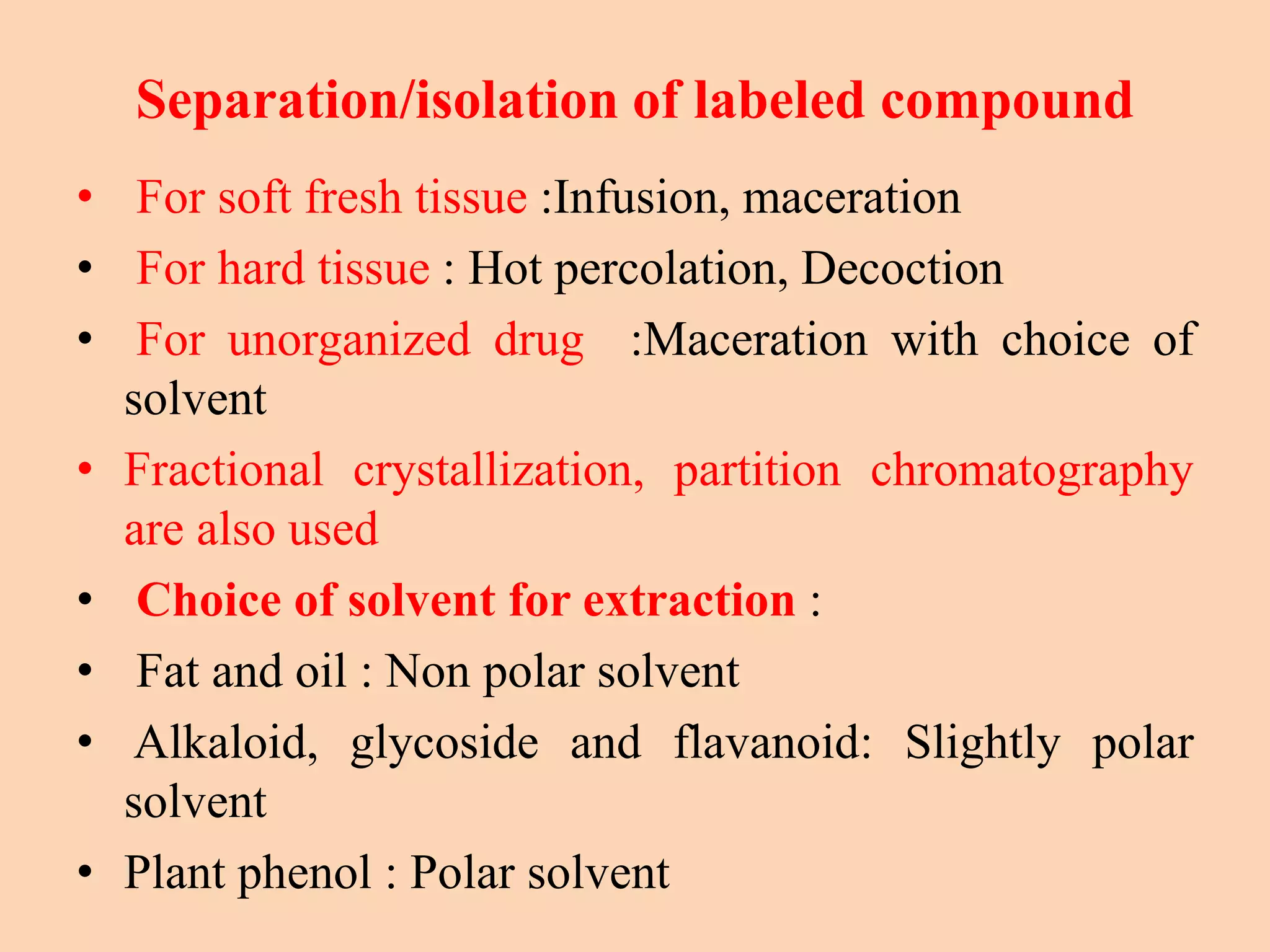
Separation/isolation of labeled compound
• For soft fresh tissue :Infusion, maceration
• For hard tissue : Hot percolation, Decoction
• For unorganized drug :Maceration with choice of
solvent
• Fractional crystallization, partition chromatography
are also used
• Choice of solvent for extraction :
• Fat and oil : Non polar solvent
• Alkaloid, glycoside and flavanoid: Slightly polar
solvent
• Plant phenol : Polar solvent
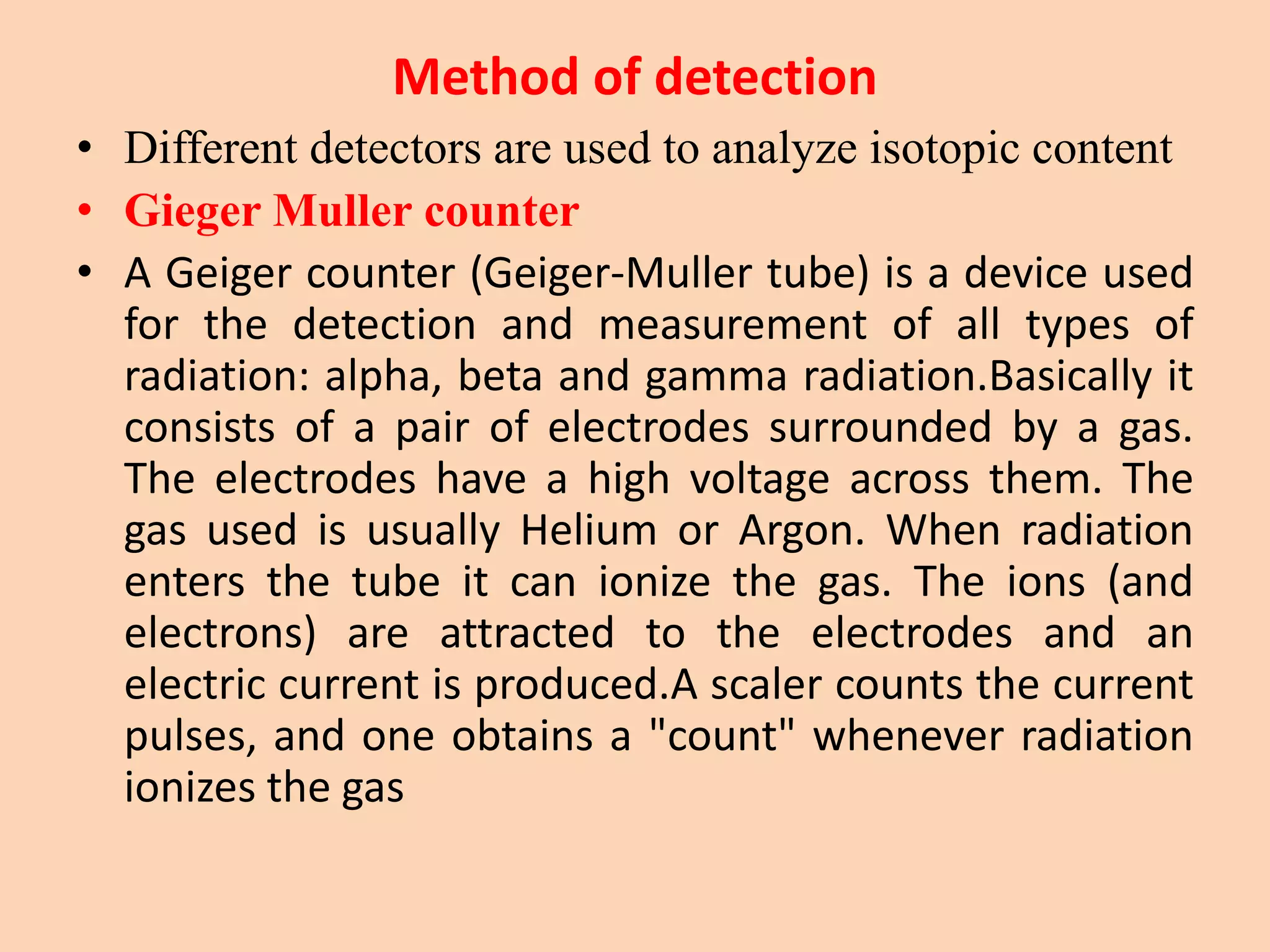
Method of detection
• Different detectors are used to analyze isotopic content
• Gieger Muller counter
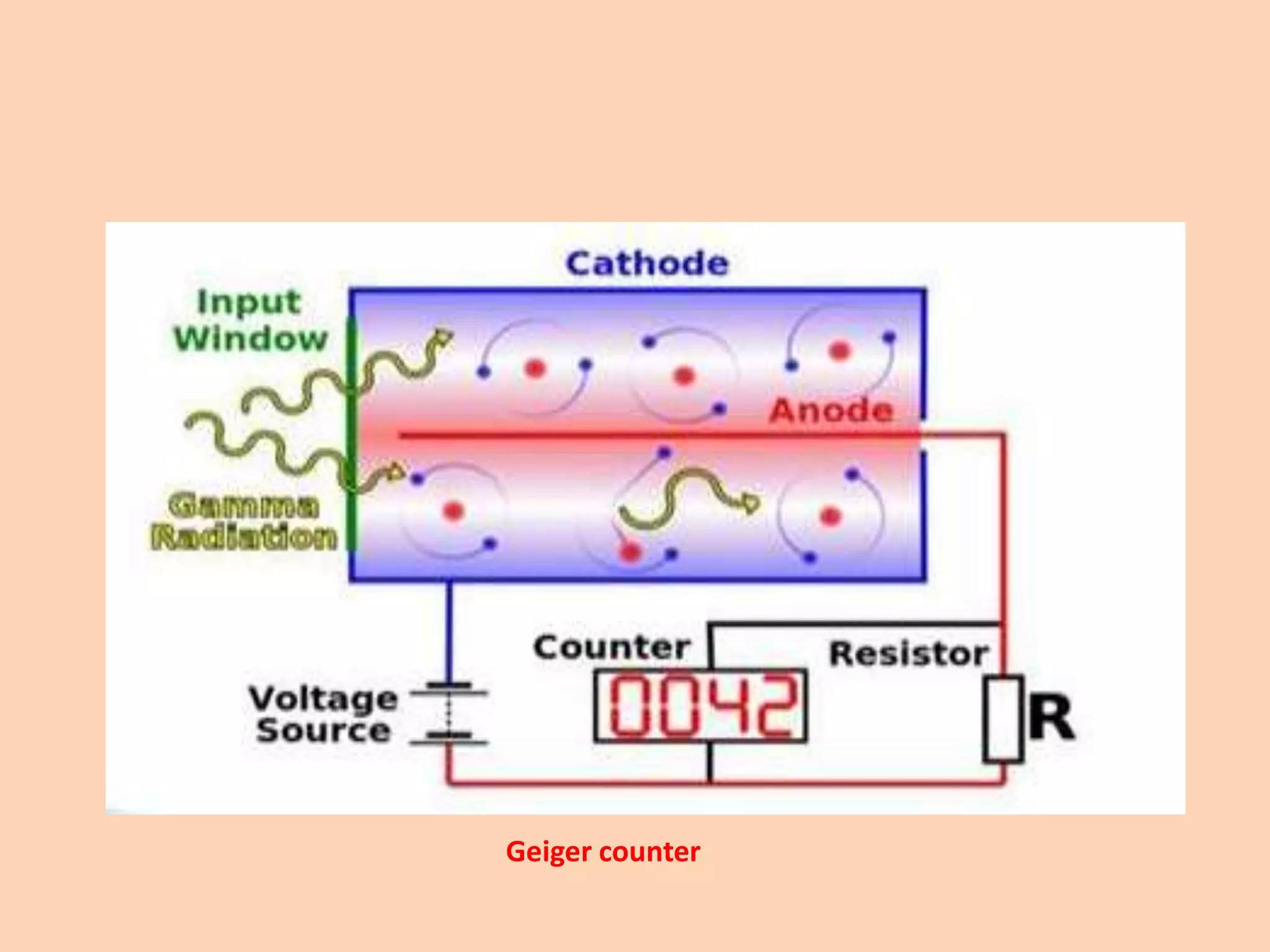
• A Geiger counter (Geiger-Muller tube) is a device used
for the detection and measurement of all types of
radiation: alpha, beta and gamma radiation.Basically it
consists of a pair of electrodes surrounded by a gas.
The electrodes have a high voltage across them. The
gas used is usually Helium or Argon. When radiation
enters the tube it can ionize the gas. The ions (and
electrons) are attracted to the electrodes and an
electric current is produced.A scaler counts the current
pulses, and one obtains a "count" whenever radiation
ionizes the gas
Geiger counter
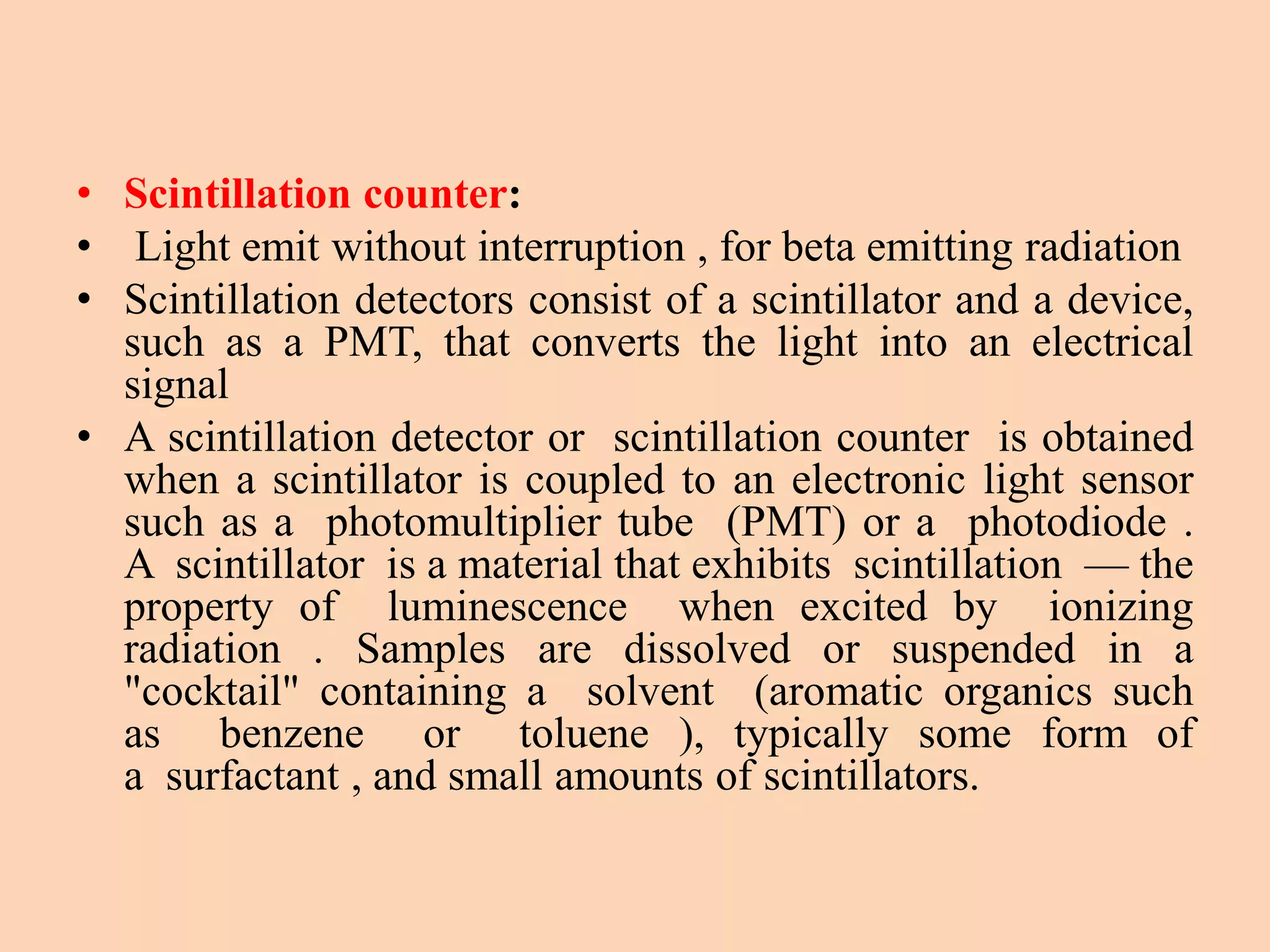
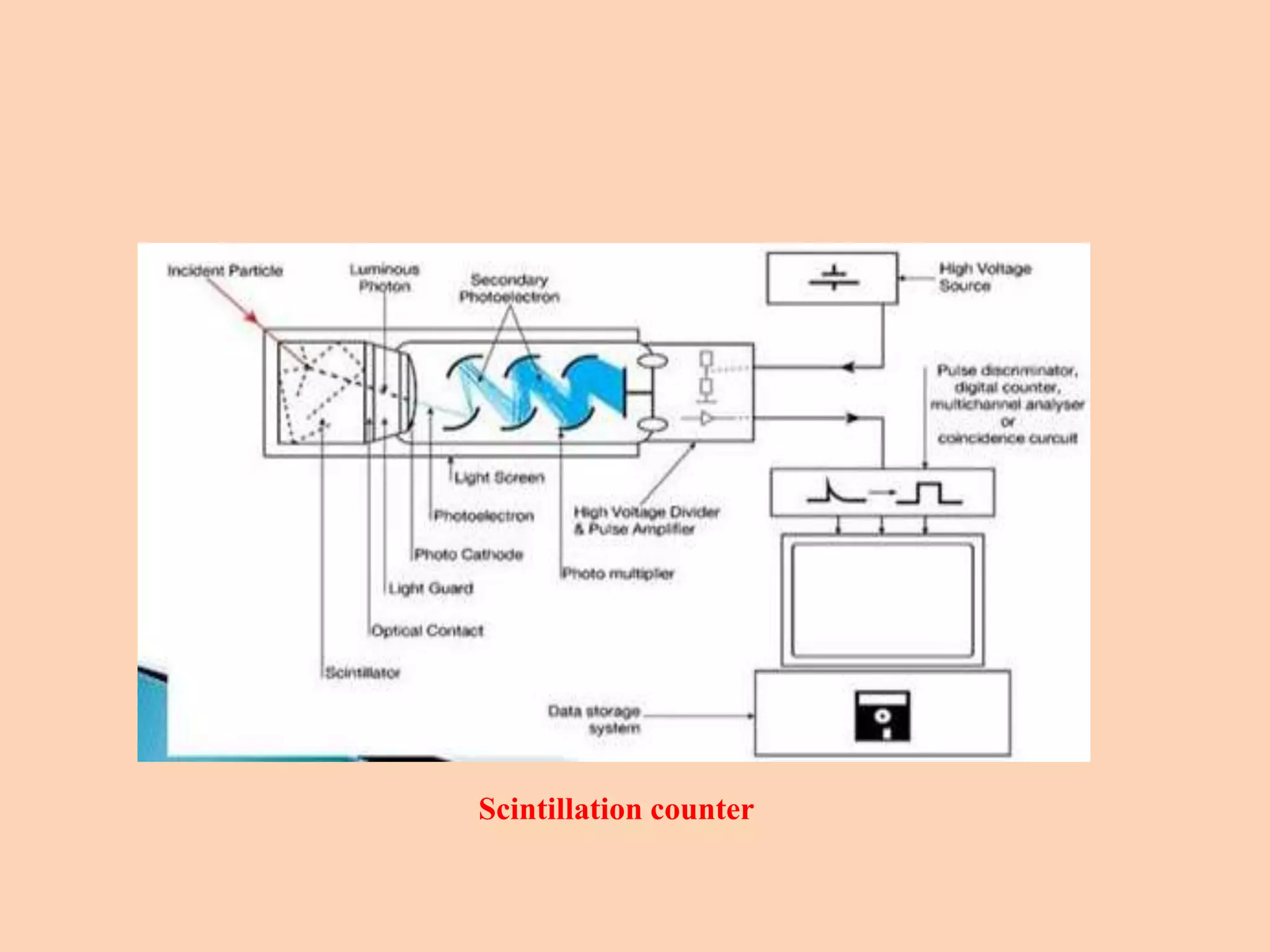
• Scintillation counter:
• Light emit without interruption , for beta emitting radiation
• Scintillation detectors consist of a scintillator and a device,
such as a PMT, that converts the light into an electrical
signal
• A scintillation detector or scintillation counter is obtained
when a scintillator is coupled to an electronic light sensor
such as a photomultiplier tube (PMT) or a photodiode .
A scintillator is a material that exhibits scintillation — the
property of luminescence when excited by ionizing
radiation . Samples are dissolved or suspended in a
"cocktail" containing a solvent (aromatic organics such
as benzene or toluene ), typically some form of
a surfactant , and small amounts of scintillators.
Scintillation counter
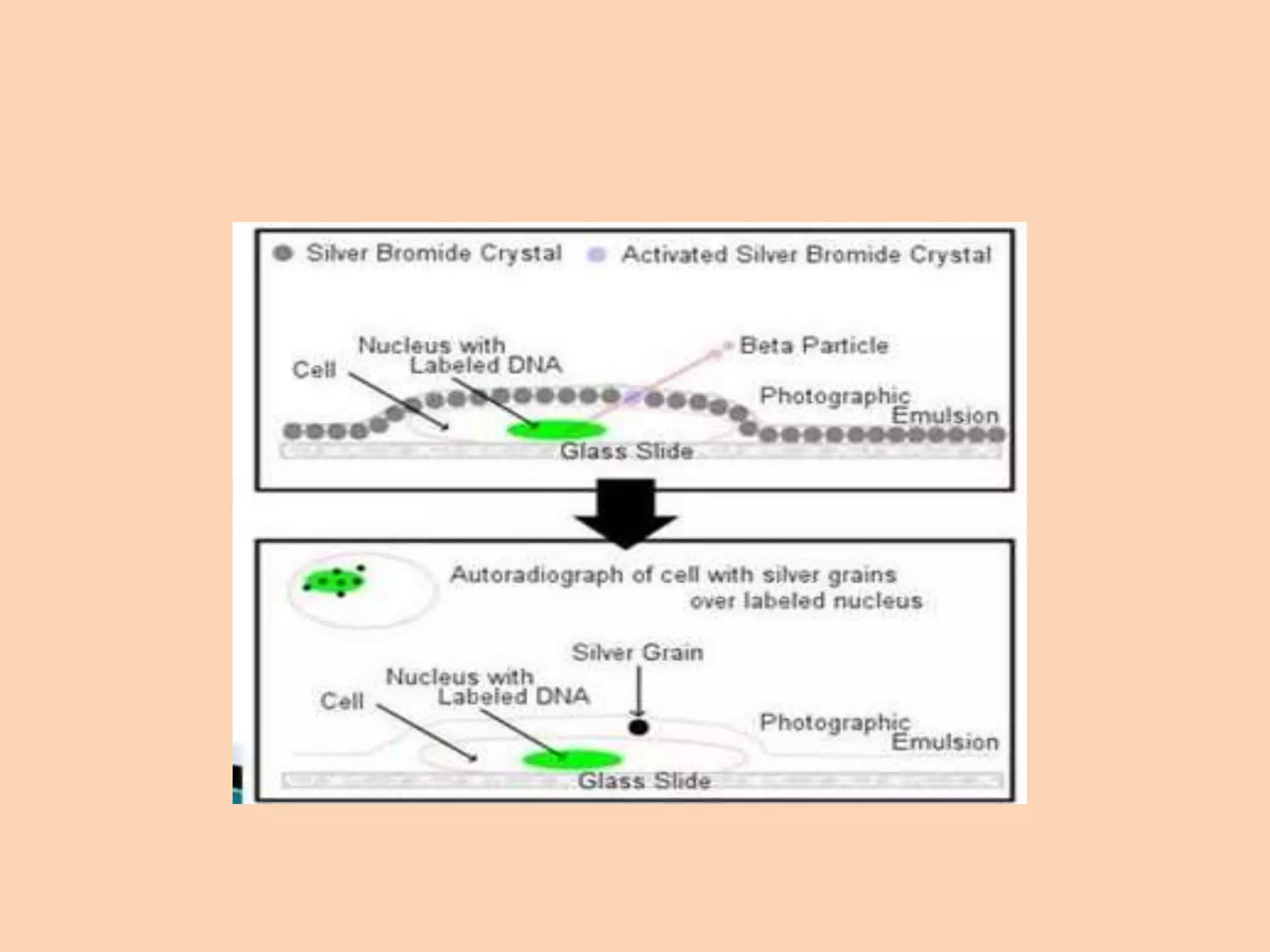
• Autoradiography :
• To determine the location of radio active isotopes
• Detecting radioactive compounds with a
photographic emulsion (x-ray film )
Autoradiography is a method for investigating the
distribution of radioactive material in a plant
object, e.g. histological tissues, a chromatography
plate. This techniques uses a photographic film or
emulsion as detector of ionizing radiation. The
sample is in close contact with emulsion for a
certain period of time (exposure period)
Detection and assay of radioactively labeled
compound
• The metabolite is isolated, purified and
analyzed for isotopic content
• If A* B C……..X Y Z*
• The relation between precursor and metabolite
is established
Methods in Tracer technique
Precursor Product Sequence:
• For the elucidation of Biosynthetic Pathway
• In this, the presumed precursor of the constituent
under investigation on a labeled form is fed into the
plant and after a suitable time the constituent is
isolated, purified and radioactivity is determined.
• Disadvantage: - The radioactivity of isolated
compound alone is not usually sufficient evidence
that the particular compound fed is direct precursor,
because substance may enter the general metabolic
pathway and from there may become randomly
distributed through a whole range of product.
• Application: This method is applied to the
biogenesis of morphine & ergot alkaloids
Correct Investigation of Precurssor product
sequence
• Double & Multiple Labelling
• In this method more than one site of the
compound is labeled.
• Application: - This method is extensively
applied to study the biogenesis of plant
secondary metabolite.
• Used for study of morphine alkaloid
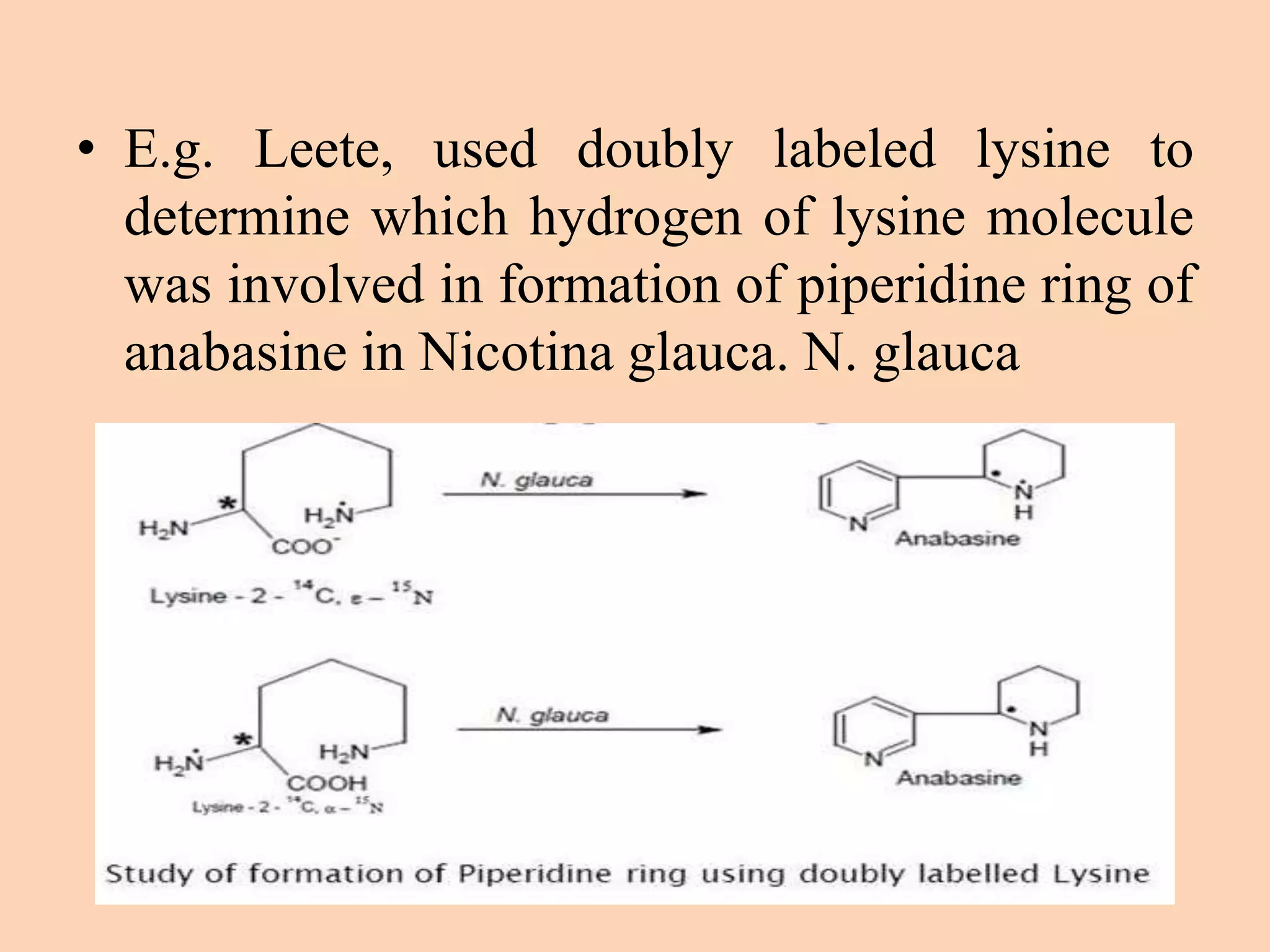
• E.g. Leete, used doubly labeled lysine to
determine which hydrogen of lysine molecule
was involved in formation of piperidine ring of
anabasine in Nicotina glauca. N. glauca
Competitive Feeding
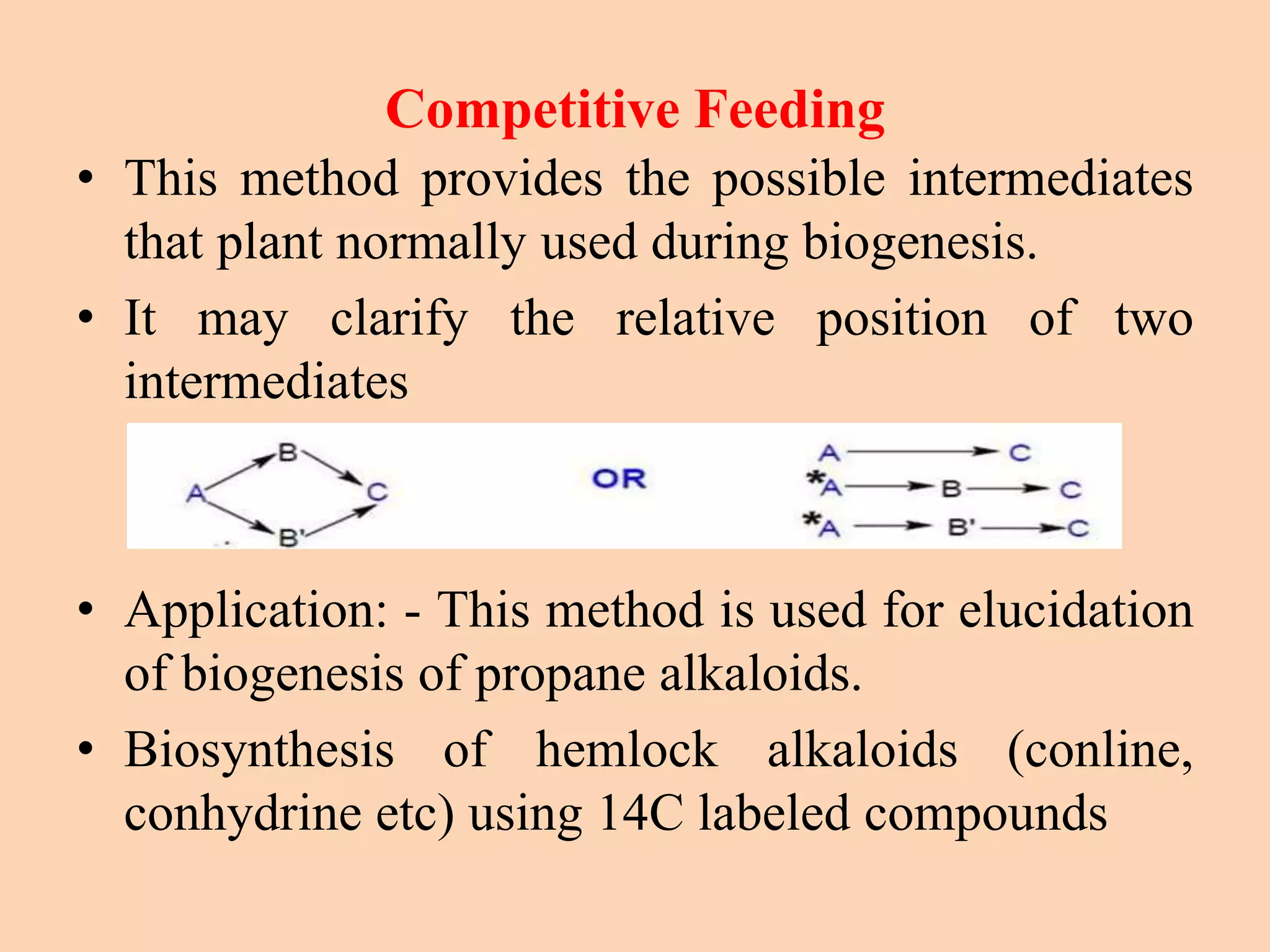
• This method provides the possible intermediates
that plant normally used during biogenesis.
• It may clarify the relative position of two
intermediates
• Application: - This method is used for elucidation
of biogenesis of propane alkaloids.
• Biosynthesis of hemlock alkaloids (conline,
conhydrine etc) using 14C labeled compounds
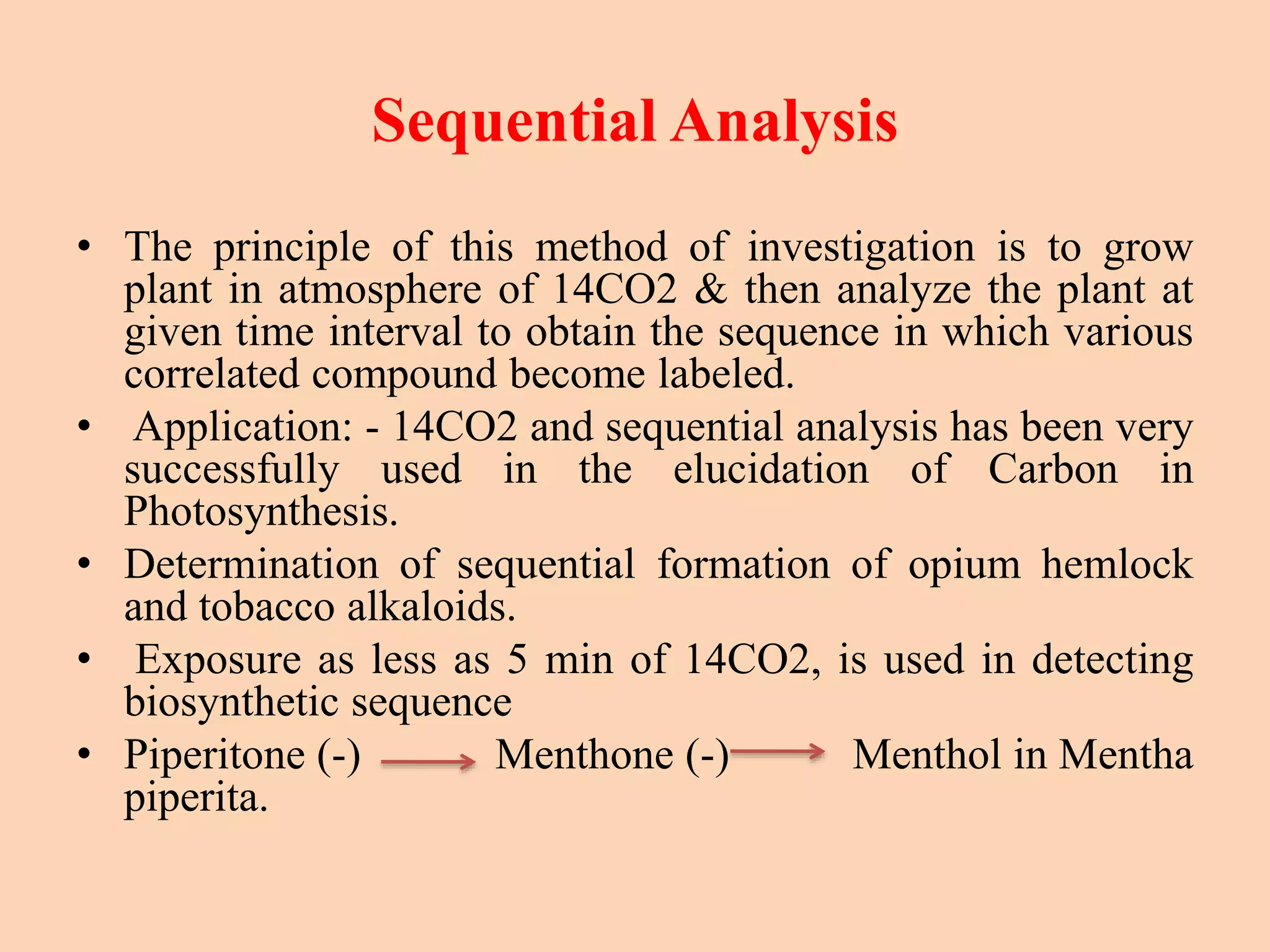
Sequential Analysis
• The principle of this method of investigation is to grow
plant in atmosphere of 14CO2 & then analyze the plant at
given time interval to obtain the sequence in which various
correlated compound become labeled.
• Application: - 14CO2 and sequential analysis has been very
successfully used in the elucidation of Carbon in
Photosynthesis.
• Determination of sequential formation of opium hemlock
and tobacco alkaloids.
• Exposure as less as 5 min of 14CO2, is used in detecting
biosynthetic sequence
• Piperitone (-) Menthone (-) Menthol in Mentha
piperita.
Application Of Tracer Technique
• Study of squalene cyclization by use of 14C, 3H
labelled mevalonic acid.
• Interrelationship among 4 – methyl sterols & 4, 4
dimethyl sterols, by use of 14C acetate.
• Terpenoid biosynthesis by chloroplast isolated in
organic solvent, by use of 2- 14C mevalonate.
• Study the formation of cinnamic acid in pathway
of coumarin from labelled coumarin.
• Origin of carbon & nitrogen atoms of purine ring
system by use of 14C or 15N labelled precursor.
• Study of formation of scopoletin by use of
labelled phenylalanine.
• By use of 45Ca as tracer, - found that the uptake
of calcium by plants from the soil. (CaO &
CaCO2).
• By adding ammonium phosphate labelled with
32P of known specific activity the uptake of
phosphorus is followed by measuring the
radioactivity as label reaches first in lower part of
plant, than the upper part i.e. branches, leaves etc

STUDY OF UTILIZATION OF RADIOACTIVE ISOTOPES IN THE INVESTIGATION OF BIOGENETIC STUDIES by Dr. Nitu Singh

  • 1.
    STUDY OF UTILIZATIONOF RADIOACTIVE ISOTOPES IN THE INVESTIGATION OF BIOGENETIC STUDIES Dr. Nitu Singh Associate Professor Oriental College of Pharmacy and Research Oriental University
  • 2.
    Investigation of BiogeneticStudies • Various intermediate and steps are involved in biosynthetic pathway in plants can be investigated by means of following techniques: - • Use of isolated organ • Grafting methods • Tracer technique
  • 3.
    Use of Isolatedorgan: • Isolated parts of the plants are used like stem, root. It is useful for determination of the site of biosynthesis • E.g. roots and leaves for synthesis of Nicotina and Dhatura, flower petals for synthesis of rose oil, tropane alkaloids synthesis in solanaceae family roots Grafting methods: • It is used for the study of biosynthesis in grafted plants. • E.g. tomato scions grafted on Dhatura produces large amount of alkaloids while Dhatura scions grafted on tomato produce very less alkaloids. It proves that the main site for synthesis of alkaloids is root.
  • 4.
    Radiotracer Technique: Basicterms • Isotopes are made up of two word. • Iso = same ,Topes =Place • Means they occupy same place in Periodic table • Elements with same Atomic number but different atomic weight, • Same no. of proton but different no. of neutron. • For E.g Radio isotopes of 6C12 are 6C13 ,6C14 • Radioisotopes of 1H1 are 1H2 and 1H3
  • 5.
    Types of Isotopes 1.Radio active isotopes : • Unstable Isotopes • Neutron and proton combination is unstable in nature and have excess energy. They release excess energy to become stable. • Decays with the emission of radiation in the form of alpha, beta and gamma rays • E.g. 3H, 14C,35 S,131 I,24Na
  • 6.
    2. Stable Isotopes •They are stable in nature • Do not emit radiations • Ex 2H ,13 C,15 N • Radio labeled Compound :when one or more atom of a compound is replaced by the radio isotopes. • When this radio labeled compound are used to trace the various biosynthetic pathways they are called as Radio tracers • And this techniques is called as Radio tracer techniques.
  • 7.
    Radio tracer Techniques •The technique which utilize this radio labeled compounds to find out or to trace various precursor or intermediates involved at different stages of Biosynthetic pathway at a given time and rate • A* B C D
  • 8.
    Tracer technique • Inthis technique the radioactive substances are frequently used as tracer or tagged in various fields. Radio-isotope is added to the reactant and its movement is studied by measuring radioactivity in draft plant • It can be defined as technique which utilizes a labeled compound to find out or to trace the different intermediates and various steps in biosynthetic pathways in plants, at a given rate & time. • When these isotopes are added into the plant they become the part of metabolic pool and undergo reaction characteristic to the metabolism of that particular plant.
  • 9.
    Criteria For TracerElement • The starting concentration of tracer must be sufficient withstand resistance with dilution in course of metabolism. • Proper Labeling: - for proper labeling physical & chemical nature of compound must be known. • Labeled compound should involve in the synthesis reaction. • Labeled compound should not damage the system to which it is used
  • 10.
    Different tracers fordifferent studies: • For studies on amino acids nitrogen gives more specific information than C. • For glycosides-O, N, S, C atoms • For terpenoids- O atoms • For studies on protein, alkaloids, and amino acid labeled nitrogen atom give more specific information.
  • 11.
    Basic steps involvedin tracer technique • Selection of Radio isotopes • Preparation of labeled compound • Incorporation of labeled compound into tissue system • Separation or isolation of labeled compound • Determination of natural metabolites
  • 12.
    Selection of Radioisotopes • Have long half life ,so that they can continuously show their radioactivity through out the investigation or study. • Half decay of radio isotopes = half life • 14 C half life = around 6000 years • 3H= around 12 years • That’s why they are mostly used in biogenetic studies.
  • 13.
    Preparation of labeledcompound • Labeled C compound can be prepared by growing Cholera in 14CO2 environment • Cholera is a green algae when it is grown in 14CO2 environment all C compound are 14C labeled • Those can be further isolated. • The tritium 3H compound are commercially available. Tritium labeling is done by catalytically exchange in aqueous media by hydrogenation of unsaturated compounds with tritium gas
  • 14.
    Or By useof Organic Synthesis
  • 15.
    Incorporation of labeledcompound into tissue system • Root feeding : Plants are cultivated hydroponically to avoid microbial contamination • Eg tobacco • Stem feeding : Substrate can be administered through cut stems immersed into the solution containing radioisotope • Not useful for latex containing plants • Direct injection :For plants with hallow stem • Eg Umbelliferous plants ,Capsular fruits
  • 16.
    • Radioisotope Infiltration/Wick feeding: For feeding the plant root in the soil or any other support without disturbing it • A thread dipped in the solution containing radioisotope is drowned through the stem • A flap cut on the stem can be dipped into the solution containing • Floating method :The plant material is allowed to float on the solution containing radioisotope • Spraying technique :Solution containing radioisotope is sprayed on the plant part
  • 17.
    Separation/isolation of labeledcompound • For soft fresh tissue :Infusion, maceration • For hard tissue : Hot percolation, Decoction • For unorganized drug :Maceration with choice of solvent • Fractional crystallization, partition chromatography are also used • Choice of solvent for extraction : • Fat and oil : Non polar solvent • Alkaloid, glycoside and flavanoid: Slightly polar solvent • Plant phenol : Polar solvent
  • 18.
    Method of detection •Different detectors are used to analyze isotopic content • Gieger Muller counter • A Geiger counter (Geiger-Muller tube) is a device used for the detection and measurement of all types of radiation: alpha, beta and gamma radiation.Basically it consists of a pair of electrodes surrounded by a gas. The electrodes have a high voltage across them. The gas used is usually Helium or Argon. When radiation enters the tube it can ionize the gas. The ions (and electrons) are attracted to the electrodes and an electric current is produced.A scaler counts the current pulses, and one obtains a "count" whenever radiation ionizes the gas
  • 19.
  • 20.
    • Scintillation counter: •Light emit without interruption , for beta emitting radiation • Scintillation detectors consist of a scintillator and a device, such as a PMT, that converts the light into an electrical signal • A scintillation detector or scintillation counter is obtained when a scintillator is coupled to an electronic light sensor such as a photomultiplier tube (PMT) or a photodiode . A scintillator is a material that exhibits scintillation — the property of luminescence when excited by ionizing radiation . Samples are dissolved or suspended in a "cocktail" containing a solvent (aromatic organics such as benzene or toluene ), typically some form of a surfactant , and small amounts of scintillators.
  • 21.
  • 22.
    • Autoradiography : •To determine the location of radio active isotopes • Detecting radioactive compounds with a photographic emulsion (x-ray film ) Autoradiography is a method for investigating the distribution of radioactive material in a plant object, e.g. histological tissues, a chromatography plate. This techniques uses a photographic film or emulsion as detector of ionizing radiation. The sample is in close contact with emulsion for a certain period of time (exposure period)
  • 24.
    Detection and assayof radioactively labeled compound • The metabolite is isolated, purified and analyzed for isotopic content • If A* B C……..X Y Z* • The relation between precursor and metabolite is established
  • 25.
    Methods in Tracertechnique Precursor Product Sequence: • For the elucidation of Biosynthetic Pathway • In this, the presumed precursor of the constituent under investigation on a labeled form is fed into the plant and after a suitable time the constituent is isolated, purified and radioactivity is determined. • Disadvantage: - The radioactivity of isolated compound alone is not usually sufficient evidence that the particular compound fed is direct precursor, because substance may enter the general metabolic pathway and from there may become randomly distributed through a whole range of product. • Application: This method is applied to the biogenesis of morphine & ergot alkaloids
  • 26.
    Correct Investigation ofPrecurssor product sequence • Double & Multiple Labelling • In this method more than one site of the compound is labeled. • Application: - This method is extensively applied to study the biogenesis of plant secondary metabolite. • Used for study of morphine alkaloid
  • 27.
    • E.g. Leete,used doubly labeled lysine to determine which hydrogen of lysine molecule was involved in formation of piperidine ring of anabasine in Nicotina glauca. N. glauca
  • 28.
    Competitive Feeding • Thismethod provides the possible intermediates that plant normally used during biogenesis. • It may clarify the relative position of two intermediates • Application: - This method is used for elucidation of biogenesis of propane alkaloids. • Biosynthesis of hemlock alkaloids (conline, conhydrine etc) using 14C labeled compounds
  • 29.
    Sequential Analysis • Theprinciple of this method of investigation is to grow plant in atmosphere of 14CO2 & then analyze the plant at given time interval to obtain the sequence in which various correlated compound become labeled. • Application: - 14CO2 and sequential analysis has been very successfully used in the elucidation of Carbon in Photosynthesis. • Determination of sequential formation of opium hemlock and tobacco alkaloids. • Exposure as less as 5 min of 14CO2, is used in detecting biosynthetic sequence • Piperitone (-) Menthone (-) Menthol in Mentha piperita.
  • 30.
    Application Of TracerTechnique • Study of squalene cyclization by use of 14C, 3H labelled mevalonic acid. • Interrelationship among 4 – methyl sterols & 4, 4 dimethyl sterols, by use of 14C acetate. • Terpenoid biosynthesis by chloroplast isolated in organic solvent, by use of 2- 14C mevalonate. • Study the formation of cinnamic acid in pathway of coumarin from labelled coumarin. • Origin of carbon & nitrogen atoms of purine ring system by use of 14C or 15N labelled precursor.
  • 31.
    • Study offormation of scopoletin by use of labelled phenylalanine. • By use of 45Ca as tracer, - found that the uptake of calcium by plants from the soil. (CaO & CaCO2). • By adding ammonium phosphate labelled with 32P of known specific activity the uptake of phosphorus is followed by measuring the radioactivity as label reaches first in lower part of plant, than the upper part i.e. branches, leaves etc