ARTEMISININ
SAPTARSHI SAMAJDAR
16mphyto02
INTRODUCTION
• Malaria is a very common disease. This probably originated in Africa
around 30 million years ago.
• In 1600s first treatment to malaria was recorded in Peru where native
tribes used bitter bark of cinchona.
• In 1897 Sir Ronald Ross described female anopheles mosquito as the
vector of the disease.
• In 1950s the disease rebounded largely due to emergence of
parasites resistant to drugs like chloroquine.
• In 1967 a national project was taken in China known as Projects 523
to stop this.
HISTORY
• Under able leadership of Dr. Y. Tu more than 2000 herbs preparations were
investigated . Out of which 640 herbs were hits.
• The turning point came when Artemisia annua L. Extract showed a promising
degree of inhibition in mouse model.
• Although the progress was not smooth as the obsevation was not reproducible in
subsequent experiments.
• During cultural revolution no clinical trials were performed so Dr. Y. Tu bravely
volunteered to the first trials.
• In Hainan first official trials happened on malaria patients. The patients showed
much better result than chloroquine (Test samples)
CONT.
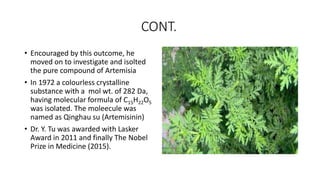
• Encouraged by this outcome, he
moved on to investigate and isolted
the pure compound of Artemisia
• In 1972 a colourless crystalline
substance with a mol wt. of 282 Da,
having molecular formula of C15H22O5
was isolated. The moleecule was
named as Qinghau su (Artemisinin)
• Dr. Y. Tu was awarded with Lasker
Award in 2011 and finally The Nobel
Prize in Medicine (2015).
CHEMISTRY OF ARTEMISININ
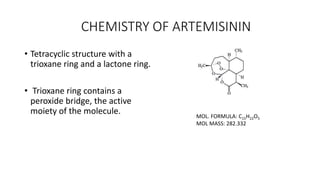
• Tetracyclic structure with a
trioxane ring and a lactone ring.
• Trioxane ring contains a
peroxide bridge, the active
moiety of the molecule. MOL. FORMULA: C15H22O5
MOL MASS: 282.332
STRUCTURE ACTIVITY RELATIONSHIP
Presence of a ‘Trioxane’ moiety which
consists of the Endoperoxide & Doxepin
oxygens that is evidently displayed by a
simplified version of 3- Aryltrioxanes.
Reduction of Artemisinin to
Dihydroartemisinin gives rise to a chiral
centre,that may ultimately lead to the
formation of ‘Prodrugs’ which could either
be oil soluble or water soluble.
Like the simpler Aryltrioxanes the two
prevailing stereoisomers Artemether,
Artesunate which are found to be active.
R
O
O
O
H
OCH3H
ARYLTRIOXANES [R= F or COOH]
O
O
O
O
CH3
H
H3C
CH3
H
OHH
DIHYDROARTEMISININ
CONT.
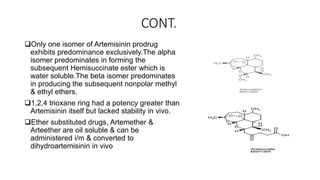
Only one isomer of Artemisinin prodrug
exhibits predominance exclusively.The alpha
isomer predominates in forming the
subsequent Hemisuccinate ester which is
water soluble.The beta isomer predominates
in producing the subsequent nonpolar methyl
& ethyl ethers.
1,2,4 trioxane ring had a potency greater than
Artemisinin itself but lacked stability in vivo.
Ether substituted drugs, Artemether &
Arteether are oil soluble & can be
administered i/m & converted to
dihydroartemisinin in vivo
MECHANISM OF ACTION
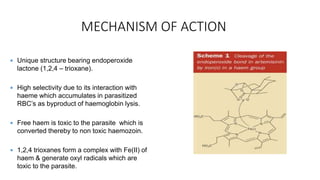
 Unique structure bearing endoperoxide
lactone (1,2,4 – trioxane).
 High selectivity due to its interaction with
haeme which accumulates in parasitized
RBC’s as byproduct of haemoglobin lysis.
 Free haem is toxic to the parasite which is
converted thereby to non toxic haemozoin.
 1,2,4 trioxanes form a complex with Fe(II) of
haem & generate oxyl radicals which are
toxic to the parasite.
DRUG INTERACTIONS
• Chloroquine and pyrimethamine may antagonise the
activity of artemisinin whereas mefloquine,
quinine,primaquine and tetracycline potentiate
artemisinin.
• The combination of artemisinin derivatives and
mefloquine improves parasite clearance compared with
either drug alone
RECENT ADVANCEMENTS
• Recent development of a semi-synthetic N containing derivative
by German pharma company Bayer.
• A compound Artemisone developed by Bayer & Richard Haynes
of Hong Kong University of Science and Technology is currently
undergoing phase 2 clinical trials.
• Jonathan Vennerstron of the university of Nebraska alongwith
Medicines for Malaria Venture & Hoffman la Roche designed a
completely synthetic drug inspired from Artemisinin but not
derived from it. Its name is 0Z277.
REFERENCE
• http://www.nature.com/nm/journal/v17/n10/full/nm.2471.html.( Accessed on 1/10/16)
• Abdin MZ, Israr M, Rehman RU, Jain SK“Artemisinin, a novel antimalarial drug:
biochemical and molecular approaches for enhanced production”.Centre for
Biotechnology, Faculty of Science, Hamdard University, New Delhi, India.
• White NJ (July 1997). "Assessment of the pharmacodynamic properties of antimalarial
drugs in vivo". Antimicrob. Agents Chemother. 41 (7): 1413–22. PMID 9210658
• Patrick L Graham,An Introduction to Medicinal Chemistry,4th Edition,Page:292-297
• Artemisinin: From Malaria to Cancer Treatment, by Robert Jay Rowen, MD Editor-in-
Chief, Second Opinion
Artemisinin

Artemisinin

  • 1.
  • 2.
    INTRODUCTION • Malaria isa very common disease. This probably originated in Africa around 30 million years ago. • In 1600s first treatment to malaria was recorded in Peru where native tribes used bitter bark of cinchona. • In 1897 Sir Ronald Ross described female anopheles mosquito as the vector of the disease. • In 1950s the disease rebounded largely due to emergence of parasites resistant to drugs like chloroquine. • In 1967 a national project was taken in China known as Projects 523 to stop this.
  • 3.
    HISTORY • Under ableleadership of Dr. Y. Tu more than 2000 herbs preparations were investigated . Out of which 640 herbs were hits. • The turning point came when Artemisia annua L. Extract showed a promising degree of inhibition in mouse model. • Although the progress was not smooth as the obsevation was not reproducible in subsequent experiments. • During cultural revolution no clinical trials were performed so Dr. Y. Tu bravely volunteered to the first trials. • In Hainan first official trials happened on malaria patients. The patients showed much better result than chloroquine (Test samples)
  • 4.
    CONT. • Encouraged bythis outcome, he moved on to investigate and isolted the pure compound of Artemisia • In 1972 a colourless crystalline substance with a mol wt. of 282 Da, having molecular formula of C15H22O5 was isolated. The moleecule was named as Qinghau su (Artemisinin) • Dr. Y. Tu was awarded with Lasker Award in 2011 and finally The Nobel Prize in Medicine (2015).
  • 5.
    CHEMISTRY OF ARTEMISININ •Tetracyclic structure with a trioxane ring and a lactone ring. • Trioxane ring contains a peroxide bridge, the active moiety of the molecule. MOL. FORMULA: C15H22O5 MOL MASS: 282.332
  • 6.
    STRUCTURE ACTIVITY RELATIONSHIP Presenceof a ‘Trioxane’ moiety which consists of the Endoperoxide & Doxepin oxygens that is evidently displayed by a simplified version of 3- Aryltrioxanes. Reduction of Artemisinin to Dihydroartemisinin gives rise to a chiral centre,that may ultimately lead to the formation of ‘Prodrugs’ which could either be oil soluble or water soluble. Like the simpler Aryltrioxanes the two prevailing stereoisomers Artemether, Artesunate which are found to be active. R O O O H OCH3H ARYLTRIOXANES [R= F or COOH] O O O O CH3 H H3C CH3 H OHH DIHYDROARTEMISININ
  • 7.
    CONT. Only one isomerof Artemisinin prodrug exhibits predominance exclusively.The alpha isomer predominates in forming the subsequent Hemisuccinate ester which is water soluble.The beta isomer predominates in producing the subsequent nonpolar methyl & ethyl ethers. 1,2,4 trioxane ring had a potency greater than Artemisinin itself but lacked stability in vivo. Ether substituted drugs, Artemether & Arteether are oil soluble & can be administered i/m & converted to dihydroartemisinin in vivo
  • 8.
    MECHANISM OF ACTION Unique structure bearing endoperoxide lactone (1,2,4 – trioxane).  High selectivity due to its interaction with haeme which accumulates in parasitized RBC’s as byproduct of haemoglobin lysis.  Free haem is toxic to the parasite which is converted thereby to non toxic haemozoin.  1,2,4 trioxanes form a complex with Fe(II) of haem & generate oxyl radicals which are toxic to the parasite.
  • 9.
    DRUG INTERACTIONS • Chloroquineand pyrimethamine may antagonise the activity of artemisinin whereas mefloquine, quinine,primaquine and tetracycline potentiate artemisinin. • The combination of artemisinin derivatives and mefloquine improves parasite clearance compared with either drug alone
  • 10.
    RECENT ADVANCEMENTS • Recentdevelopment of a semi-synthetic N containing derivative by German pharma company Bayer. • A compound Artemisone developed by Bayer & Richard Haynes of Hong Kong University of Science and Technology is currently undergoing phase 2 clinical trials. • Jonathan Vennerstron of the university of Nebraska alongwith Medicines for Malaria Venture & Hoffman la Roche designed a completely synthetic drug inspired from Artemisinin but not derived from it. Its name is 0Z277.
  • 11.
    REFERENCE • http://www.nature.com/nm/journal/v17/n10/full/nm.2471.html.( Accessedon 1/10/16) • Abdin MZ, Israr M, Rehman RU, Jain SK“Artemisinin, a novel antimalarial drug: biochemical and molecular approaches for enhanced production”.Centre for Biotechnology, Faculty of Science, Hamdard University, New Delhi, India. • White NJ (July 1997). "Assessment of the pharmacodynamic properties of antimalarial drugs in vivo". Antimicrob. Agents Chemother. 41 (7): 1413–22. PMID 9210658 • Patrick L Graham,An Introduction to Medicinal Chemistry,4th Edition,Page:292-297 • Artemisinin: From Malaria to Cancer Treatment, by Robert Jay Rowen, MD Editor-in- Chief, Second Opinion