SUB –
PHYTOCHEMISTRY AND
PHARMACOGNOSY II
UNIT III
ISOLATION
IDENTIFICATION AND
ANALYSIS OF ALKALOIDS
Prepared by : Snehal Uttam Kashid (Asso. professor)
Department of Pharmacognosy, SPMs college of pharmacy, akluj
Atropine occurance
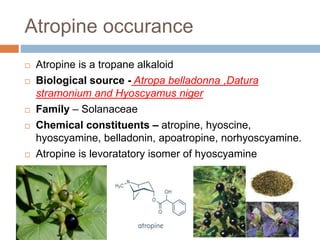
 Atropine is a tropane alkaloid
 Biological source - Atropa belladonna ,Datura
stramonium and Hyoscyamus niger
 Family – Solanaceae
 Chemical constituents – atropine, hyoscine,
hyoscyamine, belladonin, apoatropine, norhyoscyamine.
 Atropine is levoratatory isomer of hyoscyamine
Extraction and Isolation
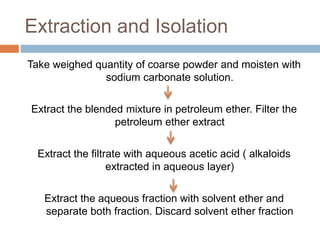
Take weighed quantity of coarse powder and moisten with
sodium carbonate solution.
Extract the blended mixture in petroleum ether. Filter the
petroleum ether extract
Extract the filtrate with aqueous acetic acid ( alkaloids
extracted in aqueous layer)
Extract the aqueous fraction with solvent ether and
separate both fraction. Discard solvent ether fraction
Extraction and Isolation
Aqueous (Acidic fraction) made alkaline with sodium
carbonate solution to obtain precipitates of tropane
alkaloids.
Filter the precipitate and dry to obtain residue.
Dissolve the residue in diethyl ether .
Filter and concentrate the filtrate.
Extraction and Isolation
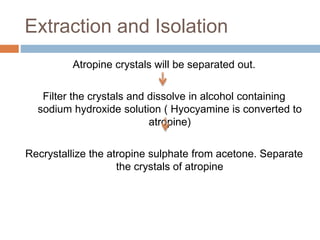
Atropine crystals will be separated out.
Filter the crystals and dissolve in alcohol containing
sodium hydroxide solution ( Hyocyamine is converted to
atropine)
Recrystallize the atropine sulphate from acetone. Separate
the crystals of atropine
Chraterization of atropine
Thin-layer chromatography (TLC)
 Sample preparation – Dissolved 1mg of Atropine in 1ml
of Chloroform
 Stationary phase - Silica gel –G
 Standard sample - Atropine
 Detecting agent – Drangendroffs reagent to produce
yellow orange Color spots
 Mobile phase – Toluene - Ethyl acetate – Diethyl amine
(70:20:10)
 RF Value – Compare with standard Atropine (0.70)
Thin-layer chromatography
(TLC)
Identification
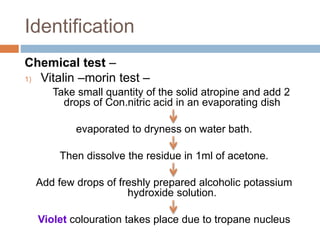
Chemical test –
1) Vitalin –morin test –
Take small quantity of the solid atropine and add 2
drops of Con.nitric acid in an evaporating dish
evaporated to dryness on water bath.
Then dissolve the residue in 1ml of acetone.
Add few drops of freshly prepared alcoholic potassium
hydroxide solution.
Violet colouration takes place due to tropane nucleus
Uses
 Atropine is a prescription medicine used to
treat the symptoms of low heart rate
(bradycardia)
 reduce salivation and bronchial secretions
before surgery
 antidote for overdose of cholinergic drugs or
mushroom poisoning.
 Antispasmodic
 Mydriatic
QUININE
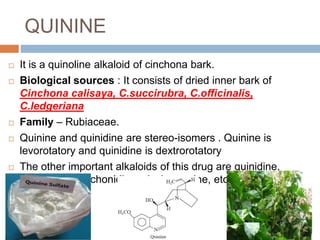
 It is a quinoline alkaloid of cinchona bark.
 Biological sources : It consists of dried inner bark of
Cinchona calisaya, C.succirubra, C.officinalis,
C.ledgeriana
 Family – Rubiaceae.
 Quinine and quinidine are stereo-isomers . Quinine is
levorotatory and quinidine is dextrorotatory
 The other important alkaloids of this drug are quinidine,
cinchonine, cinchonidine, cinchonamine, etc.
ISOLATION
 The dry powder bark material is first well mixed with
about 30% of its weight of calcium hydroxide or calcium
oxide
 Sufficient quantity of sodium hydroxide solution to make
a paste.
 It is allowed to stand for few hours.
 The mass is then transferred to a Soxhlet apparatus
and extraction is carried out with benzene
ISOLATION
 Subsequently the benzene extract is shaken with
successive portions of 5% sulphuric acid.
 The aqueous acid extract is adjusted the pH 6.5 with
dilute sodium hydroxide, cool.
 Crystals of neutral quinine sulphate are formed.
 These crystals are freed from cinchonine and
cinchonidine by repeated recrystallization from hot water
ISOLATION
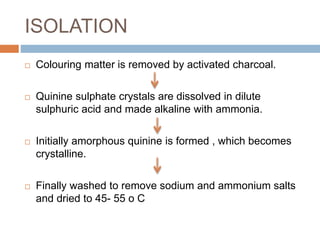
 Colouring matter is removed by activated charcoal.
 Quinine sulphate crystals are dissolved in dilute
sulphuric acid and made alkaline with ammonia.
 Initially amorphous quinine is formed , which becomes
crystalline.
 Finally washed to remove sodium and ammonium salts
and dried to 45- 55 o C
Charaterization
A. Thin-layer chromatography (TLC)
 Method Sample preparation – Dissolved
about 1mg of Quinine or Cinchona alkaloid in
1ml of methanol
 Stationary phase - Silica gel –G
 Mobile phase – Chloroform – Diethylamine
(9:1)
 Standard sample – quinine sulphate
 Detecting agent – Dragendroffs reagent
 RF Value – Quinine – 0.17, Quinidine -0.26
Charaterization
B. Identification tests
 Drug + little glacial acetic acid heat in dry test
tube purple vapors are produced cinchona
present
 A greenish resinous mass obtained by
treating an aqueous solution of quinine
sulphate with chlorin or bromine and then
adding ammonia in excess. This is an identity-
test for quinine.
 Aqueous extract + silver nitrate gives white
ppt produced which is soluble in nitric acid
quinidine present.
Uses
 Quinine is antimalarial
 Quinidine is a cardiac depressant
 Quinidine used in cardiac arrhythmias.
 Quinidine is valuable in preventing atrial
fibrillation
 Cinchona is bitter stomachic
 Anti-pyretic
Bibliography
 Kokate, C.K., Purohit, A.P. and Gohkale, S.B.
(2019) Pharmacognosy. In Terpenoids, 57th
Edition, Nirali Prakashan, Pune.
 Pharmacognosy And Phytochemistry By Vinod
Rangari. 2009 2nd edition, Career Publications.
ISOLATION IDENTIFICATION of alkaloids atropine and quinine.pptx