K.B.H.S.S TRUST INSTITUTE OF
PHARMACY
• Presented by: Rahil Wahid Khan
• Roll no: 52.
• Class: Third year b. Pharm
• Subject: pharmacognosy-ll
• Guided by:prof. Deepak Somavanshi
SENNA LEAFLET
SENNA LEAFLET
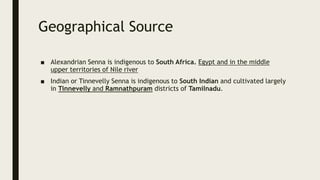
■ Synonyms: Alexandrian Senna, Tinnevelly Senna Senna leaf, Senna folium,
Indian Senna, Sonamukhi Patti.
■ Biological Source: Senna leaf consists of the dried leaflets of Cassia acutifolia
known as Alexandrian Senna and of C. Angustifolia which is commercially
known as Tinnevelly Senna.
■ It belong family Leguminosae.
Geographical Source
■ Alexandrian Senna is indigenous to South Africa. Egypt and in the middle
upper territories of Nile river
■ Indian or Tinnevelly Senna is indigenous to South Indian and cultivated largely
in Tinnevelly and Ramnathpuram districts of Tamilnadu.
Morphology
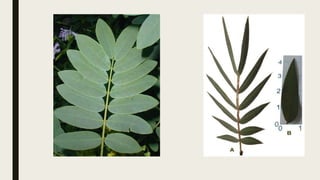
Senna Tinnevelly Senna Alexandrian Senna
Colour Light green Light greyish green
Odour Faint Faint
Test Bitter mucilaginous Bitter mucilaginous
Size 2.5-5.0 cm long & 7- 9 mm
wide
2.4 cm long & 6-10 mm wide
Shape Lanceolate Ovate Lanceolate
Appearance Generally entire and less
broken
Broken and Brittle
Apex Less acute with sharp spine Acute
Margin Entire Entire, curled
Base Less asymmetrical Conspicuously asymmetrical
Surface Less Pubescent More Pubescent
Cultivation, collection and preparation
■ CULTIVATION:
■ DONE BY SOWING THE SEEDS EITHER BY BROADCASTING OR DIBBLING METHOD.
FOR QUICK GERMINATION, POUNDING OF THE SEEDS WITH COARSE SAND IN
MORTAR IS DONE AS THE SEEDS ARE TOUGH COATED. THE CULTIVATION IS DONE
TWICE IN A YEAR, I.E. IN MARCH/APRIL AND NOVEMBER/DECEMBER.
■ CONDITION UNDER WHICH SENNA GROWS PROPERLY
■ DRY CONDITION, RED SOIL OR BLACK SOIL, WELL DRAINED IRRIGATED LAND
■ THE HARVESTED LEAVES ARE SPREAD OF THE FLOOR UNDER SHADE WITHOUT
OVERLAPPING
■ YELLOWISH GREEN LEAVES HAVE HIGH VALUE IN MARKET & YELLOW LEAVES ARE
OF POOR QUALITY. THE LEAVES ARE PRESSED, PACKED IN BAGS AND EVAPORATED
TO THE MARKETS
Chemical constituents
■ Sennosides A and B Aglycones sennidin A and B
■ Sennosides C and D Heterodianthrones of aloe- emodin and rhein
■ palmidin A.
■ Rhein anthrone and
■ Aloe-emodin glycosides.
■ Free chryso-phanol, emodin and their glycosides and free aloe- emodin, rhein,
their monoanthrones, dianthrones and their glycosides.
■ Mucilage is present in the epidermis of the leaf.
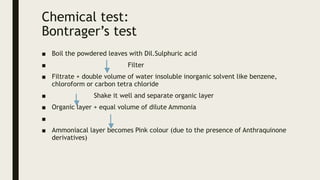
Chemical test:
Bontrager’s test
■ Boil the powdered leaves with Dil.Sulphuric acid
■ Filter
■ Filtrate + double volume of water insoluble inorganic solvent like benzene,
chloroform or carbon tetra chloride
■ Shake it well and separate organic layer
■ Organic layer + equal volume of dilute Ammonia
■
■ Ammoniacal layer becomes Pink colour (due to the presence of Anthraquinone
derivatives)
Uses
■ Senna leaves are used as laxative.
■ It causes irritation of large intestine and have some griping effect. Thus they
are prescribed along with carminatives.
■ Senna is stimulant cathartic and exerts its action by increasing the tone of the
smooth muscles in large intestine.
References
1. Gokhale S.B., Sanghal D.B., kalaskar M.G. “ Pharmacognosy and
phytochemistry”, first edition, Nirali prakashan, page no. 2.47-
2.48.
2. Shirsat Mrunal K, “Practical Handbook of Pharmacognosy: As per
New Syllabus, Success publication, 1st edition, 2017 Page No. 10-
15
3. https://youtu.be/yc4L9dlwAOg?si=5M4QQPb1NpLLf6ZO
senna plant pharmacognosy in b. Pharmacy