






Metallurgy: Mining
● Introduction of Mining
● Mining Industry
● Prospecting and Exploration
REPORTED BY: CANOY, CLAIRE E.
YR & SEC.
: 2B2- CHEMICAL ENGINEERING
TECHNOLOGY
Introduction of Mining
● Mining is the extraction of valuable minerals or other
geological materials from the earth, usually from an ore
body, vein or (coal) seam.

● Any material that cannot be grown through
agricultural processes, or created artificially in a
laboratory or factory, is usually mined. Mining in a
wider sense include extraction of non-renewable
resource
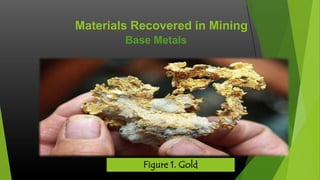
Materials Recovered in Mining
Base Metals

Figure 1. Gold
Materials Recovered in Mining

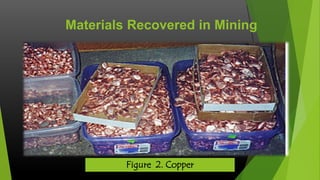
Figure 2. Copper
Materials Recovered in Mining

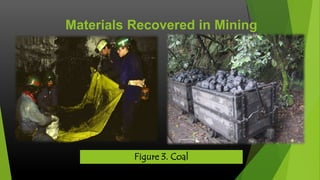
Figure 3. Coal
Materials Recovered in Mining

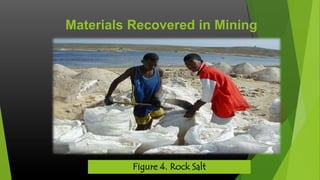
Figure 4. Rock Salt
Materials Recovered in Mining

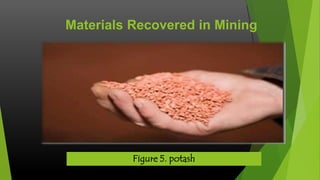
Figure 5. potash
Materials Recovered in Mining

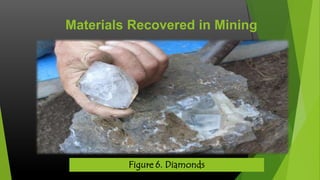
Figure 6. Diamonds
Materials Recovered in Mining

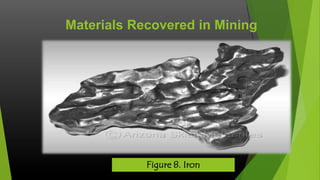
Figure 8. Iron
Materials Recovered in Mining

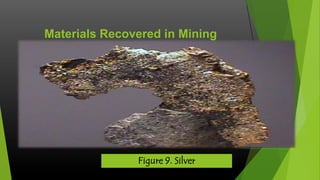
Figure 9. Silver
Materials Recovered in Mining

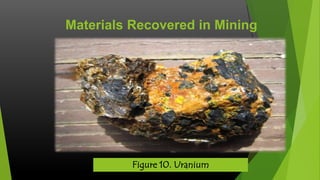
Figure 10. Uranium
Materials Recovered in Mining

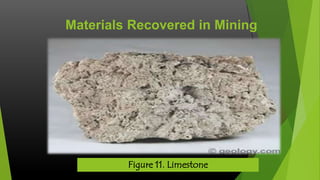
Figure 11. Limestone
History of Mining
History of Mining
Stone Age
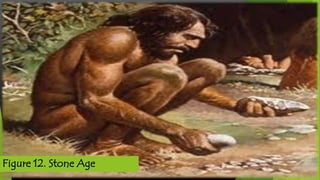
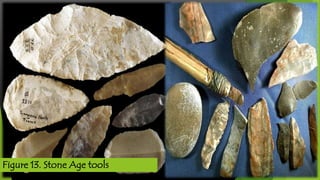
Old Stone Age man used tools of wood, stone,
horn, or bone to dig flint from softer chalk and
limestone.
Figure 12. Stone Age
Figure 13. Stone Age tools
History of Mining
Bronze Age
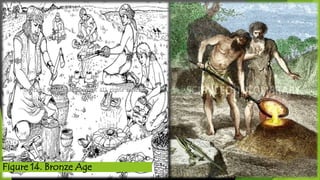
It is known that bronze age man valued copper and
bronze as both artistic and practical objects. The ore was
gained by using only simple stone and bone tools.
It is thought that initially raw metallic copper found on
the surface would have attracted the ancients to the uses
of copper.
Figure 14. Bronze Age
History of Mining
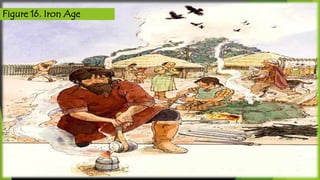
Iron Age
Iron age generally is considering to have started about
1200 B.C.
Existing iron ore deposits were not exploited in ancient
Egypt until the Late Period, but the metal was occasionally
found in its meteoric form and put to use as early as the
4th millennium BCE.
Figure 16. Iron Age
History of Mining
Iron Age
The smelting of iron was by the process known as the
'Bloomery' method.
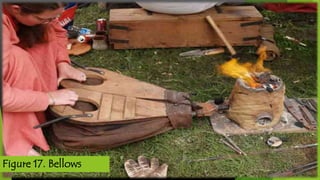
Bellows were used to fan the flames and the end
product was a malleable ball of impure iron which could be
hammered to shape.
Figure 17. Bellows
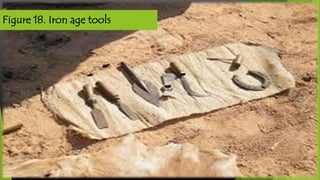
Figure 18. Iron age tools
Mining industry
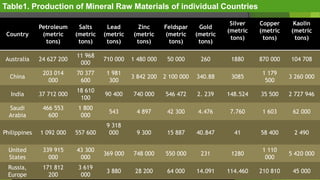
Table1. Production of Mineral Raw Materials of individual Countries
Silver
(metric
tons)

Copper
(metric
tons)

Kaolin
(metric
tons)

260

1880

870 000

104 708

2 100 000

340.88

3085

1 179
500

3 260 000

740 000

546 472

2. 239

148.524

35 500

2 727 946

543

4 897

42 300

4.476

7.760

1 603

62 000

9 318
000

9 300

15 887

40.847

41

58 400

2 490

Country

Petroleum
(metric
tons)

Salts
(metric
tons)

Lead
(metric
tons)

Zinc
(metric
tons)

Feldspar
(metric
tons)

Gold
(metric
tons)

Australia

24 627 200

11 968
000

710 000

1 480 000

50 000

China

203 014
000

70 377
600

1 981
300

3 842 200

India

37 712 000

18 610
100

90 400

Saudi
Arabia

466 553
600

1 800
000

Philippines

1 092 000

557 600

United
States

339 915
000

43 300
000

369 000

748 000

550 000

231

1280

1 110
000

5 420 000

Russia,
Europe

171 812
200

3 619
000

3 880

28 200

64 000

14.091

114.460

210 810

45 000
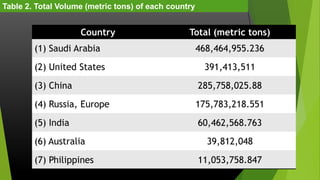
Table 2. Total Volume (metric tons) of each country

Country

Total (metric tons)

(1) Saudi Arabia

468,464,955.236

(2) United States

391,413,511

(3) China

285,758,025.88

(4) Russia, Europe

175,783,218.551

(5) India

60,462,568.763

(6) Australia

(7) Philippines

39,812,048

11,053,758.847
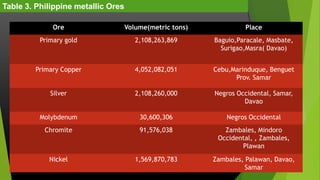
Table 3. Philippine metallic Ores
Ore

Volume(metric tons)

Place

Primary gold

2,108,263,869

Baguio,Paracale, Masbate,
Surigao,Masra( Davao)

Primary Copper

4,052,082,051

Cebu,Marinduque, Benguet
Prov. Samar

Silver

2,108,260,000

Negros Occidental, Samar,
Davao

Molybdenum

30,600,306

Negros Occidental

Chromite

91,576,038

Zambales, Mindoro
Occidental, , Zambales,
Plawan

Nickel

1,569,870,783

Zambales, Palawan, Davao,
Samar
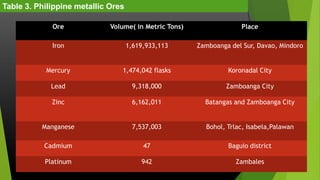
Table 3. Philippine metallic Ores
Ore

Volume( in Metric Tons)

Place

Iron

1,619,933,113

Zamboanga del Sur, Davao, Mindoro

Mercury

1,474,042 flasks

Koronadal City

Lead

9,318,000

Zamboanga City

Zinc

6,162,011

Batangas and Zamboanga City

Manganese

7,537,003

Bohol, Trlac, Isabela,Palawan

Cadmium

47

Baguio district

Platinum

942

Zambales
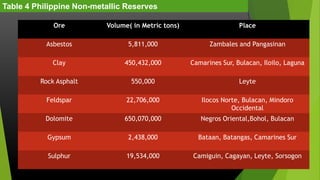
Table 4 Philippine Non-metallic Reserves
Ore

Volume( in Metric tons)

Place

Asbestos

5,811,000

Zambales and Pangasinan

Clay

450,432,000

Camarines Sur, Bulacan, Iloilo, Laguna

Rock Asphalt

550,000

Leyte

Feldspar

22,706,000

Ilocos Norte, Bulacan, Mindoro
Occidental

Dolomite

650,070,000

Negros Oriental,Bohol, Bulacan

Gypsum

2,438,000

Bataan, Batangas, Camarines Sur

Sulphur

19,534,000

Camiguin, Cagayan, Leyte, Sorsogon
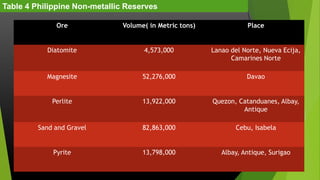
Table 4 Philippine Non-metallic Reserves
Ore

Volume( in Metric tons)

Place

Diatomite

4,573,000

Lanao del Norte, Nueva Ecija,
Camarines Norte

Magnesite

52,276,000

Davao

Perlite

13,922,000

Quezon, Catanduanes, Albay,
Antique

Sand and Gravel

82,863,000

Cebu, Isabela

Pyrite

13,798,000

Albay, Antique, Surigao
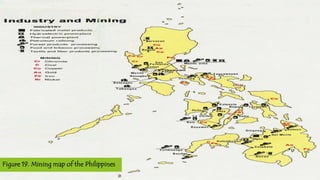
Figure 19. Mining map of the Philippines
Prospecting and
exploration
What is Prospecting ?
The process of looking for mineral
deposits.
Types of Prospecting
● Traditional Prospecting

● Modern Prospecting
Types of Prospecting
Traditional Prospecting
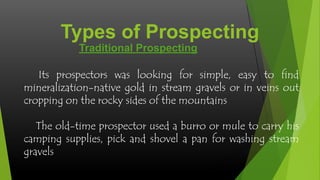
Its prospectors was looking for simple, easy to find
mineralization-native gold in stream gravels or in veins out
cropping on the rocky sides of the mountains
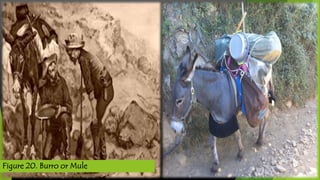
The old-time prospector used a burro or mule to carry his
camping supplies, pick and shovel a pan for washing stream
gravels
Figure 20. Burro or Mule
Types of Prospecting
Modern Prospecting
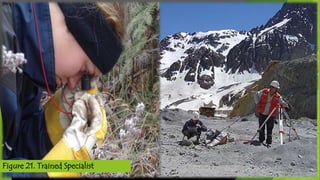
The modern prospector is a member of a team of highly
trained specialists who use sophisticated equipment in a planned,
systematic search. The team generally include experts in
geology, geophysics, geochemistry, computer techniques,
drilling, mineral economics, metallurgy, and related fields.
Figure 21. Trained Specialist
Geological guides in
prospecting
Prospecting
Geological guides in prospecting

Metallogenic associations
-It

deals with the location where undiscovered mineral
deposit relative of know regional trends of related
deposits.
Prospecting
Geological guides in prospecting

Natural associations
The relation of ore deposited structural features
such as faults, brecciate and conformities and the
boarders of intrusions is used as a guide in
prospecting
Prospecting
Geological guides in prospecting

Zoning
Most closely followed guides to ore is the
expected pattern of mineral zoning. Ore and
gangue minerals change in character with
distance from the center of mineralization.
Prospecting
Geological guides in prospecting

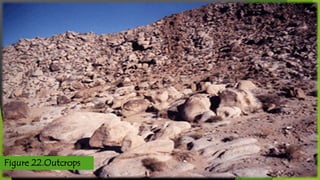
Outcrops
Gossans, the residue of red, brown, and yellow
iron oxides and silica that remains from the
weathering is used in prospecting as a guide to
hidden primary mineralization.
Figure 22.Outcrops
Prospecting methods
Prospecting
Prospecting methods


Direct method



Geochemical method



Biochemical method



Geobotanical method



Remote sensing
Prospecting
Prospecting methods
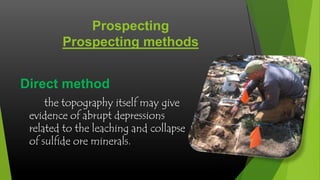
Direct method
the topography itself may give
evidence of abrupt depressions
related to the leaching and collapse
of sulfide ore minerals.
Prospecting
Prospecting methods
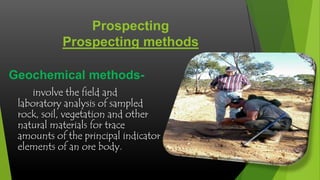
Geochemical methodsinvolve the field and
laboratory analysis of sampled
rock, soil, vegetation and other
natural materials for trace
amounts of the principal indicator
elements of an ore body.
Prospecting
Prospecting methods
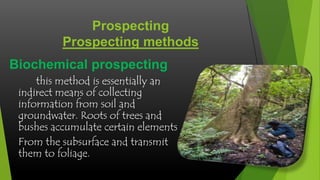
Biochemical prospecting
this method is essentially an
indirect means of collecting
information from soil and
groundwater. Roots of trees and
bushes accumulate certain elements
From the subsurface and transmit
them to foliage.
Prospecting
Prospecting methods
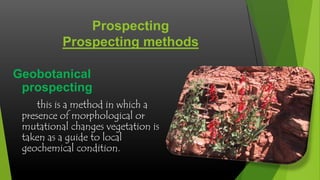
Geobotanical
prospecting
this is a method in which a
presence of morphological or
mutational changes vegetation is
taken as a guide to local
geochemical condition.
Prospecting
Prospecting methods
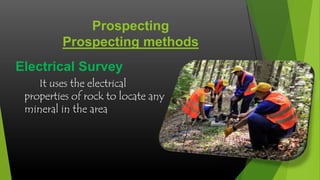
Electrical Survey
It uses the electrical
properties of rock to locate any
mineral in the area
Equipments use in
prospecting
Equipments Use in Prospecting
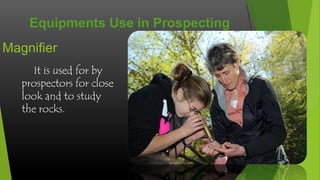
Magnifier
It is used for by
prospectors for close
look and to study
the rocks.
Equipments Use in Prospecting

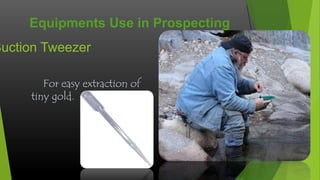
Suction Tweezer
For easy extraction of
tiny gold.
Equipments Use in Prospecting
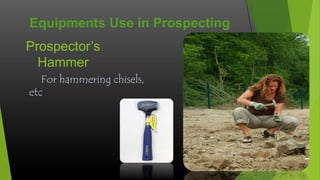
Prospector’s
Hammer
For hammering chisels,
etc
Equipments Use in Prospecting
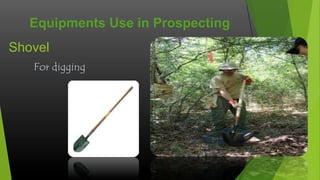
Shovel
For digging
Equipments Use in Prospecting
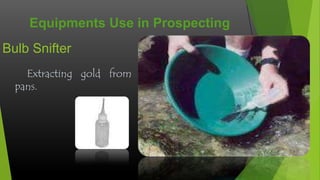
Bulb Snifter
Extracting gold from
pans.
Equipments Use in Prospecting
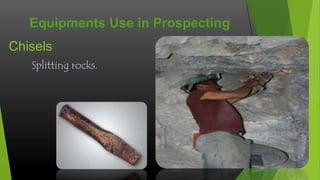
Chisels
Splitting rocks.
Equipments Use in Prospecting
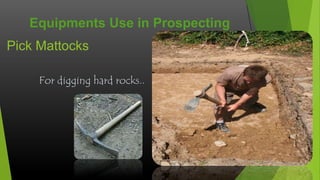
Pick Mattocks
For digging hard rocks..
Equipments Use in Prospecting
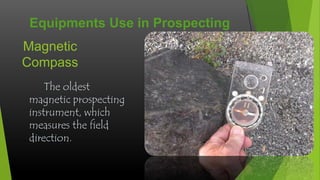
Magnetic
Compass
The oldest
magnetic prospecting
instrument, which
measures the field
direction.
Exploration
What is Exploration?
Exploration is the process of closely
examining a deposits to determined it’s
size, shape, mineral content and other
characteristics.
Exploration
Exploration techniques
Geological Inference

This is the primary method in the initial stage of
exploration, it is critical in interpreting the results of other
methods.

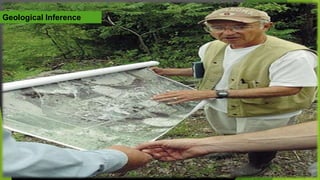
The prospecting team starts with geologic map of the
region. Such map shows the various kinds of rocks at the surface
and for thousands of feet underground as well the structural
features of the rocks thickness of beds, folds, faults, fractures, and
intrusions.
Geological Inference
Exploration
Exploration techniques
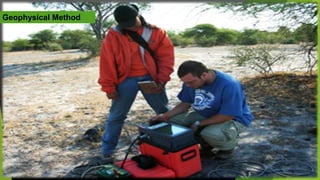
Geophysical method
involve the measuring slight differences in
physical properties of rocks and minerals.
Geophysical Method
Equipments use in
Exploration
Exploration
equipments
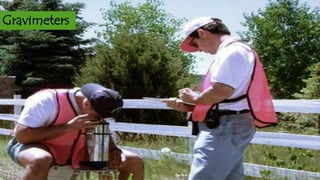
Gravimeters
Use in gravity method which typically consist
of a weigh attached to a string that stretches or
contracts corresponding to an increase or decrease
in gravity.
Gravimeters
Exploration
equipments
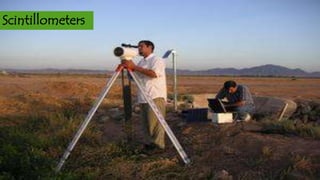
Scintillometers
Scintillometers is a device used to measure small
fluctuations of the refractive index of air caused by
variations in temperature, humidity and pressure.
Scintillometers
Exploration
equipments
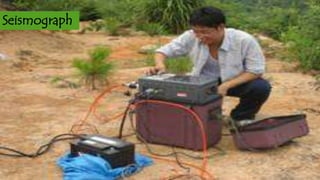
Seismograph
Use to measure earthquake. The goal of the
seismograph is to accurately record the motion of
the ground during a quake.
Seismograph

Mining (2)

  • 1.
    Metallurgy: Mining ● Introductionof Mining ● Mining Industry ● Prospecting and Exploration REPORTED BY: CANOY, CLAIRE E. YR & SEC. : 2B2- CHEMICAL ENGINEERING TECHNOLOGY
  • 2.
    Introduction of Mining ●Mining is the extraction of valuable minerals or other geological materials from the earth, usually from an ore body, vein or (coal) seam. ● Any material that cannot be grown through agricultural processes, or created artificially in a laboratory or factory, is usually mined. Mining in a wider sense include extraction of non-renewable resource
  • 3.
    Materials Recovered inMining Base Metals Figure 1. Gold
  • 4.
    Materials Recovered inMining Figure 2. Copper
  • 5.
    Materials Recovered inMining Figure 3. Coal
  • 6.
    Materials Recovered inMining Figure 4. Rock Salt
  • 7.
    Materials Recovered inMining Figure 5. potash
  • 8.
    Materials Recovered inMining Figure 6. Diamonds
  • 9.
    Materials Recovered inMining Figure 8. Iron
  • 10.
    Materials Recovered inMining Figure 9. Silver
  • 11.
    Materials Recovered inMining Figure 10. Uranium
  • 12.
    Materials Recovered inMining Figure 11. Limestone
  • 13.
  • 14.
    History of Mining StoneAge Old Stone Age man used tools of wood, stone, horn, or bone to dig flint from softer chalk and limestone.
  • 15.
  • 16.
  • 17.
    History of Mining BronzeAge It is known that bronze age man valued copper and bronze as both artistic and practical objects. The ore was gained by using only simple stone and bone tools. It is thought that initially raw metallic copper found on the surface would have attracted the ancients to the uses of copper.
  • 18.
  • 19.
    History of Mining IronAge Iron age generally is considering to have started about 1200 B.C. Existing iron ore deposits were not exploited in ancient Egypt until the Late Period, but the metal was occasionally found in its meteoric form and put to use as early as the 4th millennium BCE.
  • 20.
  • 21.
    History of Mining IronAge The smelting of iron was by the process known as the 'Bloomery' method. Bellows were used to fan the flames and the end product was a malleable ball of impure iron which could be hammered to shape.
  • 22.
  • 23.
    Figure 18. Ironage tools
  • 24.
  • 25.
    Table1. Production ofMineral Raw Materials of individual Countries Silver (metric tons) Copper (metric tons) Kaolin (metric tons) 260 1880 870 000 104 708 2 100 000 340.88 3085 1 179 500 3 260 000 740 000 546 472 2. 239 148.524 35 500 2 727 946 543 4 897 42 300 4.476 7.760 1 603 62 000 9 318 000 9 300 15 887 40.847 41 58 400 2 490 Country Petroleum (metric tons) Salts (metric tons) Lead (metric tons) Zinc (metric tons) Feldspar (metric tons) Gold (metric tons) Australia 24 627 200 11 968 000 710 000 1 480 000 50 000 China 203 014 000 70 377 600 1 981 300 3 842 200 India 37 712 000 18 610 100 90 400 Saudi Arabia 466 553 600 1 800 000 Philippines 1 092 000 557 600 United States 339 915 000 43 300 000 369 000 748 000 550 000 231 1280 1 110 000 5 420 000 Russia, Europe 171 812 200 3 619 000 3 880 28 200 64 000 14.091 114.460 210 810 45 000
  • 26.
    Table 2. TotalVolume (metric tons) of each country Country Total (metric tons) (1) Saudi Arabia 468,464,955.236 (2) United States 391,413,511 (3) China 285,758,025.88 (4) Russia, Europe 175,783,218.551 (5) India 60,462,568.763 (6) Australia (7) Philippines 39,812,048 11,053,758.847
  • 27.
    Table 3. Philippinemetallic Ores Ore Volume(metric tons) Place Primary gold 2,108,263,869 Baguio,Paracale, Masbate, Surigao,Masra( Davao) Primary Copper 4,052,082,051 Cebu,Marinduque, Benguet Prov. Samar Silver 2,108,260,000 Negros Occidental, Samar, Davao Molybdenum 30,600,306 Negros Occidental Chromite 91,576,038 Zambales, Mindoro Occidental, , Zambales, Plawan Nickel 1,569,870,783 Zambales, Palawan, Davao, Samar
  • 28.
    Table 3. Philippinemetallic Ores Ore Volume( in Metric Tons) Place Iron 1,619,933,113 Zamboanga del Sur, Davao, Mindoro Mercury 1,474,042 flasks Koronadal City Lead 9,318,000 Zamboanga City Zinc 6,162,011 Batangas and Zamboanga City Manganese 7,537,003 Bohol, Trlac, Isabela,Palawan Cadmium 47 Baguio district Platinum 942 Zambales
  • 29.
    Table 4 PhilippineNon-metallic Reserves Ore Volume( in Metric tons) Place Asbestos 5,811,000 Zambales and Pangasinan Clay 450,432,000 Camarines Sur, Bulacan, Iloilo, Laguna Rock Asphalt 550,000 Leyte Feldspar 22,706,000 Ilocos Norte, Bulacan, Mindoro Occidental Dolomite 650,070,000 Negros Oriental,Bohol, Bulacan Gypsum 2,438,000 Bataan, Batangas, Camarines Sur Sulphur 19,534,000 Camiguin, Cagayan, Leyte, Sorsogon
  • 30.
    Table 4 PhilippineNon-metallic Reserves Ore Volume( in Metric tons) Place Diatomite 4,573,000 Lanao del Norte, Nueva Ecija, Camarines Norte Magnesite 52,276,000 Davao Perlite 13,922,000 Quezon, Catanduanes, Albay, Antique Sand and Gravel 82,863,000 Cebu, Isabela Pyrite 13,798,000 Albay, Antique, Surigao
  • 31.
    Figure 19. Miningmap of the Philippines
  • 32.
  • 33.
    What is Prospecting? The process of looking for mineral deposits.
  • 34.
    Types of Prospecting ●Traditional Prospecting ● Modern Prospecting
  • 35.
    Types of Prospecting TraditionalProspecting Its prospectors was looking for simple, easy to find mineralization-native gold in stream gravels or in veins out cropping on the rocky sides of the mountains The old-time prospector used a burro or mule to carry his camping supplies, pick and shovel a pan for washing stream gravels
  • 36.
  • 37.
    Types of Prospecting ModernProspecting The modern prospector is a member of a team of highly trained specialists who use sophisticated equipment in a planned, systematic search. The team generally include experts in geology, geophysics, geochemistry, computer techniques, drilling, mineral economics, metallurgy, and related fields.
  • 38.
  • 39.
  • 40.
    Prospecting Geological guides inprospecting Metallogenic associations -It deals with the location where undiscovered mineral deposit relative of know regional trends of related deposits.
  • 41.
    Prospecting Geological guides inprospecting Natural associations The relation of ore deposited structural features such as faults, brecciate and conformities and the boarders of intrusions is used as a guide in prospecting
  • 42.
    Prospecting Geological guides inprospecting Zoning Most closely followed guides to ore is the expected pattern of mineral zoning. Ore and gangue minerals change in character with distance from the center of mineralization.
  • 43.
    Prospecting Geological guides inprospecting Outcrops Gossans, the residue of red, brown, and yellow iron oxides and silica that remains from the weathering is used in prospecting as a guide to hidden primary mineralization.
  • 44.
  • 45.
  • 46.
    Prospecting Prospecting methods  Direct method  Geochemicalmethod  Biochemical method  Geobotanical method  Remote sensing
  • 47.
    Prospecting Prospecting methods Direct method thetopography itself may give evidence of abrupt depressions related to the leaching and collapse of sulfide ore minerals.
  • 48.
    Prospecting Prospecting methods Geochemical methodsinvolvethe field and laboratory analysis of sampled rock, soil, vegetation and other natural materials for trace amounts of the principal indicator elements of an ore body.
  • 49.
    Prospecting Prospecting methods Biochemical prospecting thismethod is essentially an indirect means of collecting information from soil and groundwater. Roots of trees and bushes accumulate certain elements From the subsurface and transmit them to foliage.
  • 50.
    Prospecting Prospecting methods Geobotanical prospecting this isa method in which a presence of morphological or mutational changes vegetation is taken as a guide to local geochemical condition.
  • 51.
    Prospecting Prospecting methods Electrical Survey Ituses the electrical properties of rock to locate any mineral in the area
  • 52.
  • 53.
    Equipments Use inProspecting Magnifier It is used for by prospectors for close look and to study the rocks.
  • 54.
    Equipments Use inProspecting Suction Tweezer For easy extraction of tiny gold.
  • 55.
    Equipments Use inProspecting Prospector’s Hammer For hammering chisels, etc
  • 56.
    Equipments Use inProspecting Shovel For digging
  • 57.
    Equipments Use inProspecting Bulb Snifter Extracting gold from pans.
  • 58.
    Equipments Use inProspecting Chisels Splitting rocks.
  • 59.
    Equipments Use inProspecting Pick Mattocks For digging hard rocks..
  • 60.
    Equipments Use inProspecting Magnetic Compass The oldest magnetic prospecting instrument, which measures the field direction.
  • 61.
  • 62.
    What is Exploration? Explorationis the process of closely examining a deposits to determined it’s size, shape, mineral content and other characteristics.
  • 63.
    Exploration Exploration techniques Geological Inference Thisis the primary method in the initial stage of exploration, it is critical in interpreting the results of other methods. The prospecting team starts with geologic map of the region. Such map shows the various kinds of rocks at the surface and for thousands of feet underground as well the structural features of the rocks thickness of beds, folds, faults, fractures, and intrusions.
  • 64.
  • 65.
    Exploration Exploration techniques Geophysical method involvethe measuring slight differences in physical properties of rocks and minerals.
  • 66.
  • 67.
  • 68.
    Exploration equipments Gravimeters Use in gravitymethod which typically consist of a weigh attached to a string that stretches or contracts corresponding to an increase or decrease in gravity.
  • 69.
  • 70.
    Exploration equipments Scintillometers Scintillometers is adevice used to measure small fluctuations of the refractive index of air caused by variations in temperature, humidity and pressure.
  • 71.
  • 72.
    Exploration equipments Seismograph Use to measureearthquake. The goal of the seismograph is to accurately record the motion of the ground during a quake.
  • 73.