EXPLORATION OF
MINERAL DEPOSIT
DEFINITION

• Mineral exploration is the
process of finding ore to
mine. It is an
intensive, organized and
professional form of mineral
prospecting.

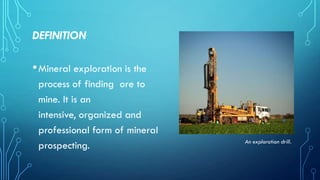
An exploration drill.
AREA SELECTION

• Area selection is the most
crucial part of mineral
exploration. Selecting the most
suitable area, geological field
and terrain will assist in making
the exploration easy, cheap
and quick.

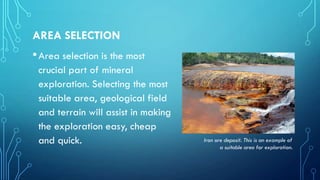
Iron ore deposit. This is an example of
a suitable area for exploration.
EXPLORATION METHODS:

GEOPHYSICS

• Geophysics uses physical methods to measure the
surface properties of the Earth.
Examples include geodesy, magnetic and electrical
techniques.
EXPLORATION METHODS:

REMOTE SENSING

• This term generally refers to the use of aerial sensor
technologies to detect and classify objects on Earth.
Today, satellites are widely used to take snapshots of
the area around the deposit in question.
EXPLORATION METHODS:

GEOCHEMICAL METHODS

• In mining
exploration, geochemis
try is used to identify
the anomaly that is
found within the area
of the mineral deposit.

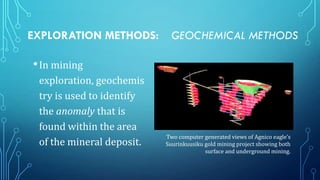
Two computer generated views of Agnico eagle’s
Suurinkuusiku gold mining project showing both
surface and underground mining.
RISK
•

The prices of minerals and exchange rates are constantly
changing

•

Poor access to exploration areas as a result of remoteness or
difficult terrain

•

Poor weather conditions over a prolonged period which
might negatively affect exploration activities and the timing of
earning revenues
GREENFIELDS AND BROWNFIELDS
• The area a mining exploration is being coducted is termed
either a greenfield or a brownfield.
A greenfield generally means an unspoilt area.

A brownfield is an area that was already drilled or explored upon.
It is almost always located nearby a known ore deposit.
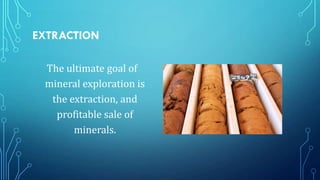
EXTRACTION
The ultimate goal of
mineral exploration is
the extraction, and
profitable sale of
minerals.
NEW WORDS
• Prospect- search for mineral deposits
• Intensive- very thorough
• Crucial- of great importance
• Suitable- right for a particular purpose
• Field- an area of open land
• Terrain- a stretch of land seen in terms of it is physical features: rough terrain
• Assist- support to something
• Method- a way of doing something
• Measure- find out the size of something be comparing it with a standard
• Include- contain something as part of a whole
• Aerial- existing in the air
• Refer- describe something
• Satellite- an artificial object placed in orbit round the earth
• Snapshot- an informal photograph
• Prolonged- continuing for long time
• Infrastructure- the basic structures needed for a society to function
• Anomaly- something that differs from what is normal
• Due- needing to be paid
• Uncertainty- not reliable
Mineral exploration

Mineral exploration

  • 1.
  • 2.
    DEFINITION • Mineral explorationis the process of finding ore to mine. It is an intensive, organized and professional form of mineral prospecting. An exploration drill.
  • 3.
    AREA SELECTION • Areaselection is the most crucial part of mineral exploration. Selecting the most suitable area, geological field and terrain will assist in making the exploration easy, cheap and quick. Iron ore deposit. This is an example of a suitable area for exploration.
  • 4.
    EXPLORATION METHODS: GEOPHYSICS • Geophysicsuses physical methods to measure the surface properties of the Earth. Examples include geodesy, magnetic and electrical techniques.
  • 5.
    EXPLORATION METHODS: REMOTE SENSING •This term generally refers to the use of aerial sensor technologies to detect and classify objects on Earth. Today, satellites are widely used to take snapshots of the area around the deposit in question.
  • 6.
    EXPLORATION METHODS: GEOCHEMICAL METHODS •In mining exploration, geochemis try is used to identify the anomaly that is found within the area of the mineral deposit. Two computer generated views of Agnico eagle’s Suurinkuusiku gold mining project showing both surface and underground mining.
  • 7.
    RISK • The prices ofminerals and exchange rates are constantly changing • Poor access to exploration areas as a result of remoteness or difficult terrain • Poor weather conditions over a prolonged period which might negatively affect exploration activities and the timing of earning revenues
  • 8.
    GREENFIELDS AND BROWNFIELDS •The area a mining exploration is being coducted is termed either a greenfield or a brownfield. A greenfield generally means an unspoilt area. A brownfield is an area that was already drilled or explored upon. It is almost always located nearby a known ore deposit.
  • 9.
    EXTRACTION The ultimate goalof mineral exploration is the extraction, and profitable sale of minerals.
  • 10.
    NEW WORDS • Prospect-search for mineral deposits • Intensive- very thorough • Crucial- of great importance • Suitable- right for a particular purpose • Field- an area of open land • Terrain- a stretch of land seen in terms of it is physical features: rough terrain • Assist- support to something
  • 11.
    • Method- away of doing something • Measure- find out the size of something be comparing it with a standard • Include- contain something as part of a whole • Aerial- existing in the air • Refer- describe something • Satellite- an artificial object placed in orbit round the earth • Snapshot- an informal photograph • Prolonged- continuing for long time • Infrastructure- the basic structures needed for a society to function
  • 12.
    • Anomaly- somethingthat differs from what is normal • Due- needing to be paid • Uncertainty- not reliable