Mining & Mineral Resources

Chapter 16, Section 2: Mineral Exploration &
                   Mining
           Standards: SEV4a, b, e
What are the steps in harvesting
      minerals?
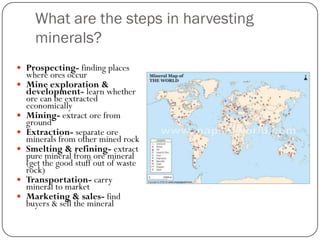
ď‚— Prospecting- finding places
    where ores occur
ď‚—   Mine exploration &
    development- learn whether
    ore can be extracted
    economically
ď‚—   Mining- extract ore from
    ground
ď‚—   Extraction- separate ore
    minerals from other mined rock
ď‚—   Smelting & refining- extract
    pure mineral from ore mineral
    (get the good stuff out of waste
    rock)
ď‚—   Transportation- carry
    mineral to market
ď‚—   Marketing & sales- find
    buyers & sell the mineral
How do we know where mineral
      deposits are located?
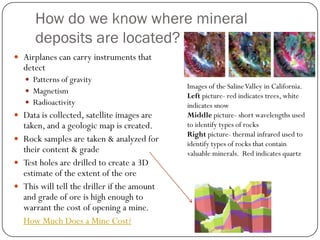
ď‚— Airplanes can carry instruments that
  detect
   ď‚— Patterns of gravity
                                             Images of the Saline Valley in California.
   ď‚— Magnetism
                                             Left picture- red indicates trees, white
   ď‚— Radioactivity                           indicates snow
ď‚— Data is collected, satellite images are    Middle picture- short wavelengths used
  taken, and a geologic map is created.      to identify types of rocks
                                             Right picture- thermal infrared used to
ď‚— Rock samples are taken & analyzed for
                                             identify types of rocks that contain
  their content & grade                      valuable minerals. Red indicates quartz
ď‚— Test holes are drilled to create a 3D
  estimate of the extent of the ore
ď‚— This will tell the driller if the amount
  and grade of ore is high enough to
  warrant the cost of opening a mine.
  How Much Does a Mine Cost?
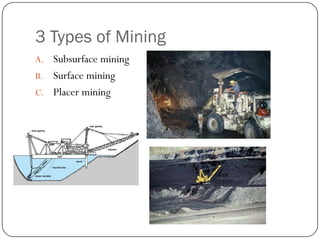
3 Types of Mining
A. Subsurface mining
B. Surface mining
C. Placer mining
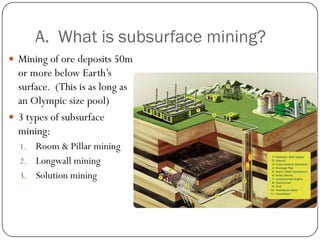
A. What is subsurface mining?
ď‚— Mining of ore deposits 50m
  or more below Earth’s
  surface. (This is as long as
  an Olympic size pool)
ď‚— 3 types of subsurface
  mining:
  1. Room & Pillar mining
  2. Longwall mining
  3. Solution mining
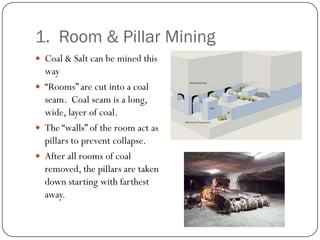
1. Room & Pillar Mining
ď‚— Coal & Salt can be mined this
  way
 “Rooms” are cut into a coal
  seam. Coal seam is a long,
  wide, layer of coal.
 The “walls” of the room act as
  pillars to prevent collapse.
ď‚— After all rooms of coal
  removed, the pillars are taken
  down starting with farthest
  away.
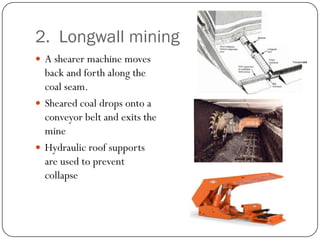
2. Longwall mining
ď‚— A shearer machine moves
  back and forth along the
  coal seam.
ď‚— Sheared coal drops onto a
  conveyor belt and exits the
  mine
ď‚— Hydraulic roof supports
  are used to prevent
  collapse
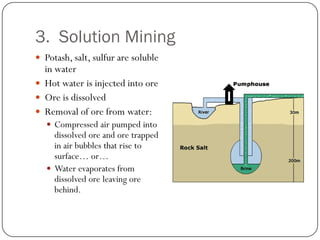
3. Solution Mining
ď‚— Potash, salt, sulfur are soluble
  in water
ď‚— Hot water is injected into ore
ď‚— Ore is dissolved
ď‚— Removal of ore from water:
   ď‚— Compressed air pumped into
     dissolved ore and ore trapped
     in air bubbles that rise to
     surface… or…
   ď‚— Water evaporates from
     dissolved ore leaving ore
     behind.
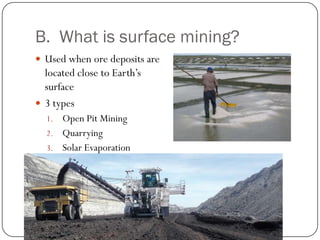
B. What is surface mining?
ď‚— Used when ore deposits are
  located close to Earth’s
  surface
ď‚— 3 types
  1. Open Pit Mining
  2. Quarrying
  3. Solar Evaporation
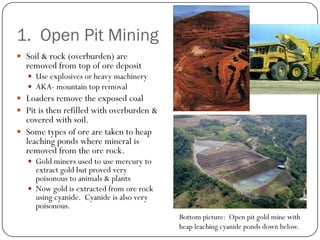
1. Open Pit Mining
ď‚— Soil & rock (overburden) are
  removed from top of ore deposit
   ď‚— Use explosives or heavy machinery
   ď‚— AKA- mountain top removal
ď‚— Loaders remove the exposed coal
ď‚— Pit is then refilled with overburden &
  covered with soil.
ď‚— Some types of ore are taken to heap
  leaching ponds where mineral is
  removed from the ore rock.
   ď‚— Gold miners used to use mercury to
     extract gold but proved very
     poisonous to animals & plants
   ď‚— Now gold is extracted from ore rock
     using cyanide. Cyanide is also very
     poisonous.
                                           Bottom picture: Open pit gold mine with
                                           heap leaching cyanide ponds down below.
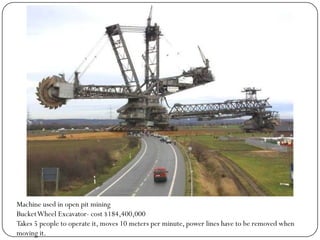
Machine used in open pit mining
Bucket Wheel Excavator- cost $184,400,000
Takes 5 people to operate it, moves 10 meters per minute, power lines have to be removed when
moving it.
2. Quarrying
ď‚— Open pit mine that is used
  to harvest
  ď‚— Granite
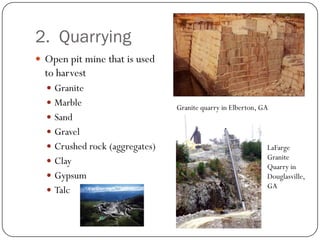
  ď‚— Marble                      Granite quarry in Elberton, GA
  ď‚— Sand
  ď‚— Gravel
  ď‚— Crushed rock (aggregates)                                LaFarge
                                                             Granite
  ď‚— Clay
                                                             Quarry in
  ď‚— Gypsum                                                   Douglasville,
                                                             GA
  ď‚— Talc
3. Solar Evaporation
  ď‚— Place sea water into
    shallow ponds
  ď‚— Water evaporates and
    leaves crystallized salt
    behind
   30% of world’s salt
    produced this way
  ď‚— Used largely in developing
    countries
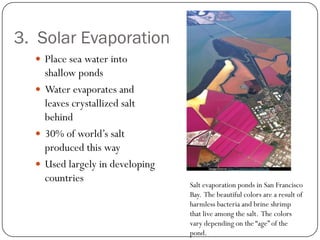
                                 Salt evaporation ponds in San Francisco
                                 Bay. The beautiful colors are a result of
                                 harmless bacteria and brine shrimp
                                 that live among the salt. The colors
                                 vary depending on the “age” of the
                                 pond.
C. What is placer mining?
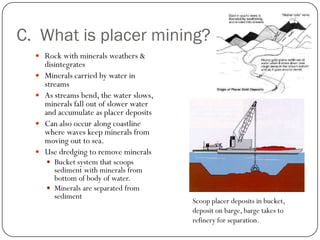
  ď‚— Rock with minerals weathers &
      disintegrates
  ď‚—   Minerals carried by water in
      streams
  ď‚—   As streams bend, the water slows,
      minerals fall out of slower water
      and accumulate as placer deposits
  ď‚—   Can also occur along coastline
      where waves keep minerals from
      moving out to sea.
  ď‚—   Use dredging to remove minerals
      ď‚— Bucket system that scoops
        sediment with minerals from
        bottom of body of water.
      ď‚— Minerals are separated from
        sediment
                                          Scoop placer deposits in bucket,
                                          deposit on barge, barge takes to
                                          refinery for separation.
How is mineral removed from ore?
ď‚— Smelting
  ď‚— Crushed ore heated to high temps.
  ď‚— Impurities are trapped by a
     material called flux & create slag
     that forms a layer on top of the
     melted metal which is easily
     removed (but toxic)
   ď‚— Purified molten metal falls to the
     bottom of the furnace and is
     harvested.
ď‚— Heap Leaching
  ď‚— Using chemicals to dissolve
     mineral from ore
   ď‚— Ex: cyanide used to remove gold
   ď‚— Ex: sulfuric acid used to remove
     copper


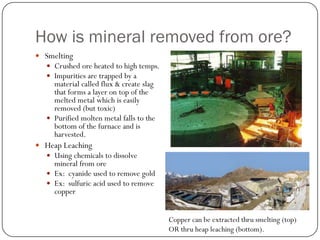
                                          Copper can be extracted thru smelting (top)
                                          OR thru heap leaching (bottom).

Unit 4 ch 16 s2 mineral exploration & mining

  • 1.
    Mining & MineralResources Chapter 16, Section 2: Mineral Exploration & Mining Standards: SEV4a, b, e
  • 2.
    What are thesteps in harvesting minerals? ď‚— Prospecting- finding places where ores occur ď‚— Mine exploration & development- learn whether ore can be extracted economically ď‚— Mining- extract ore from ground ď‚— Extraction- separate ore minerals from other mined rock ď‚— Smelting & refining- extract pure mineral from ore mineral (get the good stuff out of waste rock) ď‚— Transportation- carry mineral to market ď‚— Marketing & sales- find buyers & sell the mineral
  • 3.
    How do weknow where mineral deposits are located? ď‚— Airplanes can carry instruments that detect ď‚— Patterns of gravity Images of the Saline Valley in California. ď‚— Magnetism Left picture- red indicates trees, white ď‚— Radioactivity indicates snow ď‚— Data is collected, satellite images are Middle picture- short wavelengths used taken, and a geologic map is created. to identify types of rocks Right picture- thermal infrared used to ď‚— Rock samples are taken & analyzed for identify types of rocks that contain their content & grade valuable minerals. Red indicates quartz ď‚— Test holes are drilled to create a 3D estimate of the extent of the ore ď‚— This will tell the driller if the amount and grade of ore is high enough to warrant the cost of opening a mine. How Much Does a Mine Cost?
  • 4.
    3 Types ofMining A. Subsurface mining B. Surface mining C. Placer mining
  • 5.
    A. What issubsurface mining?  Mining of ore deposits 50m or more below Earth’s surface. (This is as long as an Olympic size pool)  3 types of subsurface mining: 1. Room & Pillar mining 2. Longwall mining 3. Solution mining
  • 6.
    1. Room &Pillar Mining  Coal & Salt can be mined this way  “Rooms” are cut into a coal seam. Coal seam is a long, wide, layer of coal.  The “walls” of the room act as pillars to prevent collapse.  After all rooms of coal removed, the pillars are taken down starting with farthest away.
  • 7.
    2. Longwall mining ď‚—A shearer machine moves back and forth along the coal seam. ď‚— Sheared coal drops onto a conveyor belt and exits the mine ď‚— Hydraulic roof supports are used to prevent collapse
  • 8.
    3. Solution Mining Potash, salt, sulfur are soluble in water  Hot water is injected into ore  Ore is dissolved  Removal of ore from water:  Compressed air pumped into dissolved ore and ore trapped in air bubbles that rise to surface… or…  Water evaporates from dissolved ore leaving ore behind.
  • 9.
    B. What issurface mining?  Used when ore deposits are located close to Earth’s surface  3 types 1. Open Pit Mining 2. Quarrying 3. Solar Evaporation
  • 10.
    1. Open PitMining ď‚— Soil & rock (overburden) are removed from top of ore deposit ď‚— Use explosives or heavy machinery ď‚— AKA- mountain top removal ď‚— Loaders remove the exposed coal ď‚— Pit is then refilled with overburden & covered with soil. ď‚— Some types of ore are taken to heap leaching ponds where mineral is removed from the ore rock. ď‚— Gold miners used to use mercury to extract gold but proved very poisonous to animals & plants ď‚— Now gold is extracted from ore rock using cyanide. Cyanide is also very poisonous. Bottom picture: Open pit gold mine with heap leaching cyanide ponds down below.
  • 11.
    Machine used inopen pit mining Bucket Wheel Excavator- cost $184,400,000 Takes 5 people to operate it, moves 10 meters per minute, power lines have to be removed when moving it.
  • 12.
    2. Quarrying ď‚— Openpit mine that is used to harvest ď‚— Granite ď‚— Marble Granite quarry in Elberton, GA ď‚— Sand ď‚— Gravel ď‚— Crushed rock (aggregates) LaFarge Granite ď‚— Clay Quarry in ď‚— Gypsum Douglasville, GA ď‚— Talc
  • 13.
    3. Solar Evaporation  Place sea water into shallow ponds  Water evaporates and leaves crystallized salt behind  30% of world’s salt produced this way  Used largely in developing countries Salt evaporation ponds in San Francisco Bay. The beautiful colors are a result of harmless bacteria and brine shrimp that live among the salt. The colors vary depending on the “age” of the pond.
  • 14.
    C. What isplacer mining? ď‚— Rock with minerals weathers & disintegrates ď‚— Minerals carried by water in streams ď‚— As streams bend, the water slows, minerals fall out of slower water and accumulate as placer deposits ď‚— Can also occur along coastline where waves keep minerals from moving out to sea. ď‚— Use dredging to remove minerals ď‚— Bucket system that scoops sediment with minerals from bottom of body of water. ď‚— Minerals are separated from sediment Scoop placer deposits in bucket, deposit on barge, barge takes to refinery for separation.
  • 15.
    How is mineralremoved from ore? ď‚— Smelting ď‚— Crushed ore heated to high temps. ď‚— Impurities are trapped by a material called flux & create slag that forms a layer on top of the melted metal which is easily removed (but toxic) ď‚— Purified molten metal falls to the bottom of the furnace and is harvested. ď‚— Heap Leaching ď‚— Using chemicals to dissolve mineral from ore ď‚— Ex: cyanide used to remove gold ď‚— Ex: sulfuric acid used to remove copper Copper can be extracted thru smelting (top) OR thru heap leaching (bottom).

Editor's Notes

  • #8 Middle picture is the shearer scraping a coal seam.Bottom picture is the hydraulic roof support
  • #11 Cyanide is very poisonous but does not accumulate in ecosystems like mercury which is probably why it is used.
  • #12 This would make an awesome Transformer!
  • #13 Small picture is talc quarry in France. For making talcum powder.