Introductory Mining
खनन ऩरयचम
Rathin Biswas यथीन बफश्वास
Manager (Mining) प्रफंधक (खनन)
RMD Training Centre आयएभडी प्रशिक्षण कें द्र
Raw Materials Division कच्चे भार प्रबाग
Steel Authority of India Limited स्टीर अथॉरयटी ऑप इंडडमा शरशभटेड
Contribution to Civilization
• Mining is the Second Endeavours of
human civilization
• Agriculture and Mining Supply all the
Basic resources need in the modern
Civilization
History
Stone Age Prior to 4000 BCE
Bronze Age 4000 to 1500 BCE
Iron Age 1500 BCE to 1780 CE
Steel Age 1780 to 1945 CE
Nuclear Age 1945 CE to Present
• The history of Mining is parallels to
the History of civilization
• Many important cultural eras
associated with and identified by
various minerals or their derivatives-
Terminology
• Mine: An excavation made in the earth to extract minerals
• Mining: the activity, occupation and industry concerned
with the extraction of minerals.
• Minerals: a natural occurring inorganic element or
compound having an orderly internal structure and a
characteristic chemical composition crystal form and
physical properties.
• Rock: any naturally formed aggregate of one or more types
of mineral particles
• Ore: a mineral deposit that has sufficient utility and value to
be mined at a profit
• Gangue: the valueless mineral particles within an ore
deposit that must be discarded
• Waste: the material associated with an ore deposit that
must be mined to get at the ore and must then be
discarded. Gangue is a particular type of waste.
Terminology .....
• Metallic Ores: those ores of the ferrous metals (iron,
manganese, molybdenum and tungsten), the base metals
(copper, lead, zinc and tin), the precious metals (gold,
silver, the platinum group metals) and the radioactive
minerals (uranium, thorium and radium)
• Non-metallic minerals (also known as industrial minerals):
the nonfuel mineral ores that are not associated with the
production of metals. These include phosphate, potash,
halite, trona, sand, gravel, limestone, sulphur, and many
others.
• Fossil fuels (also known as mineral fuels): the organic
mineral substances that can be utilize as fuels, such as
coal, petroleum, natural gas, coal bed methane, gilsonite
and tar sands.
Advancements in Technology
Date Event
450,000 BCE First Mining (Surface), by Paleolithic humans for stone
implements
40,000 Surface mining progress underground, Swaziland, Africa
30,000 Fired clay pots used in Czechoslovakia
18,000 Use of Gold and Copper in native form
5000 Fire setting to break rock, Egypt
4000 Early use of fabricated metals, start of Bronze Age
3400 First recorded mining, of turquoise by Egyptians in Sinai
3000 First smelting of copper with coal by Chinese; First use of iron
implements by Egyptians
2000 Earliest known Gold artifacts in New World, Peru
1000 Steel used by Greeks
Source: H L Hartman & J M Mutmansky, Introductory Mining Engineering (2nd Edition), John Wiley & Sons Inc
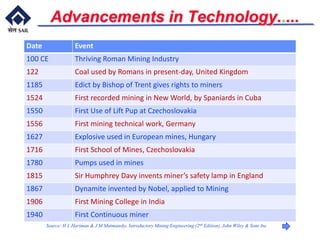
Advancements in Technology.....
Date Event
100 CE Thriving Roman Mining Industry
122 Coal used by Romans in present-day, United Kingdom
1185 Edict by Bishop of Trent gives rights to miners
1524 First recorded mining in New World, by Spaniards in Cuba
1550 First Use of Lift Pup at Czechoslovakia
1556 First mining technical work, Germany
1627 Explosive used in European mines, Hungary
1716 First School of Mines, Czechoslovakia
1780 Pumps used in mines
1815 Sir Humphrey Davy invents miner’s safety lamp in England
1867 Dynamite invented by Nobel, applied to Mining
1906 First Mining College in India
1940 First Continuous miner
Source: H L Hartman & J M Mutmansky, Introductory Mining Engineering (2nd Edition), John Wiley & Sons Inc
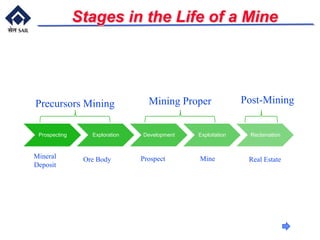
Stages in the Life of a Mine
Prospecting Exploration Development Exploitation Reclamation
Post-MiningMining ProperPrecursors Mining
Mineral
Deposit
Ore Body Prospect Mine Real Estate
Stages in the Life of a Mine.....
Prospecting Exploration Development Exploitation Reclamation
Purpose: Search for ore
Procedure:
•Prospecting Methods
•Direct: physical geologic
•Indirect: geophysical, geochemical
•Locate favourable loci (map, literature, old mine)
•Air: aerial photography, airborne geophysics, satellite
•Surface: ground geophysics, geology
•Spot anomaly, analyze, evaluate
Stages in the Life of a Mine.....
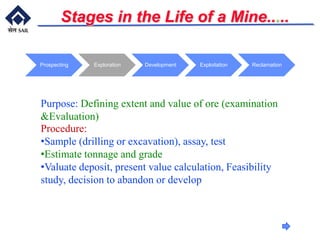
Prospecting Exploration Development Exploitation Reclamation
Purpose: Defining extent and value of ore (examination
&Evaluation)
Procedure:
•Sample (drilling or excavation), assay, test
•Estimate tonnage and grade
•Valuate deposit, present value calculation, Feasibility
study, decision to abandon or develop
Stages in the Life of a Mine.....
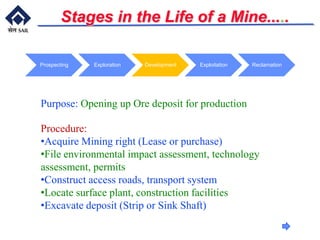
Prospecting Exploration Development Exploitation Reclamation
Purpose: Opening up Ore deposit for production
Procedure:
•Acquire Mining right (Lease or purchase)
•File environmental impact assessment, technology
assessment, permits
•Construct access roads, transport system
•Locate surface plant, construction facilities
•Excavate deposit (Strip or Sink Shaft)
Stages in the Life of a Mine.....
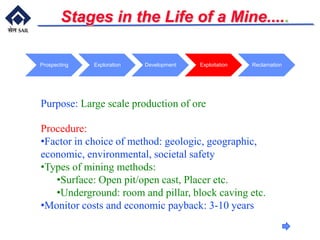
Prospecting Exploration Development Exploitation Reclamation
Purpose: Large scale production of ore
Procedure:
•Factor in choice of method: geologic, geographic,
economic, environmental, societal safety
•Types of mining methods:
•Surface: Open pit/open cast, Placer etc.
•Underground: room and pillar, block caving etc.
•Monitor costs and economic payback: 3-10 years
Stages in the Life of a Mine.....
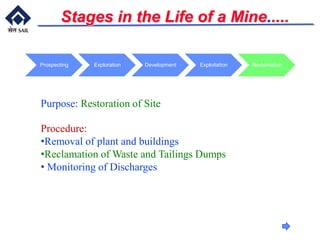
Prospecting Exploration Development Exploitation Reclamation
Purpose: Restoration of Site
Procedure:
•Removal of plant and buildings
•Reclamation of Waste and Tailings Dumps
• Monitoring of Discharges
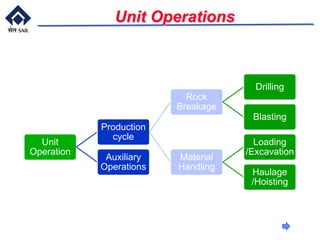
Unit Operations
Unit
Operation
Production
cycle
Rock
Breakage
Drilling
Blasting
Material
Handling
Loading
/Excavation
Haulage
/Hoisting
Auxiliary
Operations
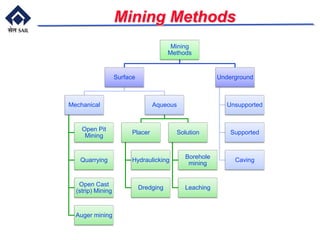
Mining Methods
Mining
Methods
Surface
Mechanical
Open Pit
Mining
Quarrying
Open Cast
(strip) Mining
Auger mining
Aqueous
Placer
Hydraulicking
Dredging
Solution
Borehole
mining
Leaching
Underground
Unsupported
Supported
Caving
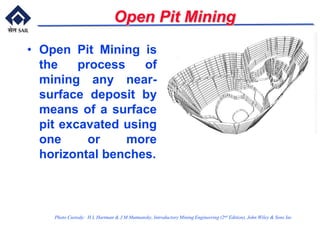
Open Pit Mining
• Open Pit Mining is
the process of
mining any near-
surface deposit by
means of a surface
pit excavated using
one or more
horizontal benches.
Photo Custody: H L Hartman & J M Mutmansky, Introductory Mining Engineering (2nd Edition), John Wiley & Sons Inc
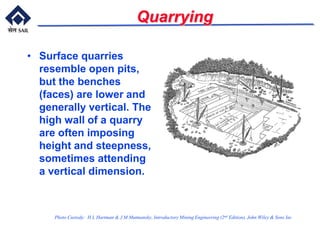
Quarrying
• Surface quarries
resemble open pits,
but the benches
(faces) are lower and
generally vertical. The
high wall of a quarry
are often imposing
height and steepness,
sometimes attending
a vertical dimension.
Photo Custody: H L Hartman & J M Mutmansky, Introductory Mining Engineering (2nd Edition), John Wiley & Sons Inc
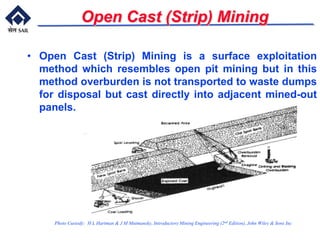
Open Cast (Strip) Mining
• Open Cast (Strip) Mining is a surface exploitation
method which resembles open pit mining but in this
method overburden is not transported to waste dumps
for disposal but cast directly into adjacent mined-out
panels.
Photo Custody: H L Hartman & J M Mutmansky, Introductory Mining Engineering (2nd Edition), John Wiley & Sons Inc
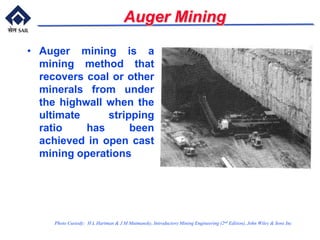
Auger Mining
• Auger mining is a
mining method that
recovers coal or other
minerals from under
the highwall when the
ultimate stripping
ratio has been
achieved in open cast
mining operations
Photo Custody: H L Hartman & J M Mutmansky, Introductory Mining Engineering (2nd Edition), John Wiley & Sons Inc
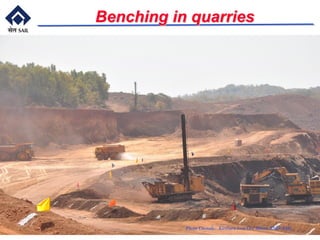
Benching in quarries
Photo Custody: Kiriburu Iron Ore Mines, RMD-SAIL
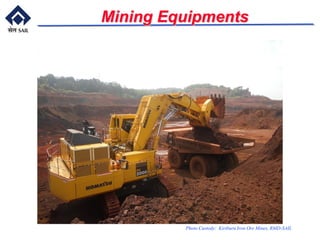
Mining Equipments
Photo Custody: Kiriburu Iron Ore Mines, RMD-SAIL
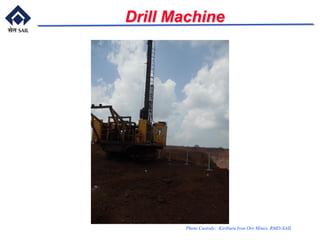
Drill Machine
Photo Custody: Kiriburu Iron Ore Mines, RMD-SAIL
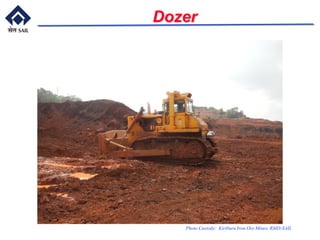
Dozer
Photo Custody: Kiriburu Iron Ore Mines, RMD-SAIL
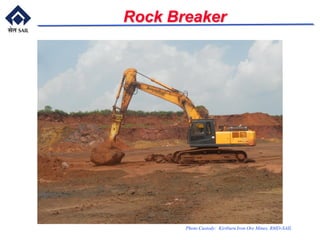
Rock Breaker
Photo Custody: Kiriburu Iron Ore Mines, RMD-SAIL
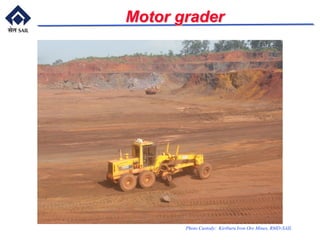
Motor grader
Photo Custody: Kiriburu Iron Ore Mines, RMD-SAIL
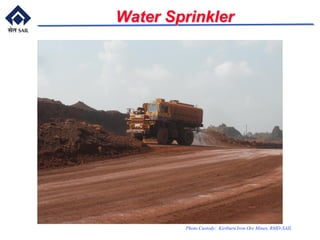
Water Sprinkler
Photo Custody: Kiriburu Iron Ore Mines, RMD-SAIL
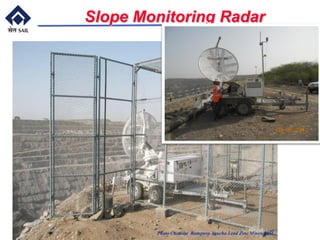
Slope Monitoring Radar
Photo Custody: Rampura Agucha Lead Zinc Mines, HZL
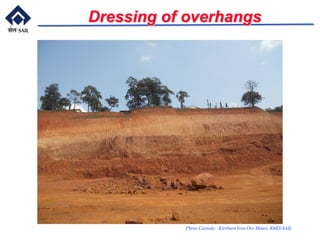
Dressing of overhangs
Photo Custody: Kiriburu Iron Ore Mines, RMD-SAIL
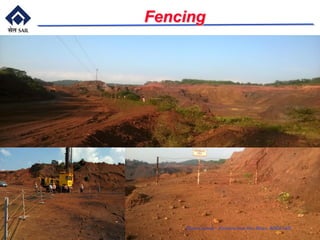
Fencing
Photo Custody: Kiriburu Iron Ore Mines, RMD-SAIL
?
OPEN SESSION
Thank You

Introductory mining v2

  • 1.
    Introductory Mining खनन ऩरयचम RathinBiswas यथीन बफश्वास Manager (Mining) प्रफंधक (खनन) RMD Training Centre आयएभडी प्रशिक्षण कें द्र Raw Materials Division कच्चे भार प्रबाग Steel Authority of India Limited स्टीर अथॉरयटी ऑप इंडडमा शरशभटेड
  • 2.
    Contribution to Civilization •Mining is the Second Endeavours of human civilization • Agriculture and Mining Supply all the Basic resources need in the modern Civilization
  • 3.
    History Stone Age Priorto 4000 BCE Bronze Age 4000 to 1500 BCE Iron Age 1500 BCE to 1780 CE Steel Age 1780 to 1945 CE Nuclear Age 1945 CE to Present • The history of Mining is parallels to the History of civilization • Many important cultural eras associated with and identified by various minerals or their derivatives-
  • 4.
    Terminology • Mine: Anexcavation made in the earth to extract minerals • Mining: the activity, occupation and industry concerned with the extraction of minerals. • Minerals: a natural occurring inorganic element or compound having an orderly internal structure and a characteristic chemical composition crystal form and physical properties. • Rock: any naturally formed aggregate of one or more types of mineral particles • Ore: a mineral deposit that has sufficient utility and value to be mined at a profit • Gangue: the valueless mineral particles within an ore deposit that must be discarded • Waste: the material associated with an ore deposit that must be mined to get at the ore and must then be discarded. Gangue is a particular type of waste.
  • 5.
    Terminology ..... • MetallicOres: those ores of the ferrous metals (iron, manganese, molybdenum and tungsten), the base metals (copper, lead, zinc and tin), the precious metals (gold, silver, the platinum group metals) and the radioactive minerals (uranium, thorium and radium) • Non-metallic minerals (also known as industrial minerals): the nonfuel mineral ores that are not associated with the production of metals. These include phosphate, potash, halite, trona, sand, gravel, limestone, sulphur, and many others. • Fossil fuels (also known as mineral fuels): the organic mineral substances that can be utilize as fuels, such as coal, petroleum, natural gas, coal bed methane, gilsonite and tar sands.
  • 6.
    Advancements in Technology DateEvent 450,000 BCE First Mining (Surface), by Paleolithic humans for stone implements 40,000 Surface mining progress underground, Swaziland, Africa 30,000 Fired clay pots used in Czechoslovakia 18,000 Use of Gold and Copper in native form 5000 Fire setting to break rock, Egypt 4000 Early use of fabricated metals, start of Bronze Age 3400 First recorded mining, of turquoise by Egyptians in Sinai 3000 First smelting of copper with coal by Chinese; First use of iron implements by Egyptians 2000 Earliest known Gold artifacts in New World, Peru 1000 Steel used by Greeks Source: H L Hartman & J M Mutmansky, Introductory Mining Engineering (2nd Edition), John Wiley & Sons Inc
  • 7.
    Advancements in Technology..... DateEvent 100 CE Thriving Roman Mining Industry 122 Coal used by Romans in present-day, United Kingdom 1185 Edict by Bishop of Trent gives rights to miners 1524 First recorded mining in New World, by Spaniards in Cuba 1550 First Use of Lift Pup at Czechoslovakia 1556 First mining technical work, Germany 1627 Explosive used in European mines, Hungary 1716 First School of Mines, Czechoslovakia 1780 Pumps used in mines 1815 Sir Humphrey Davy invents miner’s safety lamp in England 1867 Dynamite invented by Nobel, applied to Mining 1906 First Mining College in India 1940 First Continuous miner Source: H L Hartman & J M Mutmansky, Introductory Mining Engineering (2nd Edition), John Wiley & Sons Inc
  • 8.
    Stages in theLife of a Mine Prospecting Exploration Development Exploitation Reclamation Post-MiningMining ProperPrecursors Mining Mineral Deposit Ore Body Prospect Mine Real Estate
  • 9.
    Stages in theLife of a Mine..... Prospecting Exploration Development Exploitation Reclamation Purpose: Search for ore Procedure: •Prospecting Methods •Direct: physical geologic •Indirect: geophysical, geochemical •Locate favourable loci (map, literature, old mine) •Air: aerial photography, airborne geophysics, satellite •Surface: ground geophysics, geology •Spot anomaly, analyze, evaluate
  • 10.
    Stages in theLife of a Mine..... Prospecting Exploration Development Exploitation Reclamation Purpose: Defining extent and value of ore (examination &Evaluation) Procedure: •Sample (drilling or excavation), assay, test •Estimate tonnage and grade •Valuate deposit, present value calculation, Feasibility study, decision to abandon or develop
  • 11.
    Stages in theLife of a Mine..... Prospecting Exploration Development Exploitation Reclamation Purpose: Opening up Ore deposit for production Procedure: •Acquire Mining right (Lease or purchase) •File environmental impact assessment, technology assessment, permits •Construct access roads, transport system •Locate surface plant, construction facilities •Excavate deposit (Strip or Sink Shaft)
  • 12.
    Stages in theLife of a Mine..... Prospecting Exploration Development Exploitation Reclamation Purpose: Large scale production of ore Procedure: •Factor in choice of method: geologic, geographic, economic, environmental, societal safety •Types of mining methods: •Surface: Open pit/open cast, Placer etc. •Underground: room and pillar, block caving etc. •Monitor costs and economic payback: 3-10 years
  • 13.
    Stages in theLife of a Mine..... Prospecting Exploration Development Exploitation Reclamation Purpose: Restoration of Site Procedure: •Removal of plant and buildings •Reclamation of Waste and Tailings Dumps • Monitoring of Discharges
  • 14.
  • 15.
    Mining Methods Mining Methods Surface Mechanical Open Pit Mining Quarrying OpenCast (strip) Mining Auger mining Aqueous Placer Hydraulicking Dredging Solution Borehole mining Leaching Underground Unsupported Supported Caving
  • 16.
    Open Pit Mining •Open Pit Mining is the process of mining any near- surface deposit by means of a surface pit excavated using one or more horizontal benches. Photo Custody: H L Hartman & J M Mutmansky, Introductory Mining Engineering (2nd Edition), John Wiley & Sons Inc
  • 17.
    Quarrying • Surface quarries resembleopen pits, but the benches (faces) are lower and generally vertical. The high wall of a quarry are often imposing height and steepness, sometimes attending a vertical dimension. Photo Custody: H L Hartman & J M Mutmansky, Introductory Mining Engineering (2nd Edition), John Wiley & Sons Inc
  • 18.
    Open Cast (Strip)Mining • Open Cast (Strip) Mining is a surface exploitation method which resembles open pit mining but in this method overburden is not transported to waste dumps for disposal but cast directly into adjacent mined-out panels. Photo Custody: H L Hartman & J M Mutmansky, Introductory Mining Engineering (2nd Edition), John Wiley & Sons Inc
  • 19.
    Auger Mining • Augermining is a mining method that recovers coal or other minerals from under the highwall when the ultimate stripping ratio has been achieved in open cast mining operations Photo Custody: H L Hartman & J M Mutmansky, Introductory Mining Engineering (2nd Edition), John Wiley & Sons Inc
  • 20.
    Benching in quarries PhotoCustody: Kiriburu Iron Ore Mines, RMD-SAIL
  • 21.
    Mining Equipments Photo Custody:Kiriburu Iron Ore Mines, RMD-SAIL
  • 22.
    Drill Machine Photo Custody:Kiriburu Iron Ore Mines, RMD-SAIL
  • 23.
    Dozer Photo Custody: KiriburuIron Ore Mines, RMD-SAIL
  • 24.
    Rock Breaker Photo Custody:Kiriburu Iron Ore Mines, RMD-SAIL
  • 25.
    Motor grader Photo Custody:Kiriburu Iron Ore Mines, RMD-SAIL
  • 26.
    Water Sprinkler Photo Custody:Kiriburu Iron Ore Mines, RMD-SAIL
  • 27.
    Slope Monitoring Radar PhotoCustody: Rampura Agucha Lead Zinc Mines, HZL
  • 28.
    Dressing of overhangs PhotoCustody: Kiriburu Iron Ore Mines, RMD-SAIL
  • 29.
    Fencing Photo Custody: KiriburuIron Ore Mines, RMD-SAIL
  • 30.
  • 31.