LEAD AND ZINC DEPOSITS IN INDIA
Presented by
Mandar Mahindrakar
Department Of Geology
Govt.Institute Of Science
Aurangabad
Guided by
Rupesh Aher
Lead
 Lead (Pb) occur in native state , but it is quite rare.
 The metal is bluish grey in color and bright metallic lustre.
 It is so soft that it can be scratched with finger nail and
shows black streak .
 It is quite heavy, the sp.gravity being 11.34.
CHIEF oRESOF LEAD
GALENA- PbS
 Form - massive , granular , cube and octahedral.
 Cleavage - perfect
 Streak - grey
 Lustre - metallic
 Hardness - 2.5
 Sp.gr. - 7.4-7.6
CERUSSITE- PbCO3
 Color - greyish or white.
 Form - Prismatic, radiating, granular, massive, compact
and stalactitic.
 Streak - colorless
 Lustre - admantine
 Hardness - 3-3.5
 Sp.gravity - 6.55
ANGLESITE- PbSO4
 Color - white, sometime blue, grey, green, yellow tint.
 Form - prismatic, massive, occasionally stalactitic.
 Lustre - admantine
 Hardness - 2.5-3
 Sp.gravity - 6.3-6.4
ZINC
Zinc (ZnS) is a bluish, white, brittle metal.
Sp. Gravity is 7.15.
It may be rolled into sheet or drawn into wire
between 100˚-150˚c.
It is soluble in dilute acid.
CHIEF ORESOF ZINC
Sphalerite-ZnS
Color - black or brown
Form - tetrahedra, massive
Cleavage - perfect
Streak - white
Lustre - resinous to admantine
Hardness - 3.5-4
Sp.gravity - 3.9-4.2
Smithsonite- ZnCO3
 Color - white, greyish, greenish or brownish white
 Form - massive, reniform, botryoidal or stalectitic.
 Cleavage - perfect
 Lustre - vitreous
 Hardness - 5.5
 Sp. Gravity - 4-4.5
Mode of occurrence and origin.
Lead and zinc ore occur in a number of ways. The
chief modes of occurrence are;
Load and veins.
Metasomatic replacement and contact metamorphic deposits.
Cavity or joint filling or as disseminations.
Most deposits of lead and zinc are confined to limestone,
dolomite and other calc-magnesium rich rock.
Types of deposits
 There are four major types of lead zinc deposits;
1. Volcanic hosted massive sulphides (VMS)
2. Carbonate hosted (Mississippi Valley & Irish type)
3. Sedimentary hosted (SEDEX deposits)
4. Intrusion related.
Sedimentary hosted(SEDEX type)
 Sedimentary hosted lead zinc deposits are diverse group of ore
hosted by a wide variety of siliciclastic and carbonate rocks that,
with few exceptions, have no direct genetic association with
igneous activity.
 They are the products of a range of ore forming process in a
variety of geological and tectonic environment.
 The metal where precipitated through a variety of processes that
include synsedimentary precipitation on the sea floor (SEDEX),
diagenesis, epigenetic replacement, and low-grade
metamorphism
 The ore contain mainly of sphalerite,galena,and generally lesser
amounts of iron sulfides.
 The deposits have a broad range of relationships with their host rocks
that includes stratiform,strata-bound,and discordant ores; in some
deposits, vein ore is important.
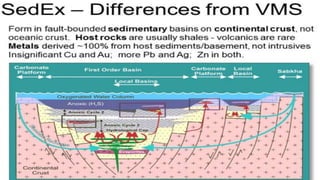
 Sedimentary hosted Pb-Zn deposits originated mainly from sedimentary
brines and from similar ore-forming processes.
 Most sedimentary hosted Pb-Zn deposits are in strata that were
deposited in rift or passive-margin settings. Theses tectonic setting are
related: passive margin from when continental rift succeed.
Carbonate hosted
 Carbonate hosted lead zinc ore deposits are imp. and highly valuable
concentrations of lead and zinc sulfides ore hosted within (limestone,
dolomite).
 These ore bodies tends to be compact, fairly uniform plung like or
pipe like replacement of there host .
 This classification of ore deposit is also known as Mississippi Valley
Type or MVT ore deposits.
 And I it is also known as Irish type carbonate lead zinc ores.
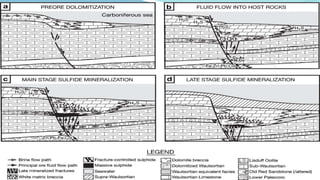
 The ore fluid of MVT deposits ore typically low temperature (100˚-
150˚c)and have the composition of basinal brines. The trap of
carbonate hosted lead zinc sulfides is a chemical reaction which
occurs a consequence of concentration of sulfur, often hydrocarbons,
and the lead and zinc which are absorbed by the hydrocarbons.
 once hydrocarbons are converted to bitumen their ability to chelate
metal ions and sulfur is reduced and results in these elements being
expeiled into the fluid which becomes saturated in zinc, lead, iron
and sulfur. Sulfide minerals such as galena,spalerite,marcasite and
pyrite thus form.
 Commonly MVT deposit form by the combination of
hydrocarbon pyrolysis liberating zinc-lead ions and sulfur to
form an acidic solution which dissolves the host carbonate
formation and replaces it with massive sulfide
accumulations.
 MVT and Irish type deposits are commonly associated with a
dolomite front alteration.
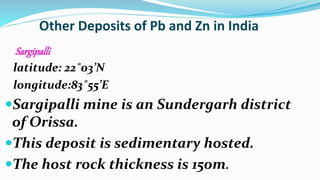
Western deposits
 The western region comprises Rajasthan and Gujarat state.
 Copper-lead-zinc mineralization occurs as bi-and multi-metal
deposits.
 There are two distinct metallogenic provinces;
1. the north eastern part characterized by predominantly copper
rich provinces, confined to the rock of Delhi Supergroup.
2. South Rajasthan and North Gujarat , the mineralization is
chiefly lead zinc ores with subordinate copper in the rock of Pre-
Aravalli and Delhi Supergroup.
BHILWARA SUPERGROUP
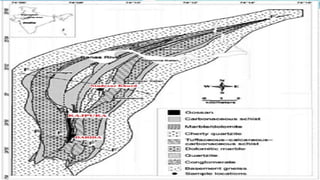
 Rajpura- Dariba-Bethumani belt
latitude:24˚58’N
longitude:74˚08’E
The Dariba-Bethumani belt, extending from Bethumani in the north
and Daeiba in the south is composed of a group of folded
metasedimentary rock belonging to the Bhilwara Supergroup.
Numerous old workings, gossans and ferruginous breccias have been
recorded in the southern part of the belt in the Rajpura-Dariba area.
TYPEOF DEPOSIT
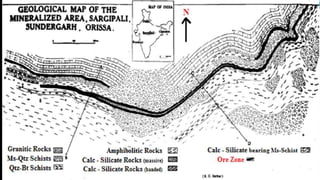
 This ore deposit is stratabound and is enclosed in a
sequence in a sequence of comprising metamorphic
equivalents of ortho-quartzites, carbonaceous facies
which are flanked by a thick monotonous sequence of
meta-argillites.
 Rajpura-Dariba ore body owes its importance to its multi-
metal sulphide-sulphosalt associations within the ores.
Economicimportanceof deposit
 Zinc is dominant metal followed by lead and copper.
 The imp. trace metals are cadmium and silver.
 The sulphide ores at Dariba mine show mineralogical
zoning.
 Copper,lead-zinc and iron rich zones appear successively
from the footwall to hanging wall.
 Rajpura Dariba is a SEDEX type deposit.
 The host rock is Dolomite and Graphite Schist.
 It is stratabound, concordant, sheet-like/ lensoid ore body.
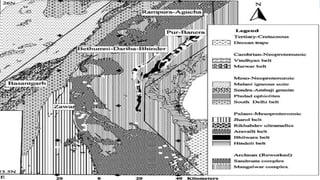
latitude: 25˚49’56’’N
longitude: 74˚44’19’’E
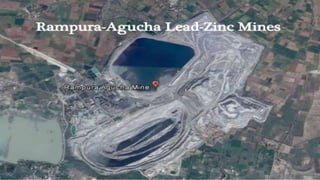
Rampura-Agucha is the largest opencast mine for zinc and lead.
The ore body is comparatively narrower and richer in the northern
part and wider in the southern. Thus open pit operation can go
deeper in the southern part.
This lead zinc deposit is located 15 km southeast of Gulabpura in the
Bhilwara district, Rajasthan.
Geology of the deposit
Greater area is capped with soil cover and fresh rock exposure are
very few, much of the information for geology gathered from the
drill cores.
The sequence of rocks, from hanging wall to footwall, can be
broadly grouped as under:
 Garnite-biotite- sillimanite gneiss with intermittent band of
calc- granulites, amphibolites and aplites/pegmatite.
 Garnite-mica- sillimanite gneiss/schist.
 Garnet- biotite - sillimanite gneiss with lenses of quartzo-
felsphathic band, amphibolites,pegmatite and aplites.
 Granite gneiss and Mylonitic rocks.
Ore genesis
 Mineralization is predominantly in graphite-mica-sillimanite
gneiss/schist over a strike length of 1550m.
 The ore zone has shape contact with the hanging wall and footwall.
 Coarse grained crystalline galena, associated with pyrite and
pyrrohitite are seen in the hanging wall rocks.
 The mineralization in hanging wall and foot wall contacts is
invariably fine to coarse grained, and made up of spalerite and
galena with numerous inclusion or rounded to sub-rounded discrete
grains of feldspar , quartz, hornblende, sillimianite and dark green
chlorite.
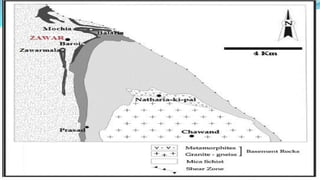
Aravalli supergroup
 Zawar lead zinc belt-
latitude: 24˚19’N
longitude: 73˚41’E
 It’s a bulk Mississipi valley type, underground mine.
 Zawar belt has been the oldest center of lead-zinc
production in the world.
 The present structural deposition of zawar area is a
manifestation of two distinct major period of tectonic
cycles, each of which was characterized by intense folding
and faulting.
Geology of the deposit
 The Archaean basement comprising of gneiss , schist,
amphibolite, quartzite, and granite dating back to 3.2 to
2.5Ga showing unconformable relationship with the Aravali
cover rocks.
 The upper Aravali group consist of greywacke-slate , phyllite,
quartzite , dolomite, and silty arenite while carbonaceous
and pelitic phyllites, dolomite, quartzite, stromatolite,
phosphorite, chlorite schist, amphibolite, quartz arenite and
local conglomerate belongs to lower Aravalli group.
 The Aravalli rocks in Udaipur-Zawar region shows a low
grade metamorphism.
 Recrystallization of the silicate mineral suggest the grade
of metamorphism to be of greenschist facies.
Stratigraphic succession, for the Aravali suoergroup of
the type area around the Udaipur and zawar show two
major group separated by an unconformity.
Ore genesis
The mineralization occurs as sheeted zones, veins,
stringers and disseminations, forming lenticular
bodies in overlapping enechelon pattern.
The mineralization is restricted solely within
dolomitic horizon along with the structural control,
but regional stratigraphic and lithological control is
also evident.
The main sulphide mineral are spalerite, pyrite
and galena.
Appreciable amount of silver and cadmium occur
within the ore minerals.
The ore bodies varies in width between 1 and 40
meters.
Other Deposits of Pb and Zn in India
Sargipalli
latitude: 22˚03’N
longitude:83˚55’E
Sargipalli mine is an Sundergarh district
of Orissa.
This deposit is sedimentary hosted.
The host rock thickness is 150m.
 The host rocks are paleoproterozic calc-silicate rock, cherat,
dolomite, dolomitic schist, marble , mica-chlorite schist,
quartzite and tourmalinite.
 The rock overlying the ore are paleoproterozoic marble and
siliceous dolomite, and thickness is greater than 200m.
 The rocks underlying the ore rock are metaconglomerate and
quartzite and their thickness is more than 600m .
 Related igneous rocks include amphibolites and granite-
pegmatite.
Ore genesis
 A stratabound, lead-dolomite sulfide deposit (SEDEX
Type) occur in Sargipalli, Orissa.
 Ore minerals found are argentifrous galena, chalcopyrite,
sphalerite, pyrite, pyrrhotite, arsenopyrite, and a little
tennanatite and tetrahedrite.
 Here both the host rock and ores got metamorphosed to
the low amphibolite facies.
Mamandur (South Arcot District)
latitude: 12˚0’53’’N
longitude: 78˚57’5’’E
This deposit is in the south Arcot district of Tamil
Nadu.
It is also a sediment-hosted Pb-Zn deposit like the
Sargipalli deposit.
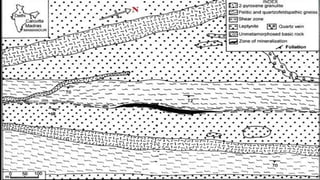
This deposit lies in the Peninsular Archen complex in
the transition zone between charnockites on the west
and migmatites on the east.
The Mamandur area is made up of migmatites and
charnockites with bands of garnetiferous biotite
sillimanite gneiss, magnetite quartzite and a suite of
ultrabasic rock comprising pyroxenite,
gabbro,norite,and anorthosite.
Ore genesis
 Host rocks of Neoarchean age include amphibolite, granulite,
migmatite,(arkose) and sillimanite gneiss.
 The host rock metamorphism varies from high grade
granulite facies to as low as retrogeade greenschist facies.
 The related igneous rocks include unmetamorphosed norite
dike and sill.
The multimetal lode comprises sphalerite , galena,
chalcopyrite, pyrrhotite, and pyrite with minor
tetrahedrite, marcasite, cubanite, bornite, etc. and
is considered to be the stratiform exhalative
volcanogenic sedimentary type.
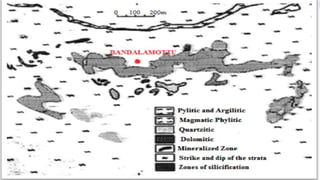
Bandalamottu (agnigundala belt)
latitude: 16˚13’15’’N
longitude: 79˚39’47’’E
 This is a sediment-hosted Cu-Pb deposit,in the Guntur
district of the Cuddupah basin.
 Host rocks included dolomite and phyllite.
Sratigraphically the host rock belongs to the
Cumbum formation of the Nallamalai Group, in the
Cuddupha Supergroup.
Tectonically this deposit is in the continental
margin basin-foreland.
Ore genesis
 This is an undifferentiated deposit (Carbonate-hosted
deposit) formed as veins along bedding planes in
dolomite.
 Zones of lead-copper mineralization occur mainly in the
upper part of the dolomite.
 Dolomite is fine-grained and massive and shows discrete
carbonaceous matter in interstices between carbonate
grains.
Thin band of chert are seen in carbonate host rocks.
The mineralization is generally poor where the
dolomites are associated with chert bands.
Lead And Zinc Deposits

Lead And Zinc Deposits

  • 1.
    LEAD AND ZINCDEPOSITS IN INDIA Presented by Mandar Mahindrakar Department Of Geology Govt.Institute Of Science Aurangabad Guided by Rupesh Aher
  • 2.
    Lead  Lead (Pb)occur in native state , but it is quite rare.  The metal is bluish grey in color and bright metallic lustre.  It is so soft that it can be scratched with finger nail and shows black streak .  It is quite heavy, the sp.gravity being 11.34.
  • 3.
    CHIEF oRESOF LEAD GALENA-PbS  Form - massive , granular , cube and octahedral.  Cleavage - perfect  Streak - grey  Lustre - metallic  Hardness - 2.5  Sp.gr. - 7.4-7.6
  • 4.
    CERUSSITE- PbCO3  Color- greyish or white.  Form - Prismatic, radiating, granular, massive, compact and stalactitic.  Streak - colorless  Lustre - admantine  Hardness - 3-3.5  Sp.gravity - 6.55
  • 5.
    ANGLESITE- PbSO4  Color- white, sometime blue, grey, green, yellow tint.  Form - prismatic, massive, occasionally stalactitic.  Lustre - admantine  Hardness - 2.5-3  Sp.gravity - 6.3-6.4
  • 6.
    ZINC Zinc (ZnS) isa bluish, white, brittle metal. Sp. Gravity is 7.15. It may be rolled into sheet or drawn into wire between 100˚-150˚c. It is soluble in dilute acid.
  • 7.
    CHIEF ORESOF ZINC Sphalerite-ZnS Color- black or brown Form - tetrahedra, massive Cleavage - perfect Streak - white Lustre - resinous to admantine Hardness - 3.5-4 Sp.gravity - 3.9-4.2
  • 8.
    Smithsonite- ZnCO3  Color- white, greyish, greenish or brownish white  Form - massive, reniform, botryoidal or stalectitic.  Cleavage - perfect  Lustre - vitreous  Hardness - 5.5  Sp. Gravity - 4-4.5
  • 9.
    Mode of occurrenceand origin. Lead and zinc ore occur in a number of ways. The chief modes of occurrence are; Load and veins. Metasomatic replacement and contact metamorphic deposits. Cavity or joint filling or as disseminations. Most deposits of lead and zinc are confined to limestone, dolomite and other calc-magnesium rich rock.
  • 10.
    Types of deposits There are four major types of lead zinc deposits; 1. Volcanic hosted massive sulphides (VMS) 2. Carbonate hosted (Mississippi Valley & Irish type) 3. Sedimentary hosted (SEDEX deposits) 4. Intrusion related.
  • 11.
    Sedimentary hosted(SEDEX type) Sedimentary hosted lead zinc deposits are diverse group of ore hosted by a wide variety of siliciclastic and carbonate rocks that, with few exceptions, have no direct genetic association with igneous activity.  They are the products of a range of ore forming process in a variety of geological and tectonic environment.  The metal where precipitated through a variety of processes that include synsedimentary precipitation on the sea floor (SEDEX), diagenesis, epigenetic replacement, and low-grade metamorphism
  • 12.
     The orecontain mainly of sphalerite,galena,and generally lesser amounts of iron sulfides.  The deposits have a broad range of relationships with their host rocks that includes stratiform,strata-bound,and discordant ores; in some deposits, vein ore is important.  Sedimentary hosted Pb-Zn deposits originated mainly from sedimentary brines and from similar ore-forming processes.  Most sedimentary hosted Pb-Zn deposits are in strata that were deposited in rift or passive-margin settings. Theses tectonic setting are related: passive margin from when continental rift succeed.
  • 14.
    Carbonate hosted  Carbonatehosted lead zinc ore deposits are imp. and highly valuable concentrations of lead and zinc sulfides ore hosted within (limestone, dolomite).  These ore bodies tends to be compact, fairly uniform plung like or pipe like replacement of there host .  This classification of ore deposit is also known as Mississippi Valley Type or MVT ore deposits.  And I it is also known as Irish type carbonate lead zinc ores.
  • 15.
     The orefluid of MVT deposits ore typically low temperature (100˚- 150˚c)and have the composition of basinal brines. The trap of carbonate hosted lead zinc sulfides is a chemical reaction which occurs a consequence of concentration of sulfur, often hydrocarbons, and the lead and zinc which are absorbed by the hydrocarbons.  once hydrocarbons are converted to bitumen their ability to chelate metal ions and sulfur is reduced and results in these elements being expeiled into the fluid which becomes saturated in zinc, lead, iron and sulfur. Sulfide minerals such as galena,spalerite,marcasite and pyrite thus form.
  • 16.
     Commonly MVTdeposit form by the combination of hydrocarbon pyrolysis liberating zinc-lead ions and sulfur to form an acidic solution which dissolves the host carbonate formation and replaces it with massive sulfide accumulations.  MVT and Irish type deposits are commonly associated with a dolomite front alteration.
  • 18.
    Western deposits  Thewestern region comprises Rajasthan and Gujarat state.  Copper-lead-zinc mineralization occurs as bi-and multi-metal deposits.  There are two distinct metallogenic provinces; 1. the north eastern part characterized by predominantly copper rich provinces, confined to the rock of Delhi Supergroup. 2. South Rajasthan and North Gujarat , the mineralization is chiefly lead zinc ores with subordinate copper in the rock of Pre- Aravalli and Delhi Supergroup.
  • 19.
    BHILWARA SUPERGROUP  Rajpura-Dariba-Bethumani belt latitude:24˚58’N longitude:74˚08’E The Dariba-Bethumani belt, extending from Bethumani in the north and Daeiba in the south is composed of a group of folded metasedimentary rock belonging to the Bhilwara Supergroup. Numerous old workings, gossans and ferruginous breccias have been recorded in the southern part of the belt in the Rajpura-Dariba area.
  • 21.
    TYPEOF DEPOSIT  Thisore deposit is stratabound and is enclosed in a sequence in a sequence of comprising metamorphic equivalents of ortho-quartzites, carbonaceous facies which are flanked by a thick monotonous sequence of meta-argillites.  Rajpura-Dariba ore body owes its importance to its multi- metal sulphide-sulphosalt associations within the ores.
  • 22.
    Economicimportanceof deposit  Zincis dominant metal followed by lead and copper.  The imp. trace metals are cadmium and silver.  The sulphide ores at Dariba mine show mineralogical zoning.  Copper,lead-zinc and iron rich zones appear successively from the footwall to hanging wall.
  • 23.
     Rajpura Daribais a SEDEX type deposit.  The host rock is Dolomite and Graphite Schist.  It is stratabound, concordant, sheet-like/ lensoid ore body.
  • 24.
    latitude: 25˚49’56’’N longitude: 74˚44’19’’E Rampura-Aguchais the largest opencast mine for zinc and lead. The ore body is comparatively narrower and richer in the northern part and wider in the southern. Thus open pit operation can go deeper in the southern part. This lead zinc deposit is located 15 km southeast of Gulabpura in the Bhilwara district, Rajasthan.
  • 26.
    Geology of thedeposit Greater area is capped with soil cover and fresh rock exposure are very few, much of the information for geology gathered from the drill cores. The sequence of rocks, from hanging wall to footwall, can be broadly grouped as under:  Garnite-biotite- sillimanite gneiss with intermittent band of calc- granulites, amphibolites and aplites/pegmatite.  Garnite-mica- sillimanite gneiss/schist.  Garnet- biotite - sillimanite gneiss with lenses of quartzo- felsphathic band, amphibolites,pegmatite and aplites.  Granite gneiss and Mylonitic rocks.
  • 27.
    Ore genesis  Mineralizationis predominantly in graphite-mica-sillimanite gneiss/schist over a strike length of 1550m.  The ore zone has shape contact with the hanging wall and footwall.  Coarse grained crystalline galena, associated with pyrite and pyrrohitite are seen in the hanging wall rocks.  The mineralization in hanging wall and foot wall contacts is invariably fine to coarse grained, and made up of spalerite and galena with numerous inclusion or rounded to sub-rounded discrete grains of feldspar , quartz, hornblende, sillimianite and dark green chlorite.
  • 28.
    Aravalli supergroup  Zawarlead zinc belt- latitude: 24˚19’N longitude: 73˚41’E  It’s a bulk Mississipi valley type, underground mine.  Zawar belt has been the oldest center of lead-zinc production in the world.  The present structural deposition of zawar area is a manifestation of two distinct major period of tectonic cycles, each of which was characterized by intense folding and faulting.
  • 30.
    Geology of thedeposit  The Archaean basement comprising of gneiss , schist, amphibolite, quartzite, and granite dating back to 3.2 to 2.5Ga showing unconformable relationship with the Aravali cover rocks.  The upper Aravali group consist of greywacke-slate , phyllite, quartzite , dolomite, and silty arenite while carbonaceous and pelitic phyllites, dolomite, quartzite, stromatolite, phosphorite, chlorite schist, amphibolite, quartz arenite and local conglomerate belongs to lower Aravalli group.
  • 31.
     The Aravallirocks in Udaipur-Zawar region shows a low grade metamorphism.  Recrystallization of the silicate mineral suggest the grade of metamorphism to be of greenschist facies. Stratigraphic succession, for the Aravali suoergroup of the type area around the Udaipur and zawar show two major group separated by an unconformity.
  • 32.
    Ore genesis The mineralizationoccurs as sheeted zones, veins, stringers and disseminations, forming lenticular bodies in overlapping enechelon pattern. The mineralization is restricted solely within dolomitic horizon along with the structural control, but regional stratigraphic and lithological control is also evident.
  • 33.
    The main sulphidemineral are spalerite, pyrite and galena. Appreciable amount of silver and cadmium occur within the ore minerals. The ore bodies varies in width between 1 and 40 meters.
  • 35.
    Other Deposits ofPb and Zn in India Sargipalli latitude: 22˚03’N longitude:83˚55’E Sargipalli mine is an Sundergarh district of Orissa. This deposit is sedimentary hosted. The host rock thickness is 150m.
  • 36.
     The hostrocks are paleoproterozic calc-silicate rock, cherat, dolomite, dolomitic schist, marble , mica-chlorite schist, quartzite and tourmalinite.  The rock overlying the ore are paleoproterozoic marble and siliceous dolomite, and thickness is greater than 200m.  The rocks underlying the ore rock are metaconglomerate and quartzite and their thickness is more than 600m .  Related igneous rocks include amphibolites and granite- pegmatite.
  • 37.
    Ore genesis  Astratabound, lead-dolomite sulfide deposit (SEDEX Type) occur in Sargipalli, Orissa.  Ore minerals found are argentifrous galena, chalcopyrite, sphalerite, pyrite, pyrrhotite, arsenopyrite, and a little tennanatite and tetrahedrite.  Here both the host rock and ores got metamorphosed to the low amphibolite facies.
  • 39.
    Mamandur (South ArcotDistrict) latitude: 12˚0’53’’N longitude: 78˚57’5’’E This deposit is in the south Arcot district of Tamil Nadu. It is also a sediment-hosted Pb-Zn deposit like the Sargipalli deposit.
  • 40.
    This deposit liesin the Peninsular Archen complex in the transition zone between charnockites on the west and migmatites on the east. The Mamandur area is made up of migmatites and charnockites with bands of garnetiferous biotite sillimanite gneiss, magnetite quartzite and a suite of ultrabasic rock comprising pyroxenite, gabbro,norite,and anorthosite.
  • 42.
    Ore genesis  Hostrocks of Neoarchean age include amphibolite, granulite, migmatite,(arkose) and sillimanite gneiss.  The host rock metamorphism varies from high grade granulite facies to as low as retrogeade greenschist facies.  The related igneous rocks include unmetamorphosed norite dike and sill.
  • 43.
    The multimetal lodecomprises sphalerite , galena, chalcopyrite, pyrrhotite, and pyrite with minor tetrahedrite, marcasite, cubanite, bornite, etc. and is considered to be the stratiform exhalative volcanogenic sedimentary type.
  • 44.
    Bandalamottu (agnigundala belt) latitude:16˚13’15’’N longitude: 79˚39’47’’E  This is a sediment-hosted Cu-Pb deposit,in the Guntur district of the Cuddupah basin.  Host rocks included dolomite and phyllite.
  • 45.
    Sratigraphically the hostrock belongs to the Cumbum formation of the Nallamalai Group, in the Cuddupha Supergroup. Tectonically this deposit is in the continental margin basin-foreland.
  • 47.
    Ore genesis  Thisis an undifferentiated deposit (Carbonate-hosted deposit) formed as veins along bedding planes in dolomite.  Zones of lead-copper mineralization occur mainly in the upper part of the dolomite.  Dolomite is fine-grained and massive and shows discrete carbonaceous matter in interstices between carbonate grains.
  • 48.
    Thin band ofchert are seen in carbonate host rocks. The mineralization is generally poor where the dolomites are associated with chert bands.