Prospecting and Exploration
Stages in the life of a Mine
• Prospecting
• Exploration
• Development
• Exploitation
• Reclamation
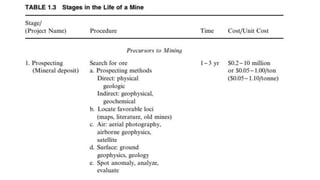
Prospecting
• First stage
• Search of ores or other valuable minerals
• Direct prospecting
• Indirect prospecting
Direct Method of discovery
• Mostly limited to surface deposits
• Visual examinations of exposure (outcrop) or
• Loose fragments (float) that have weathered away from the outcrop
• Geologic studies of the entire area
• Aerial photography, geologic maps, and structural assessment of an
area
• Looking for geologic evidences
• Precise mapping and structural analysis
• Microscopic studies of the samples
• All these info make the geologist to locate the hidden or surface
mineralization
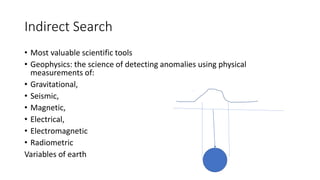
Indirect Search
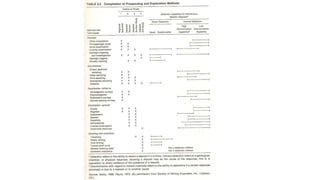
• Most valuable scientific tools
• Geophysics: the science of detecting anomalies using physical
measurements of:
• Gravitational,
• Seismic,
• Magnetic,
• Electrical,
• Electromagnetic
• Radiometric
Variables of earth
Indirect Search
• The methods are applied from air, using aircraft and satellites, or
• On the surface of the earth and
• Beneath the earth, using methods that probe below the topography
• Geochemistry,
• the quantitative analysis of soil, rock, water samples, and
• geobotany (plants), The analysis of plant growth patterns
Steps of Prospecting Procedure
1. Search reports and technical and published literature
2. Study available geologic and surface maps
3. Study aerial and satellite photographs
4. Prepare photographic map from available information and new
aerial data
5. Conduct airborne geophysical survey of area under study
6. Establish base of operation, set up mapping control and organize
ground prospecting parties
7. Conduct preliminary geologic, geophysical, and or geochemical
surveys
8. Assemble and analyze findings
EXPLORATION
• 2ND Stage in the life of mine
• Determines the size and value of a mineral deposit, utilizing
techniques more refined than used in prospecting
• Prospecting and exploration can not be distinguished
• Explorations shifts to surface and subsurface locations using a
number of measurements to obtain a more positive picture of the
extent and grade of the ore body
EXPLORATION
• Representative samples are collected for:
• Chemical analysis
• Metallurgical analysis
• X-ray
• Spectrographic or
• Radiometric evaluation
• Samples are obtained by chipping outcrops. Trenching, tunneling and
drilling
• Borehole logs are used to study geology and internal structures
EXPLORATON
• Rotary, percussion or rotary percussive drills are used for exploration
• Core drilling is important as core gives a lots of info geology,
structure, mineralogical composition and physical properties
• Core is split along its axis: half for analysis and half for further
geologic study and record
• Tonage and grade or richness is calculated
• The mining costs is estimated and other costs
• Other factors such as weather, environment, political and social
factors are considered
• All to decide to develop the project or abandoned
• A feasibility report is prepared
Difference between prospecting and
exploration
• Locals: locale shift from air to ground and sub-surface. Airborne
geophysics is replaced by ground geophysics
• Physical samples: indirect searches are transferred to direct. Sub-
surface excavations and samples are collected to get actual info.
Drilling is carried out in it
• Data: more substantial information about the target deposit is
required. Data are characterized by greater precision, specificity and
certainty.
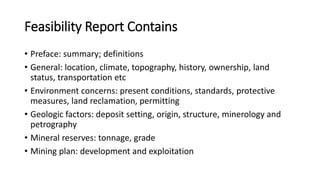
Feasibility Report Contains
• Preface: summary; definitions
• General: location, climate, topography, history, ownership, land
status, transportation etc
• Environment concerns: present conditions, standards, protective
measures, land reclamation, permitting
• Geologic factors: deposit setting, origin, structure, minerology and
petrography
• Mineral reserves: tonnage, grade
• Mining plan: development and exploitation
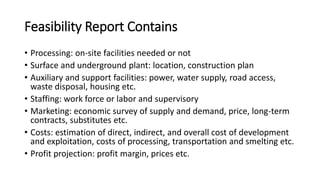
Feasibility Report Contains
• Processing: on-site facilities needed or not
• Surface and underground plant: location, construction plan
• Auxiliary and support facilities: power, water supply, road access,
waste disposal, housing etc.
• Staffing: work force or labor and supervisory
• Marketing: economic survey of supply and demand, price, long-term
contracts, substitutes etc.
• Costs: estimation of direct, indirect, and overall cost of development
and exploitation, costs of processing, transportation and smelting etc.
• Profit projection: profit margin, prices etc.
Prospecting and Exploration -

Prospecting and Exploration -

  • 1.
  • 2.
    Stages in thelife of a Mine • Prospecting • Exploration • Development • Exploitation • Reclamation
  • 3.
    Prospecting • First stage •Search of ores or other valuable minerals • Direct prospecting • Indirect prospecting
  • 5.
    Direct Method ofdiscovery • Mostly limited to surface deposits • Visual examinations of exposure (outcrop) or • Loose fragments (float) that have weathered away from the outcrop • Geologic studies of the entire area • Aerial photography, geologic maps, and structural assessment of an area • Looking for geologic evidences • Precise mapping and structural analysis • Microscopic studies of the samples • All these info make the geologist to locate the hidden or surface mineralization
  • 6.
    Indirect Search • Mostvaluable scientific tools • Geophysics: the science of detecting anomalies using physical measurements of: • Gravitational, • Seismic, • Magnetic, • Electrical, • Electromagnetic • Radiometric Variables of earth
  • 7.
    Indirect Search • Themethods are applied from air, using aircraft and satellites, or • On the surface of the earth and • Beneath the earth, using methods that probe below the topography • Geochemistry, • the quantitative analysis of soil, rock, water samples, and • geobotany (plants), The analysis of plant growth patterns
  • 8.
    Steps of ProspectingProcedure 1. Search reports and technical and published literature 2. Study available geologic and surface maps 3. Study aerial and satellite photographs 4. Prepare photographic map from available information and new aerial data 5. Conduct airborne geophysical survey of area under study 6. Establish base of operation, set up mapping control and organize ground prospecting parties 7. Conduct preliminary geologic, geophysical, and or geochemical surveys 8. Assemble and analyze findings
  • 9.
    EXPLORATION • 2ND Stagein the life of mine • Determines the size and value of a mineral deposit, utilizing techniques more refined than used in prospecting • Prospecting and exploration can not be distinguished • Explorations shifts to surface and subsurface locations using a number of measurements to obtain a more positive picture of the extent and grade of the ore body
  • 10.
    EXPLORATION • Representative samplesare collected for: • Chemical analysis • Metallurgical analysis • X-ray • Spectrographic or • Radiometric evaluation • Samples are obtained by chipping outcrops. Trenching, tunneling and drilling • Borehole logs are used to study geology and internal structures
  • 11.
    EXPLORATON • Rotary, percussionor rotary percussive drills are used for exploration • Core drilling is important as core gives a lots of info geology, structure, mineralogical composition and physical properties • Core is split along its axis: half for analysis and half for further geologic study and record • Tonage and grade or richness is calculated • The mining costs is estimated and other costs • Other factors such as weather, environment, political and social factors are considered • All to decide to develop the project or abandoned • A feasibility report is prepared
  • 12.
    Difference between prospectingand exploration • Locals: locale shift from air to ground and sub-surface. Airborne geophysics is replaced by ground geophysics • Physical samples: indirect searches are transferred to direct. Sub- surface excavations and samples are collected to get actual info. Drilling is carried out in it • Data: more substantial information about the target deposit is required. Data are characterized by greater precision, specificity and certainty.
  • 13.
    Feasibility Report Contains •Preface: summary; definitions • General: location, climate, topography, history, ownership, land status, transportation etc • Environment concerns: present conditions, standards, protective measures, land reclamation, permitting • Geologic factors: deposit setting, origin, structure, minerology and petrography • Mineral reserves: tonnage, grade • Mining plan: development and exploitation
  • 14.
    Feasibility Report Contains •Processing: on-site facilities needed or not • Surface and underground plant: location, construction plan • Auxiliary and support facilities: power, water supply, road access, waste disposal, housing etc. • Staffing: work force or labor and supervisory • Marketing: economic survey of supply and demand, price, long-term contracts, substitutes etc. • Costs: estimation of direct, indirect, and overall cost of development and exploitation, costs of processing, transportation and smelting etc. • Profit projection: profit margin, prices etc.