VSAT TECHNOLOGY
09-05-2014
2
CONTENTS
Communication
 Wireless Communication
Satellite communication
VSAT
 Introduction
 Advantages
 Applications
 Network Architecture
 Multiple Access Techniques
Distance Learning: an application
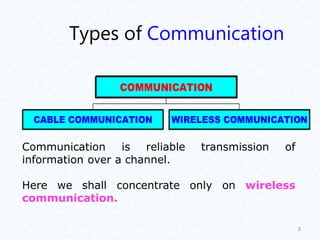
Types of Communication
CABLE COMMUNICATION WIRELESS COMMUNICATION
COMMUNICATION
Communication is reliable transmission of
information over a channel.
Here we shall concentrate only on wireless
communication.
3
Wireless Communication
People need to be online all the time and therefore
have no use of physical connectivity.
It is of two types:-
1. Microwave Communication
2. Satellite Communication
Since the microwaves travel in straight lines, if the towers are
too far away then the earth gets in the way. For communicating
at a far of distance high towers are needed which may be very
expensive. Bands above 8GHz are absorbed by water. Due to all
these reasons satellite communication is preferred.
4
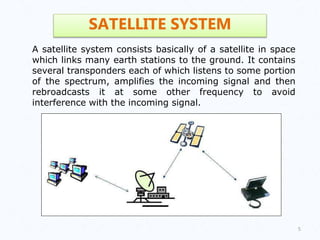
A satellite system consists basically of a satellite in space
which links many earth stations to the ground. It contains
several transponders each of which listens to some portion
of the spectrum, amplifies the incoming signal and then
rebroadcasts it at some other frequency to avoid
interference with the incoming signal.
SATELLITE SYSTEM
5
TYPES OF SATELLITES
According to orbit position satellites are of mainly three
types:
LEO(Low Earth Orbit satellite )
MEO(Medium Earth Orbit satellite )
GEO(Geosynchronous Equatorial Orbit satellite )
6Ref:[3]
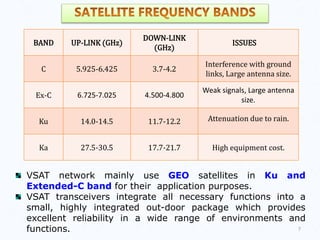
BAND UP-LINK (GHz)
DOWN-LINK
(GHz)
ISSUES
C 5.925-6.425 3.7-4.2
Interference with ground
links, Large antenna size.
Ex-C 6.725-7.025 4.500-4.800
Weak signals, Large antenna
size.
Ku 14.0-14.5 11.7-12.2 Attenuation due to rain.
Ka 27.5-30.5 17.7-21.7 High equipment cost.
VSAT network mainly use GEO satellites in Ku and
Extended-C band for their application purposes.
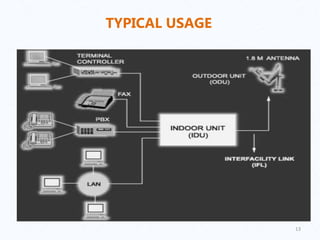
VSAT transceivers integrate all necessary functions into a
small, highly integrated out-door package which provides
excellent reliability in a wide range of environments and
functions. 7
Introduction To VSAT
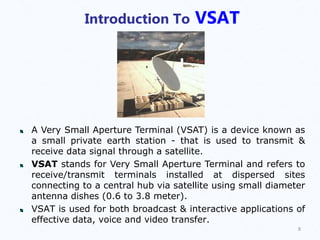
A Very Small Aperture Terminal (VSAT) is a device known as
a small private earth station - that is used to transmit &
receive data signal through a satellite.
VSAT stands for Very Small Aperture Terminal and refers to
receive/transmit terminals installed at dispersed sites
connecting to a central hub via satellite using small diameter
antenna dishes (0.6 to 3.8 meter).
VSAT is used for both broadcast & interactive applications of
effective data, voice and video transfer.
8
VSAT INSTALLATION
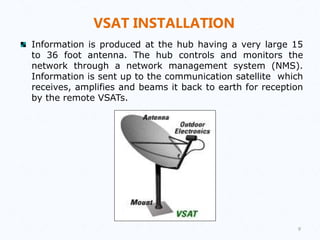
Information is produced at the hub having a very large 15
to 36 foot antenna. The hub controls and monitors the
network through a network management system (NMS).
Information is sent up to the communication satellite which
receives, amplifies and beams it back to earth for reception
by the remote VSATs.
9
Why VSAT?
The dish is small, easily transportable and installation
lead-time is much shorter if compared to terrestrial
links.
VSAT network allows rapid, low-cost network re-
configuration and expansion to meet new or unexpected
business requirements.
Cost effective transmission and network operations are
made possible by use of the Ex-C band satellite
frequency and frequency times division multiple access
(FTDMA), Frequency division multiple access (FDMA) or
Time division multiple access (TDMA) transmission
techniques.
10
ADVANTAGES
There are many advantages that VSAT offers, some of them
are as follows:
Offer flexibility as adding a site is quick and easy.
Service charges depend on the bandwidth, which is allocated
to network in line with your requirements.
VSAT terminals prices are falling.
VSAT offers a wide of protocols and features, providing
extraordinary flexibility and virtually unlimited expansion
capabilities. VSAT network is typically engineered to achieve
a minimum of 99.5% end-to-end availability for all locations.
No last mile issues.
As it is mobile, so be used for short term or emergency
communications.
Excellent for broadcast transmission.
11
APPLICATIONS
VSAT is an ideal satellite network that provides
communications support for a wide range of applications:
Distance Education
Retail Networks
• Point-of-Sale(PoS) transaction, banking, inventory,
reservation system.
Corporate Networks
• Internet/Intranet access, corporate voice, file transfer,
video-conferencing.
High-speed Internet access
• Browsing, E-mail, E-commerce .
Financial Management
12
TYPICAL USAGE
13
NETWORK ARCHITECTURE
VSAT network can be of following two types:
1. Hub type (VSAT StarNet with Star network topology)
2. Hubless type (VSAT DialNet and VSAT Direct with
point-to-point or meshed network topology)
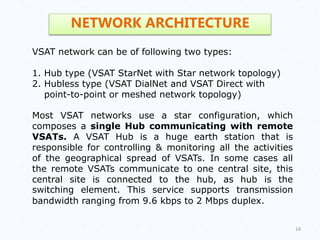
Most VSAT networks use a star configuration, which
composes a single Hub communicating with remote
VSATs. A VSAT Hub is a huge earth station that is
responsible for controlling & monitoring all the activities
of the geographical spread of VSATs. In some cases all
the remote VSATs communicate to one central site, this
central site is connected to the hub, as hub is the
switching element. This service supports transmission
bandwidth ranging from 9.6 kbps to 2 Mbps duplex.
14
VSAT HUB NETWORK
15
Ref:[4]
MULTIPLE ACCESS TECHNIQUES
1. SCPC (Single Channel Per Carrier)
(i) PAMA
(ii) DAMA
2. TDMA (Time Division Multiple Access)
PAMA
(Pre Assigned Multiple Access)
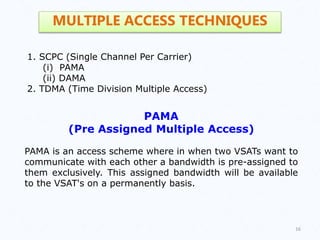
PAMA is an access scheme where in when two VSATs want to
communicate with each other a bandwidth is pre-assigned to
them exclusively. This assigned bandwidth will be available
to the VSAT's on a permanently basis.
16
DAMA
(Demand Assigned Multiple Access)
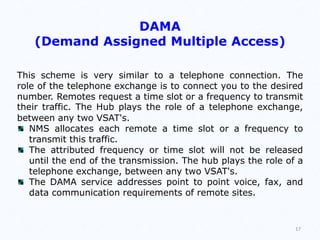
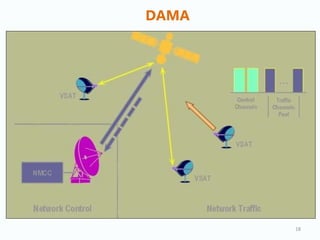
This scheme is very similar to a telephone connection. The
role of the telephone exchange is to connect you to the desired
number. Remotes request a time slot or a frequency to transmit
their traffic. The Hub plays the role of a telephone exchange,
between any two VSAT's.
NMS allocates each remote a time slot or a frequency to
transmit this traffic.
The attributed frequency or time slot will not be released
until the end of the transmission. The hub plays the role of a
telephone exchange, between any two VSAT's.
The DAMA service addresses point to point voice, fax, and
data communication requirements of remote sites.
17
18
DAMA
19
TDMA
(Time Division Multiple Access)
In TDMA a number of earth stations take turns(slots)
for transmitting through a common transponder. TDMA
network operates in a Star topology.
All the remote VSATs communicate to the central hub
station, on a Time Division Multiple Access Modes. At
the hub the signal is re-transmitted to the destination
VSAT using TDM technology after amplification.
All the remote VSAT's contend for a time divisional slot
to transmit their packets to the hub.
The channel used by the remotes to communicate to the
hub is called the Return Link. Each of these return
channels operates at a maximum of 128 Kbps.
20
VARIOUS VSAT PRODUCTS
Comparison of various VSAT Network Characteristics
Supplier Hardware Type Inbound Data
Rate (kb/s)
Outbound Data
Rate (kb/s)
Modulation
Gilat/Spacenet Skystar
Advantage
TDM/TDMA 9.6, 19.2, 38.4,
56, 64, 76.8,
128
64, 128, 256,
512, 1024, 2048
DPSK or MSK
Hughes ISBN/PES TDM/TDMA 64, 128, 256 128, 512 BPSK
Indra Espacio Arcanet CDMA
NEC Nextar V TDM/TDMA 64, 128, 256 64, 128, 256,
512, 768, 1536,
2048
BPSK/QPSK
STM X.Star TDM/TDMA 96, 192, 384 64, 128, 256,
512, 1024, 1544
BPSK
TSAT TSAT 2000 TDM/TDMA 0.3, 0.6, 1.2,
2.4, 4.8
0.3, 0.6, 1.2,
2.4, 4.8
4FSK, 2-
4PSK
TSAT TSAT 2100 TDM/TDMA 2.4 - 9.6, 14.4,
16.8
2.4 - 9.6, 14.4,
16.8
QPSK
ViaSat Sky Relay TDM/TDMA
Ref:[4]
INTERACTIVE VSAT
(DISTANCE LEARNING USING VSAT)
Distance education is an innovation that allows
educational content to be transmitted from area
to area and provides students in rural areas also
an opportunity to get education.
Due to the need for high speed and high quality
educational messages, communication satellites
are often used more for efficient transmission.
The main purpose of distance education is to
provide people greater access to education
without the limitations of distance and boundaries.
21
PROCESS OF DISTANCE LEARNING
At the teacher end the audio and video input is fed to the
Hub . A dummy student is also placed there to see whether
the information is sent correctly and in order. Data from the
hub is passed through the router to the central hub,
wherefrom it is transmitted to the satellite.
At the user end, the user is given a particular IP address
and a login ID. Using this can access the remote earth
station which receives the data from the central Hub via
satellite.
Distance education requires a network, which has
broadband capability, so that the network is able to carry
large amount of video and audio data. Satellite distribution
can facilitate two-way transmission of dense data traffic at
speeds equal to or faster than most wire-based systems.
22
23
REFERENCES
[1] Ha, Tri T., Digital Satellite Communications, 2nd ed., TMH,
2009.
[2]http://en.wikipedia.org/wiki/Very-small-aperture_terminal
[accessed on 25/09/2013].
[3]http://www.cse.iitb.ac.in/synerg/lib/exe/fetch.php?id=public%
3astudents%3azahirk%3adm%3ainterfacing_to_pc&cache=cach
e&media=public:students:zahirk:dm:vsat_doc.pdf [accessed on
29/10/2013]
[4] http://novastars.com/vsat [accessed on 28/10/2013].
[5] Rao, K.N. Raja, Fundamentals of satellite communication,
PHI pvt. Ltd., 2004.
[6] Tseng, Yuh M., Cryptanalysis and Improvement of Key
Distribution System for VSAT Satellite Communications,
INFORMATICA, 2002, Vol. 13, No. 3, P 369–376.
24
Presented by :
AKSHAY KUMAR BAJPAI
B.Tech (Final Year)
A4LE-43, GD9934
Electronics Engg. Dept..
ZHCET, AMU
ALIGARH-202002
09-05-2014

VSAT Technology

  • 1.
  • 2.
    2 CONTENTS Communication  Wireless Communication Satellitecommunication VSAT  Introduction  Advantages  Applications  Network Architecture  Multiple Access Techniques Distance Learning: an application
  • 3.
    Types of Communication CABLECOMMUNICATION WIRELESS COMMUNICATION COMMUNICATION Communication is reliable transmission of information over a channel. Here we shall concentrate only on wireless communication. 3
  • 4.
    Wireless Communication People needto be online all the time and therefore have no use of physical connectivity. It is of two types:- 1. Microwave Communication 2. Satellite Communication Since the microwaves travel in straight lines, if the towers are too far away then the earth gets in the way. For communicating at a far of distance high towers are needed which may be very expensive. Bands above 8GHz are absorbed by water. Due to all these reasons satellite communication is preferred. 4
  • 5.
    A satellite systemconsists basically of a satellite in space which links many earth stations to the ground. It contains several transponders each of which listens to some portion of the spectrum, amplifies the incoming signal and then rebroadcasts it at some other frequency to avoid interference with the incoming signal. SATELLITE SYSTEM 5
  • 6.
    TYPES OF SATELLITES Accordingto orbit position satellites are of mainly three types: LEO(Low Earth Orbit satellite ) MEO(Medium Earth Orbit satellite ) GEO(Geosynchronous Equatorial Orbit satellite ) 6Ref:[3]
  • 7.
    BAND UP-LINK (GHz) DOWN-LINK (GHz) ISSUES C5.925-6.425 3.7-4.2 Interference with ground links, Large antenna size. Ex-C 6.725-7.025 4.500-4.800 Weak signals, Large antenna size. Ku 14.0-14.5 11.7-12.2 Attenuation due to rain. Ka 27.5-30.5 17.7-21.7 High equipment cost. VSAT network mainly use GEO satellites in Ku and Extended-C band for their application purposes. VSAT transceivers integrate all necessary functions into a small, highly integrated out-door package which provides excellent reliability in a wide range of environments and functions. 7
  • 8.
    Introduction To VSAT AVery Small Aperture Terminal (VSAT) is a device known as a small private earth station - that is used to transmit & receive data signal through a satellite. VSAT stands for Very Small Aperture Terminal and refers to receive/transmit terminals installed at dispersed sites connecting to a central hub via satellite using small diameter antenna dishes (0.6 to 3.8 meter). VSAT is used for both broadcast & interactive applications of effective data, voice and video transfer. 8
  • 9.
    VSAT INSTALLATION Information isproduced at the hub having a very large 15 to 36 foot antenna. The hub controls and monitors the network through a network management system (NMS). Information is sent up to the communication satellite which receives, amplifies and beams it back to earth for reception by the remote VSATs. 9
  • 10.
    Why VSAT? The dishis small, easily transportable and installation lead-time is much shorter if compared to terrestrial links. VSAT network allows rapid, low-cost network re- configuration and expansion to meet new or unexpected business requirements. Cost effective transmission and network operations are made possible by use of the Ex-C band satellite frequency and frequency times division multiple access (FTDMA), Frequency division multiple access (FDMA) or Time division multiple access (TDMA) transmission techniques. 10
  • 11.
    ADVANTAGES There are manyadvantages that VSAT offers, some of them are as follows: Offer flexibility as adding a site is quick and easy. Service charges depend on the bandwidth, which is allocated to network in line with your requirements. VSAT terminals prices are falling. VSAT offers a wide of protocols and features, providing extraordinary flexibility and virtually unlimited expansion capabilities. VSAT network is typically engineered to achieve a minimum of 99.5% end-to-end availability for all locations. No last mile issues. As it is mobile, so be used for short term or emergency communications. Excellent for broadcast transmission. 11
  • 12.
    APPLICATIONS VSAT is anideal satellite network that provides communications support for a wide range of applications: Distance Education Retail Networks • Point-of-Sale(PoS) transaction, banking, inventory, reservation system. Corporate Networks • Internet/Intranet access, corporate voice, file transfer, video-conferencing. High-speed Internet access • Browsing, E-mail, E-commerce . Financial Management 12
  • 13.
  • 14.
    NETWORK ARCHITECTURE VSAT networkcan be of following two types: 1. Hub type (VSAT StarNet with Star network topology) 2. Hubless type (VSAT DialNet and VSAT Direct with point-to-point or meshed network topology) Most VSAT networks use a star configuration, which composes a single Hub communicating with remote VSATs. A VSAT Hub is a huge earth station that is responsible for controlling & monitoring all the activities of the geographical spread of VSATs. In some cases all the remote VSATs communicate to one central site, this central site is connected to the hub, as hub is the switching element. This service supports transmission bandwidth ranging from 9.6 kbps to 2 Mbps duplex. 14
  • 15.
  • 16.
    MULTIPLE ACCESS TECHNIQUES 1.SCPC (Single Channel Per Carrier) (i) PAMA (ii) DAMA 2. TDMA (Time Division Multiple Access) PAMA (Pre Assigned Multiple Access) PAMA is an access scheme where in when two VSATs want to communicate with each other a bandwidth is pre-assigned to them exclusively. This assigned bandwidth will be available to the VSAT's on a permanently basis. 16
  • 17.
    DAMA (Demand Assigned MultipleAccess) This scheme is very similar to a telephone connection. The role of the telephone exchange is to connect you to the desired number. Remotes request a time slot or a frequency to transmit their traffic. The Hub plays the role of a telephone exchange, between any two VSAT's. NMS allocates each remote a time slot or a frequency to transmit this traffic. The attributed frequency or time slot will not be released until the end of the transmission. The hub plays the role of a telephone exchange, between any two VSAT's. The DAMA service addresses point to point voice, fax, and data communication requirements of remote sites. 17
  • 18.
  • 19.
    19 TDMA (Time Division MultipleAccess) In TDMA a number of earth stations take turns(slots) for transmitting through a common transponder. TDMA network operates in a Star topology. All the remote VSATs communicate to the central hub station, on a Time Division Multiple Access Modes. At the hub the signal is re-transmitted to the destination VSAT using TDM technology after amplification. All the remote VSAT's contend for a time divisional slot to transmit their packets to the hub. The channel used by the remotes to communicate to the hub is called the Return Link. Each of these return channels operates at a maximum of 128 Kbps.
  • 20.
    20 VARIOUS VSAT PRODUCTS Comparisonof various VSAT Network Characteristics Supplier Hardware Type Inbound Data Rate (kb/s) Outbound Data Rate (kb/s) Modulation Gilat/Spacenet Skystar Advantage TDM/TDMA 9.6, 19.2, 38.4, 56, 64, 76.8, 128 64, 128, 256, 512, 1024, 2048 DPSK or MSK Hughes ISBN/PES TDM/TDMA 64, 128, 256 128, 512 BPSK Indra Espacio Arcanet CDMA NEC Nextar V TDM/TDMA 64, 128, 256 64, 128, 256, 512, 768, 1536, 2048 BPSK/QPSK STM X.Star TDM/TDMA 96, 192, 384 64, 128, 256, 512, 1024, 1544 BPSK TSAT TSAT 2000 TDM/TDMA 0.3, 0.6, 1.2, 2.4, 4.8 0.3, 0.6, 1.2, 2.4, 4.8 4FSK, 2- 4PSK TSAT TSAT 2100 TDM/TDMA 2.4 - 9.6, 14.4, 16.8 2.4 - 9.6, 14.4, 16.8 QPSK ViaSat Sky Relay TDM/TDMA Ref:[4]
  • 21.
    INTERACTIVE VSAT (DISTANCE LEARNINGUSING VSAT) Distance education is an innovation that allows educational content to be transmitted from area to area and provides students in rural areas also an opportunity to get education. Due to the need for high speed and high quality educational messages, communication satellites are often used more for efficient transmission. The main purpose of distance education is to provide people greater access to education without the limitations of distance and boundaries. 21
  • 22.
    PROCESS OF DISTANCELEARNING At the teacher end the audio and video input is fed to the Hub . A dummy student is also placed there to see whether the information is sent correctly and in order. Data from the hub is passed through the router to the central hub, wherefrom it is transmitted to the satellite. At the user end, the user is given a particular IP address and a login ID. Using this can access the remote earth station which receives the data from the central Hub via satellite. Distance education requires a network, which has broadband capability, so that the network is able to carry large amount of video and audio data. Satellite distribution can facilitate two-way transmission of dense data traffic at speeds equal to or faster than most wire-based systems. 22
  • 23.
    23 REFERENCES [1] Ha, TriT., Digital Satellite Communications, 2nd ed., TMH, 2009. [2]http://en.wikipedia.org/wiki/Very-small-aperture_terminal [accessed on 25/09/2013]. [3]http://www.cse.iitb.ac.in/synerg/lib/exe/fetch.php?id=public% 3astudents%3azahirk%3adm%3ainterfacing_to_pc&cache=cach e&media=public:students:zahirk:dm:vsat_doc.pdf [accessed on 29/10/2013] [4] http://novastars.com/vsat [accessed on 28/10/2013]. [5] Rao, K.N. Raja, Fundamentals of satellite communication, PHI pvt. Ltd., 2004. [6] Tseng, Yuh M., Cryptanalysis and Improvement of Key Distribution System for VSAT Satellite Communications, INFORMATICA, 2002, Vol. 13, No. 3, P 369–376.
  • 24.
    24 Presented by : AKSHAYKUMAR BAJPAI B.Tech (Final Year) A4LE-43, GD9934 Electronics Engg. Dept.. ZHCET, AMU ALIGARH-202002 09-05-2014