SUBMITTED BY
ABHISHEK PANDEY
   In this project we show the performance of MIMO-OFDM
    system in Rayleigh Fading Channel

   MIMO-OFDM system is very popular technique for mobile
    communication now a day’s .We compares Ergodic and
    Outage Capacity , with taking various numbers of
    Transmitting and Receiving antennas and various
    performance measures such as SNR, BER etc.

   MIMO-OFDM, Ergodic Capacity, BER, SNR Outage Capacity
   Ever-increasing demands in communication industry
    towards wireless

   Challenges:
    - to improve spectral efficiency

    - efficient bandwidth utilization

    - economical Signal Processing
                algorithms
    - high speed processing h/w
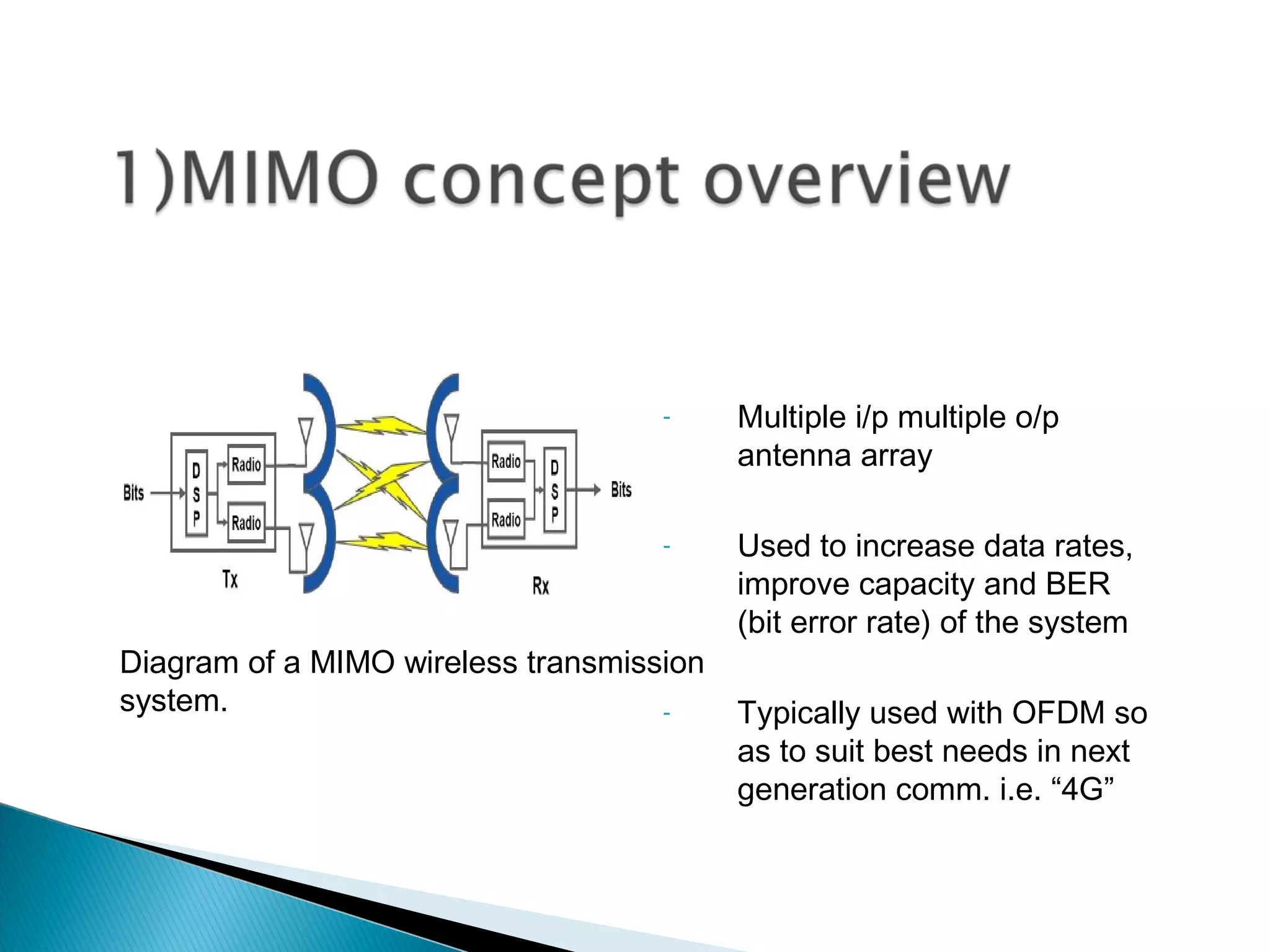
-     Multiple i/p multiple o/p
                                          antenna array

                                    -     Used to increase data rates,
                                          improve capacity and BER
                                          (bit error rate) of the system
Diagram of a MIMO wireless transmission
system.                             -     Typically used with OFDM so
                                          as to suit best needs in next
                                          generation comm. i.e. “4G”
   SU-MIMO (Single User - MIMO)

    this utilizes MIMO technology to improve the
     performance towards a single user. 

   MU-MIMO (Multi User - MIMO)

    this enables multiple users to be served through
     the use of spatial multiplexing techniques.
   Definition

   The first OFDM schemes presented in 1966

   Development of OFDM over years
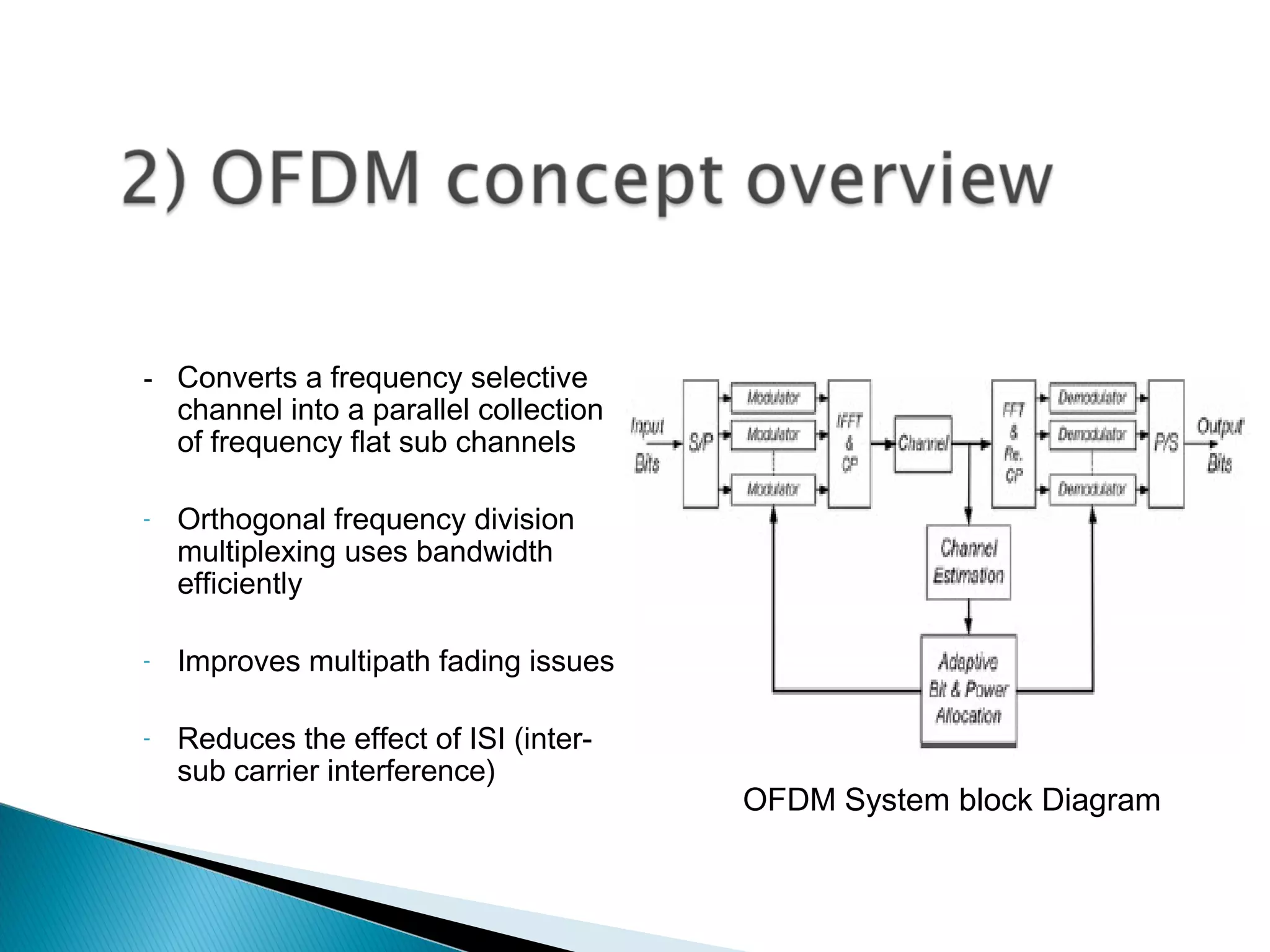
- Converts a frequency selective
    channel into a parallel collection
    of frequency flat sub channels

-   Orthogonal frequency division
    multiplexing uses bandwidth
    efficiently

-   Improves multipath fading issues

-   Reduces the effect of ISI (inter-
    sub carrier interference)
                                         OFDM System block Diagram
   It distributes the data over a large number of carriers that
    are spaced apart at precise frequencies.
    This spacing provides the "orthogonality" in this
    technique which prevents the demodulators from seeing
    frequencies other than their own.
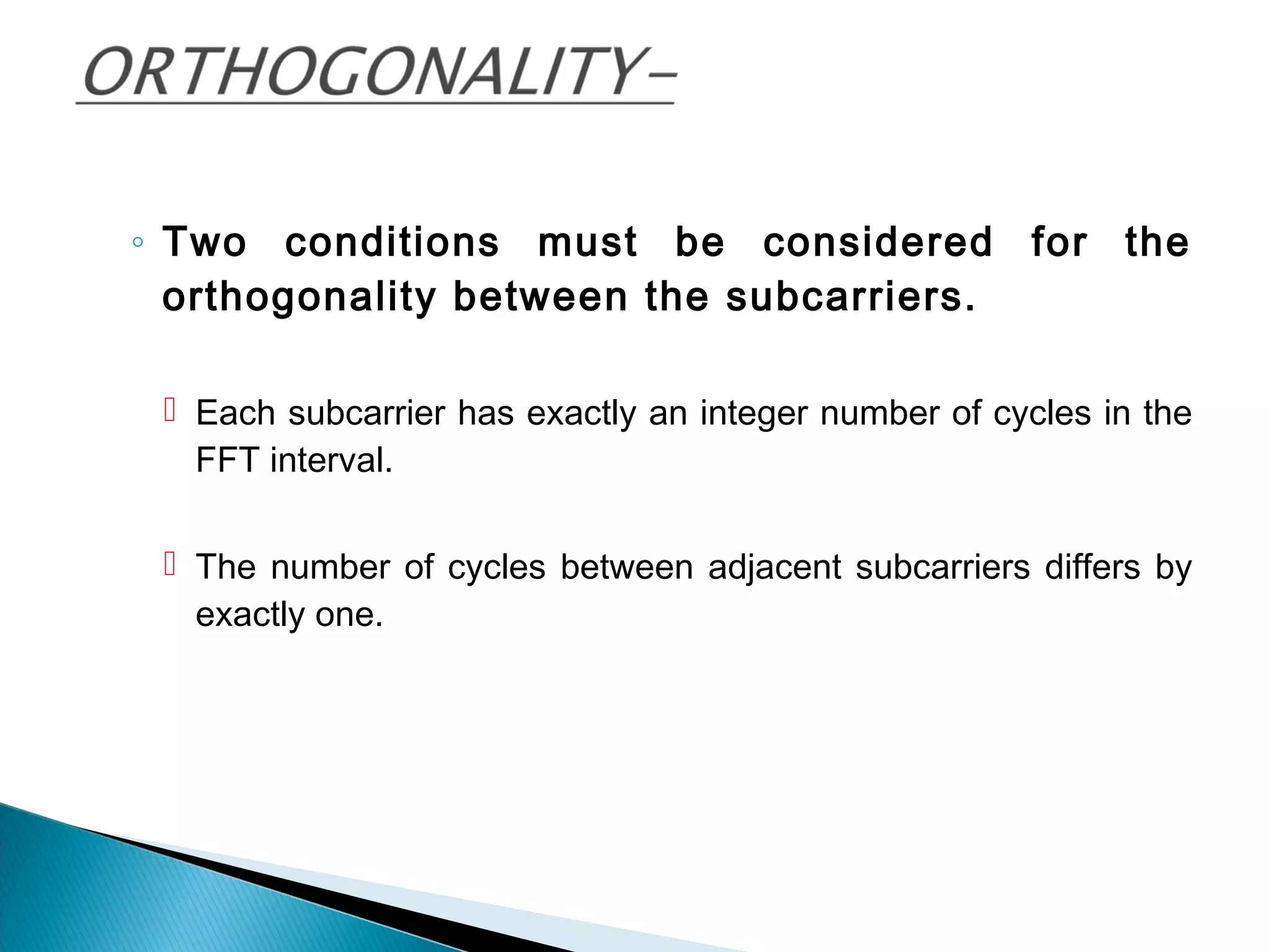
◦ Two conditions must be considered for the
  orthogonality between the subcarriers.

  Each subcarrier has exactly an integer number of cycles in the
   FFT interval.

  The number of cycles between adjacent subcarriers differs by
   exactly one.
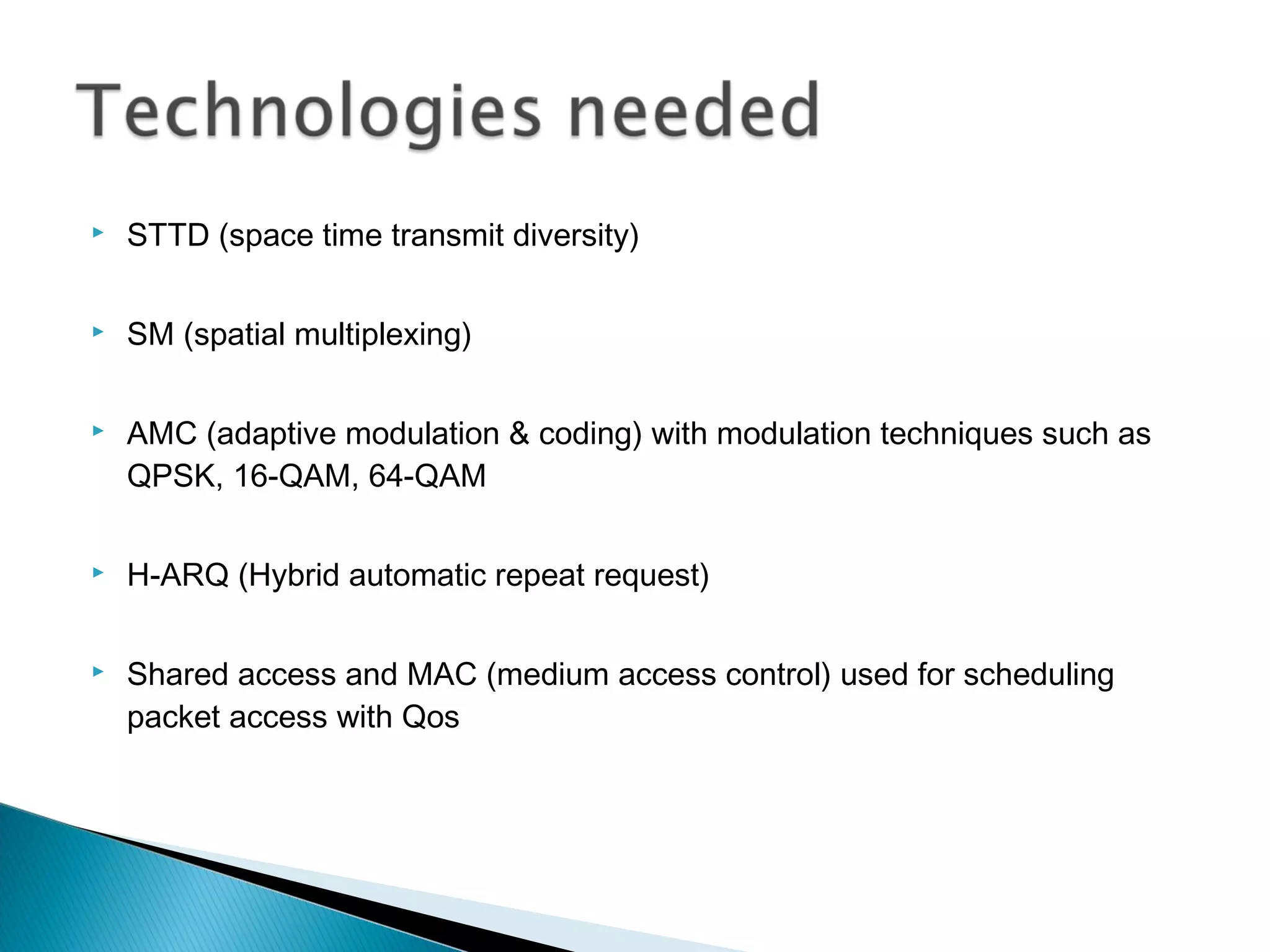
   STTD (space time transmit diversity)

   SM (spatial multiplexing)

   AMC (adaptive modulation & coding) with modulation techniques such as
    QPSK, 16-QAM, 64-QAM

   H-ARQ (Hybrid automatic repeat request)

   Shared access and MAC (medium access control) used for scheduling
    packet access with Qos
   Coupling MIMO and OFDM concepts to improve data rates in
    downlink of wireless communication networks.

   Analyzing the performance and building a prototype of
    Wireless WAN’S using MIMO-OFDM

   Use of adaptive loading algorithms such as Chows and
    Compello’s.

   Employing SVD (singular value decomposition) method to
    increase the performance incase of MIMO
   Survey, Implementation and performance analysis of existing MIMO

   Learning s/w and h/w

   Developing efficient algorithms

   Software synchronization development

   Various candidate coding and receiver strategies

   Identification of Equipment

   Implementation of prototype
   The results obtained from these tests indicate very good
    performance for the MIMO-OFDM prototype.

   Concept is proving to be very robust in highly dispersive
    channels

   Cost reduction is being investigated through various methods

   Simulation results show that at any given BER the adaptive
    SISO system will be outperformed by the adaptive MIMO
    system

   Other future work areas involve the improvement of MIMO
    processing complexity and practical implementation issues.
Mimo ofdm by abhishek pandey

Mimo ofdm by abhishek pandey

  • 1.
  • 2.
    In this project we show the performance of MIMO-OFDM system in Rayleigh Fading Channel  MIMO-OFDM system is very popular technique for mobile communication now a day’s .We compares Ergodic and Outage Capacity , with taking various numbers of Transmitting and Receiving antennas and various performance measures such as SNR, BER etc.  MIMO-OFDM, Ergodic Capacity, BER, SNR Outage Capacity
  • 3.
    Ever-increasing demands in communication industry towards wireless  Challenges: - to improve spectral efficiency - efficient bandwidth utilization - economical Signal Processing algorithms - high speed processing h/w
  • 4.
    - Multiple i/p multiple o/p antenna array - Used to increase data rates, improve capacity and BER (bit error rate) of the system Diagram of a MIMO wireless transmission system. - Typically used with OFDM so as to suit best needs in next generation comm. i.e. “4G”
  • 5.
    SU-MIMO (Single User - MIMO) this utilizes MIMO technology to improve the performance towards a single user.   MU-MIMO (Multi User - MIMO) this enables multiple users to be served through the use of spatial multiplexing techniques.
  • 6.
    Definition  The first OFDM schemes presented in 1966  Development of OFDM over years
  • 7.
    - Converts afrequency selective channel into a parallel collection of frequency flat sub channels - Orthogonal frequency division multiplexing uses bandwidth efficiently - Improves multipath fading issues - Reduces the effect of ISI (inter- sub carrier interference) OFDM System block Diagram
  • 8.
    It distributes the data over a large number of carriers that are spaced apart at precise frequencies.  This spacing provides the "orthogonality" in this technique which prevents the demodulators from seeing frequencies other than their own.
  • 9.
    ◦ Two conditionsmust be considered for the orthogonality between the subcarriers.  Each subcarrier has exactly an integer number of cycles in the FFT interval.  The number of cycles between adjacent subcarriers differs by exactly one.
  • 12.
    STTD (space time transmit diversity)  SM (spatial multiplexing)  AMC (adaptive modulation & coding) with modulation techniques such as QPSK, 16-QAM, 64-QAM  H-ARQ (Hybrid automatic repeat request)  Shared access and MAC (medium access control) used for scheduling packet access with Qos
  • 13.
    Coupling MIMO and OFDM concepts to improve data rates in downlink of wireless communication networks.  Analyzing the performance and building a prototype of Wireless WAN’S using MIMO-OFDM  Use of adaptive loading algorithms such as Chows and Compello’s.  Employing SVD (singular value decomposition) method to increase the performance incase of MIMO
  • 14.
    Survey, Implementation and performance analysis of existing MIMO  Learning s/w and h/w  Developing efficient algorithms  Software synchronization development  Various candidate coding and receiver strategies  Identification of Equipment  Implementation of prototype
  • 15.
    The results obtained from these tests indicate very good performance for the MIMO-OFDM prototype.  Concept is proving to be very robust in highly dispersive channels  Cost reduction is being investigated through various methods  Simulation results show that at any given BER the adaptive SISO system will be outperformed by the adaptive MIMO system  Other future work areas involve the improvement of MIMO processing complexity and practical implementation issues.