WIRELESS INTELLIGENT NETWORK(WIN)FOR GSM
Mr. NIMAY CHANDRA GIRI, M-Tech
CONTENTS
• OBJECTIVE
• INTRODUCTION
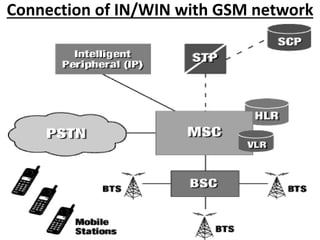
• CONNECTION OF WIN WITH GSM NETWORK
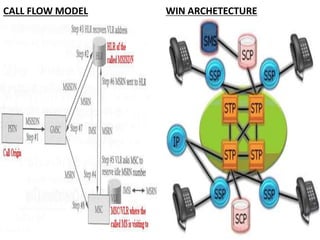
• WIN ARCHETECTURE
• CALL FLOW MODEL
• CALL FLOW CONTROL BY WIN
OBJECTIVE
Design call flow and control model in Global
System for Mobile (GSM) network through
Wireless intelligent network (WIN).
 IN mainly two types(AIN & WIN) as depend on
network connection(wire line or wire less)
AIN used for fixed network(PSTN)
WIN used for mobile network(ISDN/IN)
INTRODUCTION TO WIN & GSM
 Wireless Intelligent Network (WIN) means “Intelligence” is taken out
from Switching center to connect computer nodes for reliable
operations.
 WIN is a separate & independent network for both mobile and fixed
network.
 SS7 used in Telecom network like PSTN,ISDN & IN.
 IN/WIN is a value added system.
 Applications are-call control, service control & connection control.
GLOBAL SYSTEM FOR MOBILECOMMUNICATIONS(GSM):-
 GSM developed by the ETSI to describe 2G digital cellular networks.
 GSM standard was developed as a replacement for 1G analog
networks.
 GSM expanded to include data & voice communications, further
improvements were 3G & 4G systems.
 GSM components are BTS,BSC,MSC(HLR,VLR,AUC),PSTN,ISDN&IN.
Connection of IN/WIN with GSM network
CALL FLOW MODEL WIN ARCHETECTURE
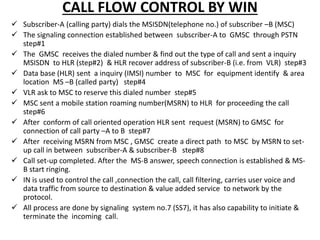
CALL FLOW CONTROL BY WIN
 Subscriber-A (calling party) dials the MSISDN(telephone no.) of subscriber –B (MSC)
 The signaling connection established between subscriber-A to GMSC through PSTN
step#1
 The GMSC receives the dialed number & find out the type of call and sent a inquiry
MSISDN to HLR (step#2) & HLR recover address of subscriber-B (i.e. from VLR) step#3
 Data base (HLR) sent a inquiry (IMSI) number to MSC for equipment identify & area
location MS –B (called party) step#4
 VLR ask to MSC to reserve this dialed number step#5
 MSC sent a mobile station roaming number(MSRN) to HLR for proceeding the call
step#6
 After conform of call oriented operation HLR sent request (MSRN) to GMSC for
connection of call party –A to B step#7
 After receiving MSRN from MSC , GMSC create a direct path to MSC by MSRN to set-
up call in between subscriber-A & subscriber-B step#8
 Call set-up completed. After the MS-B answer, speech connection is established & MS-
B start ringing.
 IN is used to control the call ,connection the call, call filtering, carries user voice and
data traffic from source to destination & value added service to network by the
protocol.
 All process are done by signaling system no.7 (SS7), it has also capability to initiate &
terminate the incoming call.
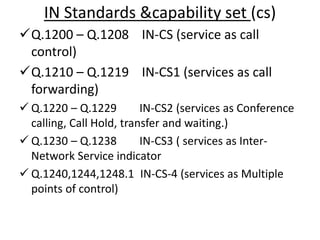
IN Standards &capability set (cs)
Q.1200 – Q.1208 IN-CS (service as call
control)
Q.1210 – Q.1219 IN-CS1 (services as call
forwarding)
 Q.1220 – Q.1229 IN-CS2 (services as Conference
calling, Call Hold, transfer and waiting.)
 Q.1230 – Q.1238 IN-CS3 ( services as Inter-
Network Service indicator
 Q.1240,1244,1248.1 IN-CS-4 (services as Multiple
points of control)
ADVANTAGES
• Takes less delivery time for services
• Fast services creation and termination
• Network is more stable
• Deliver high volume of data
• Can manage large no of devices application
CONCLUSION
 There are two overall standards employed today – CAMEL( up to 3G&4G)
and WIN( up to 2.5G/3G)
 Wireless Intelligent Networking allows the service provider to rapidly
introduce new services
 IN/WIN network is a fully independent network
 Maintaining and monitoring the Common Channel Signaling (CCS)
network is critical to its success
 Understanding and troubleshooting the SS7 protocol is a key part of that
success
 Features controlled out side the switch.
THANK YOU

Win ppt

  • 1.
    WIRELESS INTELLIGENT NETWORK(WIN)FORGSM Mr. NIMAY CHANDRA GIRI, M-Tech
  • 2.
    CONTENTS • OBJECTIVE • INTRODUCTION •CONNECTION OF WIN WITH GSM NETWORK • WIN ARCHETECTURE • CALL FLOW MODEL • CALL FLOW CONTROL BY WIN
  • 3.
    OBJECTIVE Design call flowand control model in Global System for Mobile (GSM) network through Wireless intelligent network (WIN).  IN mainly two types(AIN & WIN) as depend on network connection(wire line or wire less) AIN used for fixed network(PSTN) WIN used for mobile network(ISDN/IN)
  • 4.
    INTRODUCTION TO WIN& GSM  Wireless Intelligent Network (WIN) means “Intelligence” is taken out from Switching center to connect computer nodes for reliable operations.  WIN is a separate & independent network for both mobile and fixed network.  SS7 used in Telecom network like PSTN,ISDN & IN.  IN/WIN is a value added system.  Applications are-call control, service control & connection control. GLOBAL SYSTEM FOR MOBILECOMMUNICATIONS(GSM):-  GSM developed by the ETSI to describe 2G digital cellular networks.  GSM standard was developed as a replacement for 1G analog networks.  GSM expanded to include data & voice communications, further improvements were 3G & 4G systems.  GSM components are BTS,BSC,MSC(HLR,VLR,AUC),PSTN,ISDN&IN.
  • 5.
    Connection of IN/WINwith GSM network
  • 6.
    CALL FLOW MODELWIN ARCHETECTURE
  • 7.
    CALL FLOW CONTROLBY WIN  Subscriber-A (calling party) dials the MSISDN(telephone no.) of subscriber –B (MSC)  The signaling connection established between subscriber-A to GMSC through PSTN step#1  The GMSC receives the dialed number & find out the type of call and sent a inquiry MSISDN to HLR (step#2) & HLR recover address of subscriber-B (i.e. from VLR) step#3  Data base (HLR) sent a inquiry (IMSI) number to MSC for equipment identify & area location MS –B (called party) step#4  VLR ask to MSC to reserve this dialed number step#5  MSC sent a mobile station roaming number(MSRN) to HLR for proceeding the call step#6  After conform of call oriented operation HLR sent request (MSRN) to GMSC for connection of call party –A to B step#7  After receiving MSRN from MSC , GMSC create a direct path to MSC by MSRN to set- up call in between subscriber-A & subscriber-B step#8  Call set-up completed. After the MS-B answer, speech connection is established & MS- B start ringing.  IN is used to control the call ,connection the call, call filtering, carries user voice and data traffic from source to destination & value added service to network by the protocol.  All process are done by signaling system no.7 (SS7), it has also capability to initiate & terminate the incoming call.
  • 8.
    IN Standards &capabilityset (cs) Q.1200 – Q.1208 IN-CS (service as call control) Q.1210 – Q.1219 IN-CS1 (services as call forwarding)  Q.1220 – Q.1229 IN-CS2 (services as Conference calling, Call Hold, transfer and waiting.)  Q.1230 – Q.1238 IN-CS3 ( services as Inter- Network Service indicator  Q.1240,1244,1248.1 IN-CS-4 (services as Multiple points of control)
  • 9.
    ADVANTAGES • Takes lessdelivery time for services • Fast services creation and termination • Network is more stable • Deliver high volume of data • Can manage large no of devices application
  • 10.
    CONCLUSION  There aretwo overall standards employed today – CAMEL( up to 3G&4G) and WIN( up to 2.5G/3G)  Wireless Intelligent Networking allows the service provider to rapidly introduce new services  IN/WIN network is a fully independent network  Maintaining and monitoring the Common Channel Signaling (CCS) network is critical to its success  Understanding and troubleshooting the SS7 protocol is a key part of that success  Features controlled out side the switch.
  • 11.