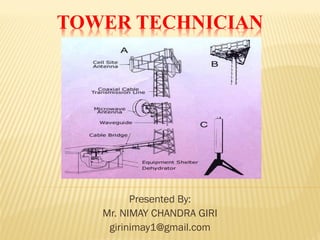
TOWER TECHNICIAN 
Presented By: 
Mr. NIMAY CHANDRA GIRI 
girinimay1@gmail.com
CONTENTE 
Objective 
Introduction 
GSM System & Architecture 
Network identities 
MS & BTS 
Architecture of BTS with configuration 
Antenna types & configurations 
Different pole types antennas 
Tilt
OBJECTIVE 
TounderstanddetailsaboutBTSsysteminGSMsystem.DifferenttypesofAntennasusedinthemarket.FunctionalstructureofBTS&differentpartsofit. 
MIMO&LTEAntennasused.
INTRODUCTION 
Acellsiteorcelltowerisacellulartelephonesitewhereantennaeandelectroniccommunicationsequipmentareplaced,usuallyonaradiomast,towerorotherhighplace,tocreateacell(oradjacentcells)inacellularnetwork. 
Frequencyreuse–samefrequencyin 
manycellsites 
Cellularexpansion–easytoaddnewcells 
Handover–movingbetweencells 
Roaming-betweennetworks
BRIEF HISTORY 
First telephone (photo phone) –Alexander Bell, 1880 
The first car mounted radio telephone –1921 
1946 –First commercial mobile radio-telephone service by Bell and AT&T in Saint Louis, USA. Half duplex(PTT) 
1973 –First handheld cellular phone –Motorola. 
1982„GroupeSpécialMobile”iscreatedwithinCEPT(ConférenceEuropéennedesPostesetTélécommunications) 
1987MainRadiotransmissiontechniquesarechosen, basedonprototypeevaluation(1986) 
1989GSMbecomesanETSItechnicalcommittee 
1990ThePhaseIGSM900specificationarefrozen 
DCS1800adaptationstarts 
1991Firstsystemsarerunning 
DCS1800specificationsarefrozen 
1992AllmajorEuropeanGSM900operatorsbegincommercialoperations(2G) 
20003Gsystemcomesintomarket. 
20104Gsystemcomesintomarket.
GLOBAL SYSTEM FOR MOBILE COMMUNICATION 
GSMisastandarddevelopedbytheEuropeanTelecommunicationsStandardsInstitute(ETSI)todescribeprotocolsforsecond-generation(2G)digitalcellularnetworksusedbymobilephones.Asof2014ithasbecomethedefaultglobalstandardformobilecommunications-withover90%marketshare,operatinginover219countriesandterritories. 
2Gnetworksdevelopedasareplacementforfirstgeneration(1G)analogcellularnetworks,andtheGSMstandardoriginallydescribedadigital,circuit- switchednetworkoptimizedforfullduplexvoicetelephony.Thisexpandedovertimetoincludedatacommunications,firstbycircuit-switchedtransport, thenbypacketdatatransportviaGPRS(GeneralPacketRadioServices) andEDGE(EnhancedDataratesforGSMEvolutionorEGPRS). 
Subsequently,the3GPPdevelopedthird-generation(3G)UMTSstandardsfollowedbyfourth-generation(4G)LTEAdvancedstandards,whichdonotformpartoftheETSIGSMstandard. 
GSMFunctions 
Transmission. 
Radio Resources management (RR). 
Mobility Management (MM). 
Communication Management (CM). 
Operation, Administration and Maintenance (OAM).
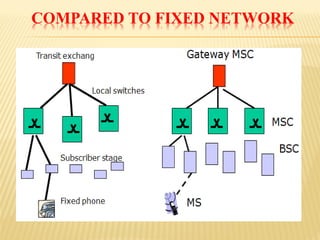
COMPARED TO FIXED NETWORK
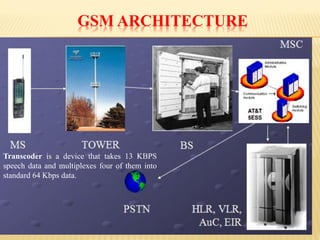
GSM ARCHITECTURE 
Transcoderisadevicethattakes13KBPSspeechdataandmultiplexesfourofthemintostandard64Kbpsdata.
NETWORK IDENTITIES 
IMEI(InternationalMobileEquipmentIdentity) 
MSISDN(MobileStationISDNNumber) 
IMSI(InternationalmobilesubscriberIdentity) 
TMSI(TemporaryMobilesubscriberIdentity) 
MSRN(MobileStationRoamingNumber)
MOBILE STATION (MS) 
AMobileStationconsistsoftwomainelements: 
Themobileequipmentorterminal. 
Therearedifferenttypesofterminalsdistinguishedprincipallybytheirpowerandapplication: 
The`fixed'terminalsaretheonesinstalledincars.Theirmaximumallowedoutputpoweris20W. 
TheGSMportableterminalscanalsobeinstalledinvehicles.Theirmaximumallowedoutputpoweris8W. 
Thehandhelsterminalshaveexperiencedthebiggestsuccessthankstotheweightandvolume, whicharecontinuouslydecreasing.Theseterminalscanemitupto2W.Theevolutionoftechnologiesallowstodecreasethemaximumallowedpowerto0.8W. 
TheSubscriberIdentityModule(SIM). 
TheSIMisasmartcardthatidentifiestheterminal.ByinsertingtheSIMcardintotheterminal, theusercanhaveaccesstoallthesubscribedservices.WithouttheSIMcard,theterminalisnotoperational. 
SIM has microprocessor and memory, IMSI, 
Authentication Key, Ki 
Security Algorithms:kc,A3,A8 
PIN & PUK 
FunctionofMS: 
Voice and data transmission & receipt 
Frequency and time synchronization 
Monitoring of power and signal quality of the surrounding cells 
Provision of location updates even during inactive state
THE BASE STATION SUBSYSTEM (BSS) 
TheBSSconnectstheMobileStationandtheNSS.Itisinchargeofthetransmissionandreception.TheBSScanbedividedintotwoparts: 
TheBaseTransceiverStation(BTS)orBaseStation. 
TheBTScorrespondstothetransceiversandantennasusedineachcellofthenetwork.ABTSisusuallyplacedinthecenterofacell.Itstransmittingpowerdefinesthesizeofacell.EachBTShasbetweenoneandsixteentransceiversdependingonthedensityofusersinthecell. 
TheBaseStationController(BSC). 
TheBSCcontrolsagroupofBTSandmanagestheirradioresources(upto100BTSs).ABSCisprincipallyinchargeofhandovers,frequencyhopping,exchangefunctionsandcontroloftheradiofrequencypowerlevelsoftheBTSs.
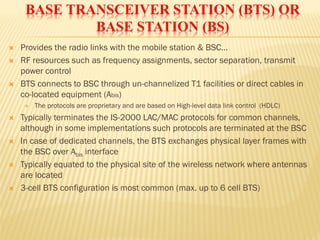
BASE TRANSCEIVER STATION (BTS) OR BASE STATION (BS) 
Provides the radio links with the mobile station & BSC… 
RF resources such as frequency assignments, sector separation, transmit power control 
BTS connects to BSC through un-channelized T1 facilities or direct cables in co-located equipment (Abis) 
The protocols are proprietary and are based on High-level data link control (HDLC) 
Typically terminates the IS-2000 LAC/MAC protocols for common channels, although in some implementations such protocols are terminated at the BSC 
In case of dedicated channels, the BTS exchanges physical layer frames with the BSC over Abisinterface 
Typically equated to the physical site of the wireless network where antennas are located 
3-cell BTS configuration is most common (max. up to 6 cell BTS)
OPERATION RANGE OF CELL TOWER 
Heightofantennaoversurroundingterrain(Line-of-sightpropagation). 
Thefrequencyofsignalinuse. 
Timinglimitationsinsometechnologies(e.g.,GSMislimitedto35km,with70kmbeingpossiblewithspecialequipment) 
Thetransmitter'sratedpower. 
Therequireduplink/downlinkdatarateofthesubscriber'sdevice. 
Thedirectionalcharacteristicsofthesiteantennaarray. 
Reflectionandabsorptionofradioenergybybuildingsorvegetation. 
Itmayalsobelimitedbylocalgeographicalorregulatoryfactorsandweatherconditions. 
GSM,haveafixedmaximumrangeof35kilometers(22mi) 
CDMAandIDENhavenobuilt-inlimit,butitispossibletogetbetween50to70km(30–45miles)
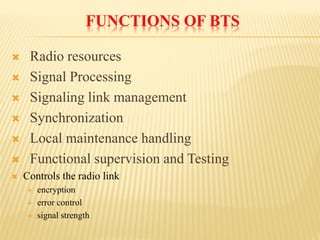
FUNCTIONS OF BTS 
Radio resources 
Signal Processing 
Signaling link management 
Synchronization 
Local maintenance handling 
Functional supervision and Testing 
Controls the radio link 
encryption 
error control 
signal strength
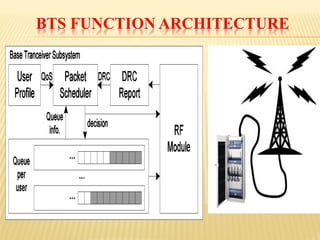
BTS FUNCTION ARCHITECTURE
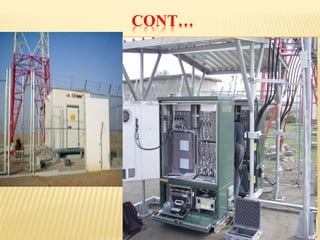
CONT… 
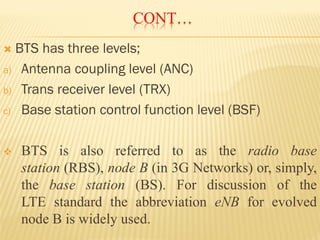
BTS has three levels; 
a)Antenna coupling level (ANC) 
b)Trans receiver level (TRX) 
c)Base station control function level (BSF) 
BTSisalsoreferredtoastheradiobasestation(RBS),nodeB(in3GNetworks)or,simply, thebasestation(BS).FordiscussionoftheLTEstandardtheabbreviationeNBforevolvednodeBiswidelyused.
GENERAL ARCHITECTURE OF BTS 
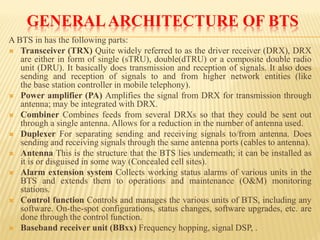
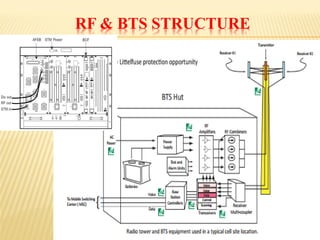
ABTSinhasthefollowingparts: 
Transceiver(TRX)Quitewidelyreferredtoasthedriverreceiver(DRX),DRXareeitherinformofsingle(sTRU),double(dTRU)oracompositedoubleradiounit(DRU).Itbasicallydoestransmissionandreceptionofsignals.Italsodoessendingandreceptionofsignalstoandfromhighernetworkentities(likethebasestationcontrollerinmobiletelephony). 
Poweramplifier(PA)AmplifiesthesignalfromDRXfortransmissionthroughantenna;maybeintegratedwithDRX. 
CombinerCombinesfeedsfromseveralDRXssothattheycouldbesentoutthroughasingleantenna.Allowsforareductioninthenumberofantennaused. 
DuplexerForseparatingsendingandreceivingsignalsto/fromantenna.Doessendingandreceivingsignalsthroughthesameantennaports(cablestoantenna). 
AntennaThisisthestructurethattheBTSliesunderneath;itcanbeinstalledasitisordisguisedinsomeway(Concealedcellsites). 
AlarmextensionsystemCollectsworkingstatusalarmsofvariousunitsintheBTSandextendsthemtooperationsandmaintenance(O&M)monitoringstations. 
ControlfunctionControlsandmanagesthevariousunitsofBTS,includinganysoftware.On-the-spotconfigurations,statuschanges,softwareupgrades,etc.aredonethroughthecontrolfunction. 
Basebandreceiverunit(BBxx)Frequencyhopping,signalDSP,.
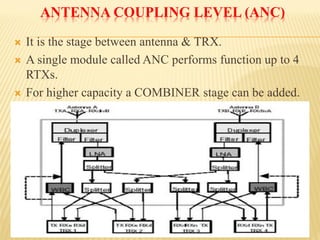
ANTENNA COUPLING LEVEL (ANC) 
It is the stage between antenna & TRX. 
A single module called ANC performs function up to 4 RTXs. 
For higher capacity a COMBINER stage can be added.
TRANS RECEIVER LEVEL (TRX) 
Trans-receiverequipment. 
Usedforreception&transmissionofRFsignal. 
TheAbsoluteRadiofrequencychannelnumber(ARFCN)isallottedtooneTRX&eachARFCNisdividedin8timeslots,henceoneTRXcanprovideconnectionto8subscribersatatime. 
OneBTS=12TRX=12ARFCN=12*8=96Users 
Soatatimeonly96userscanmakecalls.
BASE STATION CONTROL FUNCTION LEVEL (BSF) 
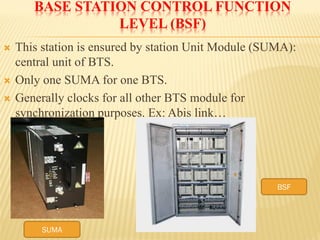
This station is ensured by station Unit Module (SUMA): central unit of BTS. 
Only one SUMA for one BTS. 
Generally clocks for all other BTS module for synchronization purposes. Ex: Abis link… 
SUMA 
BSF
RF& BTSSTRUCTURE
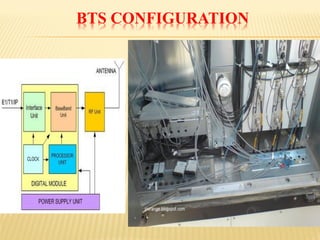
BTS CONFIGURATION
CONT…
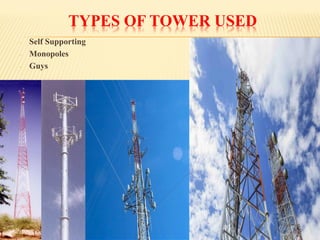
TYPES OF TOWER USED 
–Self Supporting 
–Monopoles 
–Guys
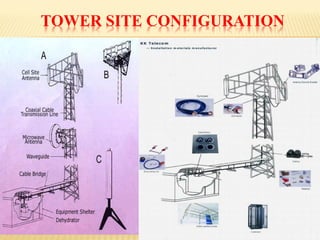
TOWER SITE CONFIGURATION
ANTENNAS USED 
AnAntennaisadevicetotransmitand/orreceiveelectromagneticwaves.Electromagneticwavesareoftenreferredtoasradiowaves.
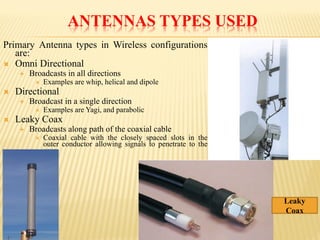
ANTENNAS TYPES USED 
PrimaryAntennatypesinWirelessconfigurationsare: 
OmniDirectional 
Broadcastsinalldirections 
Examplesarewhip,helicalanddipole 
Directional 
Broadcastinasingledirection 
ExamplesareYagi,andparabolic 
LeakyCoax 
Broadcastsalongpathofthecoaxialcable 
Coaxialcablewiththecloselyspacedslotsintheouterconductorallowingsignalstopenetratetothecore 
Leaky Coax
ELECTRICAL & MECHANICAL TILT 
Thetiltrepresentstheinclinationorangleoftheantennatoitsaxis. 
ElectricaltiltisusedforincreasingordecreasingofBeamradiation. 
(+)=>Tx&(-)=>Rx
MECHANICAL TILT 
Mechanical tilt is adjusted for maximum or minimum coverage area radiation.
MULTI-INPUT MULTI-OUTPUT (MIMO) ANTENNAS 
Mobile MIMO antenna 
Directional Base station MIMO antenna 
Dual band Wi-Fi MIMO antenna 
Single band Omni directional MIMO antenna 2.4-5 GHz
LONG TERM EVOLUTION (LTE) 
LongTermEvolution(LTE)istheworld'sleading4Gcellularnetworktechnology. 
LTE'shighdataratesandlowlatencyenableapplicationssuchasstreamingHDvideo,highdefinitionVoiceoverLTE(VoLTE), broadcasting,andpublicsafetyemergencyresponse. 
Bandwidthsrangingfrom1.4MHzto20MHz. 
ThismakesLTEanaturalupgradepathforcarrierswithbothGSM/UMTSandCDMA2000networks. 
Bandscurrentlyinuserangefrom450MHzto2700MHz,withbandsashighas3.5GHz. 
LTEMIMOantennasmustbecarefullydesignedinordertogetthefullbenefitofMIMOtechnology.
Cell tower, BTS & antennas

Cell tower, BTS & antennas

  • 1.
    TOWER TECHNICIAN PresentedBy: Mr. NIMAY CHANDRA GIRI girinimay1@gmail.com
  • 2.
    CONTENTE Objective Introduction GSM System & Architecture Network identities MS & BTS Architecture of BTS with configuration Antenna types & configurations Different pole types antennas Tilt
  • 3.
  • 4.
  • 5.
    BRIEF HISTORY Firsttelephone (photo phone) –Alexander Bell, 1880 The first car mounted radio telephone –1921 1946 –First commercial mobile radio-telephone service by Bell and AT&T in Saint Louis, USA. Half duplex(PTT) 1973 –First handheld cellular phone –Motorola. 1982„GroupeSpécialMobile”iscreatedwithinCEPT(ConférenceEuropéennedesPostesetTélécommunications) 1987MainRadiotransmissiontechniquesarechosen, basedonprototypeevaluation(1986) 1989GSMbecomesanETSItechnicalcommittee 1990ThePhaseIGSM900specificationarefrozen DCS1800adaptationstarts 1991Firstsystemsarerunning DCS1800specificationsarefrozen 1992AllmajorEuropeanGSM900operatorsbegincommercialoperations(2G) 20003Gsystemcomesintomarket. 20104Gsystemcomesintomarket.
  • 6.
    GLOBAL SYSTEM FORMOBILE COMMUNICATION GSMisastandarddevelopedbytheEuropeanTelecommunicationsStandardsInstitute(ETSI)todescribeprotocolsforsecond-generation(2G)digitalcellularnetworksusedbymobilephones.Asof2014ithasbecomethedefaultglobalstandardformobilecommunications-withover90%marketshare,operatinginover219countriesandterritories. 2Gnetworksdevelopedasareplacementforfirstgeneration(1G)analogcellularnetworks,andtheGSMstandardoriginallydescribedadigital,circuit- switchednetworkoptimizedforfullduplexvoicetelephony.Thisexpandedovertimetoincludedatacommunications,firstbycircuit-switchedtransport, thenbypacketdatatransportviaGPRS(GeneralPacketRadioServices) andEDGE(EnhancedDataratesforGSMEvolutionorEGPRS). Subsequently,the3GPPdevelopedthird-generation(3G)UMTSstandardsfollowedbyfourth-generation(4G)LTEAdvancedstandards,whichdonotformpartoftheETSIGSMstandard. GSMFunctions Transmission. Radio Resources management (RR). Mobility Management (MM). Communication Management (CM). Operation, Administration and Maintenance (OAM).
  • 7.
  • 8.
  • 9.
    NETWORK IDENTITIES IMEI(InternationalMobileEquipmentIdentity) MSISDN(MobileStationISDNNumber) IMSI(InternationalmobilesubscriberIdentity) TMSI(TemporaryMobilesubscriberIdentity) MSRN(MobileStationRoamingNumber)
  • 10.
    MOBILE STATION (MS) AMobileStationconsistsoftwomainelements: Themobileequipmentorterminal. Therearedifferenttypesofterminalsdistinguishedprincipallybytheirpowerandapplication: The`fixed'terminalsaretheonesinstalledincars.Theirmaximumallowedoutputpoweris20W. TheGSMportableterminalscanalsobeinstalledinvehicles.Theirmaximumallowedoutputpoweris8W. Thehandhelsterminalshaveexperiencedthebiggestsuccessthankstotheweightandvolume, whicharecontinuouslydecreasing.Theseterminalscanemitupto2W.Theevolutionoftechnologiesallowstodecreasethemaximumallowedpowerto0.8W. TheSubscriberIdentityModule(SIM). TheSIMisasmartcardthatidentifiestheterminal.ByinsertingtheSIMcardintotheterminal, theusercanhaveaccesstoallthesubscribedservices.WithouttheSIMcard,theterminalisnotoperational. SIM has microprocessor and memory, IMSI, Authentication Key, Ki Security Algorithms:kc,A3,A8 PIN & PUK FunctionofMS: Voice and data transmission & receipt Frequency and time synchronization Monitoring of power and signal quality of the surrounding cells Provision of location updates even during inactive state
  • 11.
    THE BASE STATIONSUBSYSTEM (BSS) TheBSSconnectstheMobileStationandtheNSS.Itisinchargeofthetransmissionandreception.TheBSScanbedividedintotwoparts: TheBaseTransceiverStation(BTS)orBaseStation. TheBTScorrespondstothetransceiversandantennasusedineachcellofthenetwork.ABTSisusuallyplacedinthecenterofacell.Itstransmittingpowerdefinesthesizeofacell.EachBTShasbetweenoneandsixteentransceiversdependingonthedensityofusersinthecell. TheBaseStationController(BSC). TheBSCcontrolsagroupofBTSandmanagestheirradioresources(upto100BTSs).ABSCisprincipallyinchargeofhandovers,frequencyhopping,exchangefunctionsandcontroloftheradiofrequencypowerlevelsoftheBTSs.
  • 12.
    BASE TRANSCEIVER STATION(BTS) OR BASE STATION (BS) Provides the radio links with the mobile station & BSC… RF resources such as frequency assignments, sector separation, transmit power control BTS connects to BSC through un-channelized T1 facilities or direct cables in co-located equipment (Abis) The protocols are proprietary and are based on High-level data link control (HDLC) Typically terminates the IS-2000 LAC/MAC protocols for common channels, although in some implementations such protocols are terminated at the BSC In case of dedicated channels, the BTS exchanges physical layer frames with the BSC over Abisinterface Typically equated to the physical site of the wireless network where antennas are located 3-cell BTS configuration is most common (max. up to 6 cell BTS)
  • 13.
    OPERATION RANGE OFCELL TOWER Heightofantennaoversurroundingterrain(Line-of-sightpropagation). Thefrequencyofsignalinuse. Timinglimitationsinsometechnologies(e.g.,GSMislimitedto35km,with70kmbeingpossiblewithspecialequipment) Thetransmitter'sratedpower. Therequireduplink/downlinkdatarateofthesubscriber'sdevice. Thedirectionalcharacteristicsofthesiteantennaarray. Reflectionandabsorptionofradioenergybybuildingsorvegetation. Itmayalsobelimitedbylocalgeographicalorregulatoryfactorsandweatherconditions. GSM,haveafixedmaximumrangeof35kilometers(22mi) CDMAandIDENhavenobuilt-inlimit,butitispossibletogetbetween50to70km(30–45miles)
  • 14.
    FUNCTIONS OF BTS Radio resources Signal Processing Signaling link management Synchronization Local maintenance handling Functional supervision and Testing Controls the radio link encryption error control signal strength
  • 15.
  • 16.
    CONT… BTS hasthree levels; a)Antenna coupling level (ANC) b)Trans receiver level (TRX) c)Base station control function level (BSF) BTSisalsoreferredtoastheradiobasestation(RBS),nodeB(in3GNetworks)or,simply, thebasestation(BS).FordiscussionoftheLTEstandardtheabbreviationeNBforevolvednodeBiswidelyused.
  • 17.
    GENERAL ARCHITECTURE OFBTS ABTSinhasthefollowingparts: Transceiver(TRX)Quitewidelyreferredtoasthedriverreceiver(DRX),DRXareeitherinformofsingle(sTRU),double(dTRU)oracompositedoubleradiounit(DRU).Itbasicallydoestransmissionandreceptionofsignals.Italsodoessendingandreceptionofsignalstoandfromhighernetworkentities(likethebasestationcontrollerinmobiletelephony). Poweramplifier(PA)AmplifiesthesignalfromDRXfortransmissionthroughantenna;maybeintegratedwithDRX. CombinerCombinesfeedsfromseveralDRXssothattheycouldbesentoutthroughasingleantenna.Allowsforareductioninthenumberofantennaused. DuplexerForseparatingsendingandreceivingsignalsto/fromantenna.Doessendingandreceivingsignalsthroughthesameantennaports(cablestoantenna). AntennaThisisthestructurethattheBTSliesunderneath;itcanbeinstalledasitisordisguisedinsomeway(Concealedcellsites). AlarmextensionsystemCollectsworkingstatusalarmsofvariousunitsintheBTSandextendsthemtooperationsandmaintenance(O&M)monitoringstations. ControlfunctionControlsandmanagesthevariousunitsofBTS,includinganysoftware.On-the-spotconfigurations,statuschanges,softwareupgrades,etc.aredonethroughthecontrolfunction. Basebandreceiverunit(BBxx)Frequencyhopping,signalDSP,.
  • 18.
    ANTENNA COUPLING LEVEL(ANC) It is the stage between antenna & TRX. A single module called ANC performs function up to 4 RTXs. For higher capacity a COMBINER stage can be added.
  • 19.
    TRANS RECEIVER LEVEL(TRX) Trans-receiverequipment. Usedforreception&transmissionofRFsignal. TheAbsoluteRadiofrequencychannelnumber(ARFCN)isallottedtooneTRX&eachARFCNisdividedin8timeslots,henceoneTRXcanprovideconnectionto8subscribersatatime. OneBTS=12TRX=12ARFCN=12*8=96Users Soatatimeonly96userscanmakecalls.
  • 20.
    BASE STATION CONTROLFUNCTION LEVEL (BSF) This station is ensured by station Unit Module (SUMA): central unit of BTS. Only one SUMA for one BTS. Generally clocks for all other BTS module for synchronization purposes. Ex: Abis link… SUMA BSF
  • 21.
  • 22.
  • 23.
  • 24.
    TYPES OF TOWERUSED –Self Supporting –Monopoles –Guys
  • 25.
  • 26.
  • 27.
    ANTENNAS TYPES USED PrimaryAntennatypesinWirelessconfigurationsare: OmniDirectional Broadcastsinalldirections Examplesarewhip,helicalanddipole Directional Broadcastinasingledirection ExamplesareYagi,andparabolic LeakyCoax Broadcastsalongpathofthecoaxialcable Coaxialcablewiththecloselyspacedslotsintheouterconductorallowingsignalstopenetratetothecore Leaky Coax
  • 28.
    ELECTRICAL & MECHANICALTILT Thetiltrepresentstheinclinationorangleoftheantennatoitsaxis. ElectricaltiltisusedforincreasingordecreasingofBeamradiation. (+)=>Tx&(-)=>Rx
  • 29.
    MECHANICAL TILT Mechanicaltilt is adjusted for maximum or minimum coverage area radiation.
  • 30.
    MULTI-INPUT MULTI-OUTPUT (MIMO)ANTENNAS Mobile MIMO antenna Directional Base station MIMO antenna Dual band Wi-Fi MIMO antenna Single band Omni directional MIMO antenna 2.4-5 GHz
  • 31.
    LONG TERM EVOLUTION(LTE) LongTermEvolution(LTE)istheworld'sleading4Gcellularnetworktechnology. LTE'shighdataratesandlowlatencyenableapplicationssuchasstreamingHDvideo,highdefinitionVoiceoverLTE(VoLTE), broadcasting,andpublicsafetyemergencyresponse. Bandwidthsrangingfrom1.4MHzto20MHz. ThismakesLTEanaturalupgradepathforcarrierswithbothGSM/UMTSandCDMA2000networks. Bandscurrentlyinuserangefrom450MHzto2700MHz,withbandsashighas3.5GHz. LTEMIMOantennasmustbecarefullydesignedinordertogetthefullbenefitofMIMOtechnology.