
Developmental Psychology:
2110 E
Professor Scott Adler
adler@yorku.ca
333 BSB
http://www.psych.yorku.ca/adler/
What is psychology?
 The scientific study of behavior
 Types of behavior:

Includes social, cognitive, emotional,
physical, abnormal, etc.
What is developmental
psychology?
 The scientific study of change in
behavior as the organism grows,
matures and gains experience with
the world around them.
 Rapid Development
 Long-term Effects
 Window into Adult Behavior
 Real World Applications
 Interesting Subject Matter
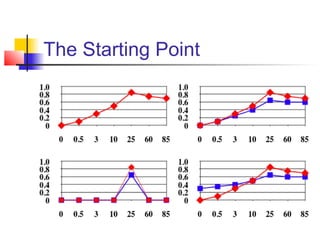
 The Starting Point
Why is research focused on
infants and children?
The Starting Point
Themes of Development
 Both biology and the social and physical
environment affect our development,
although they may influence different aspects
of development to different degrees.
 Biological versus Environmental
Influences:
To explore how biological and environmental
factors interact to produce developmental
variations in different children.
Themes of Development
 The Active versus the Passive Child:The Active versus the Passive Child:
Modern developmentalists believe that
children are usually active agents who shape,
control, and direct the course of their own
development.
 Continuity versus Discontinuity:
 Recently, suggested that our judgment of
continuity or discontinuity depends on the
power of the lens we use in examining
changes across development
Early Theorists
 Descartes - Cartesian Dualism
 Known as the Mind-Body Problem
 John Locke (17th) - Tabula Rasa
 Rousseau (18th)
 Born with knowledge and ideas
 Develop according to innate timetable
Early Theorists
 Darwin (19th)
 Evolutionary Theory and Natural
Selection
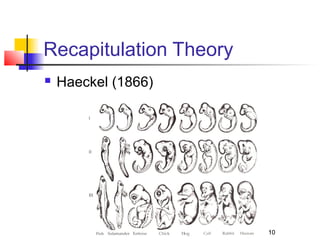
 Recapitulation Theory - ontogeny
recapitulates phylogeny
10
Recapitulation Theory
 Haeckel (1866)
10
Early Child Psychology
 Wundt - Development (and evolution)
proceeds through 3 steps:
 Impulsive Acts - innate drives
 Voluntary Acts - several motives but one
predominates
 Selective Acts - conscious choice
Early Child Psychology
 G. Stanley Hall
 First scientific study of the child
 Believed in recapitulation theory
 Watson - returns to Locke’s
environmentalism
 Behaviorism - changes in behavior occur through
conditioning
 Little Albert - conditioned reflex method

Used by Pavlov to make dog salivate to a bell
Early Child Psychology
 Freud - Theory of psychosexual
development
 Stage theory
 Repression of desires
 Believed in interaction of innate and
environment
Early Child Psychology
 Gesell
 Development due to biological mechanisms
 Focused on motor skills
 Found regular pattern and developed age norms
 Piaget
 Interested in qualitative issues of children’s
knowledge
 Used tasks and verbal problems instead of
questionnaires
 Stage theory of cognitive development
Early Child Psychology
 Erikson
 Personality Development
 Epigenetic approach - personality is in genes
 In stage theory, a positive characteristic is in
conflict with a negative one
 Vygotsky
 Sociocultural approach to cognitive development
 Contrasts with Piaget, who believed in a common
cognitive development
QuickTime™ and a
YUV420 codec decompressor
are needed to see this picture.

Recapitulation

  • 1.
    Developmental Psychology: 2110 E ProfessorScott Adler adler@yorku.ca 333 BSB http://www.psych.yorku.ca/adler/
  • 2.
    What is psychology? The scientific study of behavior  Types of behavior:  Includes social, cognitive, emotional, physical, abnormal, etc.
  • 3.
    What is developmental psychology? The scientific study of change in behavior as the organism grows, matures and gains experience with the world around them.
  • 4.
     Rapid Development Long-term Effects  Window into Adult Behavior  Real World Applications  Interesting Subject Matter  The Starting Point Why is research focused on infants and children?
  • 5.
  • 6.
    Themes of Development Both biology and the social and physical environment affect our development, although they may influence different aspects of development to different degrees.  Biological versus Environmental Influences: To explore how biological and environmental factors interact to produce developmental variations in different children.
  • 7.
    Themes of Development The Active versus the Passive Child:The Active versus the Passive Child: Modern developmentalists believe that children are usually active agents who shape, control, and direct the course of their own development.  Continuity versus Discontinuity:  Recently, suggested that our judgment of continuity or discontinuity depends on the power of the lens we use in examining changes across development
  • 8.
    Early Theorists  Descartes- Cartesian Dualism  Known as the Mind-Body Problem  John Locke (17th) - Tabula Rasa  Rousseau (18th)  Born with knowledge and ideas  Develop according to innate timetable
  • 9.
    Early Theorists  Darwin(19th)  Evolutionary Theory and Natural Selection  Recapitulation Theory - ontogeny recapitulates phylogeny
  • 10.
  • 11.
    Early Child Psychology Wundt - Development (and evolution) proceeds through 3 steps:  Impulsive Acts - innate drives  Voluntary Acts - several motives but one predominates  Selective Acts - conscious choice
  • 12.
    Early Child Psychology G. Stanley Hall  First scientific study of the child  Believed in recapitulation theory  Watson - returns to Locke’s environmentalism  Behaviorism - changes in behavior occur through conditioning  Little Albert - conditioned reflex method  Used by Pavlov to make dog salivate to a bell
  • 13.
    Early Child Psychology Freud - Theory of psychosexual development  Stage theory  Repression of desires  Believed in interaction of innate and environment
  • 14.
    Early Child Psychology Gesell  Development due to biological mechanisms  Focused on motor skills  Found regular pattern and developed age norms  Piaget  Interested in qualitative issues of children’s knowledge  Used tasks and verbal problems instead of questionnaires  Stage theory of cognitive development
  • 15.
    Early Child Psychology Erikson  Personality Development  Epigenetic approach - personality is in genes  In stage theory, a positive characteristic is in conflict with a negative one  Vygotsky  Sociocultural approach to cognitive development  Contrasts with Piaget, who believed in a common cognitive development QuickTime™ and a YUV420 codec decompressor are needed to see this picture.