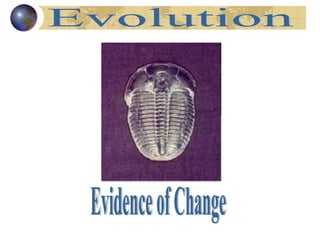
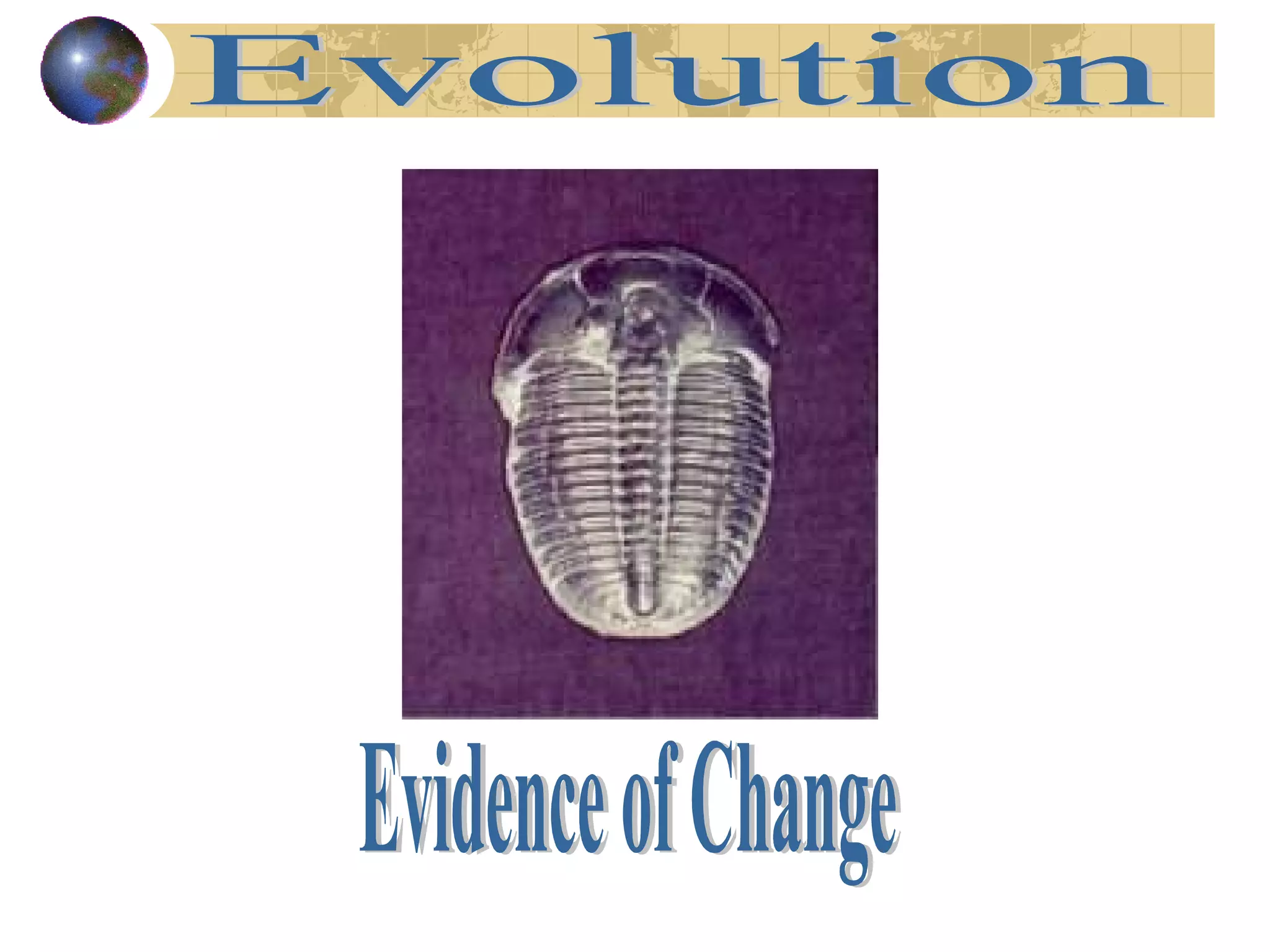
Evidence of Change Evolution
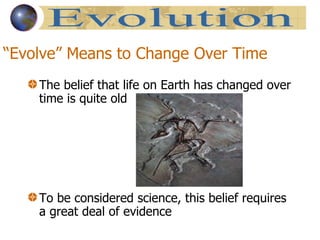
“ Evolve” Means to Change Over Time  The belief that life on Earth has changed over time is quite old To be considered science, this belief requires a great deal of evidence Evolution
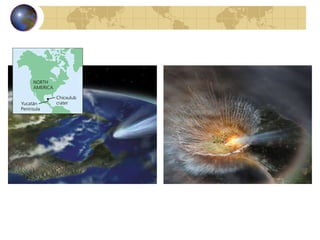
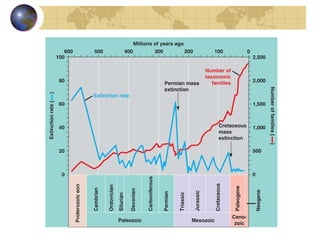
The Development of Evolutionary Theory Naturalists have always wondered at the diversity of living things……… Great varieties in shape, size, and ecological role Estimated 3 million to 20 million different living species Much of the natural world’s biodiversity has vanished through  extinction 99% of all species that ever lived are now extinct Permian-Triassic Mass Extinction What Killed the Dinosaurs? Evolution


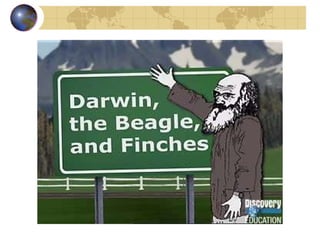
Development of Evolutionary Theory What could cause such great diversity, and why have so many species died out? Charles Darwin offered an explanation based on careful observations Who was Charles Darwin? Evolution
 
 
Development of Evolutionary Theory Darwin Concluded: Physical traits and behaviors enable organisms to  survive and reproduce   (called  Fitness  ) Fitness results from  adaptations Darwin reasoned that adaptations result from  natural selection  and result in  evolution Evolution Evolution is the process by which living things change and diversify over time
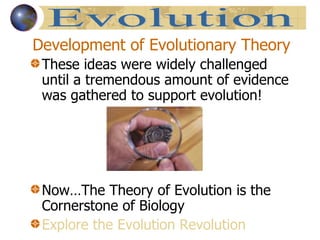
Development of Evolutionary Theory These ideas were widely challenged until a tremendous amount of evidence was gathered to support evolution! Now…The Theory of Evolution is the Cornerstone of Biology Explore the Evolution Revolution Evolution
Natural Selection and Speciation
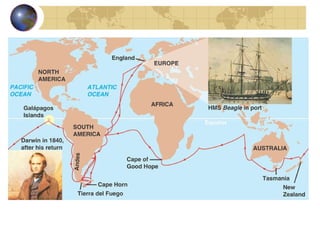
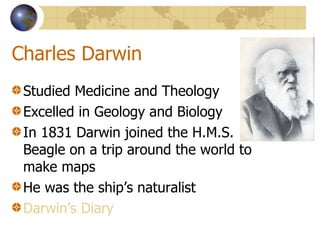
Charles Darwin Studied Medicine and Theology Excelled in Geology and Biology In 1831 Darwin joined the H.M.S. Beagle on a trip around the world to make maps He was the ship’s naturalist Darwin’s Diary
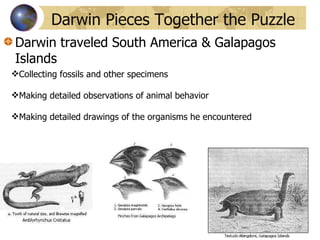
Darwin Pieces Together the Puzzle Collecting fossils and other specimens Making detailed observations of animal behavior Making detailed drawings of the organisms he encountered Darwin traveled South America & Galapagos Islands
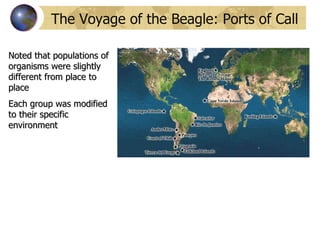
The Voyage of the Beagle: Ports of Call Noted that populations of organisms were slightly different from place to place Each group was modified to their specific environment
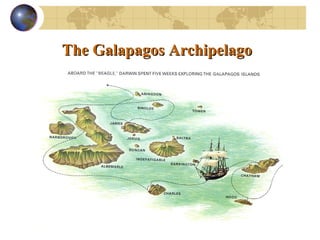
The Galapagos Archipelago
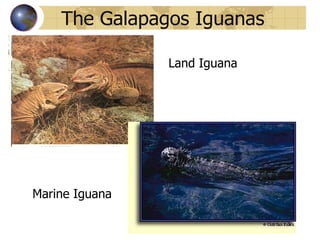
Land Iguana Marine Iguana The Galapagos Iguanas
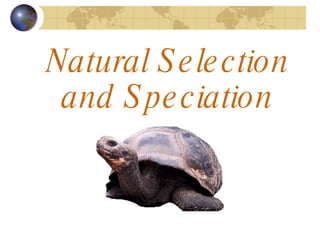
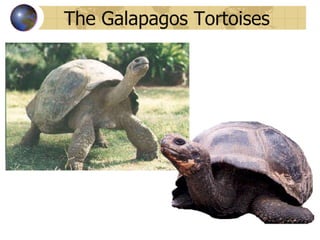
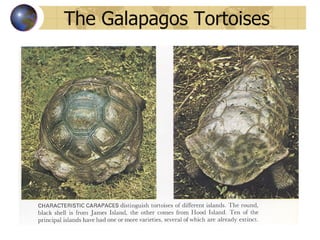
The Galapagos Tortoises
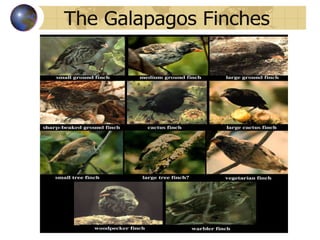
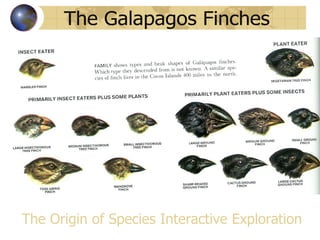
The Galapagos Finches
The Origin of Species Interactive Exploration The Galapagos Finches
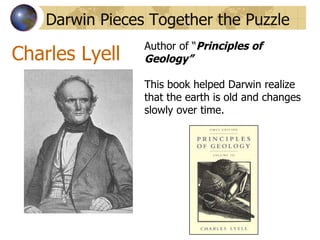
Charles Lyell Darwin Pieces Together the Puzzle Author of “ Principles of Geology” This book helped Darwin realize that the earth is old and changes slowly over time.
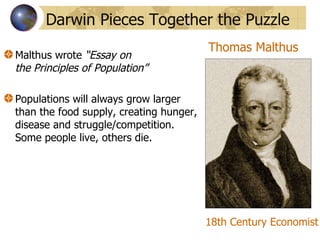
Malthus wrote  “Essay on  the Principles of Population” Populations will always grow larger than the food supply, creating hunger, disease and struggle/competition.  Some people live, others die. Darwin Pieces Together the Puzzle Thomas Malthus 18th Century Economist
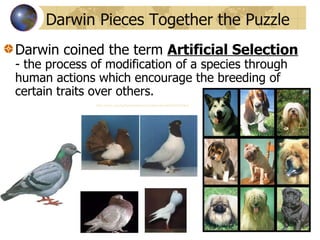
Darwin coined the term  Artificial Selection   - the process of modification of a species through human actions which encourage the breeding of certain traits over others. Darwin Pieces Together the Puzzle http://www.esp.org/books/darwin/variation/facsimile/title3.html
What Darwin Learned from Artificial Selection When chosen organisms are mated, desired characteristics are formed (Darwin didn’t know about DNA) Individuals in the  wild  who possess characteristics that make it more likely for them to reproduce will pass along these characteristics to their offspring. “ Desirable" characteristics,  in the wild , would be those which  enhance survivability , NOT those which specifically satisfy human needs.  Nature does the selecting .  Darwin Pieces Together the Puzzle
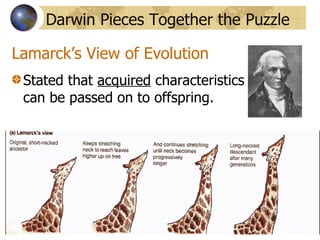
Lamarck’s View of Evolution Stated that  acquired  characteristics  can be passed on to offspring. Darwin Pieces Together the Puzzle
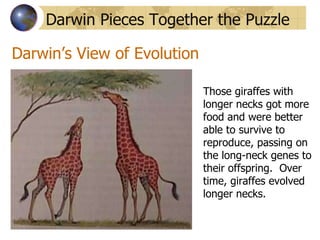
Darwin’s View of Evolution Darwin Pieces Together the Puzzle Those giraffes with longer necks got more food and were better able to survive to reproduce, passing on the long-neck genes to their offspring.  Over time, giraffes evolved longer necks.
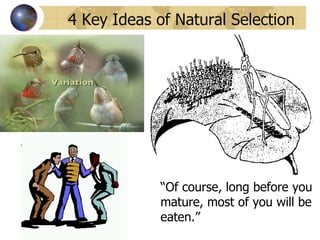
“ Of course, long before you mature, most of you will be eaten.” 4 Key Ideas of Natural Selection
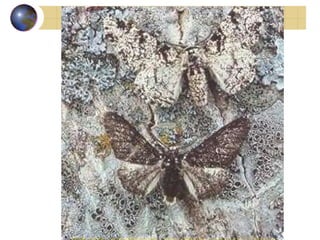
Evolution Through Natural Selection Variation (genetic) is present in the population and this variation is inherited (genetically passed to offspring).   (Praying Mantis Camouflage) Living things Overproduce Competition for Limited Resources Survival of the “Fittest” Reluctantly published  On the Origin of Species  in 1859 Video Natural Selection
4 Main Points of Natural Selection Variation (genetic) is present in the population and this variation is inherited (genetically passed to offspring).   Living things Overproduce Competition for Limited Resources Survival of the “Fittest”  Video Natural Selection
 
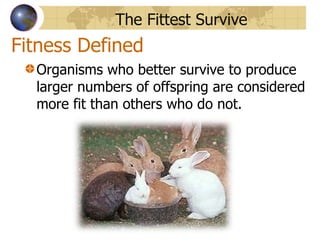
Fitness Defined Organisms who better survive to produce larger numbers of offspring are considered more fit than others who do not. The Fittest Survive
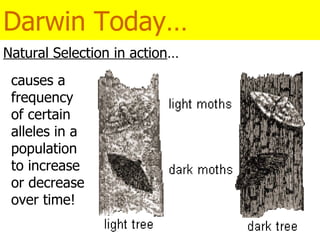
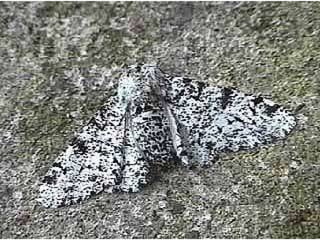
Darwin Today… Natural Selection in action … causes a frequency  of certain alleles in a population to increase or decrease over time!
 
 
Click the Link Below to Access the Cartoon http://evolution.berkeley.edu/evolibrary/article/0_0_0/sneakermales_01 Read the cartoon carefully and answer the discussion questions on a separate sheet of paper.
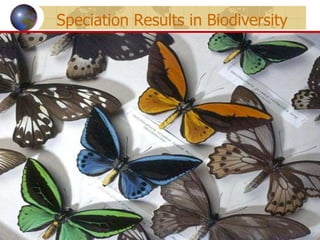
Speciation Results in Biodiversity
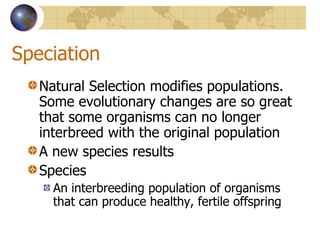
Speciation Natural Selection modifies populations. Some evolutionary changes are so great that some organisms can no longer interbreed with the original population A new species results Species An interbreeding population of organisms that can produce healthy, fertile offspring
Reproductive Barriers and Speciation Prezygotic: gametes never meet and fuse Geographic isolation  (allopatric speciation) Ecological isolation Behavioral isolation  (lacewing songs) Mechanical isolation Seasonal isolation Postzygotic: genetic differences manifest Hybrid inviability Hybrid sterility  (tigons and ligers)
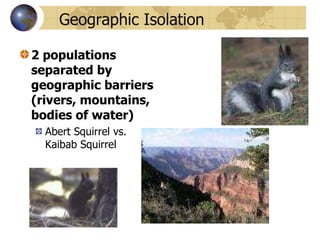
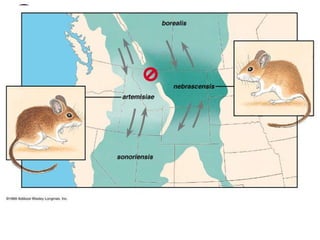
Geographic Isolation 2 populations separated by geographic barriers (rivers, mountains, bodies of water) Abert Squirrel vs. Kaibab Squirrel
 
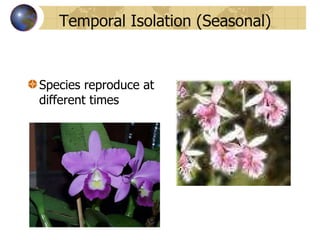
Temporal Isolation (Seasonal) Species reproduce at different times
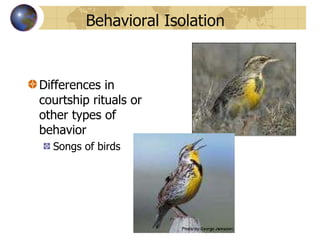
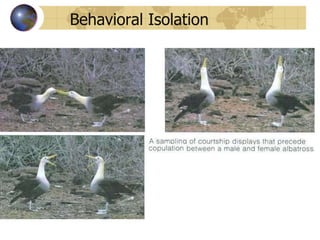
Behavioral Isolation Differences in courtship rituals or other types of behavior Songs of birds
Behavioral Isolation
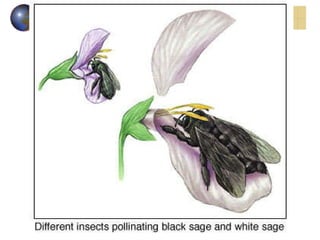
Mechanical Isolation Mating/Pollination is often impossible between different animal/plant species because of the incompatible shape and size of the reproductive structures.  Size Does Matter! Example – Black and White Sage Plants
 
Black sage and white sage plants invite different pollinators White sage flowers have large landing platforms for large pollinators causing the large pollinators to brush against the stamens, but the small ones usually don’t. Black sage flowers have small landing platform for small pollinators.  Therefore, the small pollinators cannot spread pollen to the white sage flowers therefore cross pollination is no longer possible.
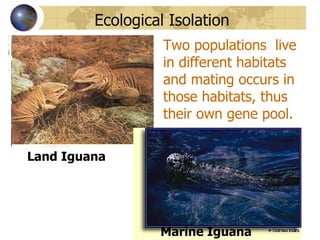
Two populations  live in different habitats and mating occurs in those habitats, thus their own gene pool. Land Iguana Marine Iguana Ecological Isolation
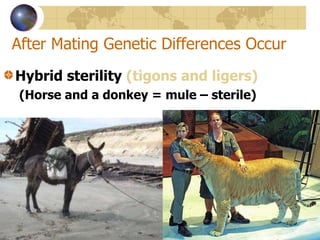
After Mating Genetic Differences Occur Hybrid sterility  (tigons and ligers) (Horse and a donkey = mule – sterile)
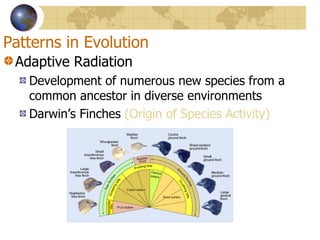
Patterns in Evolution Adaptive Radiation Development of numerous new species from a common ancestor in diverse environments Darwin’s Finches  (Origin of Species Activity)
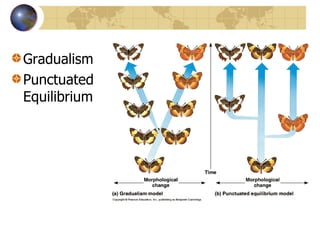
Gradualism Punctuated Equilibrium
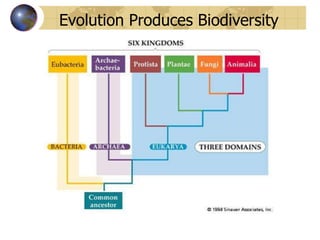
Evolution Produces Biodiversity
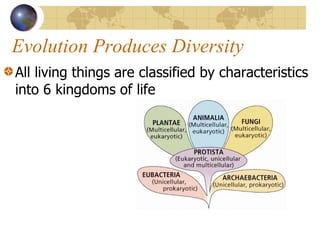
Evolution Produces Diversity All living things are classified by characteristics into 6 kingdoms of life
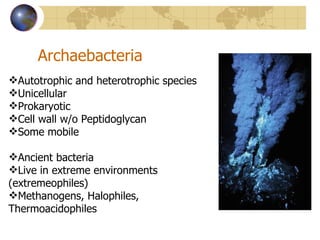
Archaebacteria Autotrophic and heterotrophic species Unicellular Prokaryotic Cell wall w/o Peptidoglycan Some mobile Ancient bacteria Live in extreme environments (extremeophiles) Methanogens, Halophiles, Thermoacidophiles
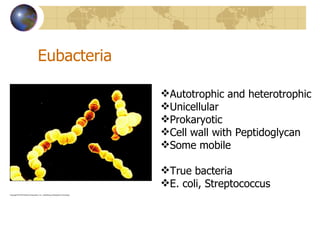
Eubacteria Autotrophic and heterotrophic Unicellular Prokaryotic Cell wall with Peptidoglycan Some mobile True bacteria E. coli, Streptococcus
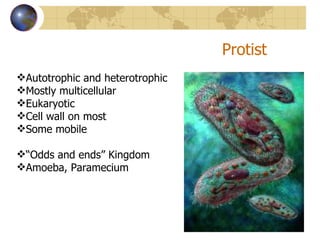
Protist Autotrophic and heterotrophic Mostly multicellular Eukaryotic Cell wall on most Some mobile “ Odds and ends” Kingdom Amoeba, Paramecium
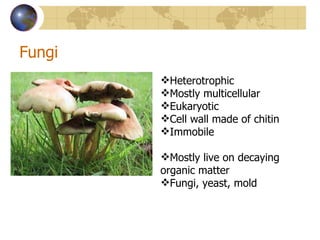
Fungi Heterotrophic  Mostly multicellular Eukaryotic Cell wall made of chitin  Immobile Mostly live on decaying organic matter Fungi, yeast, mold
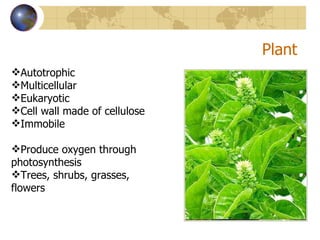
Plant Autotrophic Multicellular Eukaryotic Cell wall made of cellulose Immobile Produce oxygen through photosynthesis Trees, shrubs, grasses, flowers
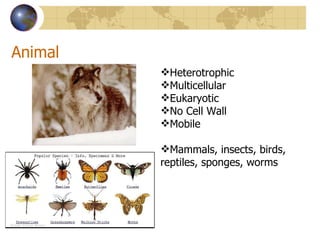
Animal Heterotrophic Multicellular Eukaryotic No Cell Wall Mobile Mammals, insects, birds, reptiles, sponges, worms
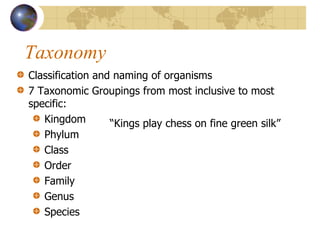
Taxonomy Classification and naming of organisms 7 Taxonomic Groupings from most inclusive to most specific: Kingdom Phylum Class Order Family  Genus Species “ Kings play chess on fine green silk”
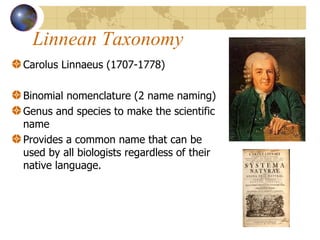
Linnean Taxonomy Carolus Linnaeus (1707-1778) Binomial nomenclature (2 name naming) Genus and species to make the scientific name Provides a common name that can be used by all biologists regardless of their native language.
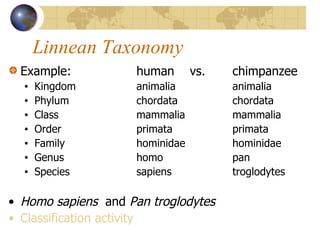
Example:  human  vs.  chimpanzee Kingdom  animalia animalia Phylum  chordata    chordata  Class  mammalia  mammalia Order  primata primata Family hominidae hominidae Genus homo pan Species sapiens troglodytes Homo sapiens  and  Pan troglodytes Classification activity Linnean Taxonomy
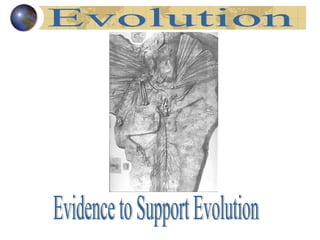
Evolution Evidence to Support Evolution
The Origin of Life Geology The Fossil Record Comparative Embryology Comparative Biochemistry Comparative Anatomy Isn’t Evolution Just a Theory? Scientists from many disciplines including biology, chemistry, physics, geology, and paleontology have contributed to the case for evolution! Evidence to Support Evolution
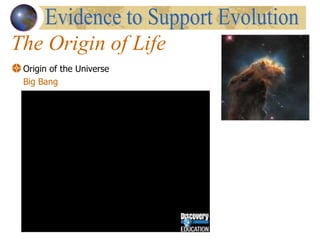
The Origin of Life Origin of the Universe Big Bang Evidence to Support Evolution
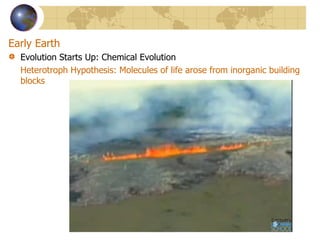
Early Earth Evolution Starts Up: Chemical Evolution Heterotroph Hypothesis: Molecules of life arose from inorganic building blocks
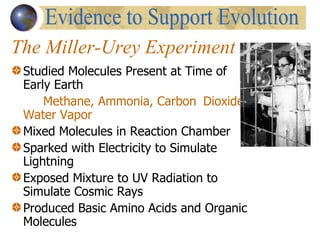
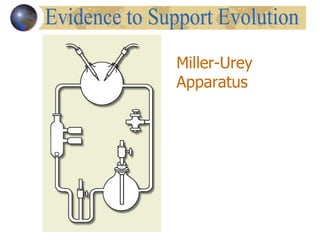
The Miller-Urey Experiment Studied Molecules Present at Time of Early Earth Methane, Ammonia, Carbon  Dioxide, Water Vapor Mixed Molecules in Reaction Chamber Sparked with Electricity to Simulate Lightning Exposed Mixture to UV Radiation to Simulate Cosmic Rays Produced Basic Amino Acids and Organic Molecules Evidence to Support Evolution
Miller-Urey Apparatus Evidence to Support Evolution
 
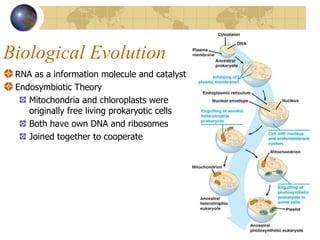
Biological Evolution RNA as a information molecule and catalyst Endosymbiotic Theory Mitochondria and chloroplasts were originally free living prokaryotic cells Both have own DNA and ribosomes Joined together to cooperate
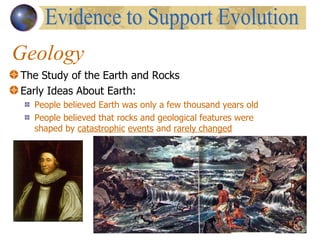
Geology The Study of the Earth and Rocks Early Ideas About Earth: People believed Earth was only a few thousand years old People believed that rocks and geological features were shaped by  catastrophic   events  and  rarely changed Evidence to Support Evolution
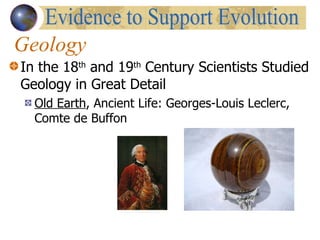
Geology In the 18 th  and 19 th  Century Scientists Studied Geology in Great Detail Old Earth , Ancient Life: Georges-Louis Leclerc, Comte de Buffon  Evidence to Support Evolution
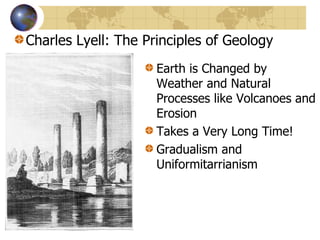
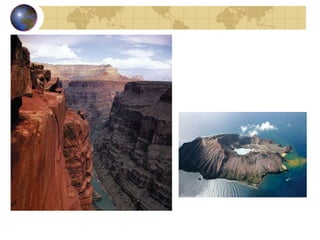
Charles Lyell: The Principles of Geology Earth is Changed by Weather and Natural Processes like Volcanoes and Erosion Takes a Very Long Time! Gradualism and Uniformitarrianism
 
 
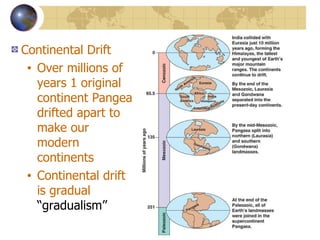
Continental Drift Over millions of years 1 original continent Pangea drifted apart to make our modern continents Continental drift is gradual   “gradualism”
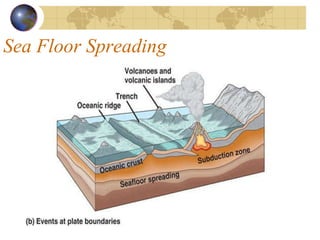
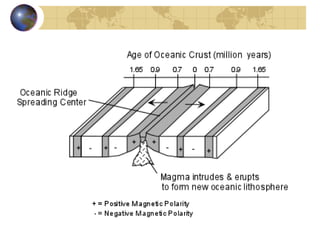
Sea Floor Spreading
 
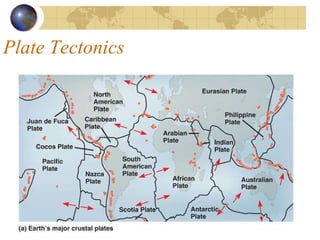
Plate Tectonics
Geology These ideas refute the idea that the Earth is only a few thousand years old Provides long time necessary for evolution Backed up by radiometric dating  The Earth is approximately 4.6 Billion Years Old   4,600,000,000 years is a long time! Evidence to Support Evolution
 
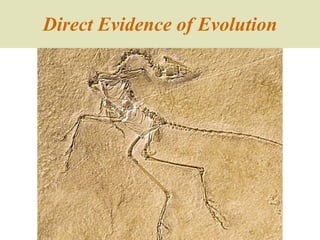
Direct Evidence of Evolution
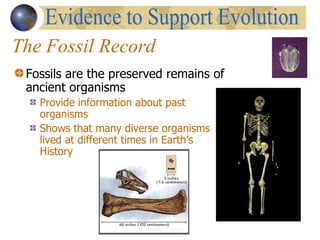
The Fossil Record Fossils are the preserved remains of ancient organisms Provide information about past organisms Shows that many diverse organisms lived at different times in Earth’s History Evidence to Support Evolution                                     
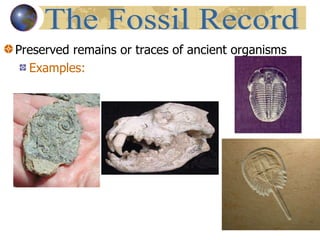
Preserved remains or traces of ancient organisms Examples: The Fossil Record
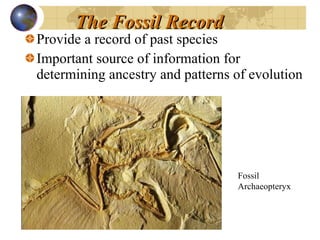
The Fossil Record Provide a record of past species Important source of information for determining ancestry and patterns of evolution Fossil Archaeopteryx
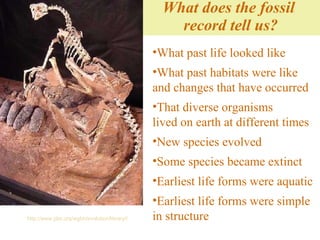
What does the fossil  record tell us? http://www.pbs.org/wgbh/evolution/library/04/3/quicktime/l_043_01.html   What past life looked like What past habitats were like and changes that have occurred That diverse organisms  lived on earth at different times New species evolved Some species became extinct Earliest life forms were aquatic Earliest life forms were simple in structure
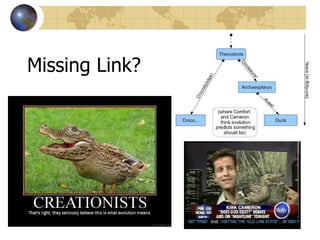
Missing Link?
The Fossil Record Taphonomy: The Formation of Fossils Fossils form in sedimentary rock Dead organisms covered by sand and silt Sediments are passed into bone by pressure from above (fossils form in sedimentary rock) Video Evidence to Support Evolution
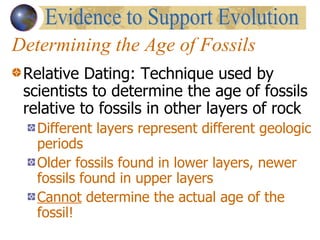
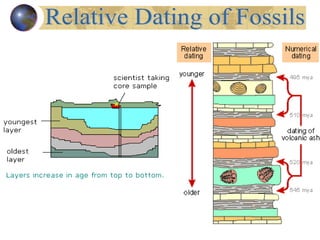
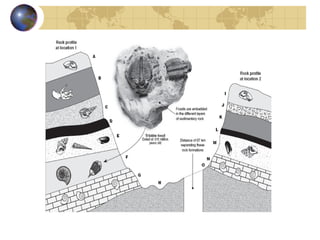
Determining the Age of Fossils Relative Dating: Technique used by scientists to determine the age of fossils relative to fossils in other layers of rock Different layers represent different geologic periods  Older fossils found in lower layers, newer fossils found in upper layers Cannot  determine the actual age of the fossil! Evidence to Support Evolution
Relative Dating of Fossils
 
Determining the Age of Fossils Radioactive Dating: Process by which traces of radioactive elements are analyzed to calculate the  actual age  of a fossil Many radioactive elements can be used as geologic clocks. Each radioactive element decays at its own nearly constant rate. Once this rate is known, geologists can estimate the length of time over which decay has been occurring by   measuring the amount of radioactive parent element and the amount of stable daughter elements  Video Evidence to Support Evolution
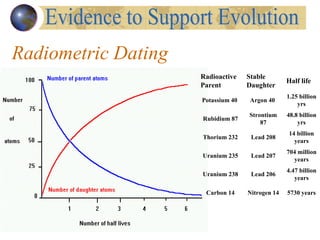
Radioactive/Radiometric Dating How it Works: - radioactive elements (uranium, Carbon14) break down/decay a    specific rates = half life - these rates are nearly constant   - the amount of radioactive decay that has taken place in a rock/fossil determines its age
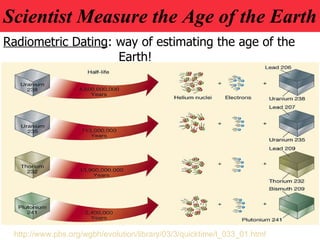
Scientist Measure the Age of the Earth Radiometric Dating : way of estimating the age of the    Earth! http://www.pbs.org/wgbh/evolution/library/03/3/quicktime/l_033_01.html
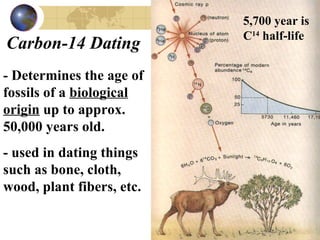
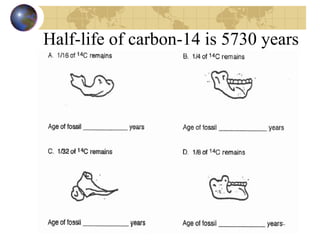
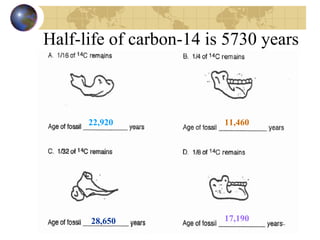
Carbon-14 Dating - Determines the age of fossils of a  biological origin  up to approx. 50,000 years old.  - used in dating things such as bone, cloth, wood, plant fibers, etc.  5,700 year is C 14  half-life
 
Half-life of carbon-14 is 5730 years
Half-life of carbon-14 is 5730 years 22,920 11,460 28,650 17,190
Radiometric Dating Evidence to Support Evolution Radioactive Parent Stable Daughter Half life Potassium 40  Argon 40  1.25 billion yrs Rubidium 87 Strontium 87 48.8 billion yrs Thorium 232 Lead 208 14 billion years Uranium 235 Lead 207 704 million years Uranium 238 Lead 206 4.47 billion years Carbon 14 Nitrogen 14 5730 years
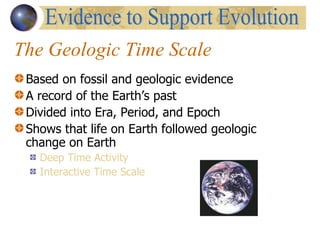
The Geologic Time Scale Based on fossil and geologic evidence A record of the Earth’s past Divided into Era, Period, and Epoch Shows that life on Earth followed geologic change on Earth Deep Time Activity Interactive Time Scale Evidence to Support Evolution
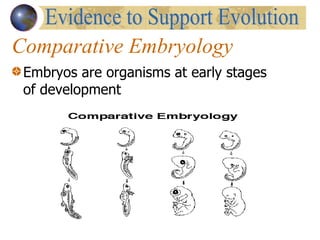
Comparative Embryology Embryos are organisms at early stages of development  Evidence to Support Evolution
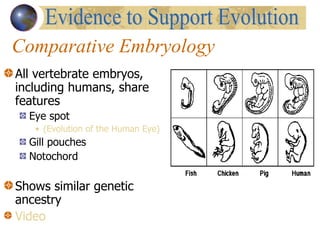
Comparative Embryology All vertebrate embryos, including humans, share features Eye spot  (Evolution of the Human Eye) Gill pouches Notochord Shows similar genetic  ancestry Video Evidence to Support Evolution
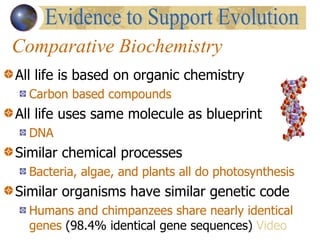
Comparative Biochemistry All life is based on organic chemistry Carbon based compounds All life uses same molecule as blueprint  DNA Similar chemical processes Bacteria, algae, and plants all do photosynthesis Similar organisms have similar genetic code Humans and chimpanzees share nearly identical genes  (98.4% identical gene sequences)  Video Evidence to Support Evolution
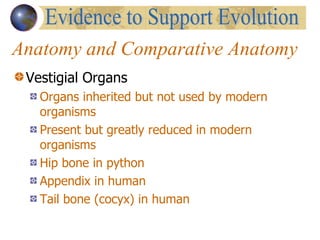
Anatomy and Comparative Anatomy Vestigial Organs Organs inherited but not used by modern organisms Present but greatly reduced in modern organisms Hip bone in python Appendix in human Tail bone (cocyx) in human Evidence to Support Evolution
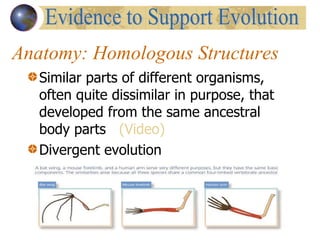
Anatomy: Homologous Structures Similar parts of different organisms, often quite dissimilar in purpose, that developed from the same ancestral body parts  (Video) Divergent evolution Evidence to Support Evolution
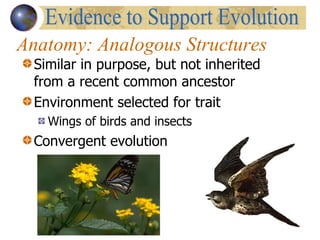
Anatomy: Analogous Structures Similar in purpose, but not inherited from a recent common ancestor Environment selected for trait Wings of birds and insects Convergent evolution  Evidence to Support Evolution
Summary There is overwhelming evidence to support the Theory of Evolution Evidence comes from disciplines as varied as biology, geology, chemistry, physics, astronomy, and paleontology Evolution has produced the great beauty and diversity of life on Earth over the last 4 billion years Evidence to Support Evolution
Human Evolution                          
Explore Human Evolution View the  Becoming Human   broadband documentary  As you view each segment, visit the related exhibits to further explore this topic Go to the Learning Center and select the “Calculating Cousins” activity Go to the Learning Center and select the “Chromosome Connection” activity Go to the Learning Center and select the “Building Bodies” activity
The Order Primate Characteristics of Primates Strong hands and opposable thumbs Free-moving shoulder joint Forward facing eyes and stereoscopic vision Intelligence/larger brain Social complexity
What Characteristics do Humans Have? All of those of primates, plus Upright posture and bipedal Use of tools and technology Advanced intelligence Complex communication and speech
The Steps to Human Evolution Terrestrialization Bipedal  (Walking on all two’s) Increased Brain Size Civilization Take a look at the Human family tree
The Hominid Family Each year new fossils are found to add to the Hominid family tree Most fossils of early humans are found in Africa and lower Asia Most well understood members include genus Australopithecus (extinct) and genus Homo Solve the Riddle of the Bones
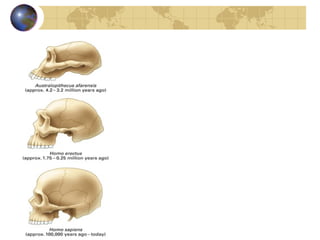
Genus Australopithecus First human ancestor to live on the ground and walk on two legs As evidenced by the  Laetoli footprints Ape-like jaw Small brain Short stature Found only in South and East Africa
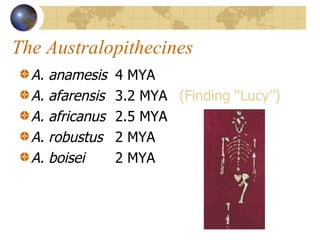
The Australopithecines A. anamesis 4 MYA A. afarensis 3.2 MYA (Finding “Lucy”) A. africanus 2.5 MYA A. robustus 2 MYA  A. boisei 2 MYA
Genus Homo More modern hominids that exhibited major evolutionary steps Increased brain size Use of tools Use of fire Use of shelter Religion Language and civilization
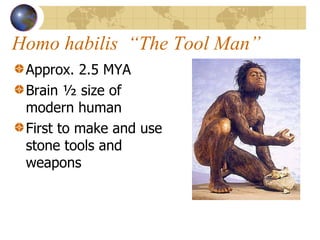
Homo habilis  “The Tool Man” Approx. 2.5 MYA Brain ½ size of modern human First to make and use stone tools and weapons
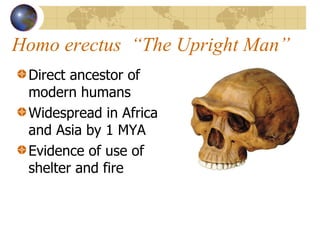
Homo erectus  “The Upright Man” Direct ancestor of modern humans Widespread in Africa and Asia by 1 MYA Evidence of use of shelter and fire
Homo sapiens “The Wise Man” Most likely evolved from  H. erectus as early as 400,000 years ago Greatly increased brain size Consisted of 2 groups Neanderthal Cro-Magnon/modern  H. sapiens
Neanderthals Found in Neander Valley in Germany Fossils found throughout Europe, Middle East, and Asia from 150,000-30,000 years ago Large bodies and brains Evidenced painting, religion, complex social structure “ Cave man”
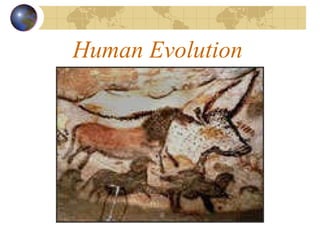
Cro Magnons and Fully Modern Humans First early modern  H. sapiens  appear about 130,000 years ago Thinner bones, smaller jaws, higher skull with little or no brow ridge, and larger brains Cave art shows complex religion and culture Lived alongside Neanderthal for several thousand years, but eventually out-competed them
                                                          

Evolution, Natural Selection, Taxonomy, and Anthropology

  • 1.
  • 2.
    “ Evolve” Meansto Change Over Time The belief that life on Earth has changed over time is quite old To be considered science, this belief requires a great deal of evidence Evolution
  • 3.
    The Development ofEvolutionary Theory Naturalists have always wondered at the diversity of living things……… Great varieties in shape, size, and ecological role Estimated 3 million to 20 million different living species Much of the natural world’s biodiversity has vanished through extinction 99% of all species that ever lived are now extinct Permian-Triassic Mass Extinction What Killed the Dinosaurs? Evolution
  • 4.
  • 5.
  • 6.
  • 7.
    Development of EvolutionaryTheory What could cause such great diversity, and why have so many species died out? Charles Darwin offered an explanation based on careful observations Who was Charles Darwin? Evolution
  • 8.
  • 9.
  • 10.
    Development of EvolutionaryTheory Darwin Concluded: Physical traits and behaviors enable organisms to survive and reproduce (called Fitness ) Fitness results from adaptations Darwin reasoned that adaptations result from natural selection and result in evolution Evolution Evolution is the process by which living things change and diversify over time
  • 11.
    Development of EvolutionaryTheory These ideas were widely challenged until a tremendous amount of evidence was gathered to support evolution! Now…The Theory of Evolution is the Cornerstone of Biology Explore the Evolution Revolution Evolution
  • 12.
  • 13.
    Charles Darwin StudiedMedicine and Theology Excelled in Geology and Biology In 1831 Darwin joined the H.M.S. Beagle on a trip around the world to make maps He was the ship’s naturalist Darwin’s Diary
  • 14.
    Darwin Pieces Togetherthe Puzzle Collecting fossils and other specimens Making detailed observations of animal behavior Making detailed drawings of the organisms he encountered Darwin traveled South America & Galapagos Islands
  • 15.
    The Voyage ofthe Beagle: Ports of Call Noted that populations of organisms were slightly different from place to place Each group was modified to their specific environment
  • 16.
  • 17.
    Land Iguana MarineIguana The Galapagos Iguanas
  • 18.
  • 19.
  • 20.
  • 21.
    The Origin ofSpecies Interactive Exploration The Galapagos Finches
  • 22.
    Charles Lyell DarwinPieces Together the Puzzle Author of “ Principles of Geology” This book helped Darwin realize that the earth is old and changes slowly over time.
  • 23.
    Malthus wrote “Essay on the Principles of Population” Populations will always grow larger than the food supply, creating hunger, disease and struggle/competition. Some people live, others die. Darwin Pieces Together the Puzzle Thomas Malthus 18th Century Economist
  • 24.
    Darwin coined theterm Artificial Selection - the process of modification of a species through human actions which encourage the breeding of certain traits over others. Darwin Pieces Together the Puzzle http://www.esp.org/books/darwin/variation/facsimile/title3.html
  • 25.
    What Darwin Learnedfrom Artificial Selection When chosen organisms are mated, desired characteristics are formed (Darwin didn’t know about DNA) Individuals in the wild who possess characteristics that make it more likely for them to reproduce will pass along these characteristics to their offspring. “ Desirable" characteristics, in the wild , would be those which enhance survivability , NOT those which specifically satisfy human needs. Nature does the selecting . Darwin Pieces Together the Puzzle
  • 26.
    Lamarck’s View ofEvolution Stated that acquired characteristics can be passed on to offspring. Darwin Pieces Together the Puzzle
  • 27.
    Darwin’s View ofEvolution Darwin Pieces Together the Puzzle Those giraffes with longer necks got more food and were better able to survive to reproduce, passing on the long-neck genes to their offspring. Over time, giraffes evolved longer necks.
  • 28.
    “ Of course,long before you mature, most of you will be eaten.” 4 Key Ideas of Natural Selection
  • 29.
    Evolution Through NaturalSelection Variation (genetic) is present in the population and this variation is inherited (genetically passed to offspring). (Praying Mantis Camouflage) Living things Overproduce Competition for Limited Resources Survival of the “Fittest” Reluctantly published On the Origin of Species in 1859 Video Natural Selection
  • 30.
    4 Main Pointsof Natural Selection Variation (genetic) is present in the population and this variation is inherited (genetically passed to offspring). Living things Overproduce Competition for Limited Resources Survival of the “Fittest” Video Natural Selection
  • 31.
  • 32.
    Fitness Defined Organismswho better survive to produce larger numbers of offspring are considered more fit than others who do not. The Fittest Survive
  • 33.
    Darwin Today… NaturalSelection in action … causes a frequency of certain alleles in a population to increase or decrease over time!
  • 34.
  • 35.
  • 36.
    Click the LinkBelow to Access the Cartoon http://evolution.berkeley.edu/evolibrary/article/0_0_0/sneakermales_01 Read the cartoon carefully and answer the discussion questions on a separate sheet of paper.
  • 37.
  • 38.
    Speciation Natural Selectionmodifies populations. Some evolutionary changes are so great that some organisms can no longer interbreed with the original population A new species results Species An interbreeding population of organisms that can produce healthy, fertile offspring
  • 39.
    Reproductive Barriers andSpeciation Prezygotic: gametes never meet and fuse Geographic isolation (allopatric speciation) Ecological isolation Behavioral isolation (lacewing songs) Mechanical isolation Seasonal isolation Postzygotic: genetic differences manifest Hybrid inviability Hybrid sterility (tigons and ligers)
  • 40.
    Geographic Isolation 2populations separated by geographic barriers (rivers, mountains, bodies of water) Abert Squirrel vs. Kaibab Squirrel
  • 41.
  • 42.
    Temporal Isolation (Seasonal)Species reproduce at different times
  • 43.
    Behavioral Isolation Differencesin courtship rituals or other types of behavior Songs of birds
  • 44.
  • 45.
    Mechanical Isolation Mating/Pollinationis often impossible between different animal/plant species because of the incompatible shape and size of the reproductive structures. Size Does Matter! Example – Black and White Sage Plants
  • 46.
  • 47.
    Black sage andwhite sage plants invite different pollinators White sage flowers have large landing platforms for large pollinators causing the large pollinators to brush against the stamens, but the small ones usually don’t. Black sage flowers have small landing platform for small pollinators. Therefore, the small pollinators cannot spread pollen to the white sage flowers therefore cross pollination is no longer possible.
  • 48.
    Two populations live in different habitats and mating occurs in those habitats, thus their own gene pool. Land Iguana Marine Iguana Ecological Isolation
  • 49.
    After Mating GeneticDifferences Occur Hybrid sterility (tigons and ligers) (Horse and a donkey = mule – sterile)
  • 50.
    Patterns in EvolutionAdaptive Radiation Development of numerous new species from a common ancestor in diverse environments Darwin’s Finches (Origin of Species Activity)
  • 51.
  • 52.
  • 53.
    Evolution Produces DiversityAll living things are classified by characteristics into 6 kingdoms of life
  • 54.
    Archaebacteria Autotrophic andheterotrophic species Unicellular Prokaryotic Cell wall w/o Peptidoglycan Some mobile Ancient bacteria Live in extreme environments (extremeophiles) Methanogens, Halophiles, Thermoacidophiles
  • 55.
    Eubacteria Autotrophic andheterotrophic Unicellular Prokaryotic Cell wall with Peptidoglycan Some mobile True bacteria E. coli, Streptococcus
  • 56.
    Protist Autotrophic andheterotrophic Mostly multicellular Eukaryotic Cell wall on most Some mobile “ Odds and ends” Kingdom Amoeba, Paramecium
  • 57.
    Fungi Heterotrophic Mostly multicellular Eukaryotic Cell wall made of chitin Immobile Mostly live on decaying organic matter Fungi, yeast, mold
  • 58.
    Plant Autotrophic MulticellularEukaryotic Cell wall made of cellulose Immobile Produce oxygen through photosynthesis Trees, shrubs, grasses, flowers
  • 59.
    Animal Heterotrophic MulticellularEukaryotic No Cell Wall Mobile Mammals, insects, birds, reptiles, sponges, worms
  • 60.
    Taxonomy Classification andnaming of organisms 7 Taxonomic Groupings from most inclusive to most specific: Kingdom Phylum Class Order Family Genus Species “ Kings play chess on fine green silk”
  • 61.
    Linnean Taxonomy CarolusLinnaeus (1707-1778) Binomial nomenclature (2 name naming) Genus and species to make the scientific name Provides a common name that can be used by all biologists regardless of their native language.
  • 62.
    Example: human vs. chimpanzee Kingdom animalia animalia Phylum chordata chordata Class mammalia mammalia Order primata primata Family hominidae hominidae Genus homo pan Species sapiens troglodytes Homo sapiens and Pan troglodytes Classification activity Linnean Taxonomy
  • 63.
    Evolution Evidence toSupport Evolution
  • 64.
    The Origin ofLife Geology The Fossil Record Comparative Embryology Comparative Biochemistry Comparative Anatomy Isn’t Evolution Just a Theory? Scientists from many disciplines including biology, chemistry, physics, geology, and paleontology have contributed to the case for evolution! Evidence to Support Evolution
  • 65.
    The Origin ofLife Origin of the Universe Big Bang Evidence to Support Evolution
  • 66.
    Early Earth EvolutionStarts Up: Chemical Evolution Heterotroph Hypothesis: Molecules of life arose from inorganic building blocks
  • 67.
    The Miller-Urey ExperimentStudied Molecules Present at Time of Early Earth Methane, Ammonia, Carbon Dioxide, Water Vapor Mixed Molecules in Reaction Chamber Sparked with Electricity to Simulate Lightning Exposed Mixture to UV Radiation to Simulate Cosmic Rays Produced Basic Amino Acids and Organic Molecules Evidence to Support Evolution
  • 68.
    Miller-Urey Apparatus Evidenceto Support Evolution
  • 69.
  • 70.
    Biological Evolution RNAas a information molecule and catalyst Endosymbiotic Theory Mitochondria and chloroplasts were originally free living prokaryotic cells Both have own DNA and ribosomes Joined together to cooperate
  • 71.
    Geology The Studyof the Earth and Rocks Early Ideas About Earth: People believed Earth was only a few thousand years old People believed that rocks and geological features were shaped by catastrophic events and rarely changed Evidence to Support Evolution
  • 72.
    Geology In the18 th and 19 th Century Scientists Studied Geology in Great Detail Old Earth , Ancient Life: Georges-Louis Leclerc, Comte de Buffon Evidence to Support Evolution
  • 73.
    Charles Lyell: ThePrinciples of Geology Earth is Changed by Weather and Natural Processes like Volcanoes and Erosion Takes a Very Long Time! Gradualism and Uniformitarrianism
  • 74.
  • 75.
  • 76.
    Continental Drift Overmillions of years 1 original continent Pangea drifted apart to make our modern continents Continental drift is gradual “gradualism”
  • 77.
  • 78.
  • 79.
  • 80.
    Geology These ideasrefute the idea that the Earth is only a few thousand years old Provides long time necessary for evolution Backed up by radiometric dating The Earth is approximately 4.6 Billion Years Old 4,600,000,000 years is a long time! Evidence to Support Evolution
  • 81.
  • 82.
  • 83.
    The Fossil RecordFossils are the preserved remains of ancient organisms Provide information about past organisms Shows that many diverse organisms lived at different times in Earth’s History Evidence to Support Evolution                                     
  • 84.
    Preserved remains ortraces of ancient organisms Examples: The Fossil Record
  • 85.
    The Fossil RecordProvide a record of past species Important source of information for determining ancestry and patterns of evolution Fossil Archaeopteryx
  • 86.
    What does thefossil record tell us? http://www.pbs.org/wgbh/evolution/library/04/3/quicktime/l_043_01.html What past life looked like What past habitats were like and changes that have occurred That diverse organisms lived on earth at different times New species evolved Some species became extinct Earliest life forms were aquatic Earliest life forms were simple in structure
  • 87.
  • 88.
    The Fossil RecordTaphonomy: The Formation of Fossils Fossils form in sedimentary rock Dead organisms covered by sand and silt Sediments are passed into bone by pressure from above (fossils form in sedimentary rock) Video Evidence to Support Evolution
  • 89.
    Determining the Ageof Fossils Relative Dating: Technique used by scientists to determine the age of fossils relative to fossils in other layers of rock Different layers represent different geologic periods Older fossils found in lower layers, newer fossils found in upper layers Cannot determine the actual age of the fossil! Evidence to Support Evolution
  • 90.
  • 91.
  • 92.
    Determining the Ageof Fossils Radioactive Dating: Process by which traces of radioactive elements are analyzed to calculate the actual age of a fossil Many radioactive elements can be used as geologic clocks. Each radioactive element decays at its own nearly constant rate. Once this rate is known, geologists can estimate the length of time over which decay has been occurring by measuring the amount of radioactive parent element and the amount of stable daughter elements Video Evidence to Support Evolution
  • 93.
    Radioactive/Radiometric Dating Howit Works: - radioactive elements (uranium, Carbon14) break down/decay a specific rates = half life - these rates are nearly constant - the amount of radioactive decay that has taken place in a rock/fossil determines its age
  • 94.
    Scientist Measure theAge of the Earth Radiometric Dating : way of estimating the age of the Earth! http://www.pbs.org/wgbh/evolution/library/03/3/quicktime/l_033_01.html
  • 95.
    Carbon-14 Dating -Determines the age of fossils of a biological origin up to approx. 50,000 years old. - used in dating things such as bone, cloth, wood, plant fibers, etc. 5,700 year is C 14 half-life
  • 96.
  • 97.
  • 98.
    Half-life of carbon-14is 5730 years 22,920 11,460 28,650 17,190
  • 99.
    Radiometric Dating Evidenceto Support Evolution Radioactive Parent Stable Daughter Half life Potassium 40 Argon 40 1.25 billion yrs Rubidium 87 Strontium 87 48.8 billion yrs Thorium 232 Lead 208 14 billion years Uranium 235 Lead 207 704 million years Uranium 238 Lead 206 4.47 billion years Carbon 14 Nitrogen 14 5730 years
  • 100.
    The Geologic TimeScale Based on fossil and geologic evidence A record of the Earth’s past Divided into Era, Period, and Epoch Shows that life on Earth followed geologic change on Earth Deep Time Activity Interactive Time Scale Evidence to Support Evolution
  • 101.
    Comparative Embryology Embryosare organisms at early stages of development Evidence to Support Evolution
  • 102.
    Comparative Embryology Allvertebrate embryos, including humans, share features Eye spot (Evolution of the Human Eye) Gill pouches Notochord Shows similar genetic ancestry Video Evidence to Support Evolution
  • 103.
    Comparative Biochemistry Alllife is based on organic chemistry Carbon based compounds All life uses same molecule as blueprint DNA Similar chemical processes Bacteria, algae, and plants all do photosynthesis Similar organisms have similar genetic code Humans and chimpanzees share nearly identical genes (98.4% identical gene sequences) Video Evidence to Support Evolution
  • 104.
    Anatomy and ComparativeAnatomy Vestigial Organs Organs inherited but not used by modern organisms Present but greatly reduced in modern organisms Hip bone in python Appendix in human Tail bone (cocyx) in human Evidence to Support Evolution
  • 105.
    Anatomy: Homologous StructuresSimilar parts of different organisms, often quite dissimilar in purpose, that developed from the same ancestral body parts (Video) Divergent evolution Evidence to Support Evolution
  • 106.
    Anatomy: Analogous StructuresSimilar in purpose, but not inherited from a recent common ancestor Environment selected for trait Wings of birds and insects Convergent evolution Evidence to Support Evolution
  • 107.
    Summary There isoverwhelming evidence to support the Theory of Evolution Evidence comes from disciplines as varied as biology, geology, chemistry, physics, astronomy, and paleontology Evolution has produced the great beauty and diversity of life on Earth over the last 4 billion years Evidence to Support Evolution
  • 108.
    Human Evolution                         
  • 109.
    Explore Human EvolutionView the Becoming Human broadband documentary As you view each segment, visit the related exhibits to further explore this topic Go to the Learning Center and select the “Calculating Cousins” activity Go to the Learning Center and select the “Chromosome Connection” activity Go to the Learning Center and select the “Building Bodies” activity
  • 110.
    The Order PrimateCharacteristics of Primates Strong hands and opposable thumbs Free-moving shoulder joint Forward facing eyes and stereoscopic vision Intelligence/larger brain Social complexity
  • 111.
    What Characteristics doHumans Have? All of those of primates, plus Upright posture and bipedal Use of tools and technology Advanced intelligence Complex communication and speech
  • 112.
    The Steps toHuman Evolution Terrestrialization Bipedal (Walking on all two’s) Increased Brain Size Civilization Take a look at the Human family tree
  • 113.
    The Hominid FamilyEach year new fossils are found to add to the Hominid family tree Most fossils of early humans are found in Africa and lower Asia Most well understood members include genus Australopithecus (extinct) and genus Homo Solve the Riddle of the Bones
  • 114.
    Genus Australopithecus Firsthuman ancestor to live on the ground and walk on two legs As evidenced by the Laetoli footprints Ape-like jaw Small brain Short stature Found only in South and East Africa
  • 115.
    The Australopithecines A.anamesis 4 MYA A. afarensis 3.2 MYA (Finding “Lucy”) A. africanus 2.5 MYA A. robustus 2 MYA A. boisei 2 MYA
  • 116.
    Genus Homo Moremodern hominids that exhibited major evolutionary steps Increased brain size Use of tools Use of fire Use of shelter Religion Language and civilization
  • 117.
    Homo habilis “The Tool Man” Approx. 2.5 MYA Brain ½ size of modern human First to make and use stone tools and weapons
  • 118.
    Homo erectus “The Upright Man” Direct ancestor of modern humans Widespread in Africa and Asia by 1 MYA Evidence of use of shelter and fire
  • 119.
    Homo sapiens “TheWise Man” Most likely evolved from H. erectus as early as 400,000 years ago Greatly increased brain size Consisted of 2 groups Neanderthal Cro-Magnon/modern H. sapiens
  • 120.
    Neanderthals Found inNeander Valley in Germany Fossils found throughout Europe, Middle East, and Asia from 150,000-30,000 years ago Large bodies and brains Evidenced painting, religion, complex social structure “ Cave man”
  • 121.
    Cro Magnons andFully Modern Humans First early modern H. sapiens appear about 130,000 years ago Thinner bones, smaller jaws, higher skull with little or no brow ridge, and larger brains Cave art shows complex religion and culture Lived alongside Neanderthal for several thousand years, but eventually out-competed them
  • 122.