Lecture 20: Morphological
Changes in Macroevolution
• Microevolution = evolution w/i species
• Macroevolution = evolution at or above sp. level
Macroevolution: often major morph changes
How do they occur?
• Saltation: new features arise by major reorgan’n-
not progression through intermediates
≠ Punctuated equilibrium ( no specific mech.)
Darwin was an anti-Saltationist
Morphological Changes
Completely new features rare:
• usually modification of ancestral feature
• e.g. branchial basket (agnathans)
→ gill arch (bony fish)
→ jaw (reptile)
→ ear bones (mammal)
(N.B. not direct descendants, C.A.)
Transformation
Changes in elements:
number
size
shape
position
association with other parts
differentiation (complexity)
Examples
• Enlargement of Cerebral Hemispheres
(reptile → mammal)
• Complexity of Lung
( amphib → rept → mamm)
• Reduction of skull bones
( fish → mamm)
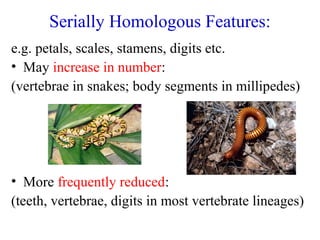
Serially Homologous Features:
e.g. petals, scales, stamens, digits etc.
• May increase in number:
(vertebrae in snakes; body segments in millipedes)
• More frequently reduced:
(teeth, vertebrae, digits in most vertebrate lineages)
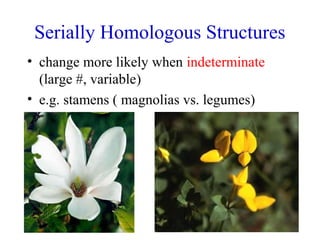
Serially Homologous Structures
• change more likely when indeterminate
(large #, variable)
• e.g. stamens ( magnolias vs. legumes)
• Differentiation of structures from ancestor:
e.g. leaves → tendrils; spines etc.
e.g. appendages of trilobites →mouthparts,
reproductive, locomotary
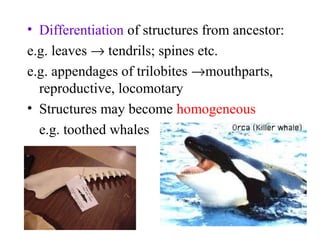
• Structures may become homogeneous
e.g. toothed whales
Allometry :
• differential rates of growth of body parts
• comparisons may be inter- or intraspecific
• intraspecific : w/i inds
(ontogenetic - different ages)
among inds
(static - same age)
Allometry
Equation: y = b xa
Linearized: log y = log b + a log x
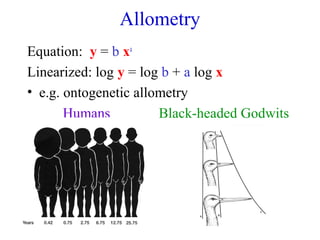
• e.g. ontogenetic allometry
Humans Black-headed Godwits
Adaptiveness of Allometry
• e.g. intestine scales 3/2 body size
i.e. intestine length = body size1.5
• b/c surface area : volume ratio
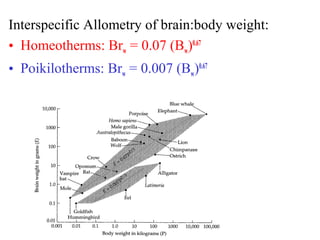
Interspecific Allometry of brain:body weight:
• Homeotherms: Brw = 0.07 (Bw)0.67
• Poikilotherms: Brw = 0.007 (Bw)0.67
Heterochrony
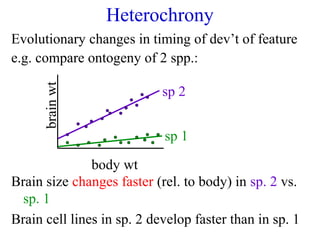
Evolutionary changes in timing of dev’t of feature
e.g. compare ontogeny of 2 spp.:
Brain size changes faster (rel. to body) in sp. 2 vs.
sp. 1
Brain cell lines in sp. 2 develop faster than in sp. 1
sp 2
sp 1
brainwt
body wt
Types of Heterochrony
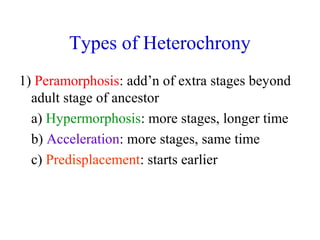
1) Peramorphosis: add’n of extra stages beyond
adult stage of ancestor
a) Hypermorphosis: more stages, longer time
b) Acceleration: more stages, same time
c) Predisplacement: starts earlier
Types of Heterochrony
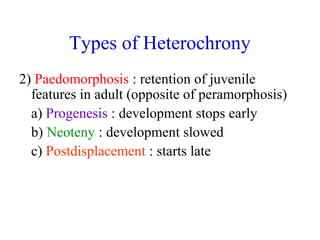
2) Paedomorphosis : retention of juvenile
features in adult (opposite of peramorphosis)
a) Progenesis : development stops early
b) Neoteny : development slowed
c) Postdisplacement : starts late
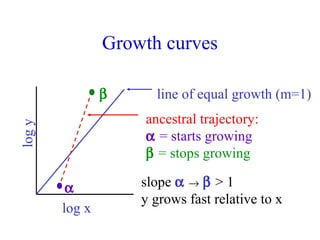
Growth curves
log x
logy
α
line of equal growth (m=1)
ancestral trajectory:
α = starts growing
β = stops growing
slope α → β > 1
y grows fast relative to x
β
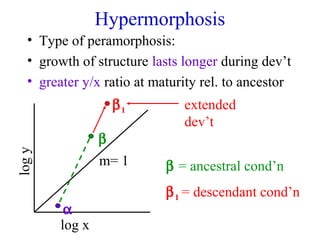
Hypermorphosis
• Type of peramorphosis:
• growth of structure lasts longer during dev’t
• greater y/x ratio at maturity rel. to ancestor
β1
log x
logy
α
β
extended
dev’t
m= 1 β = ancestral cond’n
β1 = descendant cond’n
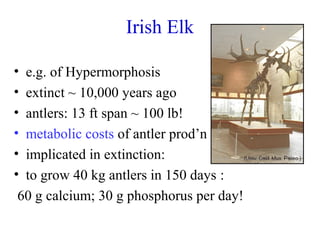
Irish Elk
• e.g. of Hypermorphosis
• extinct ~ 10,000 years ago
• antlers: 13 ft span ~ 100 lb!
• metabolic costs of antler prod’n
• implicated in extinction:
• to grow 40 kg antlers in 150 days :
60 g calcium; 30 g phosphorus per day!

Lecture 20: Morphological Changes in Macroevolution

  • 1.
    Lecture 20: Morphological Changesin Macroevolution • Microevolution = evolution w/i species • Macroevolution = evolution at or above sp. level Macroevolution: often major morph changes How do they occur? • Saltation: new features arise by major reorgan’n- not progression through intermediates ≠ Punctuated equilibrium ( no specific mech.) Darwin was an anti-Saltationist
  • 2.
    Morphological Changes Completely newfeatures rare: • usually modification of ancestral feature • e.g. branchial basket (agnathans) → gill arch (bony fish) → jaw (reptile) → ear bones (mammal) (N.B. not direct descendants, C.A.)
  • 3.
  • 4.
    Examples • Enlargement ofCerebral Hemispheres (reptile → mammal) • Complexity of Lung ( amphib → rept → mamm) • Reduction of skull bones ( fish → mamm)
  • 5.
    Serially Homologous Features: e.g.petals, scales, stamens, digits etc. • May increase in number: (vertebrae in snakes; body segments in millipedes) • More frequently reduced: (teeth, vertebrae, digits in most vertebrate lineages)
  • 6.
    Serially Homologous Structures •change more likely when indeterminate (large #, variable) • e.g. stamens ( magnolias vs. legumes)
  • 7.
    • Differentiation ofstructures from ancestor: e.g. leaves → tendrils; spines etc. e.g. appendages of trilobites →mouthparts, reproductive, locomotary • Structures may become homogeneous e.g. toothed whales
  • 8.
    Allometry : • differentialrates of growth of body parts • comparisons may be inter- or intraspecific • intraspecific : w/i inds (ontogenetic - different ages) among inds (static - same age)
  • 9.
    Allometry Equation: y =b xa Linearized: log y = log b + a log x • e.g. ontogenetic allometry Humans Black-headed Godwits
  • 10.
    Adaptiveness of Allometry •e.g. intestine scales 3/2 body size i.e. intestine length = body size1.5 • b/c surface area : volume ratio
  • 11.
    Interspecific Allometry ofbrain:body weight: • Homeotherms: Brw = 0.07 (Bw)0.67 • Poikilotherms: Brw = 0.007 (Bw)0.67
  • 12.
    Heterochrony Evolutionary changes intiming of dev’t of feature e.g. compare ontogeny of 2 spp.: Brain size changes faster (rel. to body) in sp. 2 vs. sp. 1 Brain cell lines in sp. 2 develop faster than in sp. 1 sp 2 sp 1 brainwt body wt
  • 13.
    Types of Heterochrony 1)Peramorphosis: add’n of extra stages beyond adult stage of ancestor a) Hypermorphosis: more stages, longer time b) Acceleration: more stages, same time c) Predisplacement: starts earlier
  • 14.
    Types of Heterochrony 2)Paedomorphosis : retention of juvenile features in adult (opposite of peramorphosis) a) Progenesis : development stops early b) Neoteny : development slowed c) Postdisplacement : starts late
  • 15.
    Growth curves log x logy α lineof equal growth (m=1) ancestral trajectory: α = starts growing β = stops growing slope α → β > 1 y grows fast relative to x β
  • 16.
    Hypermorphosis • Type ofperamorphosis: • growth of structure lasts longer during dev’t • greater y/x ratio at maturity rel. to ancestor β1 log x logy α β extended dev’t m= 1 β = ancestral cond’n β1 = descendant cond’n
  • 17.
    Irish Elk • e.g.of Hypermorphosis • extinct ~ 10,000 years ago • antlers: 13 ft span ~ 100 lb! • metabolic costs of antler prod’n • implicated in extinction: • to grow 40 kg antlers in 150 days : 60 g calcium; 30 g phosphorus per day!