DARWINISM
INTRODUCTION
The only thing that goes up and never
down is time or age. With time and age,
many things change including new
constructions, modification as needed to be
fittest, destruction of unfit ones and even
extinction. All these things are under
evolution.
Darwinism is the first, most accepted
theory on organic evolution explaining
evolution based on natural facts and
conclusion deduced from them.
DARWINISM
Theory
Observations and deductions
Explanation for the theory
Examples of darwinism
Criticism / objections to
darwinism
Neodarwinism
Conclusion
BACKGROUND OF THEORY
Proposed by :- Charles Darwin (1859)
– In his book Origin of species by
natural selection.
He observed some natural facts and
drew meaning full conclusions or
deductions from them.
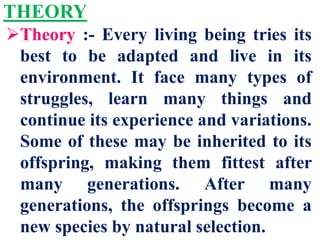
Theory :- Every living being tries its
best to be adapted and live in its
environment. For this it face many
THEORY
Theory :- Every living being tries its
best to be adapted and live in its
environment. It face many types of
struggles, learn many things and
continue its experience and variations.
Some of these may be inherited to its
offspring, making them fittest after
many generations. After many
generations, the offsprings become a
new species by natural selection.
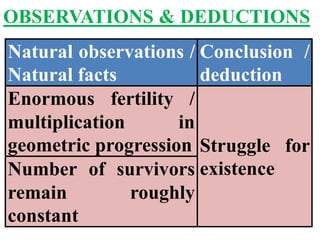
OBSERVATIONS & DEDUCTIONS
Natural observations /
Natural facts
Conclusion /
deduction
Enormous fertility /
multiplication in
geometric progression Struggle for
existenceNumber of survivors
remain roughly
constant
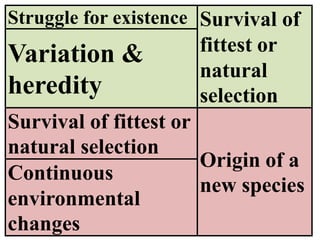
Struggle for existence Survival of
fittest or
natural
selection
Variation &
heredity
Survival of fittest or
natural selection
Origin of a
new species
Continuous
environmental
changes
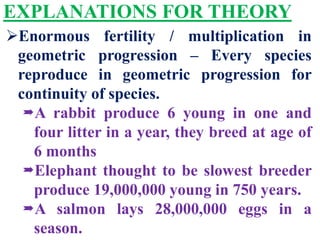
EXPLANATIONS FOR THEORY
Enormous fertility / multiplication in
geometric progression – Every species
reproduce in geometric progression for
continuity of species.
A rabbit produce 6 young in one and
four litter in a year, they breed at age of
6 months
Elephant thought to be slowest breeder
produce 19,000,000 young in 750 years.
A salmon lays 28,000,000 eggs in a
season.
Number of survivors remain roughly
constant – Though produced in geometric
progression, an equilibrium is maintained
in number of members in species due to
struggle
Struggle for existence – The sole aim of
life is to live successfully is achieved by
struggles
Intra-specific struggle – Struggle for
similar requirements in similar times
with members of own species.
Inter specific struggle – Struggle with
members of different species for eating
and being eaten, sharing habitat and
power etc.
Struggle with environment – To be
adapted to environmental changes
successfully.
Variation & heredity – Variations are
changes on same character between
members of same species. Heredity is
transfer of parental characters to offsprings.
The one winning the struggle must have
some variations as compared to others.
Survival of fittest or natural selection –
Winners of struggle have variations that
makes them fit or adapted to the habitat and
is called as fittest or naturally selected
individual.
Continuous environmental changes – These
induce more and more variations in the
fittest with time.
Origin of a new species – By acquiring too
many variations, the individual fails to inter
breed with members of own species &
became a new species, in this way a new
species originate.
EXAMPLES IN SUPPORT
 Industrial Melanism in England – Here the
peppered moth is considered. It has two
varieties – Biston betularia (grey or brown)
& Biston carbonaria (black). They live on
tree trunks and eaten by birds. Before
industrial Melanism, tree trunk were brown
or grey being covered by grey coloured
lichen hence black moth were easily
visualised and eaten by birds so their
population decreased. After Melanism, tree
trunk were black being covered by smoke ...
and dust, now brown or grey moth are easily
visualised and eaten by birds so their
population decreased.
Resistance of Mosquitoes to Pesticides or
DDT – DDT was applied to kill mosquitoes,
in original population some resistance
individuals remained, after application of
DDT only they got chance to grow and
multiply. After many generations, the
population was of only resistant mosquitoes.
Resistance of Sickle cell anaemia patients to
malaria – Similar to above malaria prone
regions have more sickle cell anaemic patients.
CRITICISM / OBJECTIONS
Darwin described small fluctuating
variations but evolution is result large &
sudden variations called mutations.
It could not explain anything about use &
disuse and vestigial organs.
He has not separated somatic and germinal
variations and considered all as inheritable.
Failed to describe cause of not dilution of
inherited characteristics when one
possessing them is breed with one lacking
them.
Described survival but not arrival of fittest.
Not described overspecialisation of a
character which may lead to extinction.
Failed to describe co-ordinated or co
adapted sets of characters.
Described artificial selection that can’t lead
to evolution.
Not explained evolution of terrestrial
animals from aquatic animals.
NEODARWINISM
Some supporters of Darwinism accepted it with
modifications due to its direct approach and
practical nature, and made it Neo-Darwinism.
Supporters :- T. H. Huxley, H. Spencer, D. S.
Jordan, A. Gray, E. Haeckel and A. Weismann.
Correns, de Vries and Tschermark (1900) :– the
factor inherited are segregated and
independently assorted.
Gradually this theory became the Modern
Synthetic Theory.
CONCLUSION
Darwinism is most scientific theory but
it actually explained artificial selection instead of
natural selection. As per this theory, a new species
originate from continued gradual inheritance of
variation factor into offspring but, as per
mutation theory of de Vries, a new species
originate due to sudden and large change as
mutation instead of slow and gradual variation.
So neodarwinism is most acceptable
being modifying darwinism based on genetics and
other modern branches of biology.

Darwinism

  • 1.
  • 2.
    INTRODUCTION The only thingthat goes up and never down is time or age. With time and age, many things change including new constructions, modification as needed to be fittest, destruction of unfit ones and even extinction. All these things are under evolution. Darwinism is the first, most accepted theory on organic evolution explaining evolution based on natural facts and conclusion deduced from them.
  • 3.
    DARWINISM Theory Observations and deductions Explanationfor the theory Examples of darwinism Criticism / objections to darwinism Neodarwinism Conclusion
  • 4.
    BACKGROUND OF THEORY Proposedby :- Charles Darwin (1859) – In his book Origin of species by natural selection. He observed some natural facts and drew meaning full conclusions or deductions from them. Theory :- Every living being tries its best to be adapted and live in its environment. For this it face many
  • 5.
    THEORY Theory :- Everyliving being tries its best to be adapted and live in its environment. It face many types of struggles, learn many things and continue its experience and variations. Some of these may be inherited to its offspring, making them fittest after many generations. After many generations, the offsprings become a new species by natural selection.
  • 6.
    OBSERVATIONS & DEDUCTIONS Naturalobservations / Natural facts Conclusion / deduction Enormous fertility / multiplication in geometric progression Struggle for existenceNumber of survivors remain roughly constant
  • 7.
    Struggle for existenceSurvival of fittest or natural selection Variation & heredity Survival of fittest or natural selection Origin of a new species Continuous environmental changes
  • 8.
    EXPLANATIONS FOR THEORY Enormousfertility / multiplication in geometric progression – Every species reproduce in geometric progression for continuity of species. A rabbit produce 6 young in one and four litter in a year, they breed at age of 6 months Elephant thought to be slowest breeder produce 19,000,000 young in 750 years. A salmon lays 28,000,000 eggs in a season.
  • 9.
    Number of survivorsremain roughly constant – Though produced in geometric progression, an equilibrium is maintained in number of members in species due to struggle Struggle for existence – The sole aim of life is to live successfully is achieved by struggles Intra-specific struggle – Struggle for similar requirements in similar times with members of own species.
  • 10.
    Inter specific struggle– Struggle with members of different species for eating and being eaten, sharing habitat and power etc. Struggle with environment – To be adapted to environmental changes successfully. Variation & heredity – Variations are changes on same character between members of same species. Heredity is transfer of parental characters to offsprings. The one winning the struggle must have some variations as compared to others.
  • 11.
    Survival of fittestor natural selection – Winners of struggle have variations that makes them fit or adapted to the habitat and is called as fittest or naturally selected individual. Continuous environmental changes – These induce more and more variations in the fittest with time. Origin of a new species – By acquiring too many variations, the individual fails to inter breed with members of own species & became a new species, in this way a new species originate.
  • 12.
    EXAMPLES IN SUPPORT Industrial Melanism in England – Here the peppered moth is considered. It has two varieties – Biston betularia (grey or brown) & Biston carbonaria (black). They live on tree trunks and eaten by birds. Before industrial Melanism, tree trunk were brown or grey being covered by grey coloured lichen hence black moth were easily visualised and eaten by birds so their population decreased. After Melanism, tree trunk were black being covered by smoke ...
  • 13.
    and dust, nowbrown or grey moth are easily visualised and eaten by birds so their population decreased. Resistance of Mosquitoes to Pesticides or DDT – DDT was applied to kill mosquitoes, in original population some resistance individuals remained, after application of DDT only they got chance to grow and multiply. After many generations, the population was of only resistant mosquitoes. Resistance of Sickle cell anaemia patients to malaria – Similar to above malaria prone regions have more sickle cell anaemic patients.
  • 14.
    CRITICISM / OBJECTIONS Darwindescribed small fluctuating variations but evolution is result large & sudden variations called mutations. It could not explain anything about use & disuse and vestigial organs. He has not separated somatic and germinal variations and considered all as inheritable. Failed to describe cause of not dilution of inherited characteristics when one possessing them is breed with one lacking them.
  • 15.
    Described survival butnot arrival of fittest. Not described overspecialisation of a character which may lead to extinction. Failed to describe co-ordinated or co adapted sets of characters. Described artificial selection that can’t lead to evolution. Not explained evolution of terrestrial animals from aquatic animals.
  • 16.
    NEODARWINISM Some supporters ofDarwinism accepted it with modifications due to its direct approach and practical nature, and made it Neo-Darwinism. Supporters :- T. H. Huxley, H. Spencer, D. S. Jordan, A. Gray, E. Haeckel and A. Weismann. Correns, de Vries and Tschermark (1900) :– the factor inherited are segregated and independently assorted. Gradually this theory became the Modern Synthetic Theory.
  • 17.
    CONCLUSION Darwinism is mostscientific theory but it actually explained artificial selection instead of natural selection. As per this theory, a new species originate from continued gradual inheritance of variation factor into offspring but, as per mutation theory of de Vries, a new species originate due to sudden and large change as mutation instead of slow and gradual variation. So neodarwinism is most acceptable being modifying darwinism based on genetics and other modern branches of biology.