Population Genetics
Presented by: Rubina Shakil
Roll no: 06
Ms 1st semester
Govt. Sadiq College Women University Bahawalpur
• Population genetics is the study of genetic variation
within populations, and involves the examination and modelling of
changes in the frequencies of genes and alleles in populations over
space and time. In natural populations, however,
the genetic composition of a population's gene pool may change over
time.
• Gene – a discrete unit of hereditary information consisting of a
specific nucleotide sequence in DNA.
• ◦ Alleles – alternative forms of a gene.
• Genotype – the genetic makeup of an individual.
• Phenotype – the physical traits of an organism.
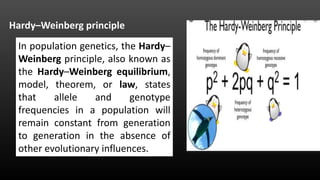
Hardy–Weinberg principle
In population genetics, the Hardy–
Weinberg principle, also known as
the Hardy–Weinberg equilibrium,
model, theorem, or law, states
that allele and genotype
frequencies in a population will
remain constant from generation
to generation in the absence of
other evolutionary influences.
The assumptions of the Hardy-Weinberg theorem are as follows:
1. The population size must be large. Large size ensures that gene frequency will not
change by chance alone.
2. Mating within the population must be random. Every individual must have an equal
chance of mating with any other individual in the population. If this condition is not
fulfilled, then some individuals are more likely to reproduce than others, and natural
selection may occur.
3. Individuals cannot migrate into, or out of, the population. Migration may introduce new
genes into the gene pool or add or delete copies of existing genes.
4. Mutations must not occur. If they do, mutational equilibrium must exist. Mutational
equilibrium exists when mutation from the wild-type allele to a mutant form is balanced by
mutation from the mutant form back to the wild type.
In either case, no new genes are introduced into the population from this source. These
assumptions must be met if allelic frequencies are not changing—that is, if evolution is not
occurring.
Factors that affect population genetics
There are five factors that can bring about evolutionary
changes in a population.
These include:
Natural selection
Mutation
Random mating
Genetic drift
Migration into or out of the population.
Mutation:
A mutation is a change in a DNA sequence. Mutations can result from DNA
copying mistakes made during cell division, exposure to ionizing radiation,
exposure to chemicals called mutagens, or infection by viruses.
Two major categories of mutations are germline mutations and
somatic mutations. Germline mutations occur in gametes.
These mutations are especially significant because they can be transmitted
to offspring and every cell in the offspring will have the mutation. So
mutations are the ultimate source of new variation.
Sickle-cell anemia is caused by a point mutation in the β-globin chain of
hemoglobin, causing the hydrophilic amino acid glutamic acid to be replaced
with the hydrophobic amino acid valine at the sixth position. The β-
globin gene is found on the short arm of chromosome 11.
Migration:
Migration is the movement of either people or animals from one area to another. Migration can be used for
the journey from one place to another or for the act of movement. In preindustrial societies, environmental
factors, such as the need for resources due to overpopulation, and in animals migration are due to breeding,
escape from extreme environmental conditions and feeding places were often the cause of migration.
Types of Migration:
There are two types of migration
Immigration:
Immigration is simply to movement of an organism from its native habitat to another area. For example, a
bird may immigrate to a new island from another island. Animals immigrate to new areas for better resources
including food, mate, habitat and tolerate able environmental conditions.
The best known migrating animals are birds, which typically migrate south in the winter to avoid cold
weather, and come back north in the summer to raise their young. Other animals migrate too. Humpback
whales, for instance, will swim thousands of miles north each year just to feed, and they only eat during the
summer.
Emigration:
Emigration means an animal leaves its home because the habitat
is no longer ideal for them and they need to find a more suitable
environment. Animals that immigrate or emigrate do not return
to the land they left.
Emigration is defined as the act of leaving one's country to live
in another. If you live in Pakistan and you move to the United
States and try to set up permanent citizenship, this is an example
of emigration.
Migrations are the very potent agent of change in populations.
Genetic Drift:
Genetic drift is a mechanism of evolution in which allele frequencies of a population change over
generations due to chance. Genetic drift occurs in all populations of non-infinite size, but its effects are
strongest in small populations.
Genetic drift is a change in the frequency of an allele within a population over time. A population of
rabbits can have brown fur and white fur with brown fur being the dominant allele. By random chance, the
offspring may all be brown and this could reduce or eliminate the allele for white fur.
Founder Effect:
The founder effect is the reduction in genetic variation that results when a small subset of a large
population is used to establish a new colony. The new population may be very different from the original
population, both in terms of its genotypes and phenotypes.
An often-cited example of the founder effect concerns the genetic makeup of the Dunkers of eastern
Pennsylvania. They emigrated from Germany to the United States early in the eighteenth century, and for
religious reasons, have not married outside their sect. Examination of certain traits (e.g., ABO blood type)
in their population reveals very different gene frequencies from the Dunker populations of Germany. These
differences are attributed to the chance absence of certain genes in the individuals who founded the original
Pennsylvania Dunker population.
Bottle neck effect
The bottleneck effect is an extreme example of genetic drift that happens when the size
of a population is severely reduced. Events like natural disasters (earthquakes, floods,
fires) can decimate a population, killing most individuals and leaving behind a small,
random assortment of survivors. The bottleneck effect, also known as a
population bottleneck, is when a species goes through an event that suddenly and
significantly reduces its population. The individuals that survive have greatly reduced
genetic diversity compared to the original population since fewer
individuals means there are fewer genotypes.
Example of bottle neck effect is, cheetah populations in South and East Africa are
endangered. Their depleted populations have reduced genetic diversity to the point that
even if populations are restored, they will have only a remnant of the original gene pool.
A similar example concerns the northern elephant seal, which was hunted to near
extinction in the late 1800s. Legislation to protect the seal was enacted in 1922, and now
the population is greater than 100,000 individuals. In spite of this relatively large
number, genetic variability in the population is low.
Non-Random Mating:
Mating that occurs more or less frequently than expected by chance. Non-random
mating means that mate selection is influenced by phenotypic differences based on
underlying genotypic differences.
Inbreeding:
Inbreeding is the production of offspring from the mating or breeding of individuals or
organisms that are closely related genetically.
Breed from closely related people or animals, especially over many generations.
"If they are allowed to inbreed even further this can eventually spoil the species". It
increases homozygosity and cause the loss of many alleles of considerable importance.
Out breeding:
Out-crossing or out-breeding is the technique of crossing between different breeds with
no common ancestors. This is the practice of introducing unrelated genetic material into a
breeding line. This increases heterozygosity in the population and mask many lethal
alleles in population.
Natural selection:
Natural selection is the process through which populations of living
organisms adapt and change. Individuals in a population
are naturally variable, meaning that they are all different in some ways.
This variation means that some individuals have traits better suited to
the environment than others.
Natural selection is the differential survival and reproduction of individuals
due to differences in phenotype. It is a key mechanism of evolution, the
change in the heritable traits characteristic of a population over generations.
Variation exists within all populations of organisms.
Modes of natural selection:
There are three modes of natural selection
Directional selection
Acts to eliminate a single extreme phenotype
Directional selection occurs when individuals at one phenotypic
extreme are at a disadvantage compared to all other individuals in the
population (figure 5.4a). In response to this selection, the deleterious
gene(s) decreases in frequency, and all other genes increase in
frequency. Directional selection may occur when a mutation gives rise
to a new gene, or when the environment changes to select against an
existing phenotype.
Industrial melanism, a classic example of directional selection,
occurred in England during the Industrial Revolution. In the early
1800s, a gray form made up about 99% of the peppered moth
population. That form still predominates in nonindustrial northern
England and Scotland. In industrial areas of England, a black form
replaced the gray form over a period of about 50 years. In these areas,
the gray form made up only about 5% of the population, and 95% of
the population was black. The nature of the selection pressure was
understood when investigators discovered that birds prey more
effectively on moths resting on a contrasting background.
Prior to Industrial Revolution, gray moths were favored
because they blended with the bark of trees on which they
rested. The black moth contrasted with the lighter, lichen-
covered bark and was easily spotted by birds (figure 5.5a).
Early in the Industrial Revolution, however, factories used
soft coal, and spewed soot and other pollutants into the air.
Soot covered the tree trunks and killed the lichens where the
moths rested. Bird predators now could easily pick out gray
moths against the black background of the tree trunk, while
the black form was effectively camouflaged.
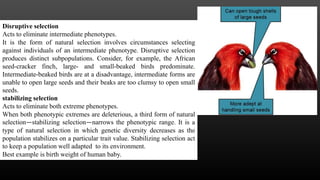
Disruptive selection
Acts to eliminate intermediate phenotypes.
It is the form of natural selection involves circumstances selecting
against individuals of an intermediate phenotype. Disruptive selection
produces distinct subpopulations. Consider, for example, the African
seed-cracker finch, large- and small-beaked birds predominate.
Intermediate-beaked birds are at a disadvantage, intermediate forms are
unable to open large seeds and their beaks are too clumsy to open small
seeds.
stabilizing selection
Acts to eliminate both extreme phenotypes.
When both phenotypic extremes are deleterious, a third form of natural
selection—stabilizing selection—narrows the phenotypic range. It is a
type of natural selection in which genetic diversity decreases as the
population stabilizes on a particular trait value. Stabilizing selection act
to keep a population well adapted to its environment.
Best example is birth weight of human baby.
Thanks for listening…..

Population Genetics.pptx

  • 1.
    Population Genetics Presented by:Rubina Shakil Roll no: 06 Ms 1st semester Govt. Sadiq College Women University Bahawalpur
  • 2.
    • Population geneticsis the study of genetic variation within populations, and involves the examination and modelling of changes in the frequencies of genes and alleles in populations over space and time. In natural populations, however, the genetic composition of a population's gene pool may change over time. • Gene – a discrete unit of hereditary information consisting of a specific nucleotide sequence in DNA. • ◦ Alleles – alternative forms of a gene. • Genotype – the genetic makeup of an individual. • Phenotype – the physical traits of an organism.
  • 3.
    Hardy–Weinberg principle In populationgenetics, the Hardy– Weinberg principle, also known as the Hardy–Weinberg equilibrium, model, theorem, or law, states that allele and genotype frequencies in a population will remain constant from generation to generation in the absence of other evolutionary influences.
  • 4.
    The assumptions ofthe Hardy-Weinberg theorem are as follows: 1. The population size must be large. Large size ensures that gene frequency will not change by chance alone. 2. Mating within the population must be random. Every individual must have an equal chance of mating with any other individual in the population. If this condition is not fulfilled, then some individuals are more likely to reproduce than others, and natural selection may occur. 3. Individuals cannot migrate into, or out of, the population. Migration may introduce new genes into the gene pool or add or delete copies of existing genes. 4. Mutations must not occur. If they do, mutational equilibrium must exist. Mutational equilibrium exists when mutation from the wild-type allele to a mutant form is balanced by mutation from the mutant form back to the wild type. In either case, no new genes are introduced into the population from this source. These assumptions must be met if allelic frequencies are not changing—that is, if evolution is not occurring.
  • 5.
    Factors that affectpopulation genetics There are five factors that can bring about evolutionary changes in a population. These include: Natural selection Mutation Random mating Genetic drift Migration into or out of the population.
  • 6.
    Mutation: A mutation isa change in a DNA sequence. Mutations can result from DNA copying mistakes made during cell division, exposure to ionizing radiation, exposure to chemicals called mutagens, or infection by viruses. Two major categories of mutations are germline mutations and somatic mutations. Germline mutations occur in gametes. These mutations are especially significant because they can be transmitted to offspring and every cell in the offspring will have the mutation. So mutations are the ultimate source of new variation. Sickle-cell anemia is caused by a point mutation in the β-globin chain of hemoglobin, causing the hydrophilic amino acid glutamic acid to be replaced with the hydrophobic amino acid valine at the sixth position. The β- globin gene is found on the short arm of chromosome 11.
  • 7.
    Migration: Migration is themovement of either people or animals from one area to another. Migration can be used for the journey from one place to another or for the act of movement. In preindustrial societies, environmental factors, such as the need for resources due to overpopulation, and in animals migration are due to breeding, escape from extreme environmental conditions and feeding places were often the cause of migration. Types of Migration: There are two types of migration Immigration: Immigration is simply to movement of an organism from its native habitat to another area. For example, a bird may immigrate to a new island from another island. Animals immigrate to new areas for better resources including food, mate, habitat and tolerate able environmental conditions. The best known migrating animals are birds, which typically migrate south in the winter to avoid cold weather, and come back north in the summer to raise their young. Other animals migrate too. Humpback whales, for instance, will swim thousands of miles north each year just to feed, and they only eat during the summer.
  • 8.
    Emigration: Emigration means ananimal leaves its home because the habitat is no longer ideal for them and they need to find a more suitable environment. Animals that immigrate or emigrate do not return to the land they left. Emigration is defined as the act of leaving one's country to live in another. If you live in Pakistan and you move to the United States and try to set up permanent citizenship, this is an example of emigration. Migrations are the very potent agent of change in populations.
  • 9.
    Genetic Drift: Genetic driftis a mechanism of evolution in which allele frequencies of a population change over generations due to chance. Genetic drift occurs in all populations of non-infinite size, but its effects are strongest in small populations. Genetic drift is a change in the frequency of an allele within a population over time. A population of rabbits can have brown fur and white fur with brown fur being the dominant allele. By random chance, the offspring may all be brown and this could reduce or eliminate the allele for white fur. Founder Effect: The founder effect is the reduction in genetic variation that results when a small subset of a large population is used to establish a new colony. The new population may be very different from the original population, both in terms of its genotypes and phenotypes. An often-cited example of the founder effect concerns the genetic makeup of the Dunkers of eastern Pennsylvania. They emigrated from Germany to the United States early in the eighteenth century, and for religious reasons, have not married outside their sect. Examination of certain traits (e.g., ABO blood type) in their population reveals very different gene frequencies from the Dunker populations of Germany. These differences are attributed to the chance absence of certain genes in the individuals who founded the original Pennsylvania Dunker population.
  • 10.
    Bottle neck effect Thebottleneck effect is an extreme example of genetic drift that happens when the size of a population is severely reduced. Events like natural disasters (earthquakes, floods, fires) can decimate a population, killing most individuals and leaving behind a small, random assortment of survivors. The bottleneck effect, also known as a population bottleneck, is when a species goes through an event that suddenly and significantly reduces its population. The individuals that survive have greatly reduced genetic diversity compared to the original population since fewer individuals means there are fewer genotypes. Example of bottle neck effect is, cheetah populations in South and East Africa are endangered. Their depleted populations have reduced genetic diversity to the point that even if populations are restored, they will have only a remnant of the original gene pool. A similar example concerns the northern elephant seal, which was hunted to near extinction in the late 1800s. Legislation to protect the seal was enacted in 1922, and now the population is greater than 100,000 individuals. In spite of this relatively large number, genetic variability in the population is low.
  • 11.
    Non-Random Mating: Mating thatoccurs more or less frequently than expected by chance. Non-random mating means that mate selection is influenced by phenotypic differences based on underlying genotypic differences. Inbreeding: Inbreeding is the production of offspring from the mating or breeding of individuals or organisms that are closely related genetically. Breed from closely related people or animals, especially over many generations. "If they are allowed to inbreed even further this can eventually spoil the species". It increases homozygosity and cause the loss of many alleles of considerable importance. Out breeding: Out-crossing or out-breeding is the technique of crossing between different breeds with no common ancestors. This is the practice of introducing unrelated genetic material into a breeding line. This increases heterozygosity in the population and mask many lethal alleles in population.
  • 12.
    Natural selection: Natural selectionis the process through which populations of living organisms adapt and change. Individuals in a population are naturally variable, meaning that they are all different in some ways. This variation means that some individuals have traits better suited to the environment than others. Natural selection is the differential survival and reproduction of individuals due to differences in phenotype. It is a key mechanism of evolution, the change in the heritable traits characteristic of a population over generations. Variation exists within all populations of organisms. Modes of natural selection: There are three modes of natural selection
  • 13.
    Directional selection Acts toeliminate a single extreme phenotype Directional selection occurs when individuals at one phenotypic extreme are at a disadvantage compared to all other individuals in the population (figure 5.4a). In response to this selection, the deleterious gene(s) decreases in frequency, and all other genes increase in frequency. Directional selection may occur when a mutation gives rise to a new gene, or when the environment changes to select against an existing phenotype. Industrial melanism, a classic example of directional selection, occurred in England during the Industrial Revolution. In the early 1800s, a gray form made up about 99% of the peppered moth population. That form still predominates in nonindustrial northern England and Scotland. In industrial areas of England, a black form replaced the gray form over a period of about 50 years. In these areas, the gray form made up only about 5% of the population, and 95% of the population was black. The nature of the selection pressure was understood when investigators discovered that birds prey more effectively on moths resting on a contrasting background.
  • 14.
    Prior to IndustrialRevolution, gray moths were favored because they blended with the bark of trees on which they rested. The black moth contrasted with the lighter, lichen- covered bark and was easily spotted by birds (figure 5.5a). Early in the Industrial Revolution, however, factories used soft coal, and spewed soot and other pollutants into the air. Soot covered the tree trunks and killed the lichens where the moths rested. Bird predators now could easily pick out gray moths against the black background of the tree trunk, while the black form was effectively camouflaged.
  • 15.
    Disruptive selection Acts toeliminate intermediate phenotypes. It is the form of natural selection involves circumstances selecting against individuals of an intermediate phenotype. Disruptive selection produces distinct subpopulations. Consider, for example, the African seed-cracker finch, large- and small-beaked birds predominate. Intermediate-beaked birds are at a disadvantage, intermediate forms are unable to open large seeds and their beaks are too clumsy to open small seeds. stabilizing selection Acts to eliminate both extreme phenotypes. When both phenotypic extremes are deleterious, a third form of natural selection—stabilizing selection—narrows the phenotypic range. It is a type of natural selection in which genetic diversity decreases as the population stabilizes on a particular trait value. Stabilizing selection act to keep a population well adapted to its environment. Best example is birth weight of human baby.
  • 16.